Selling the bitcoin it mines on the day it mines it is IREN's own stated policy, which keeps the balance sheet close to the cost of running the business rather than long a growing pile of coin. The same sites and the same power are now being turned to a second use: data centre capacity rented to AI customers on multi-year terms. On Bitbase, IREN appears as an Ondo tokenized stock on its own price page and as a perpetual futures contract, and this profile covers what the company owns, what moves it, and where those two routes differ.
What Is IREN Limited (IREN)?
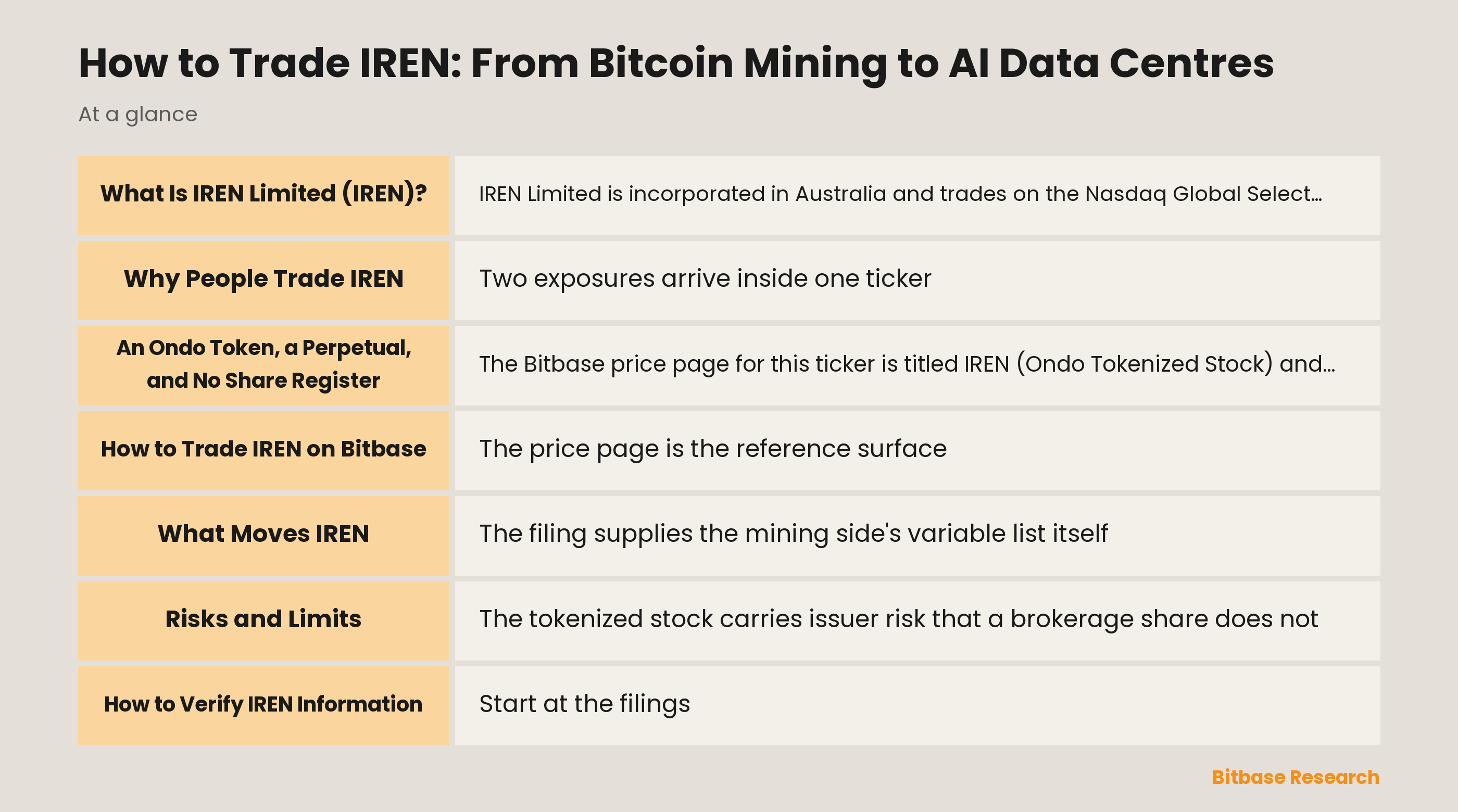
IREN Limited is incorporated in Australia and trades on the Nasdaq Global Select Market under the ticker IREN. Its annual report describes the company as a vertically integrated AI Cloud Services platform, delivering data centers, compute and software for AI training and inference. Two revenue lines sit under that description: bitcoin mining, and AI Cloud Services, which the filing says are offered primarily under multi-year reserved capacity arrangements to hyperscalers, enterprises, AI developers and frontier labs.
Vertically integrated is the phrase carrying the weight. IREN develops, owns and operates its data centres, including the associated land, grid connections and substations, rather than renting rack space in a building someone else controls. Its operating sites sit in British Columbia in Canada and in Texas in the United States, and the company states that each has been powered entirely by renewable energy, whether from clean or renewable sources or through the purchase of renewable energy certificates, since operations began there.
Why People Trade IREN
Two exposures arrive inside one ticker, and they run on different clocks. Mining revenue is repriced by the coin every day, and the company says it typically liquidates the bitcoin it mines on a daily basis, converting the proceeds into fiat currency to fund operating and capital expenditure. AI cloud revenue works the other way round: contracted ahead under multi-year reserved capacity agreements, it is largely fixed before the period in which it is earned.
The daily sale also changes what the equity is. A miner that keeps what it produces carries a treasury that marks with the coin, so its share price answers to bitcoin twice, once through revenue and once through the value of the stack. IREN's filing describes the mine and sell route instead, which leaves the stock as a claim on operating margin and on the site portfolio rather than on a hoard.
That portfolio is the other reason people hold it. The filing counts the land, the grid connections and the substations among the assets IREN owns, and capacity of that kind can be pointed at whichever workload pays more for it.
An Ondo Token, a Perpetual, and No Share Register
The Bitbase price page for this ticker is titled IREN (Ondo Tokenized Stock) and quotes the symbol IRENON. The label is the part of the page worth reading closely, because what the page tracks is not a share.
Ondo's own documentation states that one token does not necessarily represent the value of one share, and that the price of one token will not always match the price of the underlying asset. The tokens are total return trackers: dividends are reinvested net of withholding tax rather than paid out to holders. Ondo is explicit that holders do not receive shareholder voting rights, statutory information rights or other shareholder rights. Minting and burning are instant, and a purchase or sale settles as a single atomic transaction. Trading generally runs 24/5, with pauses possible around corporate actions and risk limits, and the product is described as generally available to non-US investors, subject to jurisdictional and other restrictions.
A perpetual futures contract is a different structure again. It holds no share and no token, and no issuer stands behind it on the company's behalf. It tracks a price, settles in stablecoin, exchanges a periodic funding rate between longs and shorts, and can be closed by the venue when margin runs out. Neither the token nor the contract puts your name on a share register.
How to Trade IREN on Bitbase
The price page is the reference surface. It carries the quote, the chart and the market data for the Ondo tokenized stock, it costs nothing to open, and the instrument's own naming is visible on it.
The perpetual futures market is where a leveraged directional position on the price is opened. Funding is paid or received depending on which side of the book is crowded, and a maintenance margin requirement and a liquidation price apply from the first order onward.
Which surfaces exist differs from one name to the next, and the tokenized stock and futures listings are where to check rather than assume.
What Moves IREN
The filing supplies the mining side's variable list itself: performance there is principally affected by IREN's share of global network hashrate, network difficulty, the bitcoin price, transaction fees, miner efficiency and availability, power cost and data centre operating performance. That reads as a margin equation, not as a bet on the coin. Hashrate added anywhere on the network dilutes every operator's share of a fixed block subsidy, so revenue per machine can fall during a period when the coin is climbing.
Power sits underneath all of it. IREN focuses on securing grid-connected power access rather than behind-the-meter arrangements, which generally depend on dedicated generation at or near the site; a grid-connected facility can draw on a broader and more diversified pool of generation through the transmission system. That exposes the stock to transmission access, interconnection queues and wholesale power conditions, none of which the bitcoin price says anything about.
The conversion is itself a driver for as long as it runs. IREN has begun decommissioning bitcoin mining hardware and reallocating power and data centre capacity toward AI Cloud Services, so every disclosure that shifts the revenue mix also shifts how much of this ticker is still a bitcoin proxy. Contracted capacity, customers and delivery timing can reprice the name on a day when the coin barely moves.
The reporting calendar contributes its own timing. IREN's financial year closes on 30 June rather than in December, so results land in different months from those of companies reporting on a calendar year.
Risks and Limits
The tokenized stock carries issuer risk that a brokerage share does not. What it is worth depends on the issuer's structure continuing to hold, and eligibility rules, redemption paths and jurisdictional limits are written by that issuer rather than by the venue, and can be changed by it.
The schedules do not line up. Bitcoin trades without pause, the token generally trades 24/5, and the shares it tracks trade in a shorter exchange session still. A move that happens while the token is closed does not disappear; it arrives at once when trading resumes, and that is where gap risk on this name comes from.
The perpetual adds costs that holding an asset outright does not. Funding accrues for as long as the position stays open, so a correct call on direction can still be lost to it, and leverage shortens the distance to the liquidation price.
The business risks are IREN's own. It is converting revenue from an asset it can sell every day into revenue that depends on counterparties honouring commitments years ahead, and building the capacity to serve them consumes capital before it earns any. The annual report also carries a separate risk-factor category for being incorporated outside the United States: the company under every wrapper here answers to Australian corporate law.
How to Verify IREN Information
Start at the filings. IREN's investor pages carry the quarterly results, the presentations and the announcements, and the SEC's EDGAR database carries the filings themselves, including the annual report on Form 10-K for the year ended 30 June and the risk factors set out in it. Documents filed before the 2024 rename sit in the same place under the former company name, Iris Energy Limited.
For the token, the issuer's documentation is the authority on what it is, which rights it does not carry, when it trades and who is eligible to hold it.
For what is tradable and on what terms, the price page carries the current quote and the futures market page carries the contract specifications, including funding and margin terms. Those change, and they are the ones to read before deciding on size.
Conclusion
IREN owns powered data centre sites and has been paid in bitcoin for filling them; it is now arranging to be paid in contracts for filling them differently. Because the coin is sold as it is mined, the stock is a claim on operating margin and on that portfolio rather than on a balance sheet full of bitcoin. On Bitbase the claim comes in two forms: an Ondo tokenized stock giving economic exposure without shareholder rights, and a perpetual contract giving leveraged price exposure while holding nothing. Which of them fits, if either does, depends on whether the interest is in the coin, in the business of housing compute, or in a short-dated view on the price.
Related market pages
Bitbase pages for the tokenized stocks named in this article:
- IREN: View price · Perpetual market
Related reading
Other Bitbase articles on this topic:
- How to Trade ASML: Lithography Exposure Without a Share
- How to Buy AVGO: Broadcom Chips, Software and Perpetuals
- How to Trade BRK.B: Berkshire Hathaway Perpetual Futures
- What Is Zebec? Streaming Payments On-Chain
Disclaimer: This article is educational content from Bitbase Academy, provided for information only. It explains what a company or fund does and how the instruments referenced here differ from one another; it does not constitute investment, trading, tax, or financial advice, and it is neither a recommendation nor an endorsement of any security, token, or trading strategy. A tokenized stock is issued by a third party and is designed to give economic exposure to an underlying asset: it is not a share, it carries no shareholder rights, and it depends on the issuer's structure, eligibility rules, and redemption terms, which the issuer can change. Perpetual futures are leveraged derivatives that hold no underlying asset and can be liquidated, and trading hours, product availability, and eligibility differ by instrument and by jurisdiction and can change at any time. Written as of September 2026; verify everything yourself through company filings, the issuer's own documentation, and the product pages of the venue you trade on.
References
[1] IREN investor pages: quarterly results, presentations and announcements iren.com
[2] IREN Limited, annual report on Form 10-K for the year ended 30 June 2026 (SEC EDGAR): business description, mining and AI cloud revenue, power strategy and risk factors www.sec.gov
[3] Ondo Stocks overview: backing, rights and trading hours (Ondo official documentation) docs.ondo.finance