It holds around two thousand companies, and you would struggle to name twenty of them. That is not a flaw in the iShares Russell 2000 ETF, it is the design: IWM lets the small end of the US market be held, hedged or sold short as one line instead of as a research project. The index behind it is built by a published rule, it answers to the cost of money more than to any company inside it, and on Bitbase the exposure arrives wrapped in two structures that are neither the fund nor a share.
What Is the iShares Russell 2000 ETF (IWM)?
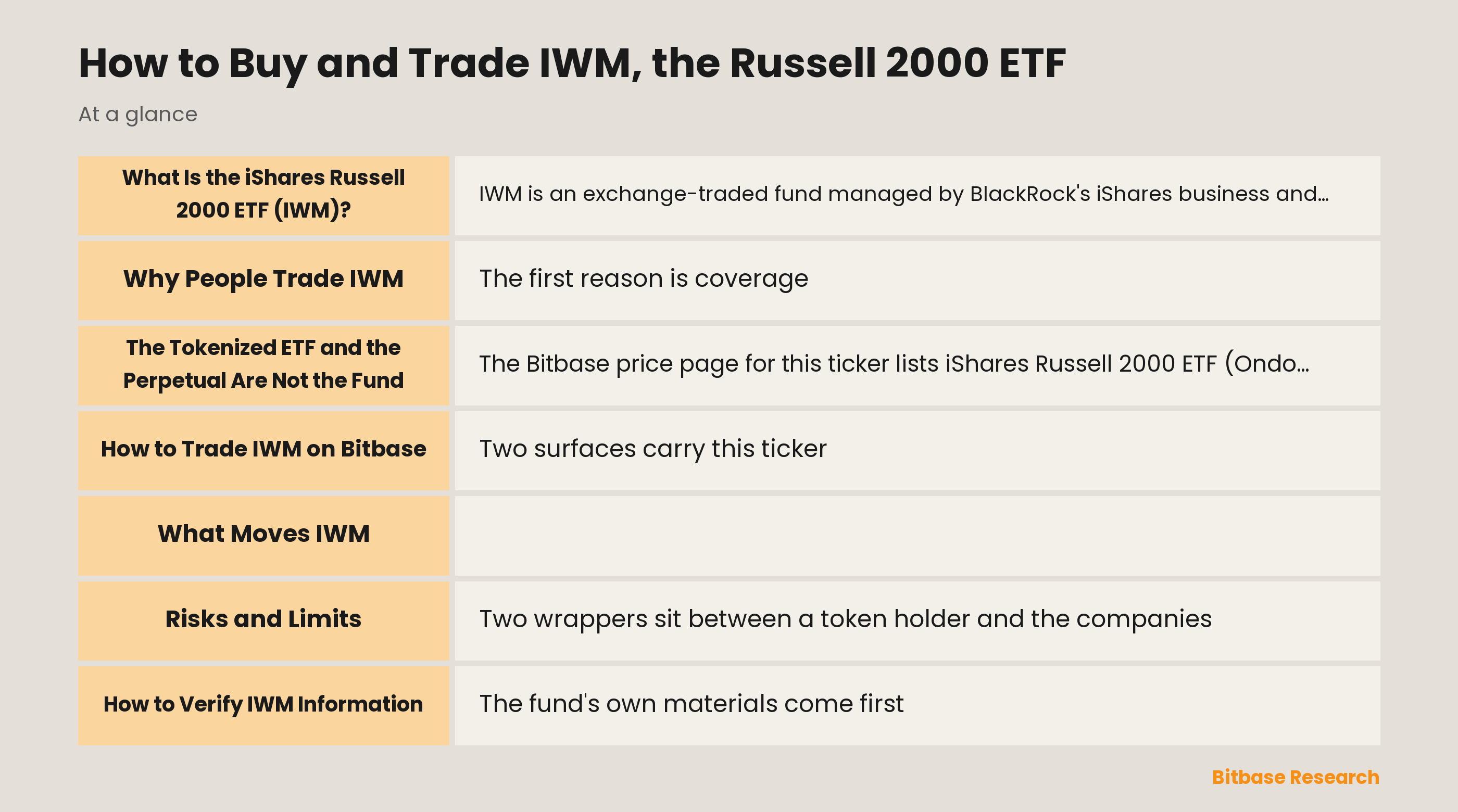
IWM is an exchange-traded fund managed by BlackRock's iShares business and listed on NYSE Arca. Its stated objective runs to one sentence: track the Russell 2000 Index, and give broad exposure to US small-cap stocks. Everything interesting about IWM is therefore a fact about that index, not about the manager.
The Russell 2000 is the small-cap slice of a family. FTSE Russell ranks eligible US securities by total market capitalisation on a rank day; the broad market becomes the Russell 3000, the largest names are carved off into the Russell 1000, and what remains is the Russell 2000, weighted by float-adjusted market capitalisation.
Two consequences follow. No single company carries this index: a name big enough to matter would be too big to be in it. And membership is a published rule, not a manager's judgment, so the portfolio's future is readable in a methodology document.
Why People Trade IWM
The first reason is coverage. Nobody researches two thousand companies one at a time, and IWM turns a segment that cannot be held name by name into a single order.
The second is breadth. When an advance is carried by a handful of very large companies, the large-cap indexes rise and IWM does not, and the ratio between the two turns a narrow rally from an opinion into a number.
The third is macro. IWM is where a view on falling policy rates, or on the domestic US economy diverging from the global one, gets expressed; a large-cap index dilutes both through multinational revenue and long-dated fixed-rate debt.
The fourth is mechanical. IWM is a liquid short leg for pair trades and hedges, so much of the flow through this ticker carries no opinion about small companies at all.
The Tokenized ETF and the Perpetual Are Not the Fund
The Bitbase price page for this ticker lists iShares Russell 2000 ETF (Ondo Tokenized ETF), trading under the symbol IWMON. The parenthesis is the load-bearing part: the page tracks a token issued by Ondo, not a share of the fund.
Ondo's documentation is direct about what that means. One token does not necessarily represent the value of one share, and a token's price will not always match the price of the underlying asset. The tokens are total return trackers, so dividends are reinvested net of withholding tax rather than paid out. Holders receive no shareholder voting rights, no statutory information rights and no other shareholder rights. Ondo describes trading as generally running 24/5, with pauses possible around corporate actions and risk limits, and the product as generally available to non-US investors.
For an index fund that dividend detail matters: a basket of small companies pays out from hundreds of payers on hundreds of dates, and here the stream is reinvested into the token's value rather than reaching an account as cash.
A perpetual futures contract is a different structure again, and the easiest to state: it holds nothing. It tracks a price, settles in stablecoin, exchanges a periodic funding rate between longs and shorts, and can be liquidated.
Exchange-listed stock index futures on the Russell 2000 are a fourth structure: dated contracts that expire and have to be rolled, priced off a curve rather than a funding payment.
How to Trade IWM on Bitbase
Two surfaces carry this ticker.
The price page carries the quote, the chart and the market data for the tokenized ETF. It is the reference point, and the one that needs no position and no leverage.
The perpetual futures market is where a leveraged directional position is opened. Funding is paid or received periodically depending on which side is crowded, and a maintenance margin requirement and a liquidation price apply.
Which tickers carry a spot market as well, and which carry only some of these surfaces, differs from name to name; the tokenized stock and ETF lineup is where to check.
One point belongs to index trading specifically: a broad basket moves less per day than any of its members, which lengthens the holding period a directional view needs, while funding is charged on elapsed time rather than on conviction.
What Moves IWM
Short rates, through interest expense rather than the discount rate. A company funding itself on a revolving credit line priced off short rates feels a shift in policy expectations in its own interest bill within a quarter or two; a company that termed out fixed-rate debt for a decade does not. An index assembled purely by size fills up with the first kind.
The reconstitution calendar, which has just changed. Russell membership is rebuilt on a schedule rather than continuously, and each rebuild is a flow event: every fund tracking the index has to trade the additions and the deletions. It used to be one date a year. FTSE Russell's reconstitution page now states that beginning in 2026 the Russell indexes are reconstituted semi-annually, in June and December.
Graduation, which is built into the definition. A Russell 2000 company that does well grows out of the size band and leaves for the Russell 1000 at the next rebuild; the index keeps the ones that did not grow and replaces the leavers from below. IWM hands its winners to a different index by construction.
Credit conditions, because nothing else is holding the index up. With no constituent large enough to carry it, IWM moves on whatever reaches hundreds of small balance sheets at once: bank lending standards, refinancing costs, the willingness of lenders to keep funding companies that do not yet finance themselves.
Risks and Limits
Two wrappers sit between a token holder and the companies: the token gives economic exposure to a fund, and the fund gives exposure to an index. The token layer's terms, including eligibility and redemption, are set by the issuer and can be changed by it.
Diversification is not protection here. Two thousand holdings sound like safety, and against any single company they are; against what those holdings share, the cost of money and the state of domestic credit, the basket is undiversified.
The schedule mismatch is sharper than for a large-cap fund. A token running 24/5 sits on a fund that trades in the NYSE Arca session, which sits on companies whose own shares can be thin. News landing while that market is shut prices a guess about hundreds of them.
The perpetual adds funding and forced closure. Funding accrues whether or not the position is working, and index-referenced contracts can gap around scheduled events, which now include two reconstitution dates a year instead of one.
How to Verify IWM Information
The fund's own materials come first: the iShares product page states the objective and the index, the prospectus carries the structure and the costs, and the manager publishes the holdings on its own schedule.
The index is a separate authority. FTSE Russell publishes the construction rules, the ranking process and the reconstitution calendar, and that is where to confirm the dates rather than in a fund document written before they changed.
For the token, the issuer's documentation is the authority on backing, rights, trading hours and eligibility. On Bitbase, the price page carries the current quote and the market pages carry the contract specifications, including funding and margin terms.
Conclusion
IWM is a rules-based basket of small US companies, and on Bitbase it appears as a token that tracks the fund and as a perpetual that tracks the price. Neither is a share, and neither is fully explained by the index behind it: the token adds an issuer's structure, the perpetual adds funding and leverage. The index itself sits closer to a position on the cost of money than to the safety a two thousand name basket suggests.
Related market pages
Bitbase pages for the tokenized stocks named in this article:
- IWM: View price · Perpetual market
Related reading
Other Bitbase articles on this topic:
- How to Trade ASML: Lithography Exposure Without a Share
- How to Buy AVGO: Broadcom Chips, Software and Perpetuals
- How to Trade BRK.B: Berkshire Hathaway Perpetual Futures
- XLK ETF Explained: Who Decides What the Fund Holds
Disclaimer: This article is educational content from Bitbase Academy, provided for information only. It explains what a company or fund does and how the instruments referenced here differ from one another; it does not constitute investment, trading, tax, or financial advice, and it is neither a recommendation nor an endorsement of any security, token, or trading strategy. A tokenized stock is issued by a third party and is designed to give economic exposure to an underlying asset: it is not a share, it carries no shareholder rights, and it depends on the issuer's structure, eligibility rules, and redemption terms, which the issuer can change. Perpetual futures are leveraged derivatives that hold no underlying asset and can be liquidated, and trading hours, product availability, and eligibility differ by instrument and by jurisdiction and can change at any time. Written as of September 2026; verify everything yourself through company filings, the issuer's own documentation, and the product pages of the venue you trade on.
References
[1] iShares Russell 2000 ETF product page: fund objective, tracked index and listing venue www.ishares.com
[2] FTSE Russell reconstitution: ranking process, index construction and the move to a semi-annual schedule in 2026 www.lseg.com
[3] Ondo Stocks overview: backing, rights and trading hours (Ondo official documentation) docs.ondo.finance