A bottle of Coca-Cola is mostly made by somebody else. The company sells beverage concentrates and syrups; independent bottling partners add the water, the sweetener and the packaging, then sell the finished drink onward. That division of labour decides which numbers move when demand does, and it settles only half the question here. The other half is which KO is on the screen: a tokenized stock quoted on a price page, or a perpetual futures contract beside it, and neither is the registered share that has raised its payout every year for more than six decades.
What Is Coca-Cola (KO)?
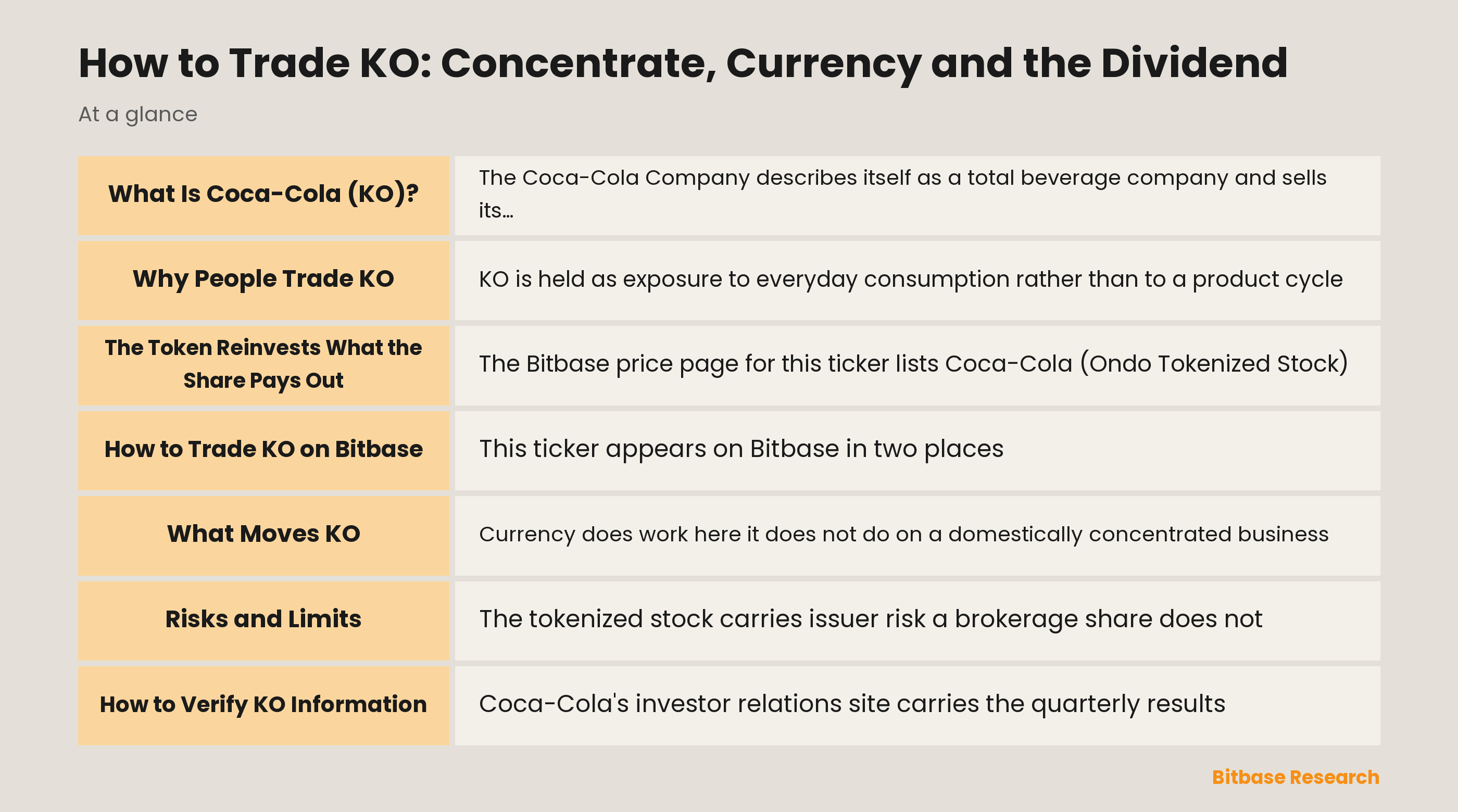
The Coca-Cola Company describes itself as a total beverage company and sells its drinks in more than 200 countries and territories. Its common stock is listed on the New York Stock Exchange under KO, and the company is incorporated in Delaware.
Revenue arrives through two different machines. Concentrate operations sell "beverage concentrates, sometimes referred to as 'beverage bases,' syrups, including fountain syrups, and certain finished beverages to authorized bottling operations." Finished product operations sell finished drinks "to retailers, or to distributors and wholesalers who in turn sell the beverages to retailers." One sells an ingredient to a partner who bottles it; the other bottles and sells the drink itself.
Reporting follows that shape: EMEA, Latin America, North America and Asia Pacific, plus a Bottling Investments segment for the bottlers the company consolidates itself. Owning one is not meant to be permanent. The company takes control of a bottling operation "often in underperforming markets where we believe we can use our resources and expertise to improve performance," and refranchises such operations back to independent bottling partners.
The portfolio is broad enough that the flagship is only part of it: more than 200 brands across sparkling soft drinks, hydration, coffee and tea, juice and dairy, and ready-to-drink alcohol, with Sprite, Powerade, Costa Coffee, Minute Maid and fairlife beside Coca-Cola itself.
Why People Trade KO
KO is held as exposure to everyday consumption rather than to a product cycle. Nothing in the results turns on a chip generation or a software release; what turns them is how many cases were sold, at what price, and in which currency. The company's most recent annual report names Mexico, China, Brazil and India as the countries outside the United States where its unit case volumes were largest, so this is also a position on demand in places whose currencies are not the dollar.
The payout record is the other reason people arrive at the name. In February 2026 the board approved the company's 64th consecutive annual dividend increase, a run stretching back more than six decades. That is why the instrument question bites harder here than on a company that pays nothing out: neither route on Bitbase treats a dividend the way a brokerage account does.
The connection to crypto runs backwards from names like Coinbase or a bitcoin miner: nothing in the concentrate business responds to a token price, and no revenue is denominated in one. What links this ticker to this market is the wrapper, not the earnings. That has a practical consequence on the perpetual, where the funding payment is set by how a crypto-native market is positioned while the price being tracked comes from an equity with no exposure to it.
None of that is an argument for holding it.
The Token Reinvests What the Share Pays Out
The Bitbase price page for this ticker lists Coca-Cola (Ondo Tokenized Stock), trading under the symbol KOON. The issuer named in that line, not the company name in front of it, decides the nature of the instrument.
Ondo's documentation states that "one token does not necessarily represent the value of one share, and the price of one token will not always match the price of the underlying asset." The tokens are built as total return trackers: dividends are reinvested net of withholding tax rather than paid out. Holders, it states, "do not receive shareholder voting rights, statutory information rights or other shareholder rights." Trading generally runs 24/5, with pauses possible around corporate actions and risk limits and a smaller set of assets tradeable outside those hours; minting and burning are instant, a purchase or a sale arriving in a single atomic transaction. The product is generally available to non-US investors, subject to jurisdictional restrictions.
On this company that construction lands somewhere specific. Sixty-four consecutive years of dividend increases is what the share is known for, and the token turns that stream into something else: no cash reaches the holder, the economics are reinvested inside the token, and a withholding tax is deducted on the way. An income-shaped reason for owning KO produces a no-income instrument here.
A perpetual futures contract is a third structure again, and it holds nothing at all: no share, no token, no claim on the company. It tracks a price, settles in stablecoin, exchanges a periodic funding payment between the two sides of the market, and closes a position out when margin runs short. Because which issuer wrote a tokenized stock changes the answer to all of those questions, the symbol deserves as much attention as the company name in front of it.
How to Trade KO on Bitbase
This ticker appears on Bitbase in two places, and a position is opened in only one of them.
The price page is for reading: quote, chart and market data for the tokenized stock, with the issuer named above the chart. Opening it commits nothing, and it is where the token's quote can be set against the hours in which the primary listing trades.
The perpetual futures market is where a leveraged directional position is taken. Funding is paid or received at the intervals the contract defines, a maintenance margin requirement applies, and a liquidation level sits underneath. Funding accrues for as long as the contract stays open, so the cost of holding a perpetual grows with time in a way holding the token does not — which suits a view with a date attached, a results release or a court decision, better than a multi-year hold.
Which surfaces exist differs from ticker to ticker. The tokenized stock and ETF directory is the place to check rather than assume.
What Moves KO
Currency does work here it does not do on a domestically concentrated business. Most of the volume this company sells is outside the United States and the results are reported in dollars, so revenue earned in pesos, reais, rupees and renminbi is translated before anyone reads it. A stronger dollar shrinks the reported figure without a single case going unsold; a weaker one flatters it.
The concentrate model puts a layer between the shelf price and the income statement. Coca-Cola sells concentrate to bottling partners, those partners sell finished drinks to retailers, and the retailer prices the shelf. A price rise in a supermarket reaches the company only through the volume of concentrate the bottlers buy and the terms on which they buy it.
The shape of the company itself is a variable. Consolidating a bottling operation adds finished-product revenue to the reported line; refranchising it to an independent partner takes that revenue away and leaves a share of the partner's earnings or losses in its place. A revenue figure can move because of who owns a bottling plant, not because of how many drinks were sold.
The calendar has a physical component a software business does not carry. The company states that sales of its ready-to-drink beverages "are somewhat seasonal, with the second and third calendar quarters historically accounting for the highest sales volumes." Weather and the timing of a selling season land on actual cases of liquid, and a quarter can read differently for reasons no strategy caused.
Policy reaches this category directly rather than through the market. Taxes on sugar-sweetened beverages are tracked as a policy class of their own: the World Health Organization publishes a report that "provides a global assessment of taxes applied to sugar-sweetened beverages" and "describes and qualitatively compares their design." Such measures, with labelling and ingredient rules beside them, move both the price and the mix of what gets sold, on timetables no earnings call influences.
There is a legal calendar as well. The annual report names, among the risks to its forward-looking statements, "the ongoing tax dispute with the United States Internal Revenue Service," and warns that the assumptions behind its estimate of the liability "could significantly change." That sits outside the operating business and moves on a court's timetable, not the company's.
Risks and Limits
The tokenized stock carries issuer risk a brokerage share does not. Its value depends on Ondo's structure continuing to work as described, there is no shareholder claim underneath it, and no cash reaches the holder. Eligibility, redemption paths and jurisdictional limits are the issuer's to set and to change, not the venue's.
The 24/5 schedule does not line up with the session in which the primary listing trades, and Ondo describes pauses around corporate actions and risk limits. Events can therefore land while one of the two markets is shut, and a position held across a closed primary market cannot be hedged there.
The perpetual adds a running cost and a forced exit. Funding accumulates while the contract is open, so a correct direction held long enough can still finish behind. Leverage sets how far the price has to move before a liquidation, and that distance is a function of the position, not of the underlying's reputation for steadiness: a guidance change, a court ruling or a currency move can open a gap a thin margin buffer does not survive.
The business risk is a specific kind of concentration. The filing calls the industry "highly competitive" and made up of "numerous companies," and much of the distribution reaching those two hundred-plus countries belongs to partners rather than to the company whose name is on the bottle. Results depend on those partners, and on a product mix that has to keep moving as the public-health argument around the category does.
How to Verify KO Information
Coca-Cola's investor relations site carries the quarterly results, the earnings calls and transcripts, and the dividend and stock information, including the press release announcing each annual increase. The SEC's EDGAR database carries the filings themselves: the annual report on Form 10-K holds the business description quoted above, the segment structure, and the risk factors in which the company sets out its tax, competitive and regulatory exposures in its own words.
For the beverage-tax picture, the World Health Organization publishes its global report on sugar-sweetened beverage taxes — where a claim of that sort belongs, rather than in a news summary of it.
For the instrument, the issuer's documentation is the authority on backing, rights, hours and eligibility — a different document from anything a trading venue publishes. On Bitbase itself, the price page carries the quote and the contract page the specifications, funding and margin terms included.
Conclusion
KO is a claim on everyday consumption in currencies mostly other than the dollar, filtered through a bottling system the company only partly owns. On Bitbase it appears as a tokenized stock and as a perpetual futures contract, and neither is the registered share: the token reinvests what the share would have paid out and carries no shareholder rights, the perpetual holds nothing at all. Which fits depends on the length of the view — and on whether the dividend was the reason for looking at KO at all.
Related market pages
Bitbase pages for the tokenized stocks named in this article:
- KO: View price · Perpetual market
Related reading
Other Bitbase articles on this topic:
- How to Buy AVGO: Broadcom Chips, Software and Perpetuals
- How to Trade BRK.B: Berkshire Hathaway Perpetual Futures
- How to Buy COST: The Membership Fee Behind Costco Stock
- Solana Meme Tokens: BOME, MEW, and Why MYRO Now Has Two Live Contracts
Disclaimer: This article is educational content from Bitbase Academy, provided for information only. It explains what a company or fund does and how the instruments referenced here differ from one another; it does not constitute investment, trading, tax, or financial advice, and it is neither a recommendation nor an endorsement of any security, token, or trading strategy. A tokenized stock is issued by a third party and is designed to give economic exposure to an underlying asset: it is not a share, it carries no shareholder rights, and it depends on the issuer's structure, eligibility rules, and redemption terms, which the issuer can change. Perpetual futures are leveraged derivatives that hold no underlying asset and can be liquidated, and trading hours, product availability, and eligibility differ by instrument and by jurisdiction and can change at any time. Written as of September 2026; verify everything yourself through company filings, the issuer's own documentation, and the product pages of the venue you trade on.
References
[1] SEC EDGAR: The Coca-Cola Company annual filings on Form 10-K, including the business description, segments and risk factors www.sec.gov
[2] The Coca-Cola Company Investor Relations: quarterly results, earnings calls and transcripts, dividend and stock information investors.coca-colacompany.com
[3] Coca-Cola press release, 19 February 2026: the board approves the company's 64th consecutive annual dividend increase investors.coca-colacompany.com
[4] The Coca-Cola Company, About Us: the brand portfolio and the role of the bottling partners www.coca-colacompany.com
[5] World Health Organization: Global report on the use of sugar-sweetened beverage taxes, 2025 www.who.int
[6] Ondo Stocks overview: backing, rights, trading hours and eligibility (Ondo official documentation) docs.ondo.finance