Mastercard's annual report calls the company a technology company in the global payments industry, then rules out most of what people assume a card company does: it does not issue cards, extend credit, or determine the interest rates and other fees issuers charge account holders. What it sells is the switching and settlement in the middle, and a portfolio of services built on the data that passes through. On Bitbase the name is carried as a perpetual futures contract, which holds no share and which a margin call can close before you decide to.
What Is Mastercard (MA)?
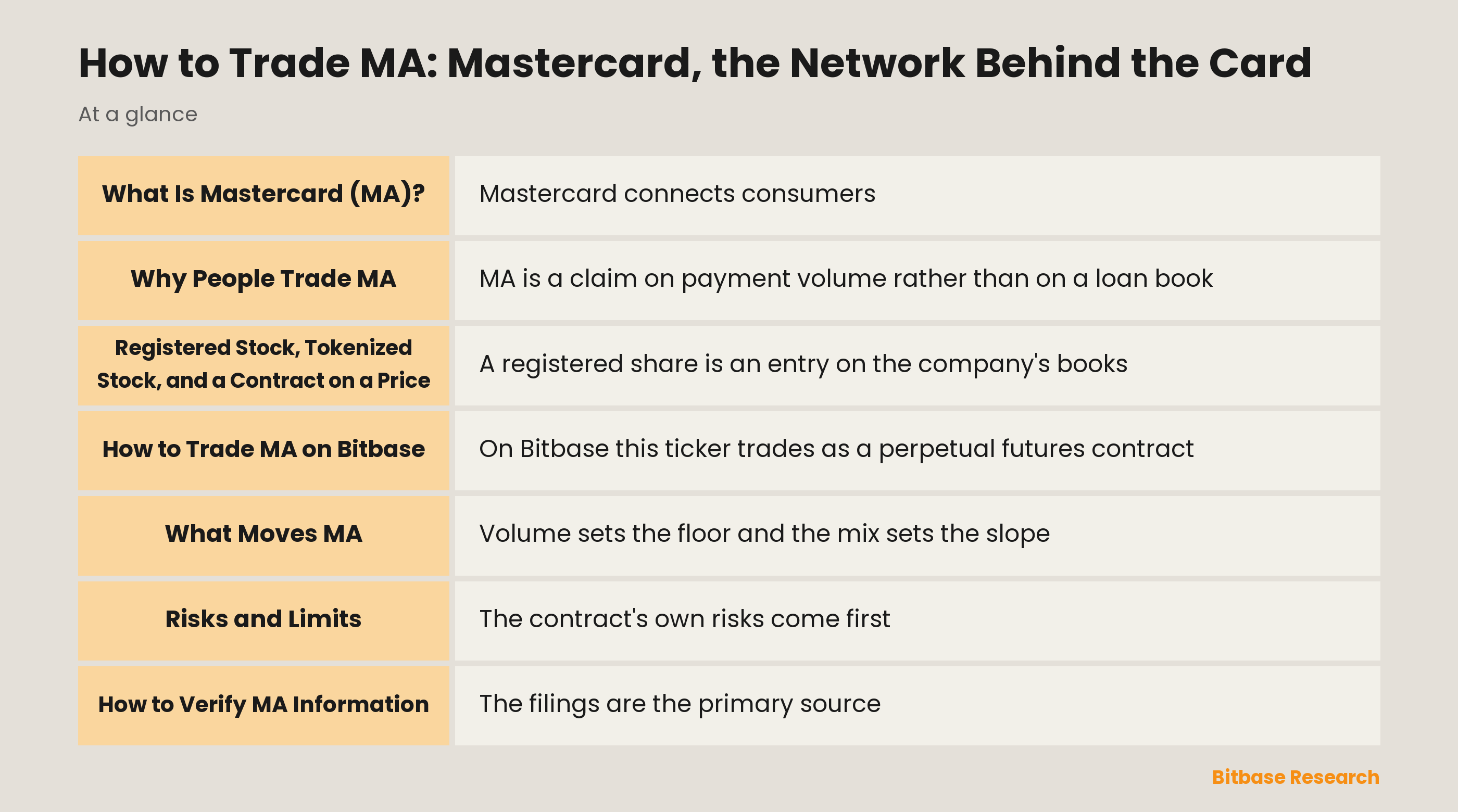
Mastercard connects consumers, financial institutions, merchants, governments, digital partners, businesses and other organisations worldwide by enabling electronic payments. Its Class A common stock is listed on the New York Stock Exchange under the symbol MA.
The structure worth holding onto is the four-party model. An account holder buys from a merchant; the issuer pays the acquirer an amount equal to the value of the transaction, minus the interchange fee and other applicable fees, and then posts the transaction to the account holder's account. The filing is blunt about where the network stops: it does not issue cards, extend credit, determine or receive revenue from the interest rates or other fees charged to account holders by issuers, nor establish the rates acquirers charge in connection with merchants' acceptance of its products.
Interchange passes through rather than accrues. Default interchange fees are established by Mastercard or, alternatively, by financial institutions, and the company administers their collection and remittance through the settlement process; the fee moves between issuer and acquirer. What Mastercard earns sits elsewhere — in the network itself, and in a portfolio of services built on proprietary data: security, consumer acquisition and engagement, business and market insights, digital and authentication, processing and gateway.
Why People Trade MA
MA is a claim on payment volume rather than on a loan book. Because the company does not extend credit, an account holder who stops paying is a problem for the issuing bank, and the credit cycle reaches this ticker through how much people spend rather than through what they fail to repay.
The crypto connection is documented rather than inferred. Mastercard states that its solutions enable consumers to use its cards to purchase digital assets and spend those balances across its acceptance network using crypto co-brand cards, that it supports the settlement of stablecoins over its network, and that it continues to expand its capabilities to support emerging blockchain-based payment models through a controlled and risk-managed framework. That puts stablecoin settlement inside the company's own description of its business — which still does not make MA a crypto position, since the fees arrive on transactions denominated in ordinary currencies.
Registered Stock, Tokenized Stock, and a Contract on a Price
A registered share is an entry on the company's books: it carries the vote attached to its class, receives whatever dividend the board declares, and runs as a claim against the company itself. Everything else is measured against that.
Tokenized stock names a category rather than a product, and its issuers answer the basic questions differently. One issuer's documentation states that a token does not necessarily represent the value of one share and that its price will not always match the price of the underlying asset, structuring the product as a total return tracker. Another calls its products derivative contracts between the holder and the issuer, priced at the prices of the underlying securities without granting rights to them. Others describe their tokens as backed one-for-one in regulated custody. Calendars differ, eligibility differs, and so does the way a dividend reaches a holder — which is why reading the issuer off the symbol comes first.
A perpetual futures contract is the easiest of the three to describe, because it holds nothing at all: no share, no token, no claim on Mastercard. It references a price, settles in stablecoin, exchanges a periodic funding rate between longs and shorts, and closes when the margin behind it runs out. Only one of the three is stock; the other two are claims written by someone other than Mastercard, on terms that party sets.
How to Trade MA on Bitbase
On Bitbase this ticker trades as a perpetual futures contract, margined and settled in stablecoin. A perpetual has no expiry date, so there is no quarterly roll to plan around. What takes an expiry's place is funding: a payment exchanged periodically between longs and shorts depending on which side is crowded, alongside a maintenance margin requirement and a liquidation price that move with the collateral. Funding accrues whether the price goes anywhere or not, so a view that is right but slow can still be expensive.
Which names carry which markets differs from ticker to ticker; the tokenized stock and perpetual listings are where to check what exists for any given name.
What Moves MA
Volume sets the floor and the mix sets the slope. The company names one activity separately in its own language — transactions where the merchant country and the country of issuance are different, which it calls cross-border transactions — and that definition makes travel and international commerce its input, while domestic switching runs on spending at home.
Rules about interchange move the stock even though the fee does not stay with the network. Mastercard's list of forward-looking risks names regulatory, legislative and litigation activity with respect to interchange rates and surcharging, alongside issuer and acquirer practices regulation. A cap changes what an issuer earns from a card, which changes what that issuer will pay a network to carry it; surcharging rules change how often the card comes out at the till.
Disintermediation appears in the same clause as pricing pressure, and the same list names the challenges relating to operating a real-time account-based payments system — a hint that Mastercard is on both sides of that shift. News about an instant-payments scheme in a large market is news about addressable traffic.
Customer concentration is named rather than inferred: loss of substantial business from significant customers, competitor relationships with its customers, consolidation amongst them. Currency is named too, as adverse currency fluctuations and foreign exchange controls — the company reports in dollars while the transactions it switches are priced in many currencies.
Risks and Limits
The contract's own risks come first, because they end positions regardless of the thesis. Funding is charged at intervals and accumulates, and leverage shortens the distance to a liquidation price that moves with the collateral as well as with the market.
Hours create a gap. The primary listing trades in an exchange session while a perpetual keeps quoting, so news landing outside the session prices into the contract before the share can respond.
The company risk is slow and legal. Interchange regulation, surcharging rules and litigation are standing conditions here rather than occasional events, and disintermediation arrives over years — while a leveraged contract is charged in funding intervals. That mismatch of clocks is the risk most easily overlooked.
How to Verify MA Information
The filings are the primary source. Mastercard's investor relations pages carry the results, and the SEC's EDGAR database carries the filings themselves: the business section sets out the four-party model, the boundary on issuing and lending, and the services portfolio, while the risk disclosures carry the regulatory, competitive and customer-concentration language quoted here.
For any tokenized product the issuer's documentation is the authority on backing, rights, hours and eligibility — the exchange listing names the instrument, the issuer defines it. For the contract, the venue's product page carries the specification: funding interval, margin tiers, mark price method and liquidation rules. Those terms change.
Conclusion
Mastercard earns from moving other people's money and lends none of its own, which makes MA an exposure to how much commerce is settled electronically and to who is allowed to sit in the middle. On Bitbase that exposure arrives as a perpetual futures contract, which references the price and holds no share. The decision it forces is about time: interchange rules and payment habits change over years, while a leveraged contract is priced in funding intervals and ended by a margin level. Settle how long the position is meant to live, and the rest follows.
Related market pages
Bitbase pages for the tokenized stocks named in this article:
- MA: Perpetual market
Related reading
Other Bitbase articles on this topic:
- How to Buy AVGO: Broadcom Chips, Software and Perpetuals
- How to Trade BRK.B: Berkshire Hathaway Perpetual Futures
- How to Buy COST: The Membership Fee Behind Costco Stock
- What Is Hemi? A Bitcoin-Ethereum Supernetwork, hVM, hBK, PoP, Tunnels, and HEMI
Disclaimer: This article is educational content from Bitbase Academy, provided for information only. It explains what a company or fund does and how the instruments referenced here differ from one another; it does not constitute investment, trading, tax, or financial advice, and it is neither a recommendation nor an endorsement of any security, token, or trading strategy. A tokenized stock is issued by a third party and is designed to give economic exposure to an underlying asset: it is not a share, it carries no shareholder rights, and it depends on the issuer's structure, eligibility rules, and redemption terms, which the issuer can change. Perpetual futures are leveraged derivatives that hold no underlying asset and can be liquidated, and trading hours, product availability, and eligibility differ by instrument and by jurisdiction and can change at any time. Written as of September 2026; verify everything yourself through company filings, the issuer's own documentation, and the product pages of the venue you trade on.
References
[1] Mastercard Investor Relations: annual and quarterly results, and the annual report itself investor.mastercard.com
[2] SEC EDGAR: Mastercard annual filings — the four-party model, the boundary on issuing and lending, and the risk disclosures quoted here www.sec.gov