Mining bitcoin produces revenue denominated in the asset itself, which stacks two positions inside one ticker: an operating business with an electricity bill, and a balance sheet holding what that business makes. On Bitbase the MARA ticker resolves to two surfaces, a tokenized stock price page and a perpetual futures contract, and neither is a share. This profile covers what the company owns, what moves it, and what each route gives you.
What Is MARA Holdings (MARA)?
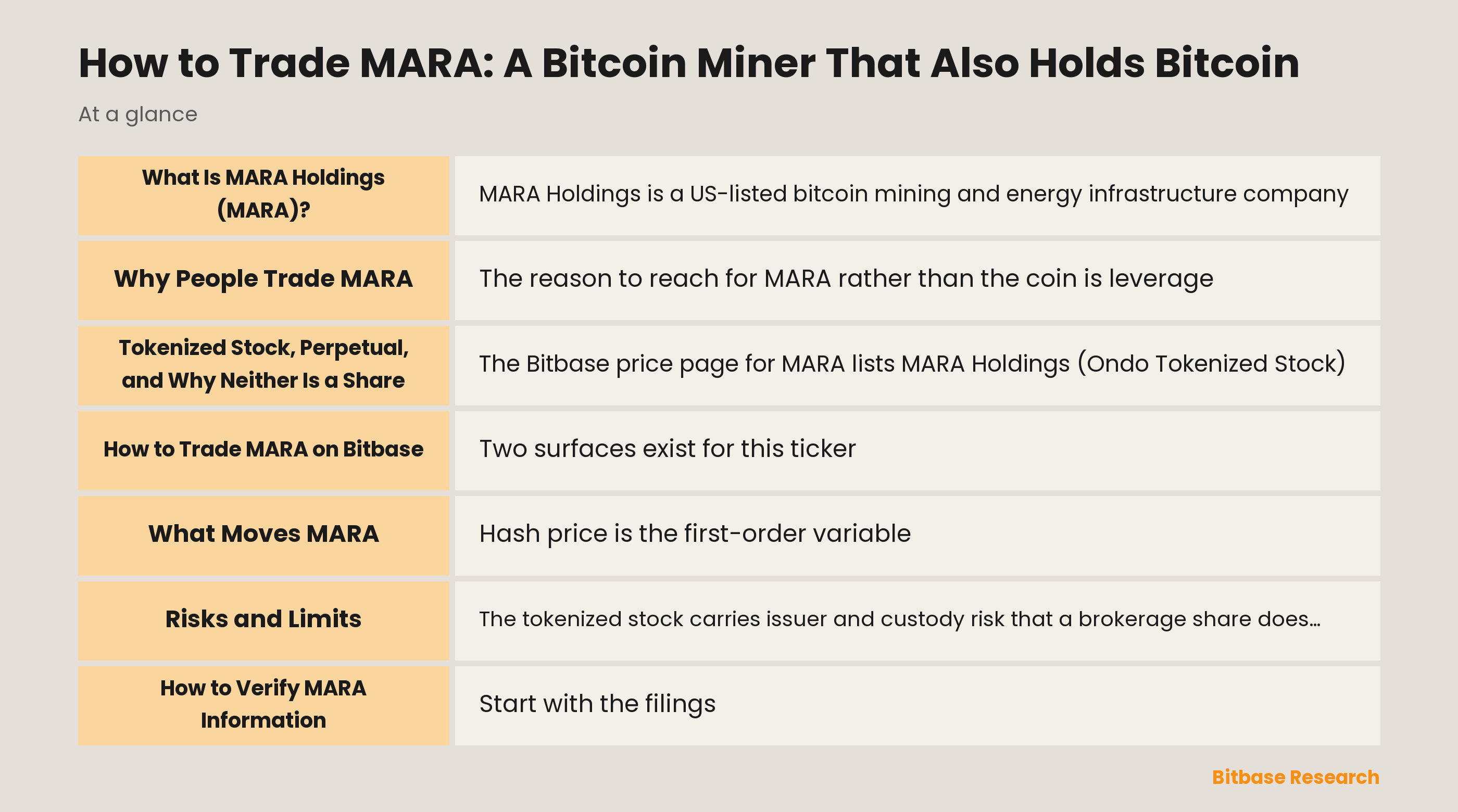
MARA Holdings is a US-listed bitcoin mining and energy infrastructure company. It trades on Nasdaq under MARA, and it was called Marathon Digital Holdings until 2024; the rename tracked a real change in the business, from renting hosting capacity to buying power generation.
Its revenue line is unusual: it is paid in the asset it produces. Running machines earns newly issued bitcoin plus the transaction fees in each block, so the top line is denominated in bitcoin before it is denominated in dollars. What the company then does with those coins is a second business layered on the first.
The energy side is where the strategy now sits. MARA describes itself as working at the intersection of energy, compute and digital capital, converting clean, stranded or underutilised energy into economic value. In practice that has meant buying generation and powered land rather than leasing rack space.
Why People Trade MARA
The reason to reach for MARA rather than the coin is leverage, and the leverage here is structural rather than borrowed. Mining revenue moves with bitcoin while power contracts, machines and staff are fixed in dollars, so margin swings harder than the coin does. Add a treasury of bitcoin on the balance sheet and the same asset appears twice in one equity.
That is a different trade from holding the coin. A miner can underperform bitcoin in a rising market if the network's total hash rate grows faster than the price, because a fixed block reward is divided among more machines. The coin gives exposure without operational risk; the miner adds a business.
The third reason is newer: powered land. Sites with interconnection, permits and cooling are scarce, and owning them lets a company ask what they are worth running something other than miners.
Tokenized Stock, Perpetual, and Why Neither Is a Share
The Bitbase price page for MARA lists MARA Holdings (Ondo Tokenized Stock), trading under the symbol MARAON. The naming carries the point: what the page tracks is not a share.
Ondo's documentation is explicit that one token does not necessarily represent the value of one share, and that its price will not always match the underlying asset. The tokens are total return trackers: dividends are reinvested net of withholding tax rather than paid out, and holders receive no shareholder voting rights, no statutory information rights and no other shareholder rights. Ondo describes trading as generally running 24/5, with pauses possible around corporate actions and risk limits, and the product as generally available to non-US investors.
A perpetual futures contract is a different structure again. It holds nothing: no share, no token, no claim on MARA Holdings. It tracks a price, settles in stablecoin, exchanges periodic funding payments between longs and shorts, and can be liquidated.
So four letters resolve to two answers here, and neither makes you an owner of the company.
How to Trade MARA on Bitbase
Two surfaces exist for this ticker. The price page carries the quote, the chart and the market data for the tokenized stock. It costs nothing to look at, and it is the reference point for everything else.
The perpetual futures market is where a leveraged directional position is opened. Funding is paid or received depending on which side of the book is crowded, and a maintenance margin requirement and a liquidation price apply from the first order.
Which tickers carry which surfaces differs by name; the tokenized stock lineup is where to check.
What Moves MARA
Hash price is the first-order variable, and it is not the bitcoin price. A miner earns the coin price multiplied by its share of the network's total computing power, so when competitors plug in machines faster than the price rises, revenue per machine falls in what still looks like a bull market. The halving is the scheduled version of that force: the block subsidy is cut in half at a fixed interval written into the protocol, roughly once every four years, and it lands overnight with no matching drop in the electricity bill.
Power is where MARA stops moving like the rest of the sector. It sorts its own operations into balancing the grid with flexible demand, owning and operating the infrastructure behind it, and developing efficiency technology on top, and it has agreed to buy gas-fired generation outright rather than rent capacity behind someone else's meter. A hosted miner is simply short the power price; an owner-operator is paid for flexibility, so power-market conditions move this name for reasons the coin has nothing to do with.
The balance sheet is next. Bitcoin held in treasury marks with the coin, so a mark-to-market exposure sits alongside the operating one. MARA has funded coin purchases with zero-coupon convertible notes, putting a lender in the capital structure whose interest is the stock's volatility rather than its direction, and it has gone the other way too, selling bitcoin to repurchase those notes. The treasury is a financing tool, not a vault.
The last driver is the compute pivot, and MARA's runs through Europe: a majority stake in a French enterprise AI-infrastructure business adds a revenue line priced off data-centre demand rather than hash rate. That reprices the stock on what it owns rather than what it mined, on days when bitcoin barely moves.
Risks and Limits
The tokenized stock carries issuer and custody risk that a brokerage share does not. Its value depends on the issuer's structure holding, and there is no shareholder claim underneath it. Eligibility, redemption paths and jurisdictional limits are set by the issuer, not the venue, and can change.
The 24/5 schedule creates gap risk from both sides. Bitcoin trades without pause, the token does not, and the underlying stock trades on a shorter exchange session still. A weekend move in the coin has nowhere to go in this name until the token reopens, and then it arrives at once.
The perpetual adds funding cost and forced closure. Funding accumulates, so a correct directional call held long enough can still lose to it, and leverage shortens the distance to the liquidation price.
The business risk is that this is one company, not an index of miners and not the coin. Fleets age, sites meet interconnection queues, and share issuance is a standing feature of a business that funds growth in the capital markets.
How to Verify MARA Information
Start with the filings. MARA's investor relations pages carry the quarterly results and operational updates, and the SEC's EDGAR database carries the filings themselves, including the risk factors, the share count and the terms of the convertible notes. Older filings sit there under the former name.
For the tokenized instrument, the issuer's documentation is the authority on what the token is, what rights it does not carry, when it trades and who may hold it, and it is a different document from anything a trading venue publishes.
For the instruments on Bitbase, the price page carries the current quote and the market pages carry the contract specifications, including funding and margin terms. Those change, and they are the numbers to read before sizing.
Conclusion
MARA is a bet on the economics of producing bitcoin wrapped around a balance sheet that also holds it, and on Bitbase it appears as a price page and a perpetual contract rather than a share. The tokenized stock gives economic exposure with no shareholder rights; the perpetual gives leveraged price exposure while holding nothing. Which fits, if either does, depends on whether the goal is bitcoin, the business of producing it, or a short-dated view on the stock.
Related market pages
Bitbase pages for the tokenized stocks named in this article:
- MARA: View price · Perpetual market
Related reading
Other Bitbase articles on this topic:
- How to Buy COST: The Membership Fee Behind Costco Stock
- How to Trade CRCL: The Company That Issues USDC
- How to Buy CRM: Two Routes to Salesforce Stock on Bitbase
Disclaimer: This article is educational content from Bitbase Academy, provided for information only. It explains what a company or fund does and how the instruments referenced here differ from one another; it does not constitute investment, trading, tax, or financial advice, and it is neither a recommendation nor an endorsement of any security, token, or trading strategy. A tokenized stock is issued by a third party and is designed to give economic exposure to an underlying asset: it is not a share, it carries no shareholder rights, and it depends on the issuer's structure, eligibility rules, and redemption terms, which the issuer can change. Perpetual futures are leveraged derivatives that hold no underlying asset and can be liquidated, and trading hours, product availability, and eligibility differ by instrument and by jurisdiction and can change at any time. Written as of September 2026; verify everything yourself through company filings, the issuer's own documentation, and the product pages of the venue you trade on.
References
[1] MARA Holdings Investor Relations: quarterly results, operational updates and press releases ir.mara.com
[2] SEC EDGAR: MARA annual filings, including risk factors, share count and convertible note terms, with older filings under the former company name www.sec.gov
[3] Ondo Stocks overview: backing, rights and trading hours (Ondo official documentation) docs.ondo.finance