Your first decision with META is not direction, it is instrument. Meta Platforms trades as META on Nasdaq, but on Bitbase that same ticker points at a tokenized stock issued by a third party and at a perpetual futures contract, and neither of them is a share. This profile covers what Meta actually sells, what moves the stock, and what each route on Bitbase gives you and withholds.
What Is Meta (META)?
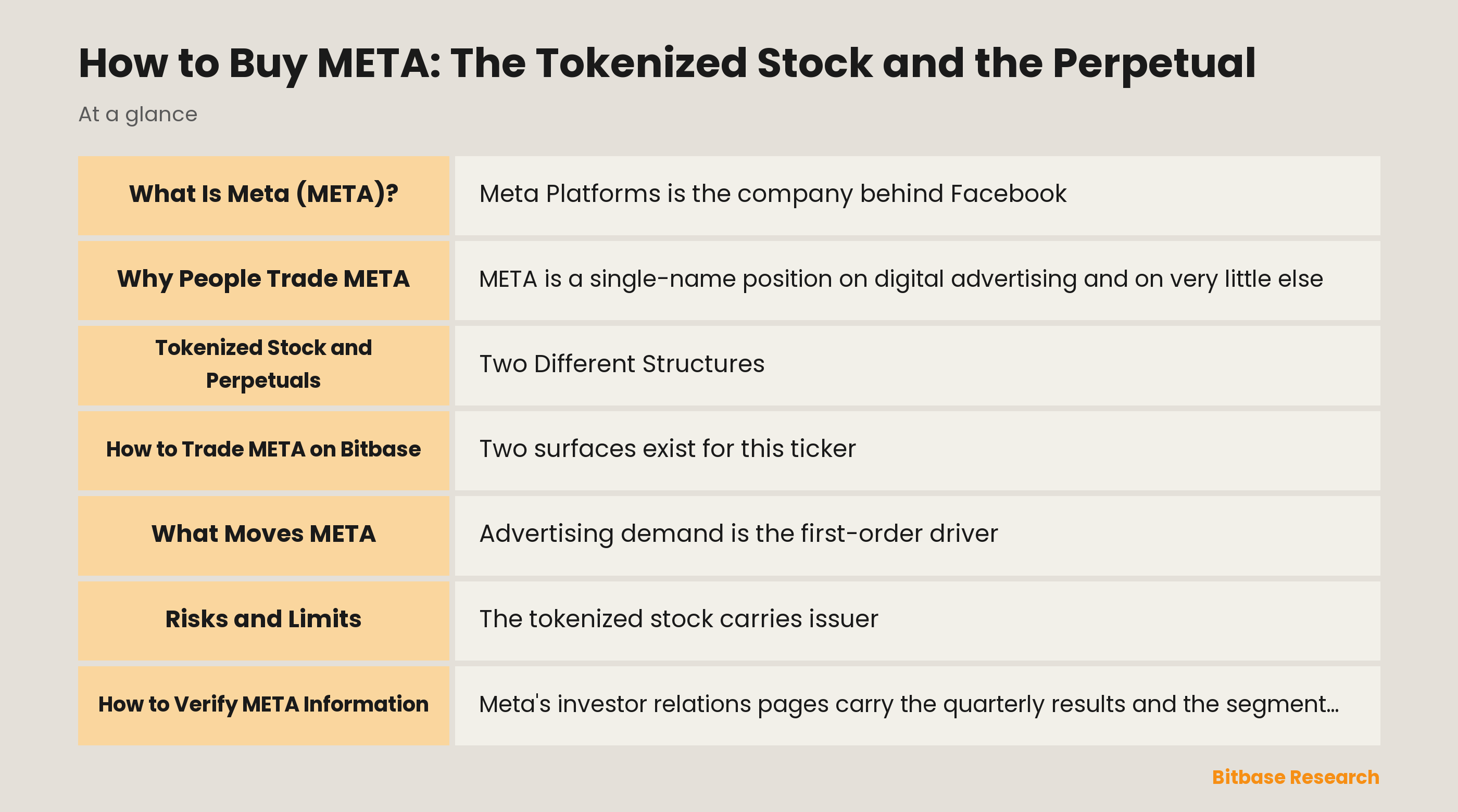
Meta Platforms is the company behind Facebook, Instagram, Messenger, WhatsApp, Threads and Meta AI. Its Class A common stock is registered on the Nasdaq Stock Market under the symbol META.
The company reports two segments, and reading them as one business is the fastest way to misunderstand the stock. Family of Apps is the social and messaging estate. Reality Labs is the hardware and platform effort, covering Meta Quest devices, the Meta Horizon Store, Ray-Ban Meta and Oakley Meta glasses, and prototype AR hardware. The company states in its annual filing that it expects the Reality Labs segment "to continue to operate at a loss for the foreseeable future."
The money comes from one place. Meta's own filing puts it in a single line: "Substantially all of our revenue is currently generated from marketers advertising on Facebook and Instagram." Everything else, from the messaging apps to the assistant to the glasses, is either a feeder into that surface or a bet financed by it.
Why People Trade META
META is a single-name position on digital advertising and on very little else. That is unusual at this size: Alphabet carries a cloud business alongside its advertising, and Microsoft carries cloud, software and device lines that cushion one another. Here the revenue is one line, and it responds to advertiser budgets.
Two further exposures come attached whether the buyer wants them or not. The first is platform dependency. Meta reaches its users through operating systems and browsers it does not control, and its filing names "changes by mobile operating system and browser providers such as Apple and Google" as a risk to its ability to deliver, target and measure advertising. The second is European regulatory exposure, which the same filing describes as possible "limitations on our ability to offer a number of our most significant products and services, including Facebook and Instagram, in Europe."
Its relationship to crypto is thin. Meta's revenue does not depend on token prices, and the correlation traders sometimes observe runs through a shared sensitivity to liquidity and to appetite for long-duration risk, not through anything on the income statement.
Tokenized Stock and Perpetuals: Two Different Structures
The Bitbase price page for this ticker lists Meta xStock, quoted under the symbol METAX. The naming is the useful part: this is an xStocks product, and the xStocks structure is not interchangeable with the other tokenized stock ranges on the market.
xStocks describes its tokens as "tokenized representations of specific US equities and ETFs," with each token "backed 1:1 by the underlying asset held in regulated custody." They are issued by Backed Assets (JE) Limited, a Jersey private limited company. The issuer's material describes the tokens as tradeable on-chain around the clock, and states that xStocks are not available in the United States or to U.S. persons.
Two cautions belong here. First, one-for-one backing is a statement about collateral, not about rights. Backed describes the instrument as a claim on the value of the collateral rather than a claim on the rights attached to it, and redemption, where it is available, runs through the issuer rather than through any exchange. You are not on a share register. Second, trading around the clock on-chain and trading around the clock wherever you happen to have an account are different claims; the hours that apply to you are the ones published by the venue you are actually using.
A perpetual futures contract is a different structure again. It holds no token, no share and no claim on Meta Platforms. It tracks a price, settles in stablecoin, exchanges a periodic funding rate between longs and shorts, and can be closed out by the exchange when margin runs short. It expresses a direction with leverage and nothing beyond that.
How to Trade META on Bitbase
Two surfaces exist for this ticker, and they answer different questions.
The price page carries the quote, the chart and the market data for the tokenized stock. It is the reference point, and the only one of the two that requires no position and no margin.
The perpetual futures market is where a leveraged directional view gets expressed. Funding is paid or received periodically depending on which side of the book is crowded, a maintenance margin requirement applies, and a liquidation price sits at a fixed distance from the entry that leverage decides. The cost of holding a perpetual is therefore not only the spread. It accrues while the position is open, which makes the contract a poor fit for "I would like to own some Meta" and a workable one for a view with a deadline.
Which tickers carry which surfaces differs from name to name; the tokenized stock listings are where to check rather than assume.
What Moves META
Advertising demand is the first-order driver, and it decomposes into two things the company itself separates: how many ads get shown, and what advertisers pay for them. A quarter in which impressions grow while pricing falls reads very differently from the reverse, even when the revenue line lands in the same place, because one is a supply story and the other is a demand story.
Platform policy has no internal remedy, which is what sets it apart. When a mobile operating system changes what an app may observe about its users, Meta's targeting and measurement degrade without anything changing inside Meta. It has happened at scale before, and the stock repriced on another company's product decision.
European rulemaking is the driver that can remove the product entirely. Meta's own risk disclosure contemplates limits on offering Facebook and Instagram in Europe at all, which is a threat to distribution rather than to pricing. It moves on legal calendars rather than on earnings dates.
Compute spending is the newest of these, and it changes the shape of the business. Meta has designed and built its own data centres, and the filing says that its increased efforts toward building frontier AI models "have driven a significant further expansion in our computing needs." That turns an advertising business into one with a heavy, front-loaded investment cycle, and the market's willingness to fund that cycle swings more than the advertising revenue does.
Reality Labs works as a sentiment valve rather than a revenue driver. Because the segment is reported separately and is expected to keep losing money, its results say less about the quarter than about how much patience the market currently has.
Risks and Limits
The tokenized stock carries issuer, custody and structural risk that a brokerage share does not. Backing, eligibility and redemption terms are set by the issuer and can be changed by the issuer, and whatever claim the token represents runs against that structure rather than against Meta Platforms.
The mismatch in trading hours creates gap risk. The underlying trades in a Nasdaq session; the instruments on the crypto side do not stop when that session does. News breaking outside market hours is priced into them first, and a position held across that boundary cannot be hedged in the primary market.
The perpetual adds funding cost and liquidation. Funding accumulates, so a correct directional call held long enough can still lose to it, and leverage shortens the distance between an adverse move and a forced exit. Equity-referenced perpetuals can gap around scheduled events such as earnings, because the primary market is closed while the contract keeps trading.
The business risk is concentration. META is one revenue line, one set of platform dependencies, and one regulatory theatre in Europe. Sizing it like a diversified technology holding is the common error.
How to Verify META Information
Meta's investor relations pages carry the quarterly results and the segment disclosure. The SEC's EDGAR database carries the filings themselves, where the revenue concentration, the Reality Labs loss expectation and the platform and European risk factors appear in the company's own words rather than in a summary of them.
For the token, the authority is the issuer, not the exchange. Backing, custody, eligibility and redemption are described in the issuer's own material, and that is the document to read before assuming the token behaves like the share.
For the instruments on Bitbase, the price page carries the current quote and the market pages carry the contract specifications, including funding and margin terms. Those change, and they are what to read before sizing anything.
Conclusion
META is a concentrated bet on advertising demand, on platform access the company does not control, and on a compute build-out funded by the first two. On Bitbase it arrives as a tokenized stock quoted on a price page and as a perpetual contract, and neither of them puts you on a share register. Which one fits is a question about holding period and about how much of the instrument's own structure you are prepared to carry, and it is a cheaper question to answer before the order than after.
Related market pages
Bitbase pages for the tokenized stocks named in this article:
- META: View price · Perpetual market
Related reading
Other Bitbase articles on this topic:
- How to Buy COST: The Membership Fee Behind Costco Stock
- How to Trade CRCL: The Company That Issues USDC
- How to Buy CRM: Two Routes to Salesforce Stock on Bitbase
- Base Meme Tokens Explained: Toshi and Brett
Disclaimer: This article is educational content from Bitbase Academy, provided for information only. It explains what a company or fund does and how the instruments referenced here differ from one another; it does not constitute investment, trading, tax, or financial advice, and it is neither a recommendation nor an endorsement of any security, token, or trading strategy. A tokenized stock is issued by a third party and is designed to give economic exposure to an underlying asset: it is not a share, it carries no shareholder rights, and it depends on the issuer's structure, eligibility rules, and redemption terms, which the issuer can change. Perpetual futures are leveraged derivatives that hold no underlying asset and can be liquidated, and trading hours, product availability, and eligibility differ by instrument and by jurisdiction and can change at any time. Written as of September 2026; verify everything yourself through company filings, the issuer's own documentation, and the product pages of the venue you trade on.
References
[1] SEC EDGAR: Meta Platforms annual filings, including the segment disclosure and the risk factors on platform dependency and Europe www.sec.gov
[2] Meta Investor Relations: quarterly results and segment reporting investor.atmeta.com
[3] xStocks official site: what an xStock is, the 1:1 backing and regulated custody, the issuing entity and availability xstocks.com