The name is now the accurate one: MicroStrategy became Strategy Inc in August 2025, and the company's annual report opens its business description by calling itself the world's first and largest Bitcoin Treasury Company, putting the analytics software second. Bitbase carries the ticker in three separate forms, and choosing among them decides what you hold, when it trades, and what can close the position for you.
What Is Strategy (MSTR)?
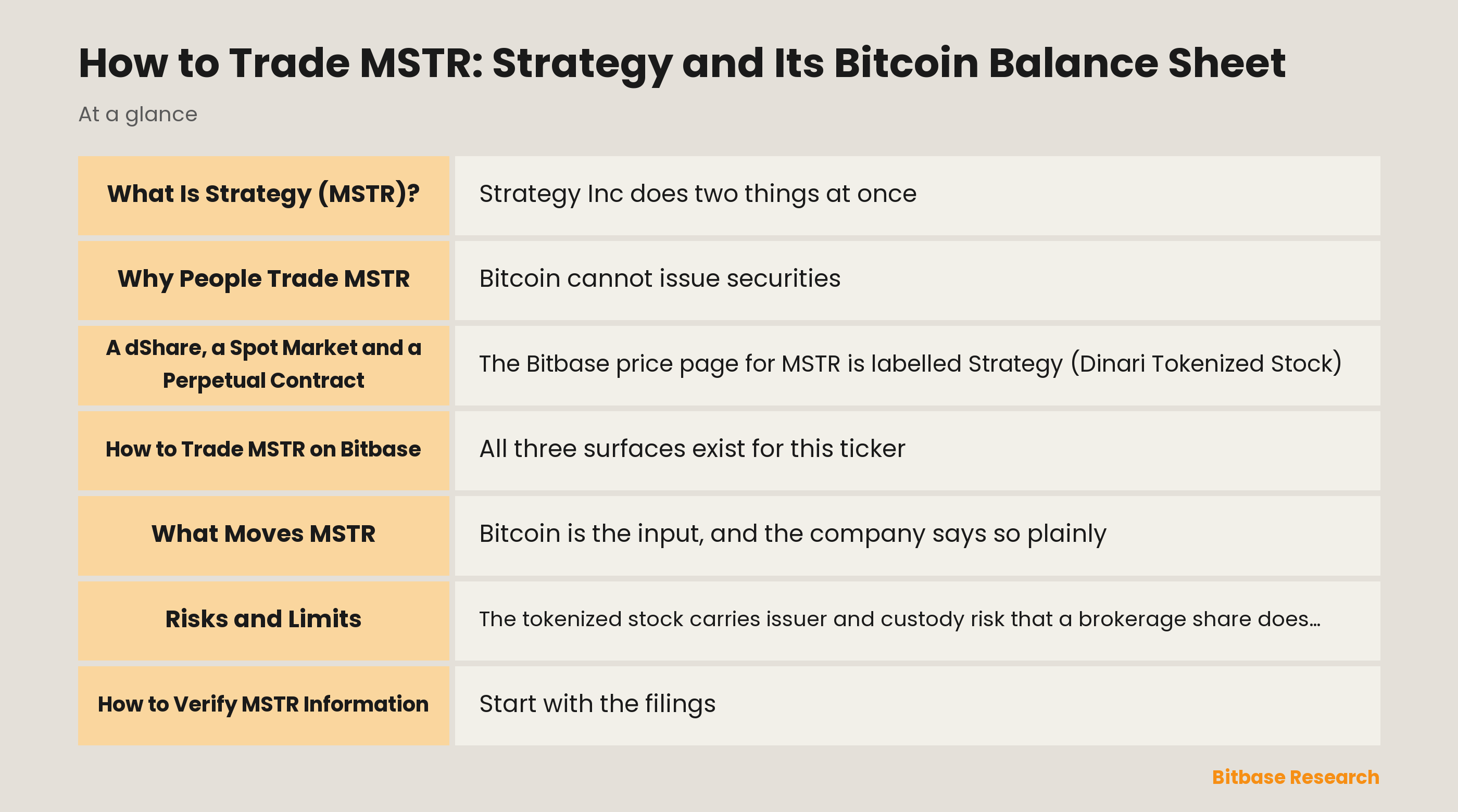
Strategy Inc does two things at once. It sells enterprise analytics software, built around Strategy One, which the company describes as an AI-powered business intelligence platform that helps organizations build, explore and act on data, with a universal data layer called Strategy Mosaic underneath it. And it holds bitcoin as the centre of its balance sheet, bought with the proceeds of securities it issues into the public markets.
The class A common stock trades on the Nasdaq Global Select Market under MSTR. That line is not alone on the exchange. Several series of perpetual preferred stock are listed beside it under their own tickers, each with its own dividend terms, and the company groups them under the name digital credit. The preferred shares rank ahead of the common stock, which makes MSTR the residual claim sitting underneath them rather than the only way to take a position in the company.
The coin itself is held away from the operating business. Strategy states that it holds substantially all of its bitcoin in custody accounts with US-based custodians that have demonstrated records of regulatory compliance and information security, and it says it views those holdings as long-term holdings and expects to continue to accumulate bitcoin.
Why People Trade MSTR
Bitcoin cannot issue securities. Strategy can, and does: it sells common stock and preferred stock through at-the-market programmes when it judges the terms advantageous, and turns the proceeds into coin. Buying the equity therefore buys the coin and the financing machine wrapped around it, which is a different exposure from holding bitcoin directly and can run in either direction.
What decides the direction is the multiple the market applies to the coin standing behind each share. A bitcoin treasury company has no creation or redemption mechanism, so nothing mechanically drags the share price back toward the value of its holdings. Issuing shares above that value raises the coin behind every share that already existed; issuing below it lowers the same figure. The identical action helps a holder at a premium and costs one at a discount, which is why the multiple, not the coin price, is the number people watch when a raise is announced.
There is also the capital structure to take a view on. The preferred series pay dividends on their own stated terms and have no maturity date, so they are a standing claim ahead of the common shares, funded in part by more issuance. Anyone buying MSTR is buying what is left after those claims are met, geared to an asset the company's own filings call highly volatile.
A dShare, a Spot Market and a Perpetual Contract
The Bitbase price page for MSTR is labelled Strategy (Dinari Tokenized Stock), and the issuer named there is the part that matters. Tokenized stock is not one structure but several, and the terms are written by whichever issuer stands behind the particular token, not by the venue that lists it.
Dinari describes a dShare as a token backed one for one by a security, commonly a US equity. The token and the security are two different objects: supply changes only after the corresponding brokerage order fills through Alpaca, so minting and burning are tied to a real order in the underlying market rather than to demand for the token itself.
Trading time arrives in sessions rather than as one continuous window. Dinari's documentation sets out a regular session, a pre-market and an after-hours session that accept limit orders only, an overnight session that also accepts limit orders only, and an on-chain round-the-clock channel that covers only some tickers and carries thinner liquidity. Market orders placed outside the regular session are converted into marketable limit orders, which may fill in full, in part, or not at all. Most dShares follow United States market hours.
Two other terms are the issuer's to set. If the underlying pays a dividend, Dinari calculates and distributes it once the cash arrives, with direct holders receiving USD+ and wrapped holders receiving the underlying dShare into their wrapped position, and amounts below a small threshold are not distributed at all. And dShares are not registered under the US Securities Act, are not offered or sold to US persons, and Dinari will reject a transfer that would breach that restriction.
A perpetual futures contract is a different structure again, and no issuer stands behind it. It holds no token and no share. It references a price, settles in stablecoin, exchanges funding payments between longs and shorts, and can be closed by the venue when margin runs out.
How to Trade MSTR on Bitbase
All three surfaces exist for this ticker, and they answer different questions.
The price page is the reference point: quote, chart and market data for the tokenized stock. It is the only one of the three that costs nothing to use.
The tokenized stock spot market is where that token is bought outright and held. There is no funding payment and no liquidation level; the position stays in the account until it is sold. This is the route for exposure without leverage, for someone willing to hold an issuer's instrument on the issuer's terms.
The perpetual futures market is where a leveraged directional position is opened. Funding is paid or received depending on which side of the book is crowded, and a maintenance margin requirement and a liquidation price apply from the first order onward.
Which tickers carry which of these surfaces differs by name; the tokenized stock and perpetual lineup is where to check.
What Moves MSTR
Bitcoin is the input, and the company says so plainly: its filings state that bitcoin is a highly volatile asset and that fluctuations in its price have influenced and are likely to continue to influence both the company's financial results and the market prices of its securities. That is the driver everything else modifies.
The multiple described above sits on top of it. A purchase announcement means opposite things above and below one, because the same issuance that adds coin per share at a premium subtracts it at a discount. Watching the coin without watching the multiple explains only half of a move.
Then comes the cash calendar, which belongs to the preferred stock rather than to bitcoin. Dividends on those series and interest on outstanding debt fall due whatever the coin is doing, and in June 2026 the board adopted a framework requiring management to maintain a US dollar reserve equal to at least twelve months of the company's expected annual preferred dividend payments and interest obligations. A reserve of that size has to be funded, and how it is funded is a live question for the common shareholder.
Part of the answer is the reason the treasury is not a vault. The same June 2026 announcement established a bitcoin monetization programme under which the company may sell bitcoin from time to time, including to generate additional proceeds for that reserve, and its filings during 2026 have reported sales as well as purchases. Anyone modelling this name as a company that only accumulates is modelling something the company has stopped saying about itself.
Index treatment is the driver with no crypto content at all. MSCI ran a consultation on digital asset treasury companies, meaning companies whose digital asset holdings make up half or more of their total assets, and announced in January 2026 that it would not exclude them at that February's index review, while freezing increases in their index share counts and deferring new additions pending a broader consultation on non-operating companies. Passive flows follow those decisions, and Strategy has argued in response that it is an operating company rather than an investment fund. The analytics software business is what that argument rests on, which is why a software line can reach the share price through a channel that has nothing to do with its own results.
Risks and Limits
The tokenized stock carries issuer and custody risk that a brokerage share does not. Eligibility, transfer restrictions, dividend handling and redemption terms are set by Dinari rather than by the venue, and they can change.
The clocks do not line up. Bitcoin trades without a pause, the underlying stock trades on an exchange session, and most dShares follow that session rather than the coin. A weekend move in bitcoin has nowhere to express itself in the wrapper until it reopens, and then it arrives all at once.
The perpetual adds costs and an exit that is not yours to choose. Funding accrues while a position is open, so a correct directional view held long enough can still lose to it, and leverage shortens the distance between the entry and the liquidation price.
The company risk is the capital structure. Preferred dividends and debt interest rank ahead of the common stock; new issuance is a permanent feature rather than an event; the financing loop reverses when the multiple falls below one; and index decisions can move the shares for reasons no bitcoin chart will show. This is one balance sheet with dates attached to it, not the coin.
How to Verify MSTR Information
Start with the filings, and read two kinds of them. The annual report on Form 10-K carries the business description, the risk factors and the terms of every listed security, and the current reports on Form 8-K carry the capital-markets activity and the dividend declarations as they happen. Both sit in the SEC's EDGAR database, with the older filings under the former MicroStrategy name.
Strategy also points investors at a disclosure dashboard on its own website, which its filings describe as carrying market prices of its outstanding securities, bitcoin purchases and holdings, certain KPI metrics and other supplemental information. Read it beside the filings rather than instead of them.
For the token, the issuer's documentation is the authority on backing, sessions, order handling, dividends and who may hold it, and it is a different document from anything a trading venue publishes. For the instruments themselves, the Bitbase price page carries the current quote and the market pages carry the contract specifications, including funding and margin terms. Those change, and they are what to read before sizing a position.
Conclusion
MSTR is the residual claim on a bitcoin balance sheet that sits behind a stack of listed preferred stock, with an analytics software business attached to it that carries weight in the index debate as well as on the income statement. On Bitbase the ticker appears as a Dinari tokenized stock with a price page and a spot market, and as a perpetual futures contract that holds nothing at all. The token gives economic exposure on an issuer's terms and on a US market calendar; the perpetual gives leveraged price exposure with funding and a liquidation level. Which one fits, if either does, depends on whether the interest is bitcoin, the machine built to accumulate it, or a dated view on the share price.
Related market pages
Bitbase pages for the tokenized stocks named in this article:
- MSTR: View price · Tokenized stock spot · Perpetual market
Related reading
Other Bitbase articles on this topic:
- How to Trade CRCL: The Company That Issues USDC
- How to Buy CRM: Two Routes to Salesforce Stock on Bitbase
- How to Trade DIA, the Dow Jones Industrial Average ETF
- Crypto Payment Gateways and Merchant Settlement
Disclaimer: This article is educational content from Bitbase Academy, provided for information only. It explains what a company or fund does and how the instruments referenced here differ from one another; it does not constitute investment, trading, tax, or financial advice, and it is neither a recommendation nor an endorsement of any security, token, or trading strategy. A tokenized stock is issued by a third party and is designed to give economic exposure to an underlying asset: it is not a share, it carries no shareholder rights, and it depends on the issuer's structure, eligibility rules, and redemption terms, which the issuer can change. Perpetual futures are leveraged derivatives that hold no underlying asset and can be liquidated, and trading hours, product availability, and eligibility differ by instrument and by jurisdiction and can change at any time. Written as of September 2026; verify everything yourself through company filings, the issuer's own documentation, and the product pages of the venue you trade on.
References
[1] Strategy Inc, Annual Report on Form 10-K for the fiscal year ended December 31, 2025: business description, listed securities, custody and risk factors www.sec.gov
[2] Strategy Inc, Current Report on Form 8-K, June 29, 2026: Digital Credit Capital Framework, USD Reserve policy and BTC Monetization Program www.sec.gov
[3] Dinari documentation: what a dShare is, how it is backed and how supply changes docs.dinari.com