Micron Technology sells memory: the DRAM inside servers and phones, the NAND inside the drives underneath them. Its earnings run on a price cycle rather than a product calendar, which is why MU behaves less like a chip designer and more like a producer of a commodity. On Bitbase the ticker opens onto two different instruments across three surfaces, and the difference between them is what you hold and what can close the position without asking you.
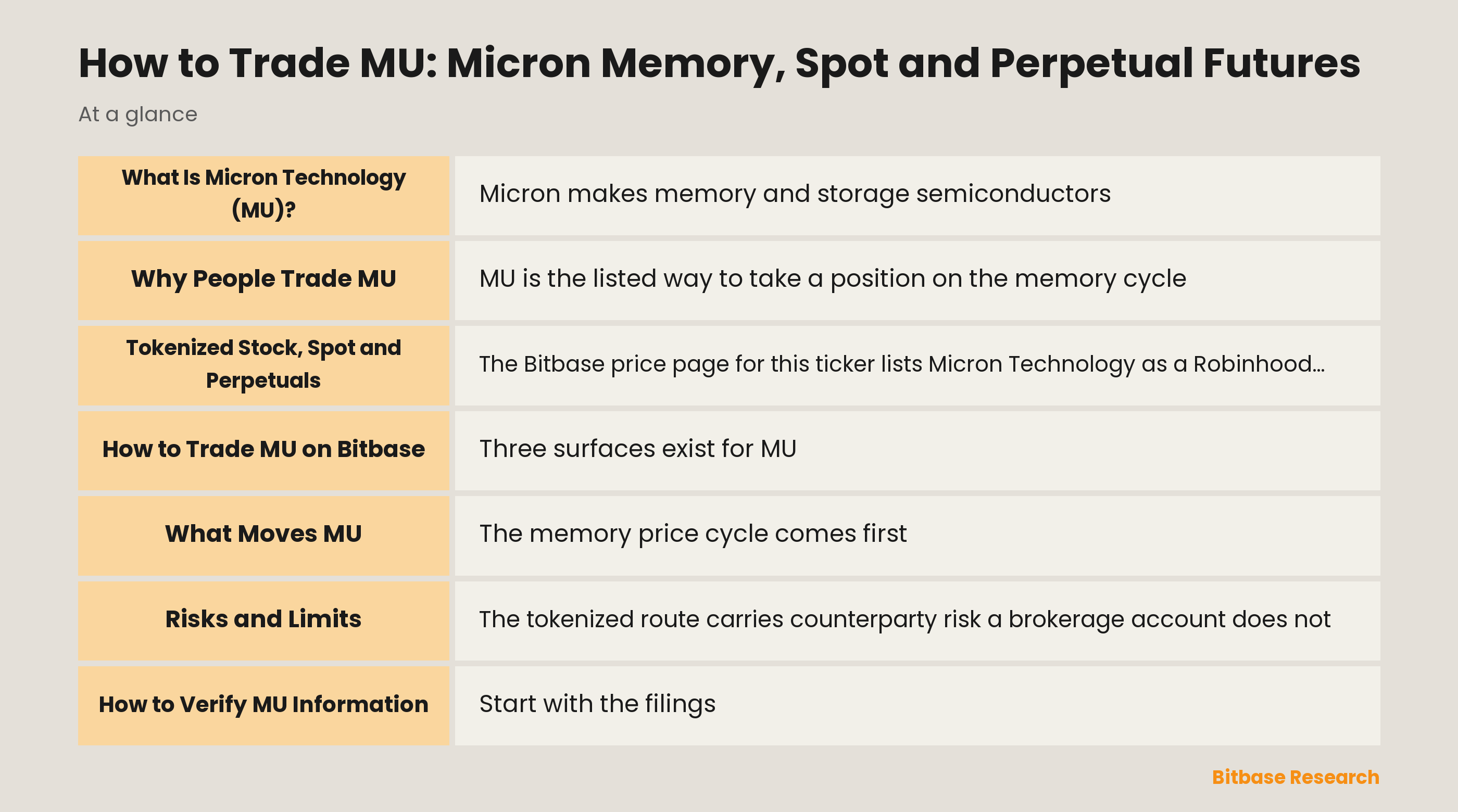
What Is Micron Technology (MU)?
Micron makes memory and storage semiconductors, sold under the Micron and Crucial brand names. Its annual report lists three product families: DRAM, the low-latency memory servers and phones run on; NAND, the storage inside solid-state drives; and NOR. The stock trades on the Nasdaq Global Select Market under the symbol MU.
The structural point is that Micron manufactures inside its own facilities, in Taiwan, Singapore, Japan, the United States, Malaysia, China and India: an integrated manufacturer, not a designer that rents capacity by the wafer.
The business is reported in four units: cloud memory, covering hyperscale customers and high bandwidth memory for data centres; core data centre; mobile and client; and automotive and embedded. Broadly similar memory goes into all four, and they do not turn together.
Why People Trade MU
MU is the listed way to take a position on the memory cycle. Memory is close to a commodity, so what moves earnings is price per bit, set by how much supply the industry has brought online against how much demand turns up. Micron's own risk disclosure says it plainly: supply increases not matched by demand lead to declines in average selling prices.
The supplier list is short. The annual report names Samsung, SK hynix, Kioxia, Sandisk, ChangXin Memory and Yangtze Memory as competitors, a small field for a component that goes into nearly every computing device.
Its link to crypto is weak. Memory demand no longer depends on mining hardware in any meaningful way, and what connects MU to crypto markets is shared sensitivity to liquidity, not shared revenue.
Tokenized Stock, Spot and Perpetuals
The Bitbase price page for this ticker lists Micron Technology as a Robinhood Tokenized Stock. The label describes a legal structure that differs from what the name suggests.
Robinhood describes its Classic Stock Tokens as derivative contracts between the holder and Robinhood, priced at the prices of the underlying securities and granting no rights to them. The underlying assets are owned by Robinhood and held with a US-licensed institution: the shares exist, but they belong to the issuer. If the underlying stock pays a dividend, Robinhood passes a corresponding amount to eligible holders in cash. The issuing entity is Robinhood Europe, UAB, supervised by the Bank of Lithuania.
Trading runs from Monday 2 AM CET to Saturday 2 AM CET: five days, around the clock within them, not seven. That is wider than a Nasdaq session and narrower than a crypto market.
A perpetual futures contract is a different instrument again. It holds no share and no token. It tracks a price, settles in stablecoin, exchanges funding between the two sides of the book, and can be closed out when margin runs short, at a liquidation price set by leverage rather than by the company.
How to Trade MU on Bitbase
Three surfaces exist for MU, and they answer different questions.
The price page is the reference: quote, chart and market data for the tokenized stock, and the only surface of the three that involves no position.
The tokenized stock spot market is where the token is bought and held outright. No funding is charged and nothing is liquidated: the position sits until it is sold. That suits exposure without leverage, for someone comfortable holding an issuer contract rather than a share.
The perpetual futures market is for leveraged directional positions. It carries a funding payment, a margin requirement and a liquidation level, and the cost of holding a perpetual accrues whether or not the trade is working. Which tickers carry which surfaces differs by name; the tokenized stock lineup is where to check.
Choosing between the last two is mostly a question about time. Memory cycles turn over quarters; funding is charged over hours.
What Moves MU
The memory price cycle comes first, and it is a supply story more often than a demand one. Capacity is committed years before it produces, so the industry repeatedly finishes a cycle with more bits than buyers want, and prices fall until capital spending is cut. The share price tends to move ahead of the reported numbers.
The reporting calendar is unusual. Micron's fiscal year ends in late August or early September rather than in December, so its quarters close about a month before the calendar quarters its customers and peers report on. Its results arrive early in each reporting season and get read as a description of memory demand generally, not only of Micron.
High bandwidth memory has changed the mix. Stacked memory sold into accelerator packages ties part of the revenue to data centre build schedules, which run on a different rhythm from phone and personal computer replacement cycles.
Policy moves it directly. The annual report states that the May 2023 decision by China's Cyberspace Administration, barring critical information infrastructure operators there from buying Micron products, hurt the company's ability to compete in China and elsewhere. Export control and sanctions rules can also change what ships where.
Capital spending cuts both ways: a new fab announcement is a demand signal and a future supply problem in the same sentence.
Risks and Limits
The tokenized route carries counterparty risk a brokerage account does not. The token is a contract with Robinhood, so its value depends on that structure holding up and on eligibility and redemption terms the issuer can change. No shareholder claim sits underneath it.
The hours create gap risk. The underlying trades in a Nasdaq session while the token trades most of the week, and Micron releases results after the US close. News that lands while the primary market is shut is priced into the token first, with nowhere to hedge until it reopens.
The perpetual adds funding cost and forced closure. Funding accrues regardless of direction, and the contract references a stock that reprices in single steps when memory pricing surprises, so gaps around an earnings release are part of the risk rather than an edge case.
The business is concentrated on both sides: the annual report says roughly half of total revenue came from the ten largest customers in each of the last three years, and production sits in a few very expensive plants.
How to Verify MU Information
Start with the filings. Micron's investor relations site carries the quarterly releases and the fiscal calendar, and the SEC's EDGAR database carries the annual report, where the segment structure, the customer concentration and the China restriction are stated in the company's own words.
For the token, the issuer is the authority, not the exchange: what the product is, who may hold it, when it trades and how dividends are handled all come from Robinhood's own disclosures.
For the instruments, the price page carries the current quote and the market pages carry the contract terms, including funding and margin. Those change, so read them before sizing rather than after.
Conclusion
MU is a position on the memory cycle, and that cycle is slower and more abrupt than the news around it. On Bitbase the ticker offers a tokenized route and a leveraged one, and neither makes anyone a Micron shareholder: one is a contract with an issuer, the other a contract with the market. The choice is mostly about holding period.
Related market pages
Bitbase pages for the tokenized stocks named in this article:
- MU: View price · Tokenized stock spot · Perpetual market
Related reading
Other Bitbase articles on this topic:
- How to Trade CRCL: The Company That Issues USDC
- How to Buy CRM: Two Routes to Salesforce Stock on Bitbase
- How to Trade DIA, the Dow Jones Industrial Average ETF
- What Is a Fiat On-Ramp? Turning Cash Into Crypto
Disclaimer: This article is educational content from Bitbase Academy, provided for information only. It explains what a company or fund does and how the instruments referenced here differ from one another; it does not constitute investment, trading, tax, or financial advice, and it is neither a recommendation nor an endorsement of any security, token, or trading strategy. A tokenized stock is issued by a third party and is designed to give economic exposure to an underlying asset: it is not a share, it carries no shareholder rights, and it depends on the issuer's structure, eligibility rules, and redemption terms, which the issuer can change. Perpetual futures are leveraged derivatives that hold no underlying asset and can be liquidated, and trading hours, product availability, and eligibility differ by instrument and by jurisdiction and can change at any time. Written as of September 2026; verify everything yourself through company filings, the issuer's own documentation, and the product pages of the venue you trade on.
References
[1] Robinhood Europe: Classic Stock Tokens are derivative contracts, with no rights to the underlying shares, dividends passed on in cash, trading Monday to Saturday robinhood.com
[2] Micron Technology, Form 10-K for the fiscal year ended August 28, 2025: products, business units, manufacturing sites, named competitors, customer concentration and the China restriction (SEC EDGAR) www.sec.gov
[3] Micron Technology Investor Relations: quarterly results and the fiscal calendar investors.micron.com