Counting subscribers is no longer how Netflix reports its own progress: from its first-quarter 2025 earnings the company stopped publishing quarterly membership numbers and average revenue per membership, and pointed shareholders at revenue, margin and engagement instead. On Bitbase the ticker resolves to two surfaces: a tokenized stock price page and a perpetual futures contract. This profile covers how Netflix earns, what moves the stock now that the headline number is gone, and what each route on Bitbase does and does not give you.
What Is Netflix (NFLX)?
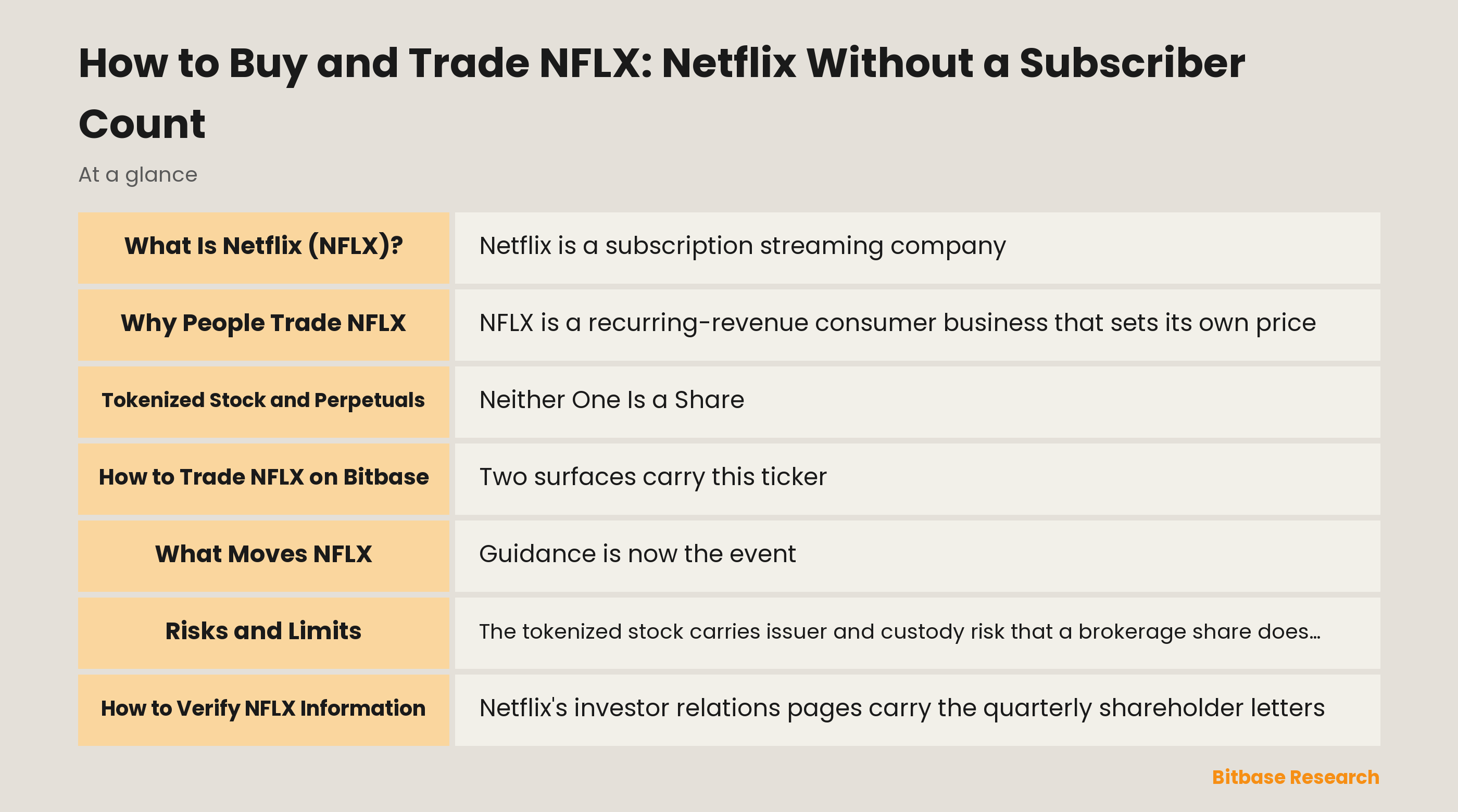
Netflix is a subscription streaming company, listed on Nasdaq under NFLX and a component of both the S&P 500 and the Nasdaq-100. Revenue arrives from paid memberships across a set of plan tiers, one of which carries advertising. The company has described advertising and its extra member feature as new revenue streams being developed alongside memberships.
Results are reported by region — the United States and Canada, EMEA, Latin America and Asia-Pacific — with the foreign exchange impact shown beside them each quarter. Netflix collects in local currencies and reports in dollars, which is why it publishes a foreign-exchange-neutral growth figure beside the reported one.
The cost side has a shape of its own. Netflix discloses what it spends on content in cash, and separately reports the amortisation of content assets that runs through the income statement. The two describe the same slate at different moments: a series is paid for while it is made and expensed while it is watched, so a heavy production year is not a heavy cost year.
Why People Trade NFLX
NFLX is a recurring-revenue consumer business that sets its own price. Nothing in it turns on a commodity price or a construction cycle: the customer pays monthly, and the main variable in revenue is a price the company sets rather than one a market sets for it.
On a crypto venue there is a second reason, and it runs the other way. Netflix revenue does not depend on token prices, block rewards or trading volumes. A book full of crypto beta holds the same bet written several ways, and this is not that bet. What it shares with the rest of the risk curve is sensitivity to the same liquidity conditions, so the correlation shows up in drawdowns without a business connection underneath it.
The third reason is that the argument about this company is narrow and testable: how far prices can rise before churn answers back, and how quickly the advertising tier grows into a line that matters.
Tokenized Stock and Perpetuals: Neither One Is a Share
The Bitbase price page for this ticker lists Netflix xStock, trading under the symbol NFLXX. The name carries the point: xStocks are issued by Backed, and the issuer, not the venue quoting it, defines what the instrument is.
Backed describes xStocks as tokenized representations of specific US equities and ETFs, each backed one for one by the underlying asset held in regulated custody. The issuing entity is Backed Assets (JE) Limited, a Jersey company. The tokens are described as tradeable around the clock on-chain — a statement about the token itself, not a promise about any venue's hours — and they are not available in the United States or to US persons.
What the token gives you is narrower than what a share gives you. Backed's own material frames it as a claim on the value of the collateral, not on the rights attached to that collateral, and redemption runs through the issuer on the issuer's terms.
A perpetual futures contract holds nothing: no share, no token, no claim on Netflix. It tracks a price, settles in stablecoin, exchanges a periodic funding rate between longs and shorts, and can be liquidated when the margin behind it runs out. So "buying NFLX" has two answers here, and neither is ownership of a Netflix share.
How to Trade NFLX on Bitbase
Two surfaces carry this ticker, and they answer different questions.
The price page is the reference point: quote, chart and market data for the tokenized stock, with nothing at risk and the instrument and its issuer named on it.
The perpetual futures market is where a leveraged directional position is opened. Funding is paid or received depending on which side is crowded, a maintenance margin requirement applies, and a liquidation price is attached from the moment the position exists. That suits a view with a deadline on it, not "I would like to own some Netflix". Funding runs for every hour the position stays open, so the holding period belongs in the plan before the first order.
Which tickers carry which surfaces differs from name to name; the tokenized stock lineup is where that is set out.
What Moves NFLX
Guidance is now the event. Netflix guides on annual revenue, operating margin and free cash flow, and forecasts quarterly revenue, operating income, net income and earnings per share; with the membership number withdrawn, those lines are what a results day revises. The old reflex of trading the net-additions print has nothing left to trade.
Pricing is the lever underneath that guidance. With member counts undisclosed, revenue growth splits into price and volume components that outsiders have to infer, and the inference is what gets repriced on results day.
Advertising is the second engine and does not behave like the first. Subscription revenue is contracted and repeats; advertising is sold against a calendar, priced against other media inventory, and cut early when marketing budgets tighten. As the ad tier grows, part of NFLX moves with the advertising cycle rather than the subscription one.
Currency does real work here. Netflix collects across four reporting regions and reports in dollars, so a currency move can open a gap between reported growth and the foreign-exchange-neutral figure published beside it. Same business, two growth rates, one headline.
Content timing sets the rhythm: a returning season lands in the quarter it lands in, while the money that made it was spent earlier and the cost is recognised later. Live programming pulls further this way — an event is watched once, on a date, which is a different asset from a series that keeps earning its amortisation for years.
Risks and Limits
The tokenized stock carries issuer and custody risk that a brokerage share does not. One-for-one backing is a statement about the issuer's structure, and that structure — eligibility, custody, redemption terms — is set by the issuer and can change. There is no shareholder claim behind the token, and it is not offered to US persons.
Hours create gap risk. The token is described as trading around the clock on-chain, while the primary listing keeps an exchange session. Netflix reports after the US close, so a results reaction can hit a token position while the shares themselves cannot be traded.
The perpetual adds two costs that holding an asset outright does not have. Funding accumulates quietly and can consume a directionally correct trade held long enough, and leverage shortens the distance between an ordinary move and a forced exit. An earnings date is a scheduled discontinuity: the move through it can exceed the distance to the liquidation price.
The business risks are the ordinary single-name ones. Attention is contested by everything else on the same screen, price rises can push churn, and a slate that disappoints does so in public.
How to Verify NFLX Information
Netflix's investor relations pages carry the quarterly shareholder letters, the primary source both for the regional revenue split with its foreign exchange impact and for what the company has said it will and will not report. The SEC's EDGAR database holds the filings behind them, including the annual report where the content-asset accounting and the risk factors appear in the company's own words.
For the token, the issuer is the authority: backing, custody, eligibility, redemption and the jurisdictions served are described in Backed's own material. For the instruments themselves, the Bitbase price page carries the live quote and the market pages carry the contract terms for the perpetual, including funding and margin — the terms to read before deciding a size.
Conclusion
Netflix asked to be judged on revenue, margin and engagement rather than on a subscriber count, and that is the company a NFLX position now expresses. Here the ticker reaches you in two forms: a tokenized stock that gives economic exposure without the rights of ownership, and a perpetual that gives leveraged price exposure without holding anything. Choosing between them is a question about holding period and about how much of an instrument's own structure you are willing to carry.
Related market pages
Bitbase pages for the tokenized stocks named in this article:
- NFLX: View price · Perpetual market
Related reading
Other Bitbase articles on this topic:
- How to Trade DIA, the Dow Jones Industrial Average ETF
- How to Trade DIS: Parks, Sports and Streaming in One Ticker
- How to Buy GOOGL: One Company, Two Nasdaq Tickers
Disclaimer: This article is educational content from Bitbase Academy, provided for information only. It explains what a company or fund does and how the instruments referenced here differ from one another; it does not constitute investment, trading, tax, or financial advice, and it is neither a recommendation nor an endorsement of any security, token, or trading strategy. A tokenized stock is issued by a third party and is designed to give economic exposure to an underlying asset: it is not a share, it carries no shareholder rights, and it depends on the issuer's structure, eligibility rules, and redemption terms, which the issuer can change. Perpetual futures are leveraged derivatives that hold no underlying asset and can be liquidated, and trading hours, product availability, and eligibility differ by instrument and by jurisdiction and can change at any time. Written as of September 2026; verify everything yourself through company filings, the issuer's own documentation, and the product pages of the venue you trade on.
References
[1] Netflix Investor Relations: quarterly shareholder letters, the regional revenue breakout and the foreign exchange impact ir.netflix.net
[2] SEC EDGAR, Netflix Form 8-K exhibit 99.1: the shareholder letter announcing the end of quarterly membership and ARM reporting www.sec.gov
[3] xStocks official site: what an xStock is, the one-for-one backing in regulated custody, the issuing entity and the US restriction xstocks.com