NVIDIA trades as NVDA on Nasdaq, but on Bitbase the ticker points at three different instruments: a tokenized stock price page, a tokenized stock spot market, and a perpetual futures contract. They are not the same product, and the difference decides what you actually own. This profile covers what NVIDIA sells, what moves the stock, and how the three routes differ on rights, hours and settlement.
What Is NVIDIA (NVDA)?
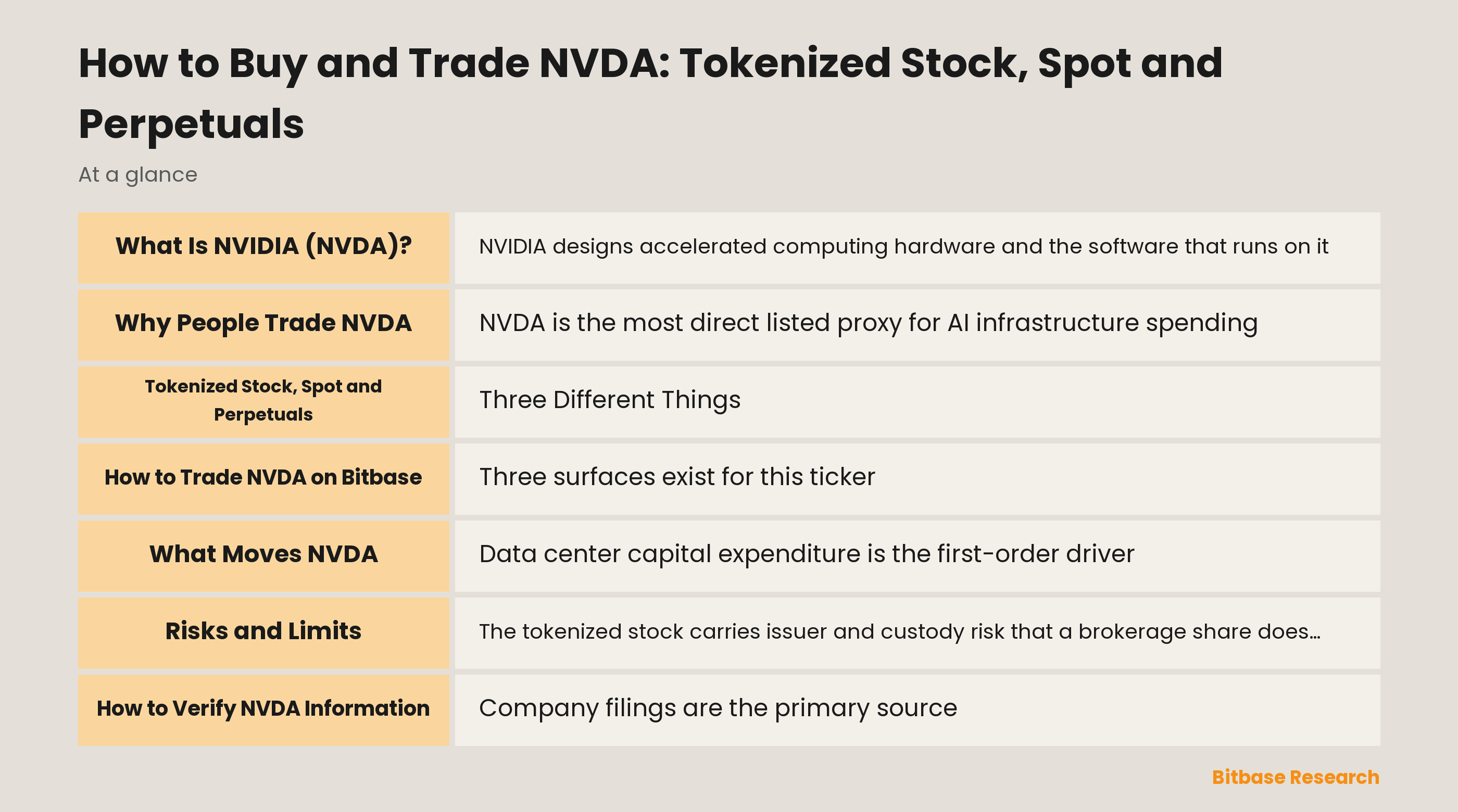
NVIDIA designs accelerated computing hardware and the software that runs on it. It is fabless: the chips are manufactured by foundry partners, and NVIDIA's own work is design, systems integration and the software layer. The company is listed on Nasdaq under NVDA and is a component of both the S&P 500 and the Nasdaq-100.
The revenue mix is worth keeping straight because it explains almost everything about how the stock behaves. The data center segment sells accelerators, networking and complete systems to cloud providers, enterprises and governments building AI infrastructure. Gaming sells consumer GPUs. Professional visualisation and automotive are smaller lines. The segments do not move together: a strong quarter in data center can coexist with a weak one in gaming, and the market prices the first far more heavily than the second.
CUDA is the part most summaries skip. It is NVIDIA's parallel computing platform and programming model, and the reason a customer who has written years of code against it does not switch hardware casually. When people describe NVIDIA as having a moat, this is usually what they mean — not the silicon alone, but the software stack that makes the silicon hard to leave.
Why People Trade NVDA
NVDA is the most direct listed proxy for AI infrastructure spending. When a hyperscaler raises its capital expenditure guidance, NVDA is the name that moves; when an AI capex cycle is questioned, it is the name that moves first and furthest. That makes it a high-beta expression of a single theme rather than a diversified technology holding.
It is also one of the largest components of the major US indices, which means index flows and options positioning around it are unusually heavy. A trader who buys NVDA is taking a position on AI demand, on export policy, and on a supply chain concentrated in a small number of facilities — three exposures that do not always point the same way.
Its relationship to crypto is indirect and often misread. NVDA is not a crypto stock in the sense that MSTR or COIN are: NVIDIA's revenue does not depend on token prices. What the two share is a sensitivity to the same liquidity conditions and the same appetite for long-duration risk, which is why they sometimes look correlated without being connected.
Tokenized Stock, Spot and Perpetuals: Three Different Things
The Bitbase price page for NVDA lists NVIDIA (Ondo Tokenized Stock), trading under the symbol NVDAON. That naming matters, because the instrument is not a share.
Ondo's own documentation is explicit on three points. First, the token is not one-for-one with a share: "One token does not necessarily represent the value of one share, and the price of one token will not always match the price of the underlying asset." The tokens are structured as total return trackers, designed to give the same economic exposure as owning the share with dividends reinvested, net of withholding tax. Second, holders get no shareholder rights — the documentation states you "do not receive shareholder voting rights, statutory information rights or other shareholder rights." Third, the product is generally available to non-US investors, subject to jurisdictional restrictions.
Trading hours are the detail that catches people out. Ondo describes minting and burning as instant and atomic, with trading generally running 24/5 and pauses possible around corporate actions and risk limits. That is longer than a Nasdaq session but it is not continuous, and it is not the same as the 24/7 schedule crypto traders are used to.
A perpetual futures contract is a different animal again. It holds nothing at all — no share, no token, no claim on NVIDIA. It tracks a price, settles in stablecoin, funds through a periodic funding rate paid between longs and shorts, and can be liquidated. Buying the perpetual gives directional exposure with leverage; it never makes you a holder of anything NVIDIA issued.
So "buying NVDA" resolves to three different answers depending on the route: an economic tracker with no shareholder rights, the same tracker bought on a spot order book, or a leveraged derivative that touches the underlying only through its price.
How to Trade NVDA on Bitbase
Three surfaces exist for this ticker, and they answer different questions.
The price page is the reference: quote, chart and market data for the tokenized stock. It is where to look before deciding anything, and it is the only one of the three that requires no position.
The tokenized stock spot market is where the token is bought and held outright. There is no funding rate and no liquidation; the position sits in the account until it is sold. This is the route for someone who wants exposure without leverage and is comfortable holding an issuer-backed instrument rather than a registered share.
The perpetual futures market is where leveraged directional positions are opened. It carries a funding payment, a maintenance margin requirement and a liquidation price. It suits shorter holding periods and hedging; it does not suit "I want to own some NVIDIA."
Which tickers have which of these three surfaces differs by name; the tokenized stock lineup is where to check.
The practical decision is usually between the second and the third, and it comes down to whether the trade is a holding or a position. A holding wants spot. A position with a thesis and a time limit wants the perpetual — with the funding cost priced in from the start.
What Moves NVDA
Data center capital expenditure is the first-order driver. NVDA's revenue is concentrated in a small number of very large customers, so guidance changes from those customers move the stock more than most macro releases do. Watching hyperscaler capex commentary is closer to watching NVDA's order book than watching the semiconductor index is.
Export controls are the second. Restrictions on which accelerators may be sold into which markets have repeatedly changed the addressable market by segment, and the stock reprices on policy news rather than on earnings when that happens. This is a political variable in a technology position, and it does not behave like the others.
Supply is the third. Because the company is fabless and the advanced packaging capacity it depends on is limited, allocation constraints can cap revenue even when demand is unquestioned. A supply-constrained quarter and a demand-constrained quarter look similar in the revenue line and mean opposite things.
Product cadence sets the rhythm. NVIDIA ships on an annual-ish architecture cycle, and the transition between generations creates a predictable pattern: customers weigh buying now against waiting, and margins move with the mix. Finally, gross margin is the number analysts argue about most, because it encodes pricing power and is the first thing to compress if competition arrives.
Risks and Limits
The tokenized stock carries issuer and custody risk that a brokerage share does not. The token's value depends on the issuer's structure holding up, and there is no shareholder claim to fall back on. Redemption paths, eligibility and jurisdictional limits are set by the issuer, not by the exchange, and they can change.
The 24/5 schedule creates gap risk. The underlying trades on a Nasdaq session; the token trades outside it. News that breaks while the primary market is closed is priced into the token first, and a position held across that boundary can move against you with no way to hedge in the primary market.
The perpetual adds funding cost and liquidation. Funding is paid or received periodically depending on which side is crowded, and it accumulates: a directionally correct trade held long enough can still lose to funding. Leverage compresses the distance to liquidation, and stock-referenced perpetuals can gap harder around earnings than crypto perpetuals typically do.
The position itself is concentrated. NVDA is a single-name bet on one theme, one supply chain and one policy environment. Sizing it like a diversified index position is the most common mistake made with it.
How to Verify NVDA Information
Company filings are the primary source: NVIDIA's investor relations pages carry the quarterly results and the segment breakdown, and the SEC's EDGAR database carries the filings themselves, including the risk factors that name the export-control and concentration exposures directly.
For the tokenized instrument, the issuer's documentation is the authority on what the token is and is not — backing structure, rights, hours and eligibility all come from there, not from the exchange listing. Read it before assuming a token behaves like a share.
For the instruments on Bitbase, the price page carries the current quote and the market pages carry the contract specifications, including funding and margin terms for the perpetual. Those are the numbers to check before sizing a position, and they change.
Conclusion
NVDA is a single-name position on AI infrastructure demand, and on Bitbase it comes in three forms that differ on the things that matter most: what you hold, when it trades, and what can force you out. The tokenized stock gives economic exposure without shareholder rights. The perpetual gives leveraged price exposure without holding anything. Neither is a share. Deciding which one fits is a question about holding period and about how much of the instrument's own structure you are willing to take on, and it is worth answering before the order, not after.
Related market pages
Bitbase pages for the tokenized stocks named in this article:
- NVDA: View price · Tokenized stock spot · Perpetual market
Related reading
Other Bitbase articles on this topic:
- How to Trade DIA, the Dow Jones Industrial Average ETF
- How to Trade DIS: Parks, Sports and Streaming in One Ticker
- How to Buy GOOGL: One Company, Two Nasdaq Tickers
- Fiat Rails Compared: Bank Transfer, Card, ACH and SEPA
Disclaimer: This article is educational content from Bitbase Academy, provided for information only. It explains what a company or fund does and how the instruments referenced here differ from one another; it does not constitute investment, trading, tax, or financial advice, and it is neither a recommendation nor an endorsement of any security, token, or trading strategy. A tokenized stock is issued by a third party and is designed to give economic exposure to an underlying asset: it is not a share, it carries no shareholder rights, and it depends on the issuer's structure, eligibility rules, and redemption terms, which the issuer can change. Perpetual futures are leveraged derivatives that hold no underlying asset and can be liquidated, and trading hours, product availability, and eligibility differ by instrument and by jurisdiction and can change at any time. Written as of September 2026; verify everything yourself through company filings, the issuer's own documentation, and the product pages of the venue you trade on.
References
[1] Ondo Stocks overview: backing, rights and trading hours (Ondo official documentation) docs.ondo.finance
[2] NVIDIA Investor Relations: quarterly results and segment reporting investor.nvidia.com
[3] SEC EDGAR: NVIDIA annual filings, including risk factors on export controls and customer concentration www.sec.gov