The oldest part of Oracle's revenue renews itself: substantially all customers who buy a software license also buy a support contract, and substantially all of them renew it when it expires. The newest part behaves in the opposite way, consuming capital years before the revenue it is contracted to earn. On Bitbase the ORCL ticker leads to a Robinhood tokenized stock, a spot market for that token, and a perpetual futures contract, and none of the three registers a share in your name.
What Is Oracle (ORCL)?
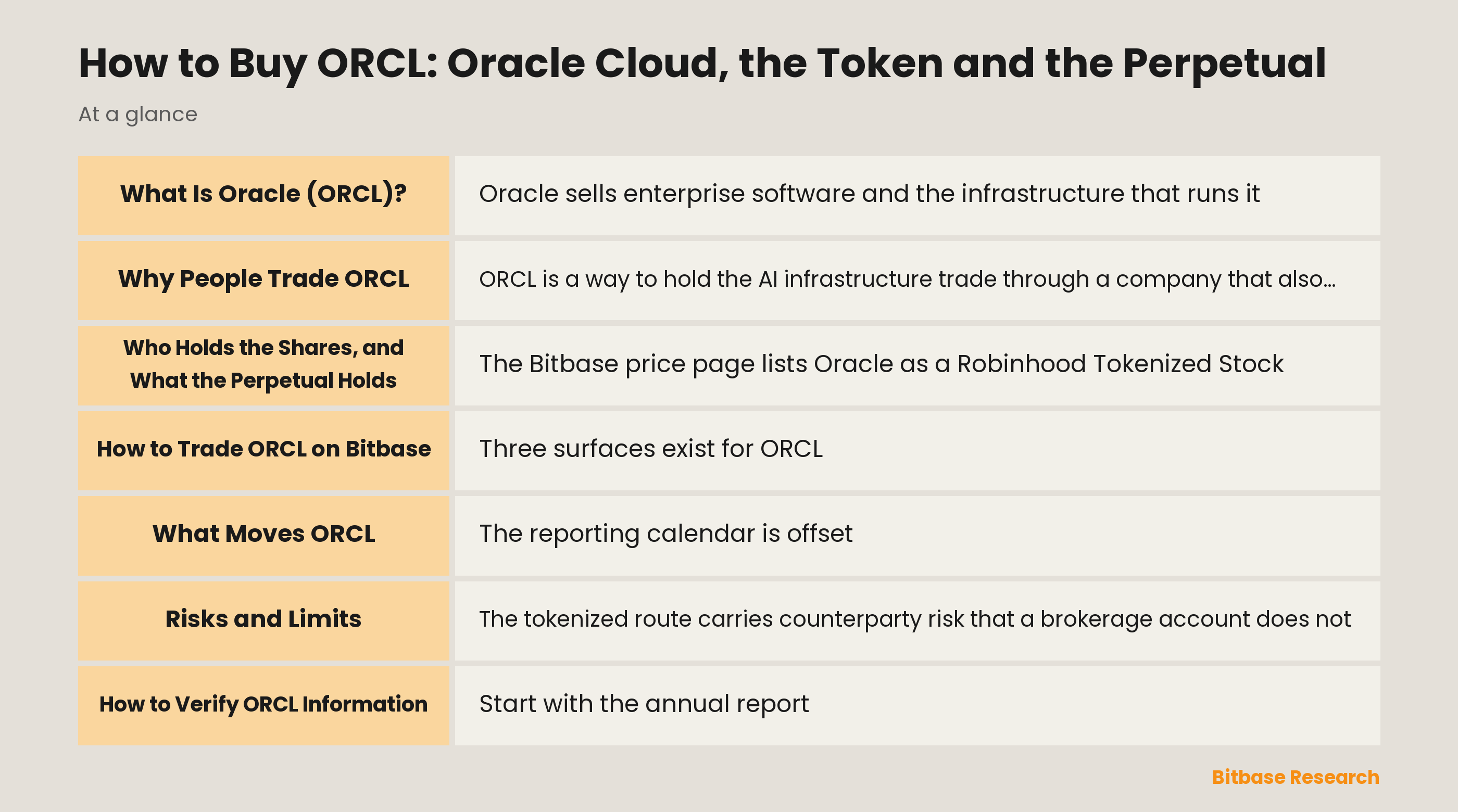
Oracle sells enterprise software and the infrastructure that runs it. Its common stock trades on the New York Stock Exchange under the symbol ORCL, and its principal executive offices are in Austin, Texas.
The annual report divides the company into three businesses: cloud and software, which the filing notes was formerly called cloud and license; hardware; and services. The applications and the infrastructure described below both sit inside that first business.
The applications side is a catalogue of business systems sold as subscriptions: Oracle Fusion Cloud Enterprise Resource Planning, which includes enterprise performance management; Oracle Fusion Cloud Human Capital Management, described in the filing as designed to help organizations find, develop and retain their talent; the NetSuite Applications Suite, marketed to small and medium-sized organizations; and Oracle Health applications, designed to enable medical professionals to deliver better healthcare.
The infrastructure side, Oracle Cloud Infrastructure, rents compute, storage and networking as a service. Its compute offerings range from virtual machines and graphics processing unit based offerings to bare metal servers, and its database products now carry the Autonomous AI Database name. This is the part of Oracle that competes with the general-purpose clouds rather than with other application vendors.
Hardware remains a reported business, covering Engineered Systems, servers and storage; services covers the consulting work that helps customers deploy the rest.
Underneath all of it sits an unusual revenue structure. Substantially all customers who buy an Oracle software license also buy a support contract, and substantially all of those customers renew when the contract expires. That is a base that arrives whether or not anything new is sold in a given quarter.
Why People Trade ORCL
ORCL is a way to hold the AI infrastructure trade through a company that also owns an installed base of enterprise software that renews on its own. Both halves sit in the same share, and they do not move for the same reasons.
The balance between them has shifted. In the annual report for the fiscal year ended May 31, 2026, cloud infrastructure was the larger share of total cloud revenues, after being the smaller share in each of the two preceding years. The order of those two lines reversed inside a single fiscal year.
The figure Oracle's own quarterly releases lead with is remaining performance obligations: contracted revenue that has not yet been recognized. In the release for its fourth quarter of fiscal 2026, the company attributed most of the increase in that figure over the two preceding quarters to large-scale AI contracts, some of which involved the customer prepaying Oracle for the purchase of the graphics processing units, and some of which involved the customer buying that hardware and supplying it to Oracle.
That is an unusual thing to own. Part of the growth is contracted years ahead, and part of the equipment behind it has already been paid for by someone else.
Competition is named in the filing rather than implied: Adobe, Alphabet, Amazon, Cisco, Intel, IBM, Microsoft, Salesforce and SAP.
The link to crypto is indirect. Nothing in Oracle's description of its own revenue depends on digital-asset prices; what connects the two is the cost of capital, and Oracle raised both debt and equity financing during fiscal 2026 to fund its data center buildout.
Who Holds the Shares, and What the Perpetual Holds
The Bitbase price page lists Oracle as a Robinhood Tokenized Stock, and that label describes something narrower than the name suggests.
Robinhood describes its Classic Stock Tokens as derivative contracts between the holder and Robinhood, priced at the prices of the underlying securities and granting no rights to them. The underlying assets are owned by Robinhood and held with a US-licensed institution: the shares exist, but they belong to the issuer. If the underlying stock pays a dividend, Robinhood passes a corresponding amount to eligible holders in cash. The issuing entity is Robinhood Europe, UAB, supervised by the Bank of Lithuania.
Trading runs from Monday 2 AM CET to Saturday 2 AM CET: five days, around the clock within them, rather than seven. That is wider than a New York Stock Exchange session and narrower than a crypto market, and the space between those two schedules is where the surprises land.
This structure is one answer among several. Other issuers of tokenized stocks build the product differently: what backs the token, when it trades and who may hold it all vary by issuer, and the price page is what says which structure applies to a given ticker.
A perpetual futures contract is a different instrument again. It holds no share and no token. It tracks a price, settles in stablecoin, exchanges funding between the two sides of the book, and can be closed out when margin runs short, at a level set by leverage rather than by anything Oracle does.
How to Trade ORCL on Bitbase
Three surfaces exist for ORCL, and choosing between them is mostly a question about time.
The price page is the reference point: quote, chart and market data for the tokenized stock, and the only one of the three that involves no position at all.
The tokenized stock spot market is where the token is bought and held outright. Nothing is charged for holding it and nothing is liquidated: the position sits until it is sold. That suits exposure carried across reporting dates, for someone comfortable holding an issuer contract rather than a share.
The perpetual futures market is for leveraged directional positions. It carries a funding payment, a margin requirement and a liquidation level, and margin tiers set how much leverage stays available as a position grows. Funding accrues whether or not the trade is working.
Which tickers carry which surfaces differs by name, and the TradFi listings page is where to check.
The choice follows the holding period. Oracle's backlog is disclosed once a quarter and converts over years; funding on a perpetual is charged over hours. A view that needs three quarters to be right is expensive to hold in the instrument that bills by the hour.
What Moves ORCL
The reporting calendar is offset. Oracle's fiscal year ends on May 31 rather than in December, so its fourth-quarter results arrive in June and its first quarter is reported in September. Its numbers land a month away from the calendar-quarter companies it gets compared against, so its results are published in the months when those companies are not publishing theirs.
Remaining performance obligations behave differently from revenue, and they get read differently. Revenue accumulates; contracted backlog arrives in individual signings, and Oracle's fourth-quarter release for fiscal 2026 described most of the recent increase as coming from large-scale AI contracts. A line that grows in steps produces a share that moves in steps.
How the buildout is funded is part of the story rather than a footnote to it. Oracle raised debt and equity financing during fiscal 2026 to build data center capacity, and its own release noted that customer prepayments and customer-supplied hardware substantially reduce the amount of capital it has to raise. Anything that changes that arithmetic, from the cost of borrowing to the terms customers will accept, reaches the share directly.
The support base pulls the other way. Because substantially all support customers renew, a large part of revenue is insensitive to the AI cycle entirely. That is what separates ORCL from a pure infrastructure position: the weak case still has a subscription business underneath it.
Capacity decisions taken elsewhere set part of the price. Alphabet, Amazon and Microsoft are named as competitors in Oracle's own filing and sell comparable capacity, so their build and pricing choices change the market Oracle sells into without Oracle announcing anything.
The applications half has drivers of its own that have nothing to do with accelerators: resource planning and human capital renewals, NetSuite among smaller customers, and Oracle Health, where the buyer is a hospital system rather than a model developer.
Risks and Limits
The tokenized route carries counterparty risk that a brokerage account does not. The token is a contract with Robinhood, so what it is worth depends on that structure holding, and on eligibility and redemption terms the issuer can change. No shareholder claim sits underneath it.
The hours create gap risk. The underlying trades in a New York Stock Exchange session while the token trades most of the week. Oracle publishes results on its own fiscal calendar, and news that lands while the primary market is closed is priced into the token first, with nowhere to hedge until the exchange reopens.
The perpetual adds funding cost and forced closure. Funding accrues regardless of direction, and the contract references a stock that can reprice sharply when a single large contract is announced or fails to appear, so gaps are part of the risk rather than an edge case.
The business carries a risk visible in the shape of the disclosures rather than in a warning. Contracted backlog is not revenue: it is revenue the company expects to recognize later, while the capacity to serve it is paid for first. If contracts convert more slowly than the capacity is built, the spending has already happened.
Concentration works the same way. A backlog assembled from large individual contracts is a backlog where news about one customer is news about the company.
How to Verify ORCL Information
Start with the annual report. Oracle files a Form 10-K with the SEC for each fiscal year ending May 31, and EDGAR carries it: the three businesses, the product lines and the named competitors are stated there in the company's own words.
For the quarterly picture, Oracle's investor relations site carries the earnings releases, the reported remaining performance obligations and the dates of the announcements. Those releases are where the backlog figure and its drivers are described.
For the token, the issuer is the authority and the exchange is not: what a Classic Stock Token is, who may hold one, when it trades and how dividends are handled all come from Robinhood's own disclosures.
For the instruments, the ORCL price page carries the current quote, and the spot and perpetual market pages carry the contract terms, including funding and margin. Those change, so read them before sizing a position rather than after.
Conclusion
ORCL packages two businesses that run on different clocks: a support base that renews almost automatically, and an infrastructure build contracted years ahead and paid for up front. On Bitbase the ticker offers a tokenized route and a leveraged one, and neither makes anyone an Oracle shareholder: one is a contract with an issuer, the other a contract with the market. The price page is where to look first, and the choice between the other two is a choice about how long the view needs to be right.
Related market pages
Bitbase pages for the tokenized stocks named in this article:
- ORCL: View price · Tokenized stock spot · Perpetual market
Related reading
Other Bitbase articles on this topic:
- How to Trade DIA, the Dow Jones Industrial Average ETF
- How to Trade DIS: Parks, Sports and Streaming in One Ticker
- How to Buy GOOGL: One Company, Two Nasdaq Tickers
- How to Read Crypto ETF Flows
Disclaimer: This article is educational content from Bitbase Academy, provided for information only. It explains what a company or fund does and how the instruments referenced here differ from one another; it does not constitute investment, trading, tax, or financial advice, and it is neither a recommendation nor an endorsement of any security, token, or trading strategy. A tokenized stock is issued by a third party and is designed to give economic exposure to an underlying asset: it is not a share, it carries no shareholder rights, and it depends on the issuer's structure, eligibility rules, and redemption terms, which the issuer can change. Perpetual futures are leveraged derivatives that hold no underlying asset and can be liquidated, and trading hours, product availability, and eligibility differ by instrument and by jurisdiction and can change at any time. Written as of September 2026; verify everything yourself through company filings, the issuer's own documentation, and the product pages of the venue you trade on.
References
[1] Robinhood Europe: Classic Stock Tokens are derivative contracts, with no rights to the underlying shares, dividends passed on in cash, trading Monday to Saturday robinhood.com
[2] Oracle Corporation, Form 10-K for the fiscal year ended May 31, 2026: the three businesses, the product lines, the support renewal language, the exchange and symbol, and the named competitors (SEC EDGAR) www.sec.gov
[3] Oracle Investor Relations, fourth quarter and fiscal 2026 results release: remaining performance obligations, the large-scale AI contracts behind the increase, prepaid and customer-supplied GPUs, and the financing raised for the datacenter buildout investor.oracle.com