Palantir sells software platforms to two buyers who work on completely different calendars: government agencies moving on appropriation cycles, and companies moving on procurement cycles. Which of the two sets the pace in a given period shapes how the market prices PLTR. On Bitbase the ticker leads to a tokenized stock price page and a perpetual futures contract, and neither of them is a share in the company.
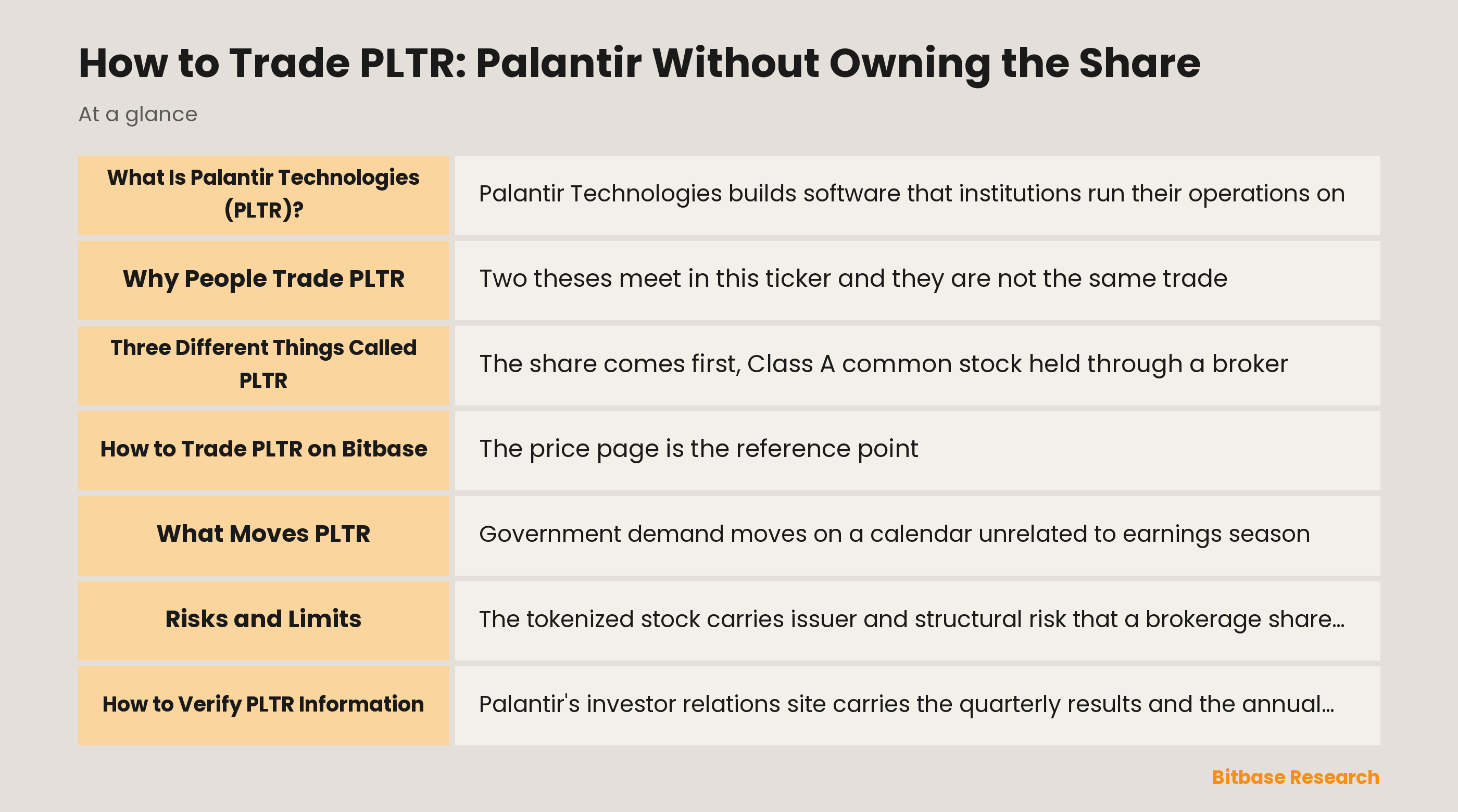
What Is Palantir Technologies (PLTR)?
Palantir Technologies builds software that institutions run their operations on. Its filings describe four principal platforms: Gotham, which integrates data across domains and sensors for defense and intelligence users; Foundry, described by the company as a central operating system for an organization's interconnected data, logic and action; Apollo, which delivers the software into environments Palantir does not control; and AIP, which wires large language models into the other three.
Revenue is cut two ways in the filings: government against commercial, and United States against international. Each half of each pair answers to something different, which is why those cuts carry more than the top line does.
The listing history has two turns. Palantir came public through a direct listing on the New York Stock Exchange in September 2020 rather than an underwritten offering, then moved to Nasdaq, where trading began on November 26, 2024. It sits in both the S&P 500 and the Nasdaq-100.
One structural feature returns below. Palantir has three classes of common stock, and its filings state that the multi-class structure and two founder voting agreements concentrate voting power with the founders and their affiliates. The ordinary Class A share buys economics and a vote the structure was built to outweigh.
Why People Trade PLTR
Two theses meet in this ticker and they are not the same trade.
The first is government software: contract awards, budget authority and the speed at which agencies replace legacy systems. Those buyers are slow, sticky and politically visible.
The second is enterprise adoption of AI. PLTR is a listed way to take a view on whether artificial intelligence produces measurable operational change inside ordinary institutions, rather than a view on chips or on models. That question resolves through deployments and contracts, not compute budgets.
Its link to crypto is incidental. Nothing in Palantir's revenue depends on coin prices, so when PLTR and crypto move together it is because both sit on the same risk appetite.
Three Different Things Called PLTR
The share comes first: Class A common stock held through a broker, carrying whatever rights the multi-class structure leaves it.
The tokenized stock is second. The Bitbase price page for this ticker lists Palantir Technologies (Ondo Tokenized Stock). Ondo's documentation states that one token does not necessarily represent the value of one share and that a token's price will not always match the underlying. The tokens are built as total return trackers, so dividends are reinvested net of withholding tax rather than paid out, and holders receive no shareholder voting rights, no statutory information rights and no other shareholder rights. Ondo describes trading as running 24/5, with pauses possible around corporate actions and risk limits, and the product as generally available to non-US investors.
That last set of exclusions lands differently here. Where control is concentrated by design, the votes a tokenized stock withholds were already the least valuable part of the share; what it does not replace is the information right and the legal claim underneath.
The perpetual futures contract is third, and it is not a version of either. It holds nothing: no share, no token, no claim on Palantir. It tracks a price, settles in stablecoin, exchanges a periodic funding rate between longs and shorts, and can be liquidated.
How to Trade PLTR on Bitbase
The price page is the reference point: quote, chart and market data for the tokenized stock, and no position is required to read it.
The perpetual futures market is where a leveraged directional view gets expressed. Funding passes between the two sides at intervals depending on which one is crowded, a maintenance margin requirement applies, and a liquidation price exists from the moment the position opens. That fits a view with a deadline on it, and it is a poor substitute for wanting to own Palantir for three years.
Which surfaces exist differs from ticker to ticker, and a URL is not evidence; the tokenized stock lineup is the list to check.
What Moves PLTR
Government demand moves on a calendar unrelated to earnings season. Appropriations, continuing resolutions and procurement decisions set the pace, and Palantir's own risk factors name changes in the contracting or fiscal policies of the public sector as a live exposure.
Deal timing is why quarters here are lumpy. The filings put the sales cycle at six to nine months, extending to a year or more for some customers, and say that the loss or delay of one or more large transactions in a quarter would affect that quarter's results.
Commercial mix is the third driver. The rate at which non-government customers adopt the platforms decides whether this is a government contractor with software margins or a software company with a government anchor, and those two descriptions do not earn the same multiple.
What barely moves it is governance. With voting power concentrated by structure, the activist and takeover channels that reprice other large caps are effectively shut here.
Risks and Limits
The tokenized stock carries issuer and structural risk that a brokerage share does not. Its value depends on the issuer's arrangements rather than on a registered claim against the company, and eligibility, redemption paths and jurisdictional limits are set by the issuer and can change.
The 24/5 schedule creates gap risk against a shorter Nasdaq session. Filings, contract announcements and budget events do not observe the trading calendar, and news arriving while the primary market is closed prices into the token first.
The perpetual adds funding cost and liquidation. Funding accumulates, so a directionally correct trade held long enough can still lose to it, and leverage shortens the distance to the liquidation price.
The business risk is concentration. Revenue leans on public-sector demand and on a small number of large customer relationships, which the filings name as a risk factor, and customer contracts can be terminated on notice periods of varying lengths.
How to Verify PLTR Information
Palantir's investor relations site carries the quarterly results and the annual report, where the government and commercial splits appear in the company's own words. The SEC's EDGAR database carries the filings themselves: the annual report on Form 10-K holds the risk factors quoted here, the description of the three share classes and the customer concentration disclosure, and the 8-K filed in November 2024 documents the move from the New York Stock Exchange to Nasdaq.
For the token, the issuer's documentation is the authority on what it is, which rights it does not carry, when it trades and who may hold it. On Bitbase, the price page carries the current quote and the futures market page carries the contract specifications, including funding and margin terms.
Conclusion
Palantir is a software company paid by two buyers working on two clocks, and PLTR reprices on both plus the discount rate applied to years of expected growth. On Bitbase the ticker gives you something to watch and something to trade, and neither makes you a shareholder. The question worth settling first is how long you intend to hold.
Related market pages
Bitbase pages for the tokenized stocks named in this article:
- PLTR: View price · Perpetual market
Related reading
Other Bitbase articles on this topic:
- How to Trade DIS: Parks, Sports and Streaming in One Ticker
- How to Buy GOOGL: One Company, Two Nasdaq Tickers
- How to Trade GS: Goldman Sachs, Deal Fees and a Perpetual
Disclaimer: This article is educational content from Bitbase Academy, provided for information only. It explains what a company or fund does and how the instruments referenced here differ from one another; it does not constitute investment, trading, tax, or financial advice, and it is neither a recommendation nor an endorsement of any security, token, or trading strategy. A tokenized stock is issued by a third party and is designed to give economic exposure to an underlying asset: it is not a share, it carries no shareholder rights, and it depends on the issuer's structure, eligibility rules, and redemption terms, which the issuer can change. Perpetual futures are leveraged derivatives that hold no underlying asset and can be liquidated, and trading hours, product availability, and eligibility differ by instrument and by jurisdiction and can change at any time. Written as of September 2026; verify everything yourself through company filings, the issuer's own documentation, and the product pages of the venue you trade on.
References
[1] Palantir Investor Relations: quarterly results and the annual report, with the government and commercial split investors.palantir.com
[2] SEC EDGAR: Palantir annual report on Form 10-K, including the risk factors, the four platforms and the multi-class share structure www.sec.gov
[3] SEC EDGAR: Palantir Form 8-K on the transfer of the listing from the NYSE to Nasdaq www.sec.gov
[4] Ondo Stocks overview: backing, rights and trading hours (Ondo official documentation) docs.ondo.finance