Owning QQQ through a brokerage account makes you a shareholder in a fund that holds the Nasdaq-100. On Bitbase the same three letters resolve to something else: a tokenized ETF price page and a perpetual futures contract, and neither one registers a fund share in your name. This profile covers what the Nasdaq-100 selects for, why its membership can change for reasons unconnected to any company's results, and what each route on Bitbase gives you.
What Is Invesco QQQ (QQQ)?
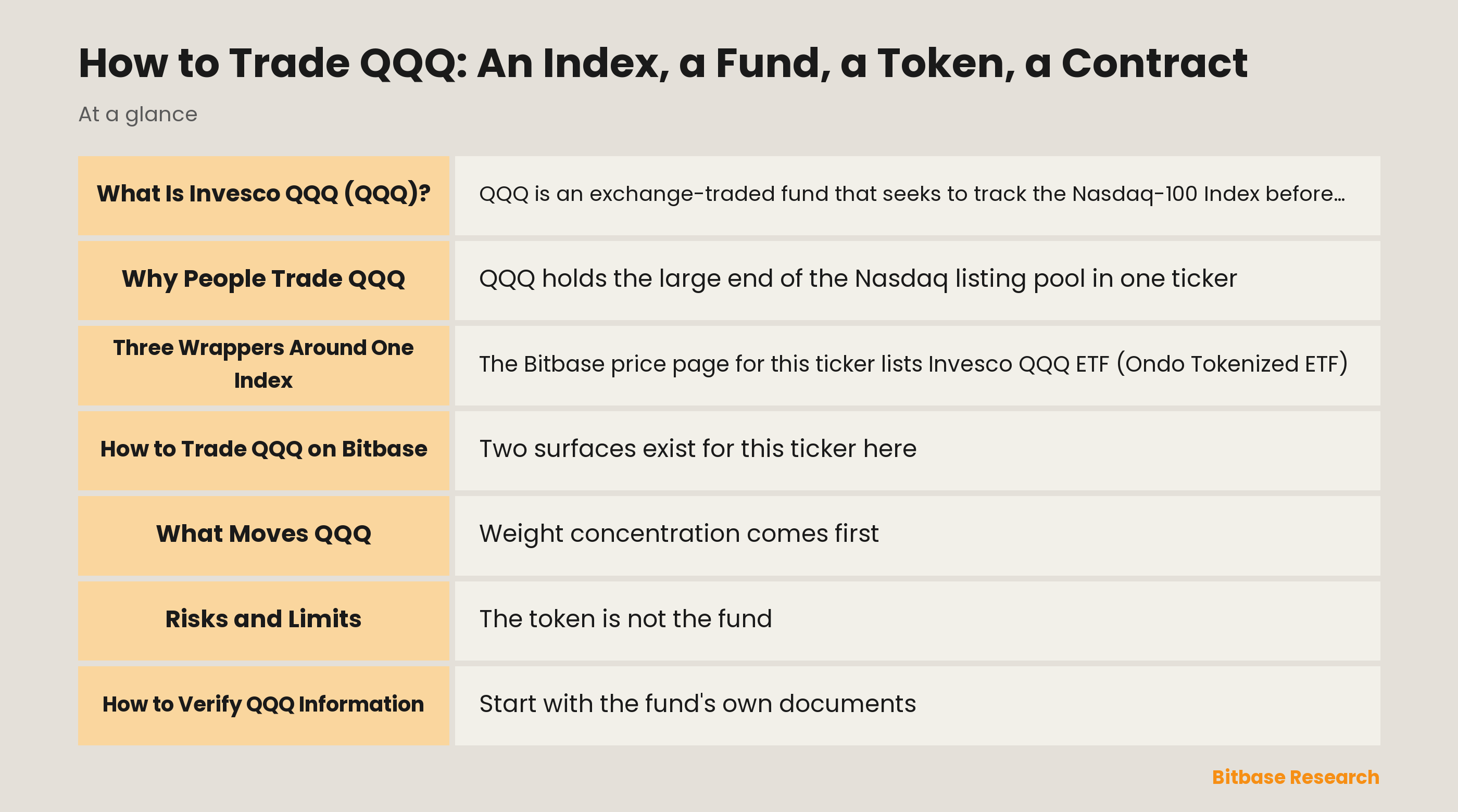
QQQ is an exchange-traded fund that seeks to track the Nasdaq-100 Index before fees and expenses. It trades on The Nasdaq Stock Market under the ticker QQQ, and its legal name is still Invesco QQQ Trust, Series 1 — a leftover from the structure it used to have.
That structure changed at the end of 2025. Effective after the close on December 19, 2025, the fund was reclassified as an open-end management investment company, having run since launch as a unit investment trust. The trust wrapper had prohibited ordinary fund operations — reinvesting income between distribution dates, lending securities, using futures — and the open-end structure permits all three.
The index underneath is narrower than a US market label suggests, in two ways set by rule rather than by a manager. Eligibility runs through listing venue: a company must be primarily listed on a US Nasdaq-affiliated exchange. And financials are excluded, because the methodology bars any company classified in the Financial Industry under the ICB scheme. What is left is the hundred largest of the remainder, weighted by a modified market capitalisation scheme that Invesco's prospectus describes as a hybrid between equal weighting and conventional capitalisation weighting.
Why People Trade QQQ
QQQ holds the large end of the Nasdaq listing pool in one ticker, which in practice means a portfolio tilted hard toward software, semiconductors, internet platforms and consumer technology. Traders reach for it to express risk appetite in that part of the market, and to hedge a book that leans the same way.
The exclusion rule is what to internalise before treating the fund as a market proxy: an index with no banks and no insurers in it does not respond to a banking story. Its link to crypto runs through shared conditions rather than shared cash flows — nothing in the Nasdaq-100 earns revenue from token prices, but both react to the same discount rates and the same appetite for long-duration risk.
Three Wrappers Around One Index
The Bitbase price page for this ticker lists Invesco QQQ ETF (Ondo Tokenized ETF), trading under the symbol QQQON. Reading that name closely is the whole exercise, because several separate objects are in play and only one of them is the fund.
The fund is the registered vehicle described above, and buying its shares through a broker makes you a shareholder of it.
The tokenized ETF is issued by Ondo, whose documentation is explicit that it does not behave like a fund share. One token does not necessarily represent the value of one share, and a token's price will not always match the underlying asset. The tokens are structured as total return trackers, so distributions are reinvested net of withholding tax rather than paid out, and holders receive no shareholder voting rights, no statutory information rights and no other shareholder rights. Ondo describes minting and burning as instant and atomic, trading as generally running 24/5 with pauses possible around corporate actions and risk limits, and the product as generally available to non-US investors.
Set that on top of what the fund already is and there are two tracking layers rather than one: the fund tracks an index and accepts some error doing it, the token tracks the fund and accepts its own. Anyone who has worked through tracking error in ordinary ETFs is looking at that problem twice over.
A perpetual futures contract holds none of the above: no index, no fund share, no token. It tracks a price, settles in stablecoin, exchanges a periodic funding rate between longs and shorts, and carries a liquidation price.
How to Trade QQQ on Bitbase
Two surfaces exist for this ticker here, and they answer different questions.
The price page carries the quote, the chart and the market data for the tokenized ETF, and it is where the issuer's name is printed. Which tickers have which surfaces varies across the list of tokenized stocks and ETFs, so it is worth checking rather than assuming.
The perpetual futures market is where a leveraged directional position on QQQ is opened, with a maintenance margin requirement and a liquidation price in force from the moment it exists. That suits a view with a time limit and makes a poor substitute for holding an index fund: an index holding falls and recovers on the index's own timescale, while a leveraged position can be closed out by a move the holder would have sat through.
What Moves QQQ
Weight concentration comes first. Under a modified market capitalisation scheme the largest constituents carry the bulk of the index, so its day is dominated by what its biggest names did. The methodology caps that concentration with company-level weight constraints, and breaching them between scheduled events can trigger an off-calendar special rebalance — weights cut for mechanical reasons, not because anyone changed their view of a company.
The rebalance calendar is second, and it is published rather than guessed at. Membership is reconstituted once a year, off a reference date on the last trading day of November, effective after the third Friday in December; weights are adjusted quarterly in March, June, September and December, again after the third Friday. Additions and deletions are announced ahead of the effective date, and funds tracking the index have to trade them.
Listing venue is third, and it is the driver people forget. Because eligibility runs through where a company is listed, a company can become eligible by moving its listing to Nasdaq and lose eligibility by moving away, with no change in its business at all. Exchange-transfer news is index news here in a way it is not for a broad market benchmark.
Rates are fourth. With financials excluded, a shift in interest rate expectations reaches this index through valuation rather than earnings, because there are no net interest margins inside it to move the other way.
The fund's own machinery is fifth. Income reinvestment and securities lending became available only after the reclassification, so the sources of drag and of small offsetting income are not what they were under the trust structure.
Risks and Limits
The token is not the fund, and the fund is not the index. Each layer has its own way of falling behind, and the tokenized version adds issuer risk on top: eligibility rules, redemption terms and the structure itself are set by the issuer and can be changed by it, with no shareholder claim to fall back on.
Trading hours do not line up. Fund shares trade in the US session, the token on a 24/5 schedule, the perpetual continuously. News landing while the primary market is shut gets priced by whichever instrument is open, and a position carried across that boundary can travel a long way before the underlying market reopens.
The perpetual adds funding cost and forced closure: funding accrues in whichever direction the crowd sits, so a correct view held long enough can still lose money to it, and leverage shortens the distance to the liquidation price.
Concentration is the risk hiding behind the word index. A fund holding a hundred names sounds diversified; this one is weighted so that a handful of them dominate the outcome, inside a sector mix that excludes an entire industry by rule.
How to Verify QQQ Information
Start with the fund's own documents. Invesco publishes the prospectus and the fund pages for QQQ, and the SEC's EDGAR database carries the filings for Invesco QQQ Trust, Series 1, including the supplements recording structural changes such as the reclassification.
For the index, go to the source rather than to summaries of it: Nasdaq publishes the Nasdaq-100 methodology, where the eligibility criteria, the weighting constraints and the reconstitution calendar are defined, and it announces membership and weight changes ahead of their effective dates. For the tokenized version, the issuer's documentation is the authority on backing, rights, hours and eligibility; none of that comes from the exchange listing, and on Bitbase the price page carries the quote while the contract page carries the perpetual's specifications.
Conclusion
QQQ is a rules-based slice of the Nasdaq listing pool rather than a picture of the US market, and those rules — venue-based eligibility, an industry exclusion, weight caps, a published rebalance calendar — explain more of its behaviour than any single holding does. On Bitbase the ticker gives you a tokenized version of the fund and a perpetual on its price, and neither is fund ownership. Work out which layer you want exposure to before the order goes in.
Related market pages
Bitbase pages for the tokenized stocks named in this article:
- QQQ: View price · Perpetual market
Related reading
Other Bitbase articles on this topic:
- How to Trade DIS: Parks, Sports and Streaming in One Ticker
- How to Buy GOOGL: One Company, Two Nasdaq Tickers
- How to Trade GS: Goldman Sachs, Deal Fees and a Perpetual
- What Is Recall Network? AI Skill Markets and RECALL
Disclaimer: This article is educational content from Bitbase Academy, provided for information only. It explains what a company or fund does and how the instruments referenced here differ from one another; it does not constitute investment, trading, tax, or financial advice, and it is neither a recommendation nor an endorsement of any security, token, or trading strategy. A tokenized stock is issued by a third party and is designed to give economic exposure to an underlying asset: it is not a share, it carries no shareholder rights, and it depends on the issuer's structure, eligibility rules, and redemption terms, which the issuer can change. Perpetual futures are leveraged derivatives that hold no underlying asset and can be liquidated, and trading hours, product availability, and eligibility differ by instrument and by jurisdiction and can change at any time. Written as of September 2026; verify everything yourself through company filings, the issuer's own documentation, and the product pages of the venue you trade on.
References
[1] Ondo Stocks overview: backing, shareholder rights and trading hours (Ondo official documentation) docs.ondo.finance
[2] Nasdaq-100 Index (NDX) methodology: eligibility, weighting constraints and the rebalance calendar (Nasdaq) indexes.nasdaqomx.com
[3] Invesco QQQ Trust, Series 1 prospectus: listing venue, investment objective and the reclassification from a unit investment trust fundcompli.rightprospectus.com
[4] Invesco QQQ fund pages: what the fund tracks and how the index is rebalanced and reconstituted www.invesco.com