Because membership is decided by a size ranking rather than by a committee, the index that RTY settles against is not a stable list of companies: it is taken apart and rebuilt from scratch on a published calendar, and from 2026 that rebuild happens twice a year instead of once. The CME contract written on it is RTY, and M2K is the same exposure at one-tenth the size. The rest of this page is the ranking that decides membership, the rebuild that applies it, and the risks that belong to the contract rather than to the companies underneath.
What RTY Is Written On
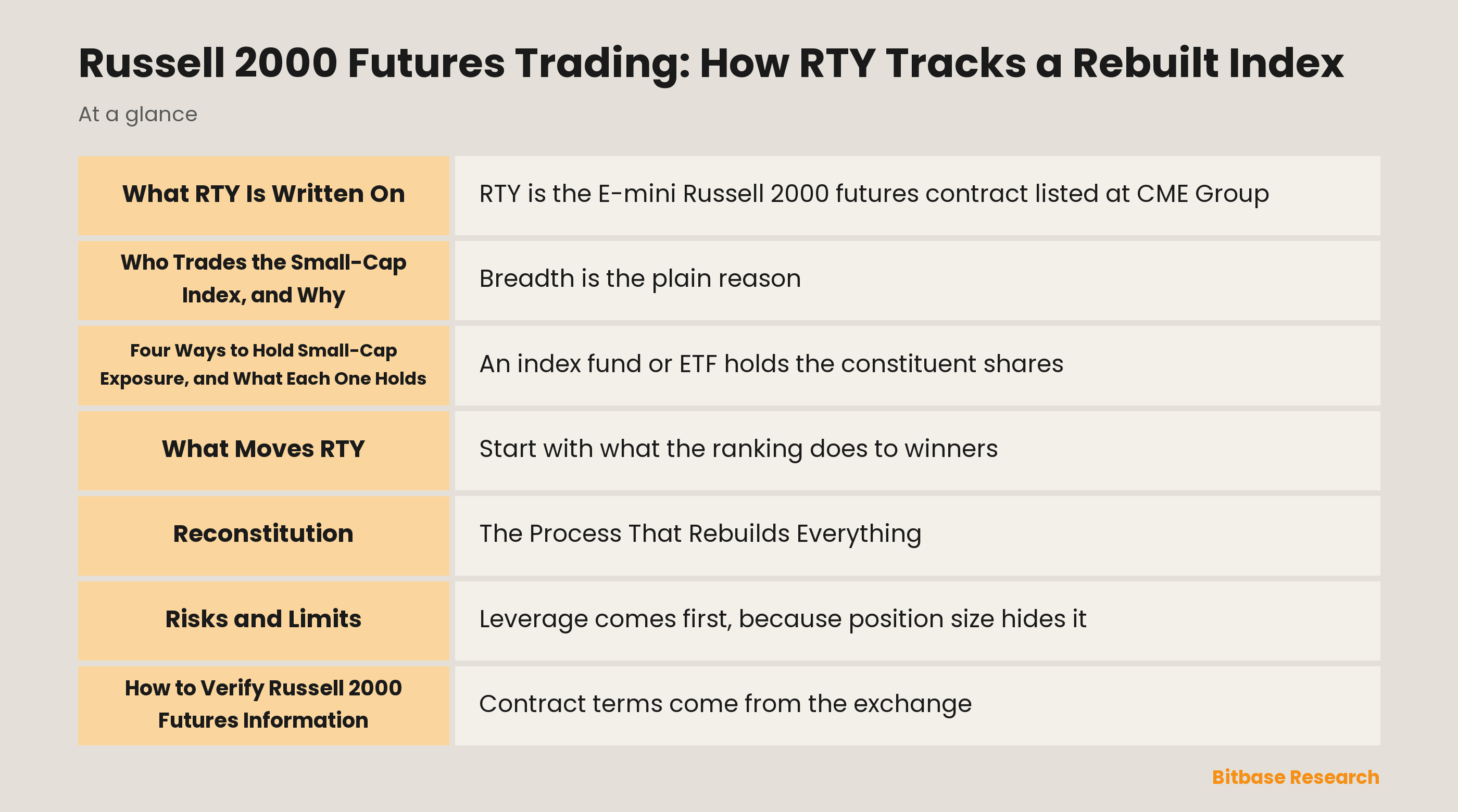
RTY is the E-mini Russell 2000 futures contract listed at CME Group, and the index beneath it is not a hand-picked list. FTSE Russell ranks eligible United States securities by total market capitalisation on a single rank day; the largest 4,000 become the Russell 3000E Index, and the Russell 2000 is the slice of that ranking running from 1,001 down to 3,000. The boundaries are positions in a list, not judgements about companies.
That is close to the whole selection rule. Eligibility turns on where a company trades, a minimum closing price on rank day, minimum market capitalisation and free float, exclusions for certain share types and company structures, and a minimum share of voting rights in public hands. Profitability is not among them. Weighting is float-adjusted and market-capitalisation-weighted, so a constituent's share of the index is its investable market value.
The contract on top of that number is cash-settled, because a ranking is not something anyone can deliver. Contracts are listed on the March quarterly cycle — March, June, September and December — and final settlement is made against a Special Opening Quotation calculated from the opening prices of the index components on the third Friday of the contract month. M2K, the Micro E-mini, is one-tenth the size, on the same index and the same calendar.
Who Trades the Small-Cap Index, and Why
Breadth is the plain reason. A single position expresses a view on a band of the United States market that would otherwise take a basket of two thousand names, on margin, on a schedule that runs nearly around the clock on weekdays. Relative positioning is the other common use: a view that smaller companies will do better or worse than larger ones is two index contracts rather than two portfolios, and both legs settle in cash against published values.
Then there is the calendar. Because FTSE Russell publishes the rebuild dates in advance, there is a known moment at which membership changes and money tracking the index has to trade, and that event belongs to the index rather than to any company in it.
Four Ways to Hold Small-Cap Exposure, and What Each One Holds
An index fund or ETF holds the constituent shares. You own units of a portfolio, dividends flow through, there is no expiry and no margin call, and it trades during exchange hours.
A futures contract holds nothing at all. It is a margined agreement about a future index level, marked to market daily, and it ends on a fixed calendar. There are no dividends, because there is no share; expected dividends and financing costs sit in the gap between contract and index, and the vocabulary of contango and backwardation is how that gap gets described.
A perpetual contract holds nothing either, but it never expires, so in place of a term curve it charges a periodic funding payment, and the cost of holding a perpetual is continuous rather than concentrated into four dated decisions a year.
A tokenized stock is a fourth structure, and its terms are set by a private issuer rather than by an exchange. It gives economic exposure to an underlying asset, and the details that matter — how the token is backed, when it can be traded, what happens to dividends, who is eligible to hold it — differ from issuer to issuer, so a description of one issuer's product is not a description of the category. The tokenized stock and ETF directory lists individual companies and funds; none of them is an index, because an index is a calculated number, and exposure to a number arrives through something that holds shares.
What Moves RTY
Start with what the ranking does to winners, because it has no equivalent in a large-cap benchmark. Membership is a band, not a floor: a constituent that grows enough is promoted out of the Russell 2000 into the Russell 1000 at the next rebuild, and the index keeps what is left behind. Success inside this index is a reason to leave it, so the level RTY settles against describes a population refreshed from below.
Composition is the other structural driver, and it is a fact about the rulebook rather than a forecast. The eligibility criteria include no profitability test, so the rules permit constituents that are not yet earning anything; a benchmark with a profitability screen holds a different population by construction.
Financing sits underneath all of it. The gap between contract and index reflects expected dividends and the cost of carrying exposure, so it moves with interest rates whether or not anything has happened to a single company. Toward an expiry that gap is a cost to be measured, not a signal to be read.
Scheduled macro releases move the whole band together — inflation prints, employment data, central bank decisions — at published times. So does the overnight session: the contract runs a near-continuous weekday schedule, so a move that a cash-market trader meets as a gap at the open may already have happened in the futures book, hours earlier, while the exchange was closed.
Reconstitution: The Process That Rebuilds Everything
FTSE Russell's own description leaves no room for interpretation: reconstitution is the process by which all Russell indexes are completely rebuilt. It is not a rebalance of weights around a settled membership. On rank day, eligible securities are ranked by total market capitalisation, the largest 4,000 become the Russell 3000E Index, and every Russell US index is cut out of that ranking again. Between rebuilds, eligible initial public offerings are added quarterly.
The schedule changed for 2026. Reconstitution had been an annual June event; it is now semi-annual, taking effect after the close on the fourth Friday in June and again on the second Friday in December. Rank day sits well ahead of implementation — for the December rebuild it falls on the last business day of October.
The band around each boundary decides the marginal cases, and it is not the same at both ends. FTSE Russell places a cumulative band around the market-capitalisation breakpoints so that a company near a boundary has to show material and sustained growth or decline before it moves. Around the breakpoint at the top of the Russell 2000 that band is 2.5% either side. At the bottom of the Russell 3000 there is no band at all: the upper edge has a cushion, and the lower edge is a cliff.
What the rebuild produces on the day is trade. Money tracking the index has to hold the new membership by the time it takes effect, and that demand concentrates into the closing auction; FTSE Russell publishes the volume, and it runs to hundreds of billions of dollars across the New York Stock Exchange and Nasdaq. For an RTY position that date is a scheduled liquidity event, not a news event with a direction.
Risks and Limits
Leverage comes first, because position size hides it. Initial margin on an index future is a fraction of the contract's notional value, so the exposure is far larger than the cash posted against it, and daily mark-to-market turns an adverse move into a same-day cash requirement.
Expiry is an operational risk and not only a cost. A position still open in an expiring contract is settled in cash against the Special Opening Quotation whether or not that was anyone's plan, and staying exposed past it means closing one contract and opening the next while liquidity migrates between them.
Gap risk is structural: the contract does not trade through the weekend, and anything that happens while it is closed arrives as a single jump when it reopens, with no prices in between at which a position could have been exited.
The definition itself moves, and that risk belongs to this index rather than to futures in general. A long price history of the Russell 2000 is not a history of the same companies; it is one rule applied repeatedly to a changing population, so a comparison spanning a reconstitution compares two memberships.
Breadth is not protection either. Two thousand names is a wide list, but a leveraged position on a wide list is still a leveraged position, and eligibility rules that admit a company say nothing about whether it can survive a given environment.
How to Verify Russell 2000 Futures Information
Contract terms come from the exchange. CME Group publishes contract specifications for the E-mini Russell 2000 and the Micro E-mini Russell 2000 — contract unit, tick size, trading hours, listed months, final settlement — and the rulebook carries a chapter for each. Margin requirements are published separately, they change, and a broker may require more than the exchange minimum.
Index rules come from the index provider. FTSE Russell publishes a construction and methodology document for the Russell US indexes containing the rank-day procedure, the breakpoint table, the banding rule and the eligibility screens; the reconstitution calendar is published separately, and index notices carry changes between editions, which is where a schedule change of the kind made for 2026 appears first. For an individual constituent, filings sit on the United States Securities and Exchange Commission's EDGAR system.
For any instrument you are about to trade, the specification published by the venue you trade on is the one that binds, not a general description of index futures and not this article.
Conclusion
RTY is a cash-settled, quarterly, margined contract on a number that is recalculated every day and reconstructed twice a year. The reconstruction is the part worth carrying away: membership is a rank band, growth pushes a company out of the top of it, the upper edge has a cushion and the lower edge has none, and none of it involves a judgement about whether a company deserves its place. M2K is the same instrument at one-tenth the size, which changes what a position costs and nothing about the index.
Related reading
Other Bitbase articles on this topic:
- How to Trade DIS: Parks, Sports and Streaming in One Ticker
- How to Buy GOOGL: One Company, Two Nasdaq Tickers
- How to Trade GS: Goldman Sachs, Deal Fees and a Perpetual
- What Is Succinct? A Decentralized Proving Network
Disclaimer: This article is educational content from Bitbase Academy, provided for information only. It explains what a company or fund does and how the instruments referenced here differ from one another; it does not constitute investment, trading, tax, or financial advice, and it is neither a recommendation nor an endorsement of any security, token, or trading strategy. A tokenized stock is issued by a third party and is designed to give economic exposure to an underlying asset: it is not a share, it carries no shareholder rights, and it depends on the issuer's structure, eligibility rules, and redemption terms, which the issuer can change. Perpetual futures are leveraged derivatives that hold no underlying asset and can be liquidated, and trading hours, product availability, and eligibility differ by instrument and by jurisdiction and can change at any time. Written as of September 2026; verify everything yourself through company filings, the issuer's own documentation, and the product pages of the venue you trade on.
References
[1] FTSE Russell: Russell US Indexes construction and methodology www.lseg.com
[2] CME Group: E-mini Russell 2000 futures contract specifications www.cmegroup.com
[3] FTSE Russell: Russell Reconstitution schedule and results www.lseg.com
[4] CME Group: Micro E-mini Russell 2000 futures product page www.cmegroup.com