The second of Shopify's two revenue lines is the one that decides what SHOP is as a position: a merchant pays a subscription to run a store, and then pays again when a customer checks out. That makes the ticker a claim on other people's order volume, not only on software seats. On Bitbase, SHOP resolves to two surfaces, an Ondo tokenized stock price page and a perpetual futures contract, and neither of them is a share in the company that files the accounts.
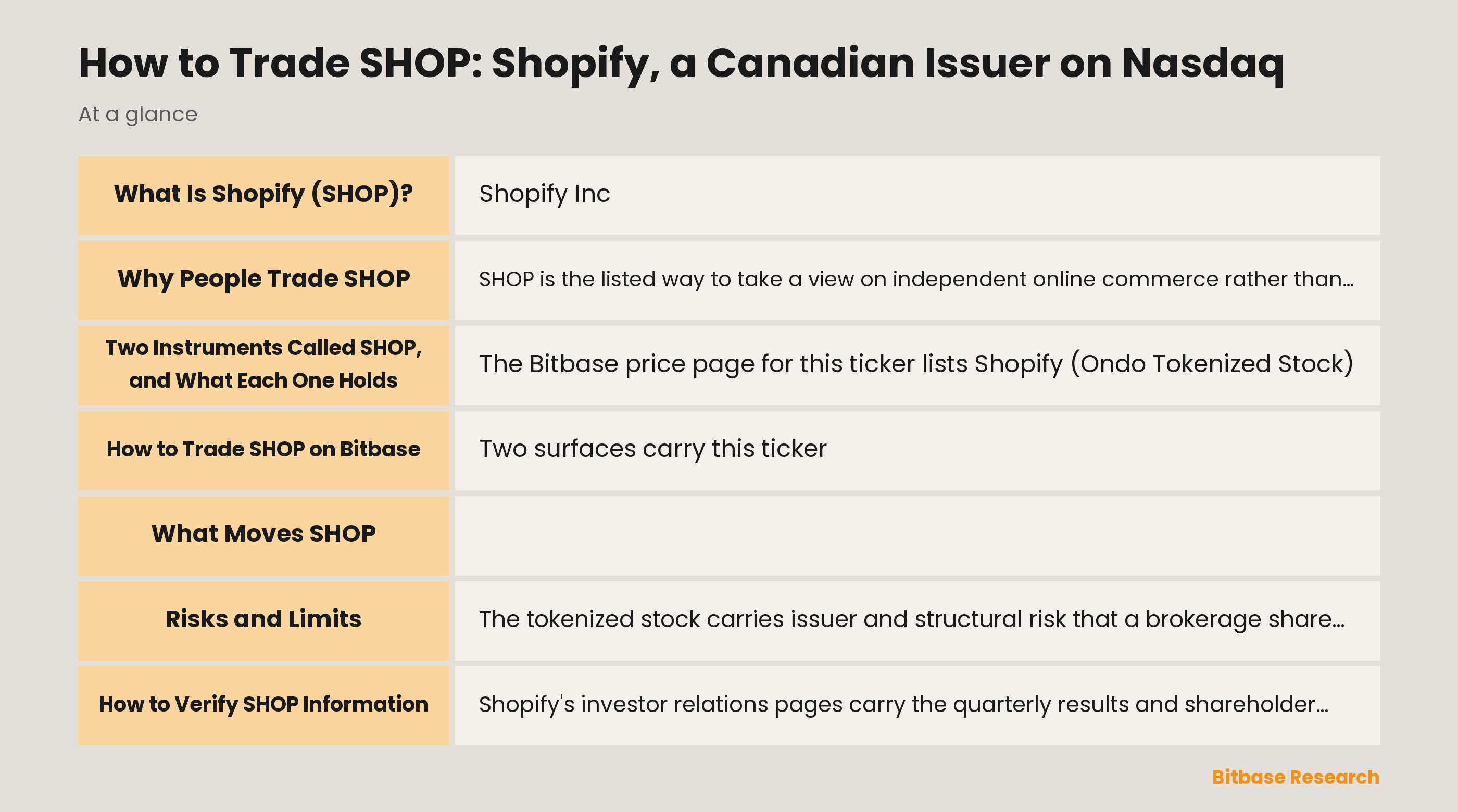
What Is Shopify (SHOP)?
Shopify Inc. builds and rents the software independent merchants use to sell online and in person. Its head office is in Ottawa, Ontario, and it files with the US Securities and Exchange Commission on Form 10-K.
The filings split revenue into two lines. Subscription solutions comes from platform subscriptions, variable platform fees and the POS Pro offering. Merchant solutions comes from payment processing and currency conversion fees on Shopify Payments, plus lending, partner referral fees, shipping labels and POS hardware.
Gross merchandise volume ties that second line to the outside world. Shopify defines GMV as the total dollar value of orders facilitated through its platform, net of refunds and inclusive of shipping and handling, duty and value-added taxes, and states that GMV does not represent revenue earned by the company. It is the pool the merchant solutions line draws from.
Where the shares trade needs stating precisely, because two listings exist. Shopify moved its US listing from the New York Stock Exchange to the Nasdaq Global Select Market on March 31, 2025, leaving the Toronto listing untouched. The same Class A subordinate voting shares trade under SHOP on both venues, and the company entered the Nasdaq-100 index in May 2025.
Voting is where the Canadian corporate structure shows. Class B restricted voting shares carry ten votes each, and a single non-transferable Founder share, issued to founder and chief executive Tobias Lütke, carries a variable number of votes that, with the Class B shares he and his affiliates hold, comes to 40% of the aggregate voting power. The Founder share itself carries no economic rights.
Why People Trade SHOP
SHOP is the listed way to take a view on independent online commerce rather than on a single marketplace. The subscription line gives the business a floor and the payments line gives it the swing, because it moves with what merchants sell rather than with how many merchants there are. A weak consumer quarter therefore reaches Shopify twice: through slower merchant growth, and through smaller baskets at checkout.
There is also a direct line into crypto, and it runs through the product rather than the balance sheet. In June 2025 Shopify, with Coinbase and Stripe, opened USDC payments on the Base network to Shopify Payments merchants: buyers pay in USDC from supported wallets, and merchants receive local currency by default or can claim USDC into their own wallet. That puts stablecoin payments inside the checkout of a Nasdaq-100 company, a different exposure from a treasury that holds coins.
Two Instruments Called SHOP, and What Each One Holds
The Bitbase price page for this ticker lists Shopify (Ondo Tokenized Stock), under the symbol SHOPON. The issuer name is the load-bearing part of that string.
Ondo's documentation states that one token does not necessarily represent the value of one share, and that the price of one token will not always match the price of the underlying asset. The tokens are total return trackers: dividends are reinvested net of withholding tax rather than paid out. Holders receive no shareholder voting rights, no statutory information rights and no other shareholder rights. Ondo describes trading as running 24/5, with pauses possible around corporate actions and risk limits, and the product as generally available to non-US investors.
Those clauses land differently on SHOP than on a dividend payer. Shopify's filings state that it expects to pay no cash dividends in the foreseeable future, so the reinvestment mechanism has little to reinvest. The rights clause is the one that bites, and it bites twice: the token carries no vote, and the share class it references is already the subordinate one underneath a founder share.
A perpetual futures contract is a third structure. It holds nothing: no share, no token, no claim on Shopify. It tracks a price, settles in stablecoin, exchanges periodic funding between longs and shorts, and can be liquidated. The cost of holding a perpetual is a separate question from the direction of the price, and it accrues whether the view turns out right or wrong.
How to Trade SHOP on Bitbase
Two surfaces carry this ticker.
The price page carries the quote, the chart and the market data for the tokenized stock. It requires no position, and it is the reference point for what the token is doing.
The perpetual futures market is where a leveraged directional position is opened. Funding is paid or received periodically depending on which side is crowded, a maintenance margin requirement applies, and a liquidation price sits at a distance set by leverage. That suits a view with a deadline, not a way to hold the company.
Coverage differs by ticker, and the tokenized stock listings page is where to see which surfaces exist for a given name.
What Moves SHOP
The fourth quarter carries more than its share. Shopify's filings describe the business as affected by seasonality due to holiday demand, which has historically produced higher GMV and revenue in the fourth quarter. The company also publishes a live tracker of Black Friday and Cyber Monday order volume while the weekend runs, so a four-day window produces a public number read as a verdict on the quarter.
Large accounts move the number, not the store count. Shopify states that the majority of its GMV has come from merchants subscribing to its Shopify Plus plan and enterprise offerings. A shift among a small set of large accounts therefore moves the volume that drives the payments line, while the headline count of stores can move the other way without contradicting it.
Payment attach, not subscription growth alone. The merchant solutions line depends on how much GMV runs through Shopify Payments rather than an outside gateway, and that share expands with each market where the payment product becomes available. Payment availability by country is therefore a revenue event here, which it is not for a subscription business.
Cross-border rules. Shopify's GMV definition is inclusive of duty and value-added taxes, a hint at how much of that volume crosses a border. Changes to customs treatment and to low-value import thresholds land on merchant order volume first and on the payments line immediately after.
Two quotes, one company. The Toronto listing is priced in Canadian dollars and the Nasdaq listing in US dollars, while the accounts are reported in US dollars. The tokenized product references the US line, so a Canadian screen and the token differ by currency rather than by mispricing.
Risks and Limits
The tokenized stock carries issuer and structural risk that a brokerage share does not. Its value depends on the issuer's arrangement holding together, eligibility and redemption terms are the issuer's to set and change, and there is no shareholder claim underneath it.
The 24/5 schedule creates gap risk against a shorter primary session. Shopify reports quarterly and releases results outside trading hours, so a token position held across that boundary prices the news before the primary market reopens and cannot be hedged there meanwhile.
The perpetual adds funding cost and liquidation. Funding accrues on a schedule regardless of direction, and leverage sets how far the price can travel before the position closes itself. A stock-referenced perpetual can gap hard around an earnings release, because the event that reprices it is scheduled and lands outside the trading day.
The business risk is concentration of an unusual kind: a single-name bet on discretionary spending reaching independent merchants, on payment attach continuing to widen, and on a small set of large accounts staying put. The governance structure caps even a real shareholder's vote by design, and a token holder has no vote to cap.
How to Verify SHOP Information
Shopify's investor relations pages carry the quarterly results and shareholder materials. The filings sit in the SEC's EDGAR database, where the Form 10-K holds the GMV definition, the revenue-line definitions, the share-class descriptions and the risk factors in the company's own words. Because Shopify is also a Canadian reporting issuer, its Canadian filings are posted on SEDAR+.
For the token, the issuer's documentation is the authority on what it is, which rights it does not carry, when it trades and who may hold it. That is a different document from anything a trading venue publishes.
For the instruments on Bitbase, the price page carries the current quote and the contract page the specifications, including funding and margin terms. Those change, and they are the terms to read before sizing anything.
Conclusion
Shopify charges the same merchant twice, and the second charge is what makes SHOP track order volume rather than subscriber count. On Bitbase the ticker appears as an Ondo tokenized stock with a price page and as a perpetual futures contract, and neither one delivers a share or a vote. Which of the two fits is a question about holding period, and about which structure's risks belong in the plan.
Related market pages
Bitbase pages for the tokenized stocks named in this article:
- SHOP: View price · Perpetual market
Related reading
Other Bitbase articles on this topic:
- How to Trade GS: Goldman Sachs, Deal Fees and a Perpetual
- How to Buy INTC: A Chip Designer That Owns Its Factories
- How to Trade IREN: From Bitcoin Mining to AI Data Centres
- What Is Linea? An Ethereum-Compatible zkEVM Layer 2
Disclaimer: This article is educational content from Bitbase Academy, provided for information only. It explains what a company or fund does and how the instruments referenced here differ from one another; it does not constitute investment, trading, tax, or financial advice, and it is neither a recommendation nor an endorsement of any security, token, or trading strategy. A tokenized stock is issued by a third party and is designed to give economic exposure to an underlying asset: it is not a share, it carries no shareholder rights, and it depends on the issuer's structure, eligibility rules, and redemption terms, which the issuer can change. Perpetual futures are leveraged derivatives that hold no underlying asset and can be liquidated, and trading hours, product availability, and eligibility differ by instrument and by jurisdiction and can change at any time. Written as of September 2026; verify everything yourself through company filings, the issuer's own documentation, and the product pages of the venue you trade on.
References
[1] Shopify Inc., Form 10-K: revenue-line and GMV definitions, share classes, seasonality and risk factors www.sec.gov
[2] Shopify Inc., Form 8-K exhibit: transfer of the US listing to Nasdaq, with the TSX listing unaffected www.sec.gov
[3] Shopify: updated governance structure, the Founder share and the aggregate voting power it carries www.shopify.com
[4] Shopify: USDC payments on Base for Shopify Payments merchants, with Coinbase and Stripe www.shopify.com