SMH compresses the semiconductor trade into twenty-five US-listed names, and those names do not run on the same clock: a designer, a manufacturer and an equipment maker sit at different points of one cycle. Bitbase carries the ticker as a tokenized stock spot market and as a perpetual futures contract, and neither of those is a share of the fund.
What Is the Semiconductor ETF (SMH)?
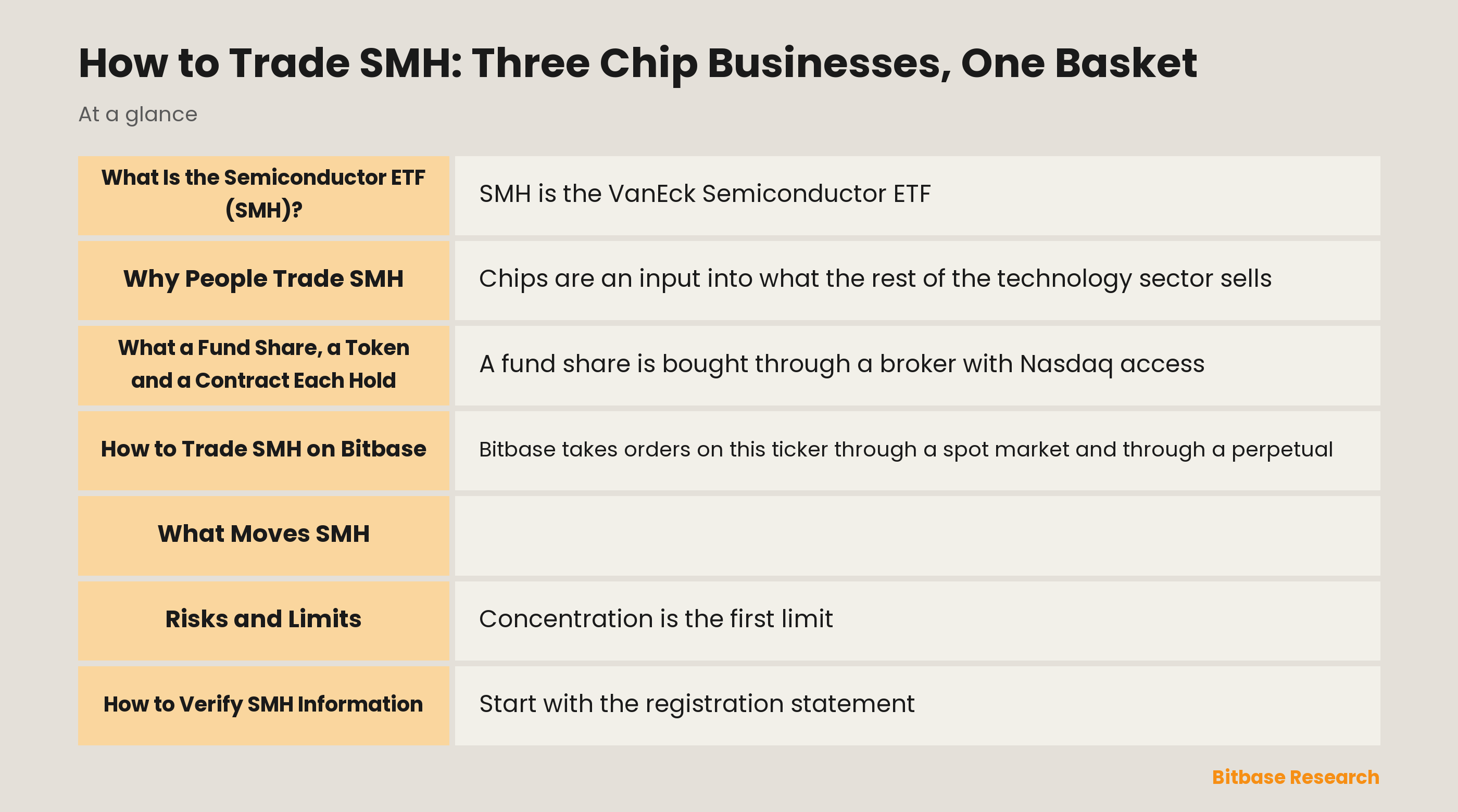
SMH is the VanEck Semiconductor ETF, listed on Nasdaq. Its prospectus says the fund "seeks to replicate as closely as possible, before fees and expenses, the price and yield performance of the MVIS® US Listed Semiconductor 25 Index" and "normally invests at least 80% of its total assets in securities that comprise the Fund's benchmark index."
The rules live in the index, which "includes common stocks and depositary receipts of U.S. exchange-listed companies in the semiconductor industry", and to be eligible "companies must generate at least 50% of their revenues from semiconductors." Of the fifty largest by full market capitalisation, the index takes the top twenty-five by free float and three-month trading volume.
Two things follow. The depositary receipt clause puts foreign issuers inside a fund whose index name says US Listed, and the wrapper differs by company: some foreign issuers reach a US exchange through a depositary receipt, others through registry shares of the ordinary stock. And the revenue test is a business-mix test, so a company that diversifies until chips fall below half of its revenue stops being eligible. The fund is also "classified as a non-diversified fund under the Investment Company Act of 1940".
Why People Trade SMH
Chips are an input into what the rest of the technology sector sells, and exposure to that input is a different decision from picking which chip company wins it. SMH is the first decision without the second: one order covers designers, manufacturers and toolmakers, and holds a view on data centre capital spending without naming a supplier.
Its link to crypto is shared conditions rather than shared revenue. Token prices are not a line in these companies' accounts; what the two markets share is sensitivity to liquidity and to appetite for long-duration risk.
What a Fund Share, a Token and a Contract Each Hold
A fund share is bought through a broker with Nasdaq access. It makes you a shareholder of the fund, and the fund holds the companies.
A tokenized version of the fund is issued by a third party and adds a second wrapper. It is built to give economic exposure to the fund rather than a holding in it, and what you actually hold is defined by the issuer's structure, eligibility rules and redemption terms. Bitbase lists tokenized equities from more than one issuer, and they are not built alike. Some tokens are backed one for one and some explicitly are not; one issuer's product is a contract with that issuer rather than a token backed by shares; trading windows differ. Rights are not uniform either: some issuers state plainly that their token confers no shareholder rights, and where an issuer says nothing, that silence is not evidence either way. Read the documentation of the issuer behind the specific token; a general account of tokenization answers none of that.
A perpetual futures contract holds nothing at all. It tracks a price, settles in stablecoin, pays or charges a funding rate between the two sides of the market, and can be liquidated. It never makes you a holder of the fund or the token.
How to Trade SMH on Bitbase
Bitbase takes orders on this ticker through a spot market and through a perpetual, and the two answer different questions.
The tokenized stock spot market is where the token is bought and held outright. There is no funding cost and no liquidation price; the position sits in the account until it is sold.
The perpetual futures market is where leveraged directional positions are opened. It carries funding, a maintenance margin requirement and a liquidation price, which fits a defined holding period or a hedge. It does not fit "I want to own some semiconductors."
Which surfaces exist differs from one ticker to the next; the tokenized stock and ETF listings are where to check.
What Moves SMH
The cycle, and which part of it you hold. The prospectus is blunt: "The semiconductor industry is highly cyclical, which may cause the operating results of many semiconductor companies to vary significantly." The cycle does not arrive everywhere at once. Equipment orders are placed before capacity exists, foundry utilisation moves with capacity already built, and designers move with end demand. The fund can hold a company reporting a record order book next to one cutting output.
Capital intensity and obsolescence. The same document notes that these companies "typically face high capital costs and such companies may need additional financing, which may be difficult to obtain", and names rapid product obsolescence as a risk of its own. The cost of money is a direct input here, and a generational transition can reprice a constituent before revenue moves.
Export licensing. Trade policy is written straight into this sector's addressable market. The Bureau of Industry and Security's October 2022 rule on advanced computing and semiconductor manufacturing items expanded "the scope of foreign-produced items subject to license requirements" for named entities. Because the index admits foreign issuers, a licensing decision taken elsewhere lands inside a fund that looks domestic.
Membership arithmetic. With twenty-five slots and a float ranking, an addition or a deletion is a whole slot rather than a rounding. A company whose chip revenue slips under the eligibility threshold leaves; a newly floated one with a large free float can enter. Neither is news about the fund, and both change what a holder owns.
Risks and Limits
Concentration is the first limit, and it is structural: with twenty-five holdings and a non-diversified classification, one company's guidance can move the whole basket.
The token adds issuer risk on top of fund risk. It is not a holding in the fund, so its value depends on the issuer's arrangement continuing to work, and eligibility, redemption terms and trading hours are set by the issuer, not by the fund or the venue. What rights, if any, attach to it is a question for that issuer's documentation, and the answer is not the same at every issuer.
Sessions do not line up. The fund's own market prices during Nasdaq hours while a token trades outside them, so news arriving while the primary market is shut moves the token against a reference that has stopped updating.
The perpetual adds funding and forced exit. Funding accumulates against whichever side is crowded, so a directionally correct position held long enough can still lose to it, and leverage shortens the distance to a liquidation price.
How to Verify SMH Information
Start with the registration statement. VanEck files it with the SEC and it is public on EDGAR: the objective, the index name, the eligibility rules and the fee schedule are in the fund's own words.
For what belongs in the basket, go to the index side: the index provider publishes the methodology and the review calendar. The sponsor's fund page carries holdings as of a stated date, and that date deserves as much attention as the numbers beside it.
For the token, the issuer's documentation is the authority on backing, rights, hours and eligibility. On Bitbase the market pages carry the perpetual's contract specifications. Keep a fund's tracking error and a token's own deviation from that fund apart: two gaps, measured against two different references.
Conclusion
SMH is a rules-bound basket of twenty-five semiconductor companies, selected by free float, admitted on a revenue test, and open to foreign issuers listed in the United States. That construction is where both its usefulness and its risk come from: it captures a supply chain in one order, and concentrates the trade into a few names exposed to trade policy as directly as to demand. On Bitbase it appears as a token and as a perpetual, and neither is a share of the fund.
Related market pages
Bitbase pages for the tokenized stocks named in this article:
- SMH: Tokenized stock spot · Perpetual market
Related reading
Other Bitbase articles on this topic:
- How to Trade GS: Goldman Sachs, Deal Fees and a Perpetual
- How to Buy INTC: A Chip Designer That Owns Its Factories
- How to Trade IREN: From Bitcoin Mining to AI Data Centres
- What Is The Graph? Subgraphs, Indexers and GRT
Disclaimer: This article is educational content from Bitbase Academy, provided for information only. It explains what a company or fund does and how the instruments referenced here differ from one another; it does not constitute investment, trading, tax, or financial advice, and it is neither a recommendation nor an endorsement of any security, token, or trading strategy. A tokenized stock is issued by a third party and is designed to give economic exposure to an underlying asset: it is not a share, it carries no shareholder rights, and it depends on the issuer's structure, eligibility rules, and redemption terms, which the issuer can change. Perpetual futures are leveraged derivatives that hold no underlying asset and can be liquidated, and trading hours, product availability, and eligibility differ by instrument and by jurisdiction and can change at any time. Written as of September 2026; verify everything yourself through company filings, the issuer's own documentation, and the product pages of the venue you trade on.
References
[1] VanEck Semiconductor ETF (SMH) prospectus filed with the SEC: objective, the 80% policy, index eligibility, non-diversified classification, semiconductor sector risk, Nasdaq listing www.sec.gov
[2] Bureau of Industry and Security, Implementation of Additional Export Controls: Certain Advanced Computing and Semiconductor Manufacturing Items, Federal Register, 13 October 2022 www.govinfo.gov
[3] ASML investor relations, Shares: the ordinary shares are listed for trading in the form of registered Nasdaq shares, not depositary receipts www.asml.com