You buy a rulebook when you buy SPY, and the fund wrote none of it. S&P Dow Jones Indices decides which companies belong in the index, a unit investment trust holds them in the weights the index hands it and is not permitted to disagree, and on Bitbase the ticker is carried as a perpetual futures contract with a price page labelled as a Dinari tokenized ETF. Each layer has a different author.
What Is the State Street SPDR S&P 500 ETF Trust (SPY)?
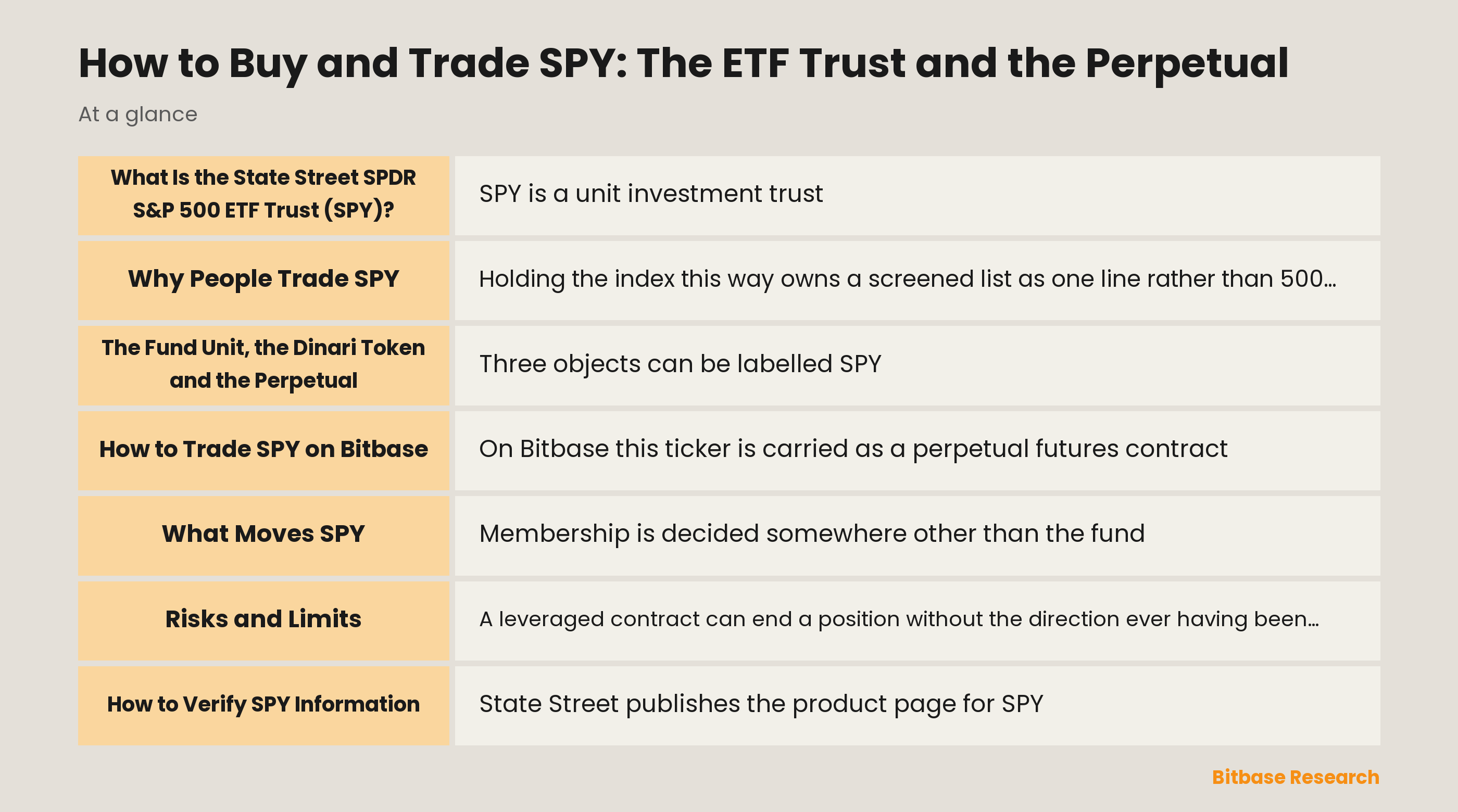
SPY is a unit investment trust, and that phrase is a list of prohibitions rather than a marketing label. It seeks to provide investment results that, before expenses, correspond generally to the price and yield performance of the S&P 500 Index, and the index it copies includes five hundred selected companies.
Nobody inside the trust holds an opinion about that list. Since the Trust is not actively managed, the adverse financial condition of an issuer will not result in its elimination from the Portfolio unless that issuer is removed from the Index — a constituent can be visibly failing and still be held at its index weight.
The structure takes a second tool away. Trusts built this way are not permitted to lend out the securities they hold, so no lending revenue works against what the trust spends.
The sponsor is PDR Services LLC and the trustee is State Street Global Advisors Trust Company: a legal arrangement between named parties rather than a desk inside an asset manager. Units are listed on NYSE Arca under the symbol SPY, the trust commenced operations on 22 January 1993, and payments of dividends are made quarterly, on the last business day of April, July, October and January.
Why People Trade SPY
Holding the index this way owns a screened list as one line rather than 500 separate decisions, and the screen is the part that gets skipped. S&P Dow Jones Indices applies a financial viability test: GAAP net income from continuing operations positive for the most recent quarter and for the sum of the four most recent quarters. A stock also has to trade on an eligible exchange for at least 12 months before it can be considered.
So the index is not the US market. It is the part of it that has cleared a profitability test, seasoned for a year, and been picked by a committee that publishes its criteria.
There is also what a unit does not ask of you: no margin requirement and no expiry date, whereas stock index futures written on the same index put an expiry date in front of the holder.
The Fund Unit, the Dinari Token and the Perpetual
Three objects can be labelled SPY, and only one of them is the trust.
A unit of the trust is bought from another investor on the exchange where it is listed. It receives the quarterly distribution, and what stands behind it is a portfolio of shares held by the trustee.
A tokenized ETF is issued by somebody else, and here that somebody is Dinari. Dinari describes a dShare as a token backed one-for-one by a security, with tokens created or destroyed only after the matching brokerage order settles through Alpaca. Its market is not one continuous session but several: regular US hours, pre-market and post-market windows that take limit orders only, an overnight window on the same terms, and a round-the-clock session covering a limited set of tickers. Cash dividends reaching the issuer are passed on above a minimum, and a direct holder receives them as USD+.
A perpetual futures contract stands furthest from the portfolio. It holds no units and no shares, tracks a price, never expires, settles in stablecoin, and exchanges a periodic funding payment between the two sides depending on which one is crowded.
Read them in that order and the distance grows: a claim on the trust's holdings, a claim on an issuer's arrangements around them, and an agreement about a number.
How to Trade SPY on Bitbase
On Bitbase this ticker is carried as a perpetual futures contract, and the price page beside it is where the quote and the issuer label can be read.
A perpetual has no expiry, so nothing has to be rolled. In its place is funding, paid or received periodically depending on which side is crowded, alongside a maintenance margin requirement and a liquidation price that move with the mark and the collateral.
One difference belongs specifically to index exposure held this way. The trust pays its holders on four dates a year; the contract distributes nothing on any date, and what the trust pays out reaches unit holders.
Size against the contract's own numbers, taken from the futures market page for this ticker. Whether another ticker resolves the same way is answered on the tokenized stock and ETF listings page rather than by assuming this one generalises.
What Moves SPY
Membership is decided somewhere other than the fund. The trustee adjusts the portfolio from time to time to conform to periodic changes made by S&P to the identity and relative weightings of the index constituents, so a company can leave SPY because the index provider replaced it.
The entry rules decide what is able to arrive at all. A large and heavily traded company can sit outside the index for a year after listing, or for as long as it reports losses. Those rules can move too: S&P Dow Jones Indices consulted publicly during 2026 on whether megacap companies should be exempted from the seasoning period and the minimum investable weight factor, and in June announced no change.
Float rather than the headline share count sets how much each name matters, and weight decides whose results are index events. A company carrying one of the largest weights moves the level in proportion to it, so its earnings day is felt across the whole line while an equally dramatic day at one of the smallest weights is not.
On the contract side, funding is a driver with no company behind it at all. It is a payment between traders, so a level that ends the week where it started can still have cost or paid something in between.
Risks and Limits
A leveraged contract can end a position without the direction ever having been wrong. Maintenance margin and the liquidation price move with the mark and the collateral, and being early is closed out like being mistaken.
Sessions do not line up. The constituents trade on a US schedule and the index is computed from the prices they are printing, so a contract market open while they are shut is quoting what that market believes rather than reading the index.
The token route depends on an issuer rather than on the trust: Dinari sets the sessions, the order handling and the dividend route, and can change them.
The trust cannot defend itself: a constituent in serious trouble stays in the portfolio until the index removes it.
Expenses, and cash sitting with the trust between a dividend arriving and a distribution date, are why the fund's result and the index's result are two different series; that distance is measured as tracking error.
How to Verify SPY Information
State Street publishes the product page for SPY, and the prospectus, the holdings file and the distribution history are on it.
The trust's own filings sit on SEC EDGAR under its name, where the current prospectus arrives as a dated post-effective amendment rather than as a quiet rewrite.
S&P Dow Jones Indices publishes the index methodology, announces constituent changes, and consults publicly before altering the criteria — the 2026 consultation and its result are both on the record.
Dinari's own documentation is where the token's sessions, order handling and dividend route are written down: the issuer's terms, not the fund's.
On Bitbase, the futures market page carries the contract specification and the funding history, and the price page carries the issuer label.
Conclusion
SPY is an instruction rather than a strategy: an index provider names the constituents, and a trust that is not allowed to disagree holds them in the weights it is handed. That makes the fund unusually easy to read, and it moves the interesting decisions elsewhere — to the committee that writes the criteria, and to whichever wrapper you meet the exposure through. On Bitbase that wrapper is a perpetual futures contract: the price with leverage, none of the ownership, and a funding charge for the time held.
Related market pages
Bitbase pages for the tokenized stocks named in this article:
- SPY: View price · Perpetual market
Related reading
Other Bitbase articles on this topic:
- How to Buy INTC: A Chip Designer That Owns Its Factories
- How to Trade IREN: From Bitcoin Mining to AI Data Centres
- How to Buy and Trade IWM, the Russell 2000 ETF
Disclaimer: This article is educational content from Bitbase Academy, provided for information only. It explains what a company or fund does and how the instruments referenced here differ from one another; it does not constitute investment, trading, tax, or financial advice, and it is neither a recommendation nor an endorsement of any security, token, or trading strategy. A tokenized stock is issued by a third party and is designed to give economic exposure to an underlying asset: it is not a share, it carries no shareholder rights, and it depends on the issuer's structure, eligibility rules, and redemption terms, which the issuer can change. Perpetual futures are leveraged derivatives that hold no underlying asset and can be liquidated, and trading hours, product availability, and eligibility differ by instrument and by jurisdiction and can change at any time. Written as of September 2026; verify everything yourself through company filings, the issuer's own documentation, and the product pages of the venue you trade on.
References
[1] State Street product page for SPY: prospectus, holdings file and distribution history www.ssga.com
[2] SPY's own filing on SEC EDGAR: the post-effective amendment carrying the current prospectus www.sec.gov
[3] Dinari documentation: what a dShare is, its backing, its sessions and how dividends are routed docs.dinari.com
[4] S&P Dow Jones Indices: the 2026 megacap consultation and its result for the eligibility criteria press.spglobal.com