Because Tesla files its production and delivery figures within days of a quarter closing and its financial results only weeks later, the ticker carries two dated events per quarter rather than one. On Bitbase, TSLA resolves to three separate instruments: a tokenized stock price page, a tokenized stock spot market and a perpetual futures contract. This profile covers what Tesla sells, what actually moves the stock, and where the three routes differ on rights, hours and settlement.
What Is Tesla (TSLA)?
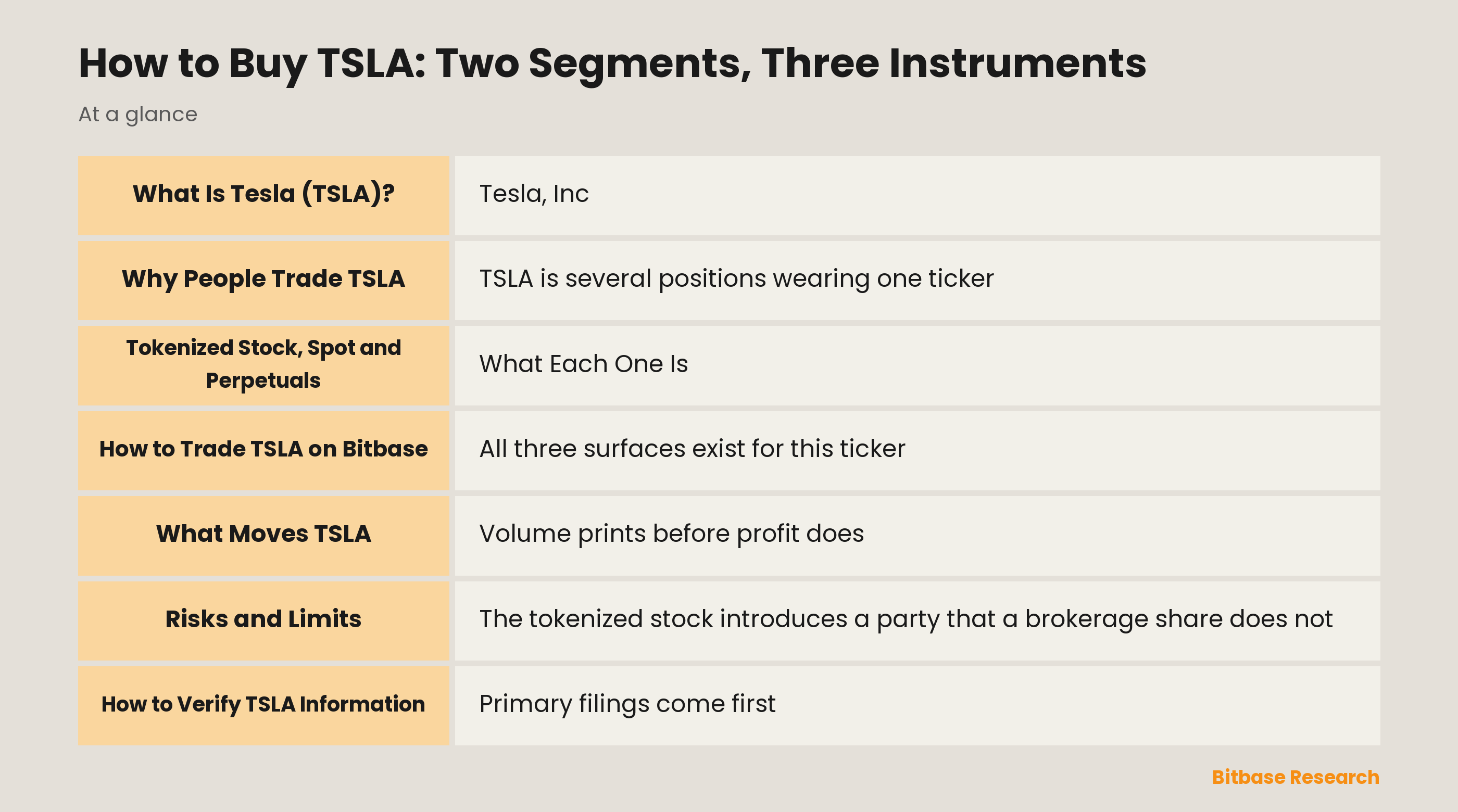
Tesla, Inc. is incorporated in Texas, and its common stock trades on the Nasdaq Global Select Market under TSLA. Its own annual report is blunt about the shape of the business: "We operate as two reportable segments: (i) automotive and (ii) energy generation and storage."
Those segments have less in common than the single ticker suggests. Automotive designs, builds, sells and leases electric vehicles and runs the service and charging network around them. Energy sells storage systems and solar products, largely to utilities and commercial projects rather than to drivers. Different customers, different sales cycles, one income statement.
One automotive revenue line has no equivalent at a conventional manufacturer. Tesla earns regulatory credits and, in the words of the filing, sells "these credits globally to other regulated entities who can use the credits to comply with emission standards and other regulatory requirements." That is revenue driven by what other companies are legally obliged to do, not by what Tesla sells to its own customers.
Why People Trade TSLA
TSLA is several positions wearing one ticker: a manufacturer with factories and a cost per vehicle, an energy storage business on a utility procurement cycle, and an option on autonomy software, which is not one of the two segments the company reports. Two people can hold this ticker for entirely different reasons and both be consistent about it.
The crypto connection here sits on the balance sheet rather than in the business model. Bitcoin first appeared in a Tesla annual report in the 10-K filed in February 2021, and the most recent annual report still discloses a bitcoin position. That link is real and it is also narrow: Tesla's revenue does not come from token prices, and holding TSLA is not a way to hold bitcoin.
Tokenized Stock, Spot and Perpetuals: What Each One Is
The Bitbase price page for this ticker lists Tesla xStock, trading under the symbol TSLAX. The issuer name matters, because the issuer writes the terms, and issuers do not write the same ones.
xStocks are issued by Backed Assets (JE) Limited, a Jersey private limited company. Backed's own site describes them as "tokenized representations of specific US equities and ETFs" and states that "each xStock is backed 1:1 by the underlying asset held in regulated custody." Redemption runs back to the issuer, on the issuer's terms.
Two details are worth reading slowly. The first is what the token is a claim on: Backed's material describes it as exposure to the value of the collateral rather than to the rights attached to it. The second is hours. The site says xStocks are "tradeable 24/7, across chains, by anyone in the world" — a property of the token on-chain, which is not a statement about the opening hours of any particular market that lists it. The site also states that xStocks are "not available in the United States or to U.S. persons."
"Tokenized stock" is a label rather than a standard. Issuers differ on backing, on hours and on who may hold the token, so the issuer's documentation is the thing to read, and what holds for one ticker's token does not carry over to another's.
A perpetual futures contract is a different instrument again, and the difference is not one of degree. It holds nothing: no share, no token, no claim on Tesla. It tracks a price, settles in stablecoin, pays or receives funding periodically, and has a liquidation price set by the margin posted against it. The cost of holding a perpetual accrues while the contract is open, which makes holding period part of the trade rather than a detail of it.
How to Trade TSLA on Bitbase
All three surfaces exist for this ticker, and they answer different questions.
The price page is the reference: quote, chart and market data for the tokenized stock. It is the only one of the three that requires no position.
The tokenized stock spot market is where the token is bought outright and held. There is no funding payment and no liquidation level; the position sits in the account until it is sold. This is the route for exposure without leverage, for someone comfortable holding an issuer's instrument rather than a registered share.
The perpetual futures market is where a leveraged directional position is opened. It carries funding, a maintenance margin requirement and a level at which the venue closes the position. It suits a trade with a thesis and a time limit better than an intention to own something.
Which tickers have which of these surfaces differs by name; the list of tokenized stocks is where to check.
The calendar sharpens the choice here. Delivery figures land within days of a quarter's close and the financial results arrive separately, so a position opened around one of those events has a known date attached to it, while a holding does not.
What Moves TSLA
Volume prints before profit does. Tesla files the quarter's production, deliveries and energy deployments as an 8-K within days of the quarter closing — the recent ones are dated the second of January, April, July and October — and the revenue and margin figures follow weeks afterwards. A strong delivery number alongside a disappointing margin is not a contradiction; they are different measurements arriving on different days.
Regulatory credits move on other companies' obligations. That line exists because other manufacturers have compliance requirements to meet, so it reprices when emissions rules change in either direction, without a single extra car being built or sold.
The energy segment runs on its own clock. Storage deployments appear in the same quarterly release as vehicle deliveries, but they are sold to different buyers on longer procurement cycles, and the two segments do not necessarily turn at the same point in a cycle.
Cost per vehicle decides whether volume becomes profit. Factory utilisation, product changeovers and input costs sit between the delivery number and the margin line, and a changeover between models can depress deliveries for reasons unrelated to demand.
Autonomy is priced before it is reported. A business line that is not a reported segment can still carry a large presence in the share price, which is why demonstrations, timelines and permits move the stock on days when nothing in the reported results has changed.
Risks and Limits
The tokenized stock introduces a party that a brokerage share does not: the issuer. Backing, eligibility and redemption terms live in the issuer's documentation rather than in the venue's listing, and the issuer can change them. Eligibility is the first gate rather than the last — xStocks are not available in the United States or to U.S. persons, which is a jurisdiction question to settle before any market question.
Hours create gap risk in both directions. A token trading outside the Nasdaq session can price news the primary market has not yet seen, and a position held across that boundary can move with no way to hedge it where the shares themselves trade. The dated releases make part of that risk scheduled rather than random.
The perpetual adds funding cost and forced closure. Funding is paid or received depending on which side is crowded, and it accumulates, so a directionally correct position held long enough can still lose money. Leverage shortens the distance to the liquidation level, and a dated release can move the reference price faster than a position can be adjusted.
The exposure is also concentrated in a way the segment list makes obvious. One ticker carries manufacturing execution, a utility-scale energy business, a revenue line that depends on regulation elsewhere, and a software thesis that neither reported segment names.
How to Verify TSLA Information
Primary filings come first. The annual report on Form 10-K carries the segment definitions, the risk factors and the digital asset disclosure, and it sits on the SEC's EDGAR database rather than in any summary of it. The quarterly production and delivery figures arrive there too, as 8-K exhibits filed within days of the quarter closing.
Tesla's investor relations pages carry the quarterly update and the webcast, where management commentary on margins, deployments and product timing appears in full rather than in quotation.
For the token, read the issuer. Backed's own site is the authority on what an xStock is, how it is backed, who may hold it and how redemption works. The venue that lists the token is not the source for those terms, and an explainer written about a different issuer's product is not the source either.
For the instruments, the price page carries the quote and the market pages carry the contract specifications, including margin and funding terms for the perpetual. Those specifications change, which is a reason to check them at the point of sizing.
Conclusion
Tesla is two reportable segments plus a thesis that neither of them names, on a calendar that separates volume from profit. On Bitbase the ticker reaches that company through three instruments that differ on what you hold, when it trades and what can close the position for you. The tokenized stock is an issuer's product, and its backing, eligibility and redemption terms come from the issuer's documentation. The perpetual holds nothing and can be closed out by the venue. Reading the delivery calendar and the issuer's terms first settles most of what the choice between them decides.
Related market pages
Bitbase pages for the tokenized stocks named in this article:
- TSLA: View price · Tokenized stock spot · Perpetual market
Related reading
Other Bitbase articles on this topic:
- How to Buy INTC: A Chip Designer That Owns Its Factories
- How to Trade IREN: From Bitcoin Mining to AI Data Centres
- How to Buy and Trade IWM, the Russell 2000 ETF
Disclaimer: This article is educational content from Bitbase Academy, provided for information only. It explains what a company or fund does and how the instruments referenced here differ from one another; it does not constitute investment, trading, tax, or financial advice, and it is neither a recommendation nor an endorsement of any security, token, or trading strategy. A tokenized stock is issued by a third party and is designed to give economic exposure to an underlying asset: it is not a share, it carries no shareholder rights, and it depends on the issuer's structure, eligibility rules, and redemption terms, which the issuer can change. Perpetual futures are leveraged derivatives that hold no underlying asset and can be liquidated, and trading hours, product availability, and eligibility differ by instrument and by jurisdiction and can change at any time. Written as of September 2026; verify everything yourself through company filings, the issuer's own documentation, and the product pages of the venue you trade on.
References
[1] xStocks official site: what an xStock is, 1:1 backing in regulated custody, issuer and eligibility xstocks.com
[2] Tesla annual report on Form 10-K: cover page listing, the two reportable segments, and the regulatory credit revenue line www.sec.gov
[3] SEC EDGAR: Tesla current reports on Form 8-K, where the quarterly production and delivery figures are filed days after each quarter closes www.sec.gov