The ticker TSM does not name a share. Behind it stands an American depositary share issued over ordinary shares listed in Taipei, and on Bitbase that line is wrapped again as an Ondo tokenized stock, with a spot market and a perpetual contract beside it. Every wrapper changes what you hold, when it prices and who writes the terms. This profile covers what TSMC manufactures, what moves the stock, and how the three routes differ.
What Is Taiwan Semiconductor Manufacturing (TSM)?
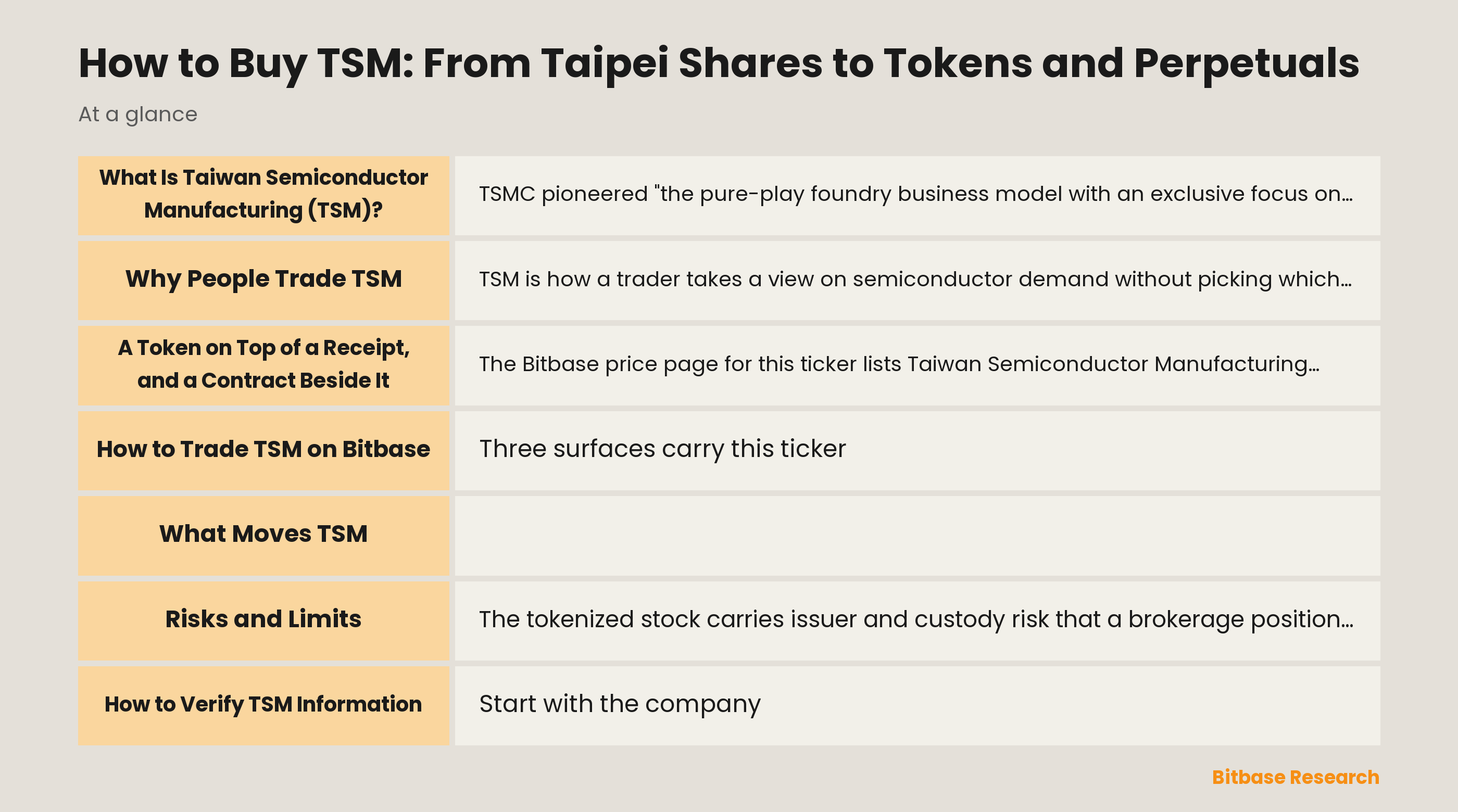
TSMC pioneered "the pure-play foundry business model with an exclusive focus on manufacturing its customers' products." It does not design chips of its own and does not sell them under its own brand. Customers bring the design; TSMC supplies the process technology, the fab capacity and the packaging that turn a design into working silicon.
That one sentence explains much of what follows. A foundry's revenue is the sum of everyone else's product cycles at once: phone processors, AI accelerators, automotive controllers, networking parts. Its customers compete with one another, so TSM is less a bet on a designer than on the category they all sell into.
The listing structure deserves the same care. TSMC's ordinary shares trade on the Taiwan Stock Exchange under code 2330. TSM is something else: an American depositary share listed on the New York Stock Exchange, where, in the company's own filing language, "each ADS represents ownership of five common shares on deposit with the custodian," with Citibank, N.A. as depositary. The New York line is a claim on shares held in Taipei, not the shares themselves, and that distinction shapes the rest of this page.
Manufacturing sits mainly in Taiwan, where the company runs its 12-inch GIGAFAB facilities, with further capacity in Arizona, Nanjing, Washington and Japan and a specialty fab under construction in Germany. What it costs to build outside Taiwan is a standing question on earnings calls.
Why People Trade TSM
TSM is how a trader takes a view on semiconductor demand without picking which designer wins. If the argument is that more advanced silicon will be needed, TSM expresses it no matter whose logo ends up on the package — a different exposure from a fabless designer, whose fortunes turn on its own roadmap.
It is also, unavoidably, a position on Taiwan. The manufacturing base and the supplier cluster around it sit on one island beside a contested strait, and that concentration is priced into the stock in a way it is not priced into a company whose fabs span three continents. Holding TSM means holding a geopolitical variable.
There is a currency layer as well. TSMC earns and reports in New Taiwan dollars while the depositary share is quoted in US dollars, so exchange-rate moves show up in the New York price with nothing changed at the company.
Its relationship with crypto is thin. TSMC's revenue does not depend on token prices. What the two share is sensitivity to the same liquidity conditions, which makes them look correlated at times without being connected.
A Token on Top of a Receipt, and a Contract Beside It
The Bitbase price page for this ticker lists Taiwan Semiconductor Manufacturing (Ondo Tokenized Stock), trading under the symbol TSMON. The issuer's name is the load-bearing part: the terms come from the issuer, not the venue.
Ondo's documentation is direct about what the token is. It is not one-for-one with a share: "One token does not necessarily represent the value of one share, and the price of one token will not always match the price of the underlying asset." The tokens are structured as total return trackers, built to reproduce the economic outcome of holding the share with dividends reinvested, net of withholding tax. Holders receive no shareholder rights — the documentation states that you "do not receive shareholder voting rights, statutory information rights or other shareholder rights." Minting and burning are described as instant and atomic, and the product is generally available to non-US investors, subject to jurisdictional restrictions.
The phrase "net of withholding tax" does more work here than it would for a domestic issuer. TSMC's own investor FAQ states that "dividends distributed to the holders of TSMC's ADSs are subject to R.O.C. withholding tax." That deduction happens at source, before anything reaches a holder of the receipt, let alone a token referencing it. What a tracker reinvests is what survives the step.
Trading hours are the next thing to get right. Ondo describes trading as generally running 24/5, with pauses possible around corporate actions and risk limits, and a limited set of tokens reachable in extra off-hours windows. Longer than an exchange session, but not the continuous schedule crypto traders expect.
A perpetual futures contract is a different instrument again. It holds no share, no receipt and no token, and never makes you a holder of anything TSMC issued. It tracks a price, settles in stablecoin, exchanges a periodic funding payment between longs and shorts, and can be closed by liquidation when margin runs short. The wider category of tokenized securities is covered separately; the point here is that one ticker gives three different answers about what you own.
How to Trade TSM on Bitbase
Three surfaces carry this ticker, and they answer different questions.
The price page is the reference: quote, chart and market data for the tokenized stock. It requires no position and is the sensible place to start.
The tokenized stock spot market is where the token is bought and held outright. There is no funding payment and no liquidation level; the position sits in the account until it is sold. This is the route for exposure without leverage, for someone content to hold an issuer-structured instrument.
The perpetual futures market is where leveraged directional positions are opened. It carries funding, a maintenance margin requirement and a liquidation level. It suits trades with a horizon and hedges with a purpose, not the wish to own a piece of TSMC.
Which tickers have which surfaces varies from name to name; the list of tokenized stocks and ETFs is where to check. The decision that matters is between the second and the third: a holding, or a position with a deadline attached.
What Moves TSM
Monthly revenue. TSMC publishes consolidated net revenue every month, not only every quarter. That puts twelve scheduled revenue prints a year on the calendar on top of the quarterly results, each able to move the price on the day it lands. Trading TSM without that schedule in view means trading around events you have not marked.
Capital expenditure and depreciation. A foundry commits capital years before it earns revenue from it, and the fabs built today become the depreciation line that sets gross margin tomorrow. Capex guidance is read twice at once: as a signal about demand and a warning about cost. A node ramp does the same, carrying start-up costs that compress margin before volume lifts it.
Capacity that is not wafers. Advanced packaging is a constraint separate from lithography, with its own build-out schedule. Wafer capacity and packaging capacity can be tight at different moments, and a quarter limited by one looks much like a quarter limited by the other while meaning something else.
Policy. Export controls set which processes may serve which customers and markets, and rules written in Washington, Taipei or Beijing can change the addressable market without demand changing. Add the conditions attached to fabs abroad, and part of the cost base is decided by governments.
The receipt itself. Taipei and New York sit on opposite sides of the clock, and the two sessions do not overlap. The ordinary shares set a price while New York is closed, and the depositary share then opens against whatever happened while it was shut. TSM's first print of the day reflects the Taipei session as much as any fresh opinion.
Risks and Limits
The tokenized stock carries issuer and custody risk that a brokerage position does not. Its value depends on the issuer's structure holding up, and no shareholder claim stands behind it. Redemption paths, eligibility and jurisdictional limits are set by the issuer, and the issuer can change them.
Gap risk compounds through the stack. Four clocks are involved: the Taipei session for the ordinary shares, the New York session for the receipt, the issuer's 24/5 schedule for the token, and a perpetual that never closes. News arriving inside any one window is priced by whichever venue is open, and a position carried across the boundaries can travel far with no way to hedge in the primary market.
The perpetual adds funding and liquidation. Funding accrues in whichever direction the crowd is leaning, so a directionally correct trade held long enough can still lose to it, and leverage shortens the distance to a liquidation level. The cost of holding a perpetual is worth working out before the position is opened.
The concentration is unusual too. A TSM position is one company, one dominant manufacturing base and one strait, stacking sector and geographic concentration into a single line. That is not a reason to avoid the name; it is a reason to size it as what it is.
How to Verify TSM Information
Start with the company. TSMC's investor relations site carries the monthly revenue releases, the quarterly results and the annual report — the primary source for the segment and technology breakdowns.
For filings, TSMC is a foreign private issuer, so its annual report to the SEC is a Form 20-F rather than a 10-K, filed on EDGAR alongside its 6-K submissions. The investor FAQ carries the listing mechanics: TWSE code, NYSE ticker and depositary bank.
For the token, the issuer's documentation is the authority on backing, rights, hours and eligibility, and nothing on a listing page overrides it. For the instruments, the Bitbase price page carries the quote and the market pages carry the contract specifications. Those change, so check them before sizing.
Conclusion
TSM is a position on semiconductor manufacturing reached through more layers than the ticker suggests: ordinary shares in Taipei, a depositary share in New York, and on Bitbase a tokenized stock with a spot market and a perpetual beside it. The token gives economic exposure without shareholder rights; the perpetual gives leveraged price exposure without holding anything. Neither is a share, and the gap opens where the terms are written rather than where the price is quoted. Decide which layer you want before the order goes in.
Related market pages
Bitbase pages for the tokenized stocks named in this article:
- TSM: View price · Tokenized stock spot · Perpetual market
Related reading
Other Bitbase articles on this topic:
- How to Buy and Trade IWM, the Russell 2000 ETF
- How to Trade JPM: Rates, Credit and a Tokenized Bank Stock
- How to Trade KO: Concentrate, Currency and the Dividend
Disclaimer: This article is educational content from Bitbase Academy, provided for information only. It explains what a company or fund does and how the instruments referenced here differ from one another; it does not constitute investment, trading, tax, or financial advice, and it is neither a recommendation nor an endorsement of any security, token, or trading strategy. A tokenized stock is issued by a third party and is designed to give economic exposure to an underlying asset: it is not a share, it carries no shareholder rights, and it depends on the issuer's structure, eligibility rules, and redemption terms, which the issuer can change. Perpetual futures are leveraged derivatives that hold no underlying asset and can be liquidated, and trading hours, product availability, and eligibility differ by instrument and by jurisdiction and can change at any time. Written as of September 2026; verify everything yourself through company filings, the issuer's own documentation, and the product pages of the venue you trade on.
References
[1] Ondo Stocks overview: backing, holder rights and trading hours (Ondo official documentation) docs.ondo.finance
[2] TSMC company profile: the pure-play foundry model and the list of manufacturing sites www.tsmc.com
[3] TSMC investor FAQ: TWSE code, NYSE ticker, depositary bank and withholding tax on ADS dividends investor.tsmc.com
[4] TSMC Form 20-F, Exhibit 2(a)(1): each ADS represents five common shares on deposit with the custodian www.sec.gov
[5] TSMC monthly revenue releases: consolidated net revenue reported every month investor.tsmc.com