Uber's drivers provide their own vehicles and are treated in the company's own filings as independent contractors, which makes this a marketplace rather than a fleet. What Uber books as revenue is the slice it keeps out of the bookings crossing that marketplace, so trip growth and the share retained are two separate questions. On Bitbase the name appears as an Ondo tokenized stock on a price page and as a perpetual futures contract, and neither of those is a share.
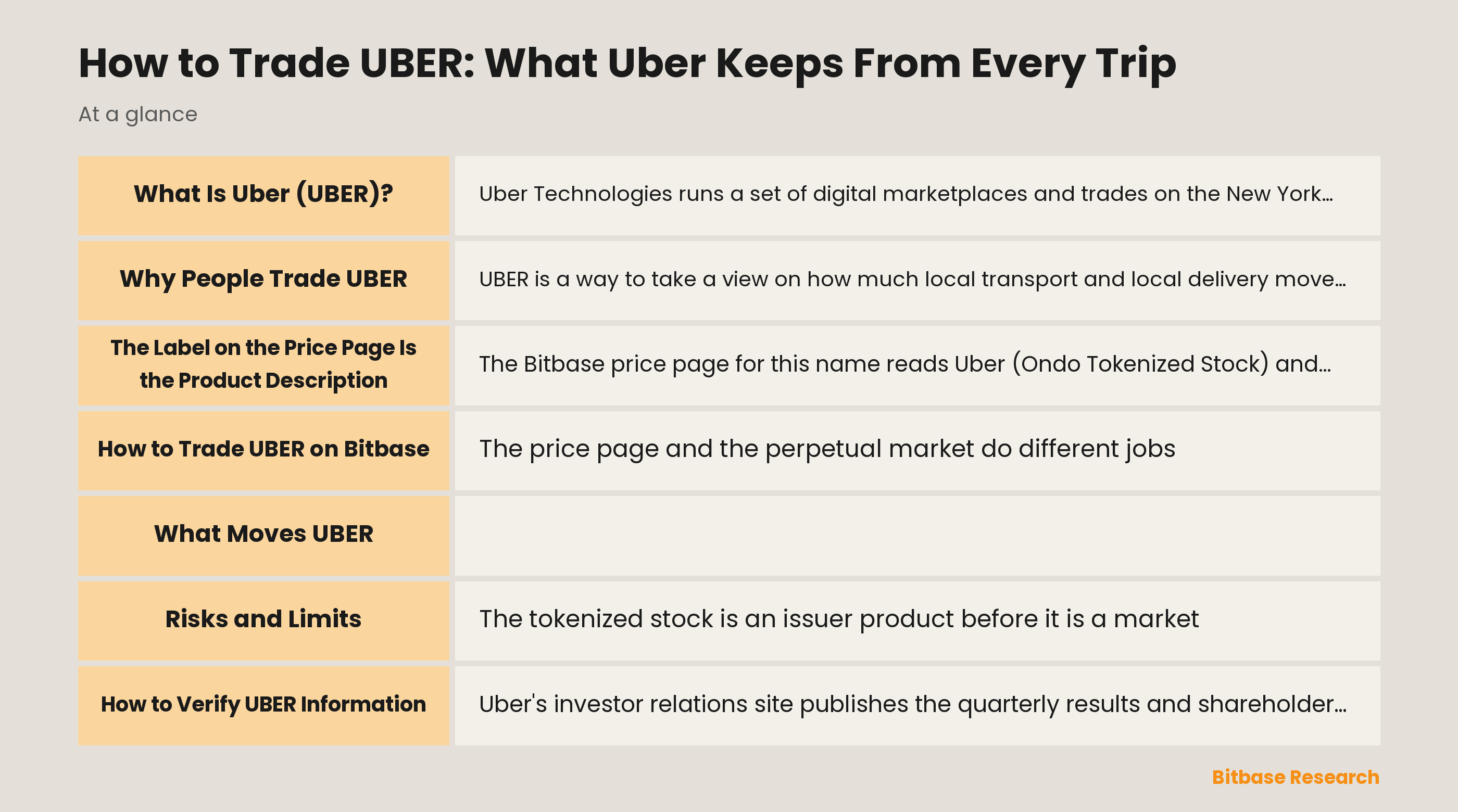
What Is Uber (UBER)?
Uber Technologies runs a set of digital marketplaces and trades on the New York Stock Exchange under UBER. It joined the S&P 500 in the index change that took effect before the open on December 18, 2023.
Its annual report divides the business into three reportable segments. Mobility connects consumers with transportation modalities including ridesharing, carsharing, micromobility, rentals, public transit and taxis. Delivery covers local commerce, from restaurants to grocery, alcohol, convenience and other retailers. Freight connects shippers and carriers in a digital marketplace to move shipments.
What binds the three together is the shape of the economics rather than the customer. Uber matches two sides and keeps a portion of what changes hands: it reports the value flowing across the platform as Gross Bookings, and Revenue Margin as revenue expressed as a percentage of those bookings. Identical trip counts with a different percentage produce a different company.
Drivers are not employees in Uber's own account of the arrangement. The filings say they can choose whether, when and where to provide services, are free to provide services on competitors' platforms, and provide a vehicle. That last clause explains the balance sheet: the cars are not on it.
Why People Trade UBER
UBER is a way to take a view on how much local transport and local delivery move through an app instead of a phone call or a shopfront, and on how much of that flow one intermediary keeps.
Two arguments that rarely share a ticker sit inside it. One is expansion: Uber launched its advertising division in October 2022, and its filings describe Uber One as a single cross-platform membership program that brings together the best of Uber. Both lift the retained share without adding a trip. The other runs the opposite way and asks whether the marketplace is permitted to keep this shape at all, because the classification of drivers is contested in more than one country at a time.
Its link to crypto is close to absent. None of the three reported segments is a digital-asset business, so the tokenized version of this stock is about access and hours rather than about crypto exposure.
The Label on the Price Page Is the Product Description
The Bitbase price page for this name reads Uber (Ondo Tokenized Stock) and quotes under the symbol UBERON. The words inside the brackets are the product description.
Ondo's documentation states that one token does not necessarily represent the value of one share, and that the price of one token will not always match the price of the underlying asset. The tokens are structured as total return trackers, so a dividend the underlying pays is reinvested net of withholding tax rather than reaching you as cash. Holders receive no shareholder voting rights, no statutory information rights and no other shareholder rights. Ondo describes minting and burning as instant, delivering tokens or stablecoins in a single atomic transaction; describes trading as generally running 24/5, with pauses possible around corporate actions and risk limits; and describes the product as generally available to non-US investors, subject to jurisdictional and other restrictions.
A perpetual futures contract is a different structure again, and it holds nothing at all: no share, no token, no claim on Uber Technologies. It tracks a price, settles in stablecoin, exchanges a periodic funding rate between longs and shorts, and can be liquidated.
So four letters point at an operating company, at a tracker token issued by a third party, and at a derivative that owns neither.
How to Trade UBER on Bitbase
The price page and the perpetual market do different jobs, and only one of them takes an order.
The price page carries the quote, the chart and the market data for the Ondo tokenized stock. Watching it costs nothing, and it is the reference the other decision gets measured against.
The perpetual futures market is where a leveraged directional position is opened. Funding is paid or received periodically depending on which side of the book is crowded, and a maintenance margin requirement and a liquidation price apply from the moment the position exists. That suits a view with a deadline attached, and suits poorly the sentence "I would like to own some Uber for a few years."
The list of tokenized stocks and perpetuals is where the current set of names and markets is published.
What Moves UBER
The gap between bookings and revenue. Uber publishes the value crossing the marketplace and the percentage it retains, and the second reprices faster than the first. Advertising and membership lift the retained share without adding a single trip; discounting to hold a city pushes it down while trips still grow. A period can look strong on volume and weak on economics.
Courtrooms and legislatures, not only earnings dates. Uber's own risk disclosure states that the classification of Drivers is currently being challenged in courts, by legislators and by government agencies in the United States and abroad. A ruling of that kind does not adjust a forecast; it changes what the cost base is. The filings cite a September 2021 ruling by a Netherlands court that Mobility drivers are employees within the meaning of the taxi collective bargaining agreement.
Autonomous vehicles, which cut both ways on one headline. Uber lists among its risks that it may fail to offer autonomous vehicle technologies on its platform at competitive scale, fail to offer them before its competitors, or find that they do not perform as expected. It is also a distribution channel for them: in September 2024 Uber and Waymo announced that autonomous ride-hailing would arrive in Austin and Atlanta from early 2025, on top of the trips Waymo had already run in Phoenix. So evidence that robotaxis work argues both that the driver cost inside every trip can be engineered away and that Uber can be routed around. This name moves on announcements made by companies it does not own.
Three cycles that refuse to line up. Mobility answers to travel, commuting and airport traffic. Delivery answers to what households spend on convenience. Freight answers to the trucking market and its own capacity cycle.
Risks and Limits
The tokenized stock is an issuer product before it is a market. Its structure, its eligibility rules and its redemption terms are set by Ondo and can be changed by Ondo, and the token's price is not promised to match the share.
The perpetual carries the risks that belong to leveraged derivatives. Funding turns against a crowded side, leverage compounds a mistake as efficiently as it compounds a view, and a maintenance margin breach closes the position at a price nobody chose.
Trading hours do not align. The New York Stock Exchange runs a session; the perpetual runs continuously; Ondo describes its own trading as generally 24/5, with pauses around corporate actions and risk limits. Whatever happens while one venue is shut gets priced by whichever venue is open, and the reopening arrives as a gap rather than as a move.
How to Verify UBER Information
Uber's investor relations site publishes the quarterly results and shareholder letters, with the definitions of the metrics used here. SEC EDGAR holds the annual report on Form 10-K, where the segment descriptions, the risk factors and the driver classification language quoted above sit in context. Ondo's own documentation is where to check what the token is and is not. And the Bitbase price page shows the label the token quotes under, which is the fastest way to confirm you are looking at the instrument you think you are.
Conclusion
Uber is a marketplace that keeps a percentage. Two questions follow: how large that percentage can get, and whether the marketplace is allowed to keep its present shape. Neither route on Bitbase makes you a shareholder: the price page tracks an Ondo token that is explicitly not a share, and the perpetual holds nothing whatsoever. Decide which question you want a position on before you pick the instrument, and if the answer is the perpetual, put the funding cost and the liquidation price into the plan on the first day.
Related market pages
Bitbase pages for the tokenized stocks named in this article:
- UBER: View price · Perpetual market
Related reading
Other Bitbase articles on this topic:
- How to Buy and Trade IWM, the Russell 2000 ETF
- How to Trade JPM: Rates, Credit and a Tokenized Bank Stock
- How to Trade KO: Concentrate, Currency and the Dividend
Disclaimer: This article is educational content from Bitbase Academy, provided for information only. It explains what a company or fund does and how the instruments referenced here differ from one another; it does not constitute investment, trading, tax, or financial advice, and it is neither a recommendation nor an endorsement of any security, token, or trading strategy. A tokenized stock is issued by a third party and is designed to give economic exposure to an underlying asset: it is not a share, it carries no shareholder rights, and it depends on the issuer's structure, eligibility rules, and redemption terms, which the issuer can change. Perpetual futures are leveraged derivatives that hold no underlying asset and can be liquidated, and trading hours, product availability, and eligibility differ by instrument and by jurisdiction and can change at any time. Written as of September 2026; verify everything yourself through company filings, the issuer's own documentation, and the product pages of the venue you trade on.
References
[1] Ondo Stocks overview: backing, rights and trading hours (Ondo official documentation) docs.ondo.finance
[2] Uber Investor Relations: quarterly results, shareholder letters and metric definitions investor.uber.com
[3] SEC EDGAR: Uber annual filings, including the segment descriptions and the driver classification risk factor www.sec.gov