Paying its own customers is a reported line in Visa's accounts, and it is subtracted before the net revenue figure anyone quotes: incentives to financial institution clients, sellers and other business partners for growing volume across the network. Visa also sets a default interchange rate that it does not collect, because that fee is generally paid by acquirers to issuers. On Bitbase the ticker appears on a price page carrying a Robinhood Token label and in a perpetual futures market, and Robinhood defines what sits behind that label as a derivative contract between you and Robinhood.
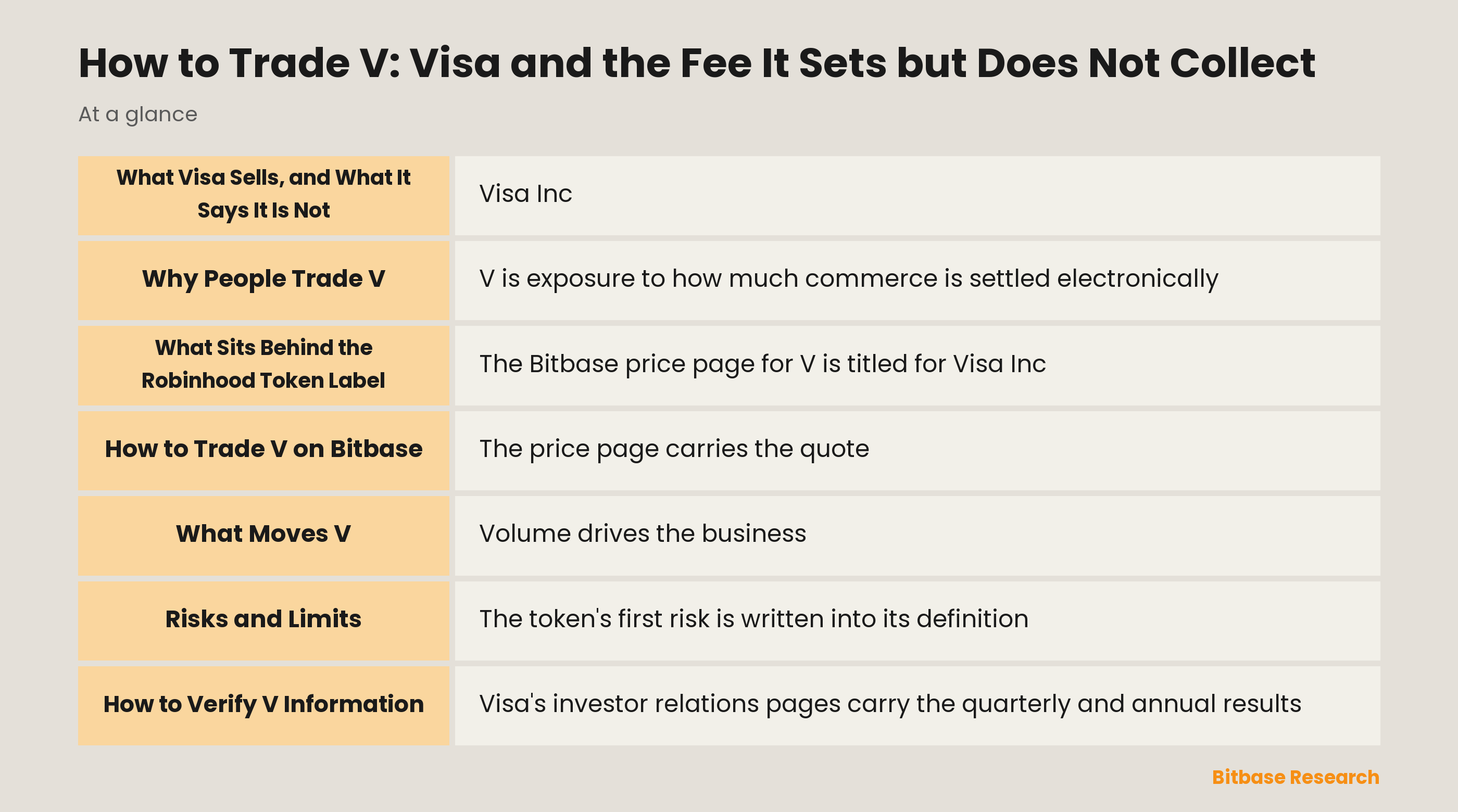
What Visa Sells, and What It Says It Is Not
Visa Inc. registers its Class A common stock on the New York Stock Exchange under the symbol V, and the annual filing draws the boundary around what that share is a claim on in one sentence: Visa is not a financial institution, it does not issue cards, extend credit or set rates and fees for account holders of Visa products, and it neither earns revenue from nor bears credit risk with respect to any of those activities.
What it does run is the switch. Visa describes providing transaction processing services, primarily authorization, clearing and settlement, among consumers, issuing and acquiring financial institutions and sellers, in a structure it calls the four-party model. VisaNet is its name for that plumbing: a proprietary advanced transaction processing network offering a single connection point for money movement across more than 200 countries and territories.
Four named revenue lines sit on top of it: service revenues, earned in support of client usage of Visa's payment services; data processing revenues, for authorization, clearing and settlement; international transaction revenues, for cross-border transaction processing and currency conversion; and other revenues, covering advisory services and licence fees on the Visa brand.
Then comes the line that surprises people opening the income statement for the first time. Client incentives are paid to financial institution clients, sellers and other business partners to grow payments volume and increase acceptance, and Visa classifies them as reductions to net revenue rather than as a cost below it; upfront and fixed payments are capitalised when made and amortised over the contractual term. The revenue figure in a headline is already net of what the company paid to win the traffic behind it. Beside the card business sits Visa Direct, which Visa describes as a money movement platform that began with cards, letting users receive money to their bank accounts via their debit cards as an endpoint.
Why People Trade V
V is exposure to how much commerce is settled electronically, and specifically not to a loan book. Because the company neither earns from nor bears credit risk on account holders, a borrower who stops paying is the issuing bank's problem, and the consumer cycle reaches this ticker through spending rather than through defaults. Those two do not turn on the same date.
The cross-border line makes it more than a domestic-spending proxy, tying part of the company to travel, to goods bought across a border, and to how much currencies move against each other.
For a crypto audience the question underneath the ticker is a routing question: how much value keeps moving over card rails, and how much moves over rails that reach a bank account with no card in the middle.
What Sits Behind the Robinhood Token Label
The Bitbase price page for V is titled for Visa Inc. and carries a Robinhood Token label, and the issuer named there decides what the instrument actually is.
Robinhood describes its Classic Stock Tokens as derivative contracts between you and Robinhood, priced at the prices of the underlying securities without granting rights to them. The underlying assets, it says, are owned by Robinhood and held with a US-licensed institution, and the tokens grant no rights to the underlying shares or ETPs. Where the underlying pays a dividend, Robinhood says it passes a corresponding amount to eligible holders in cash. The trading week is defined rather than continuous, running from Monday 2 AM CET/CEST to Saturday 2 AM CET/CEST. The issuer is Robinhood Europe, UAB, authorised and regulated by the Bank of Lithuania as a financial brokerage firm, a crypto-asset service provider and a payment institution, and the product is offered to eligible investors in the European Union.
Keep that separate from the category it gets filed under: backing, rights, calendars and eligibility are each set by the issuer, so the name on the label comes before any generalisation about tokenized stocks as a group.
A perpetual futures contract is a third structure again, and the simplest to state, because it holds nothing: no share, no token, no claim on Visa. It references a price, settles in stablecoin, exchanges a periodic funding rate between longs and shorts, and closes when the margin behind it runs out.
How to Trade V on Bitbase
The price page carries the quote, the chart and the market data for the token, and it is the surface that requires no position at all.
The perpetual futures market is where a leveraged directional position is opened. Funding is exchanged periodically depending on which side is crowded, a maintenance margin requirement applies, and a liquidation price moves as the position and the collateral move. That suits a view with a deadline on it, and suits badly the plan of holding a payments network for years.
Which markets exist differs from one name to the next; the tokenized stock and perpetual listings are where to check what a given ticker carries.
What Moves V
Volume drives the business, but the reported line lags it. Visa states that current quarter service revenues are primarily assessed using a calculation of pricing applied to the prior quarter's payments volume, so a shock to spending lands in a print one quarter after the spending itself. Mapping a consumer data release straight onto the next earnings date gets the calendar wrong by a quarter.
Cross-border activity moves a line of its own. Travel seasons, currency swings and the share of commerce that crosses a border all feed the revenues earned for cross-border processing and currency conversion, and none of them has to move with domestic card spending.
Incentive contracts can move reported revenue with no change in traffic at all. Because incentives reduce net revenue and are amortised over the contractual term, a renewal cycle with large issuers reshapes the reported top line on the terms of a contract rather than on the number of transactions.
Interchange is the political variable. Visa establishes default interchange reimbursement fees, which apply absent other established settlement terms, and states that those fees are generally paid by acquirers to issuers. The company does not keep them, and that is why a cap still matters to it: the fee is what an issuer earns from carrying a card, so changing it changes what an issuer will accept to carry.
Money moving outside a purchase is the slow one. Visa Direct is the company's own answer to value that has to reach a bank account rather than a till, and news about account-to-account schemes in a large market is news about which rail the volume rides.
Risks and Limits
The token's first risk is written into its definition: a derivative contract with Robinhood performs if Robinhood performs. No share of Visa belongs to you underneath it, and eligibility, availability and terms are set by the issuer, who can change them.
The defined trading week creates a gap. The primary listing trades in an exchange session while the token keeps its own week, so news arriving while that market is shut prices into the token first, and a position held across the boundary cannot be hedged where the share trades.
The perpetual adds costs that do not depend on being right: funding accrues at intervals whether or not the price goes anywhere, and leverage shortens the distance to a liquidation that a correct view can still reach before it pays. Against that sits a company risk that is slow and legal. Interchange regulation, the litigation that follows it, and long-term incentive contracts are standing conditions here rather than events on a calendar, which is a poor match for an instrument charged in funding intervals.
How to Verify V Information
Visa's investor relations pages carry the quarterly and annual results; the SEC's EDGAR database carries the filings themselves, where Item 1 sets out what the company says it is not, the four-party model and the revenue lines, and the accounting policies note explains how client incentives reduce net revenue.
For the token, Robinhood's European product pages define what a Classic Stock Token is, who owns the underlying, how dividends are handled and when it trades. The venue names the instrument; the issuer defines it.
For the instruments on Bitbase, the price page carries the current quote and market data, and the futures market page carries the contract specification, including funding intervals and margin requirements. Those terms change, and reading them belongs before the first order.
Conclusion
Visa switches other people's money, lends none of its own, pays its customers to route volume through it, and sets a fee it does not collect. On Bitbase that exposure arrives in two forms, and neither of them is a share: a token that Robinhood defines as a contract with itself, and a perpetual that holds nothing and charges funding for as long as it stays open. Choosing between them is a question about how long the position is meant to live, and about how much issuer structure or margin you are willing to carry on top of the company.
Related market pages
Bitbase pages for the tokenized stocks named in this article:
- V: View price · Perpetual market
Related reading
Other Bitbase articles on this topic:
- How to Buy and Trade IWM, the Russell 2000 ETF
- How to Trade JPM: Rates, Credit and a Tokenized Bank Stock
- How to Trade KO: Concentrate, Currency and the Dividend
Disclaimer: This article is educational content from Bitbase Academy, provided for information only. It explains what a company or fund does and how the instruments referenced here differ from one another; it does not constitute investment, trading, tax, or financial advice, and it is neither a recommendation nor an endorsement of any security, token, or trading strategy. A tokenized stock is issued by a third party and is designed to give economic exposure to an underlying asset: it is not a share, it carries no shareholder rights, and it depends on the issuer's structure, eligibility rules, and redemption terms, which the issuer can change. Perpetual futures are leveraged derivatives that hold no underlying asset and can be liquidated, and trading hours, product availability, and eligibility differ by instrument and by jurisdiction and can change at any time. Written as of September 2026; verify everything yourself through company filings, the issuer's own documentation, and the product pages of the venue you trade on.
References
[1] Visa Investor Relations: quarterly and annual results, and the operational metrics behind payments volume investor.visa.com
[2] SEC EDGAR: Visa annual filings, with Item 1 on the four-party model and the note explaining client incentives www.sec.gov
[3] Robinhood Europe: what Classic Stock Tokens are, who owns the underlying, dividends and trading hours robinhood.com