You cannot buy the VIX. The index is a calculation run on S&P 500 option prices, not a portfolio anyone can hold, so every instrument offering volatility exposure is offering something else: a dated futures contract, a fund holding those contracts, or a derivative on one of them. What follows is the measurement, the instruments built on it, and the part that catches people out — a rising index and a losing position are not a contradiction.
What the VIX Index Actually Measures
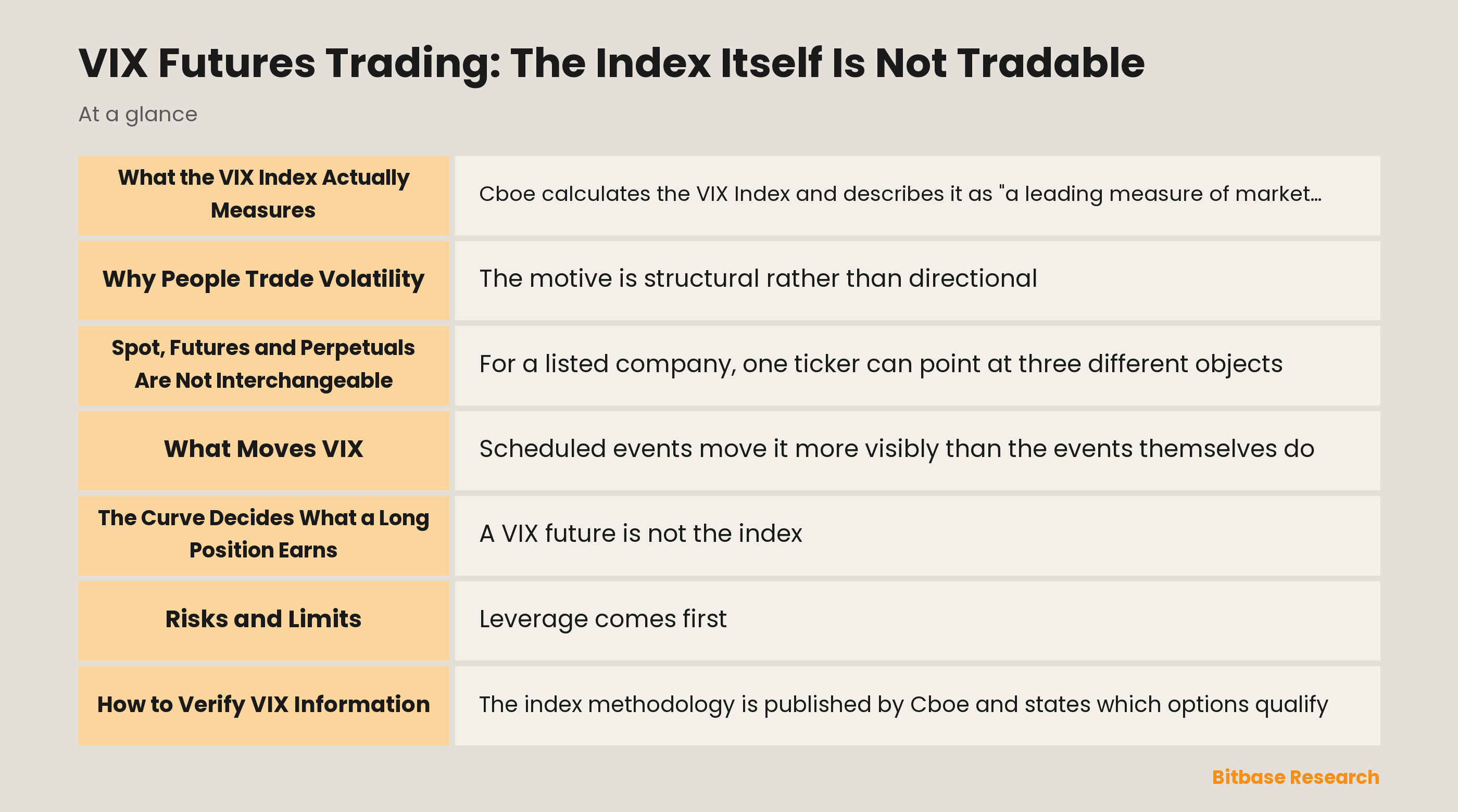
Cboe calculates the VIX Index and describes it as "a leading measure of market expectations of near-term volatility conveyed by S&P 500 Index (SPX) option prices". Two phrases do all the work there: *expectations*, and *option prices*.
Expectations means the reading is forward-looking. It does not summarise how far the market has already moved, but how much movement the options market is charging for over the coming thirty days, restated as an annualised figure. A calm week can end with a higher reading than a violent one if something the options market is wary of sits just ahead.
Option prices means the input is a set of quotes, not a set of holdings: the value comes from a strip of SPX puts and calls across strikes, and changing those quotes changes the index. The S&P 500 is also a number, but one you can approximate by buying the shares behind it. Nothing you can buy has the VIX as its value.
Why People Trade Volatility
The motive is structural rather than directional. The VIX and the index it derives from tend to move in opposite directions, because the demand that lifts option premiums is demand for protection, and protection is bought when equities fall. An instrument that gains as the VIX rises gains at the moment other holdings are losing, which makes volatility exposure a hedging tool before it is a speculative one.
A quieter second use: the level is read as a gauge of how much uncertainty is priced across risk assets, which is why traders in other markets watch it without holding it. Digital-asset markets have built the same construction, and crypto volatility indexes are assembled from options on crypto as the VIX is from options on stocks.
Spot, Futures and Perpetuals Are Not Interchangeable
For a listed company, one ticker can point at three different objects. A share is registered equity in a business. A tokenized stock is a token issued by a third party to give economic exposure to that share: it is not a share, it carries no shareholder rights, and what it is worth to you depends on the issuer's structure, eligibility rules and redemption terms, which the issuer can change. A perpetual futures contract holds nothing at all, tracking a price with leverage and charging funding rather than expiring.
The VIX has neither of the first two, and not by oversight: there is no share to tokenize, because behind the index there is no company, no fund and no issuer. A statistic cannot be placed in custody, so there is nothing for an issuer to hold. What exists is the dated futures contract. VIX futures are listed on the Cboe Futures Exchange and are cash-settled, the final settlement value being determined on the morning of the expiration date, usually a Wednesday, through a Special Opening Quotation of the index.
One warning belongs here. A short ticker on a crypto venue identifies a listing on that venue, not a benchmark: three-letter symbols collide, and a token can carry the same letters as a well-known index without any connection to it. Read the instrument name and the issuer, not the abbreviation. For the equity-linked instruments that do exist in tokenized form, the tokenized stock lineup is the list of what is actually there.
What Moves VIX
Scheduled events move it more visibly than the events themselves do. Options spanning a known release carry premium for it in advance, and once the release has happened that premium leaves the quotes whether the news was good or bad, so the index falls. Someone positioned long volatility into a scheduled event can be right about the event and still lose, because the price of uncertainty collapses the moment the uncertainty resolves.
Realised movement feeds back into it: when the market actually swings, option sellers raise their prices to cover the risk they are taking, and those higher quotes enter the calculation directly.
Supply matters as much as demand. Funds that write calls for income, and structured products that finance a payout by selling options, put continuous downward pressure on the premiums the index is computed from. A low reading can reflect heavy option supply rather than an absence of worry.
The shape of its moves is asymmetric: it climbs in bursts and drifts back down, reverting toward a range instead of trending, because it measures a rate of movement rather than a price. Concentration reaches it too — SPX options are written on a capitalisation-weighted index, so when a few very large companies dominate that weight, their own event dates price into a market-wide volatility measure.
The Curve Decides What a Long Position Earns
A VIX future is not the index, and the gap between them is not a tracking error to be waved away. Each contract prices one thing: the settlement value on its own expiration morning. A spike today moves the nearest contract by less than it moves the index, and a distant contract less again, because nobody expects the spike to still be there in several months.
The consequence lands on anyone holding exposure past an expiry. Staying long means closing the expiring contract and opening a later one at a different price. When the later contract is priced above the one being closed, the roll is a cost, it repeats every cycle, and it accrues whether or not the index moves. This is the same contango and backwardation relationship that shapes crypto futures curves: an upward-sloping curve charges the holder of a long position, an inverted one pays them.
So a fund built on VIX futures can fall over a period in which the index finished where it started. Nothing has malfunctioned; the fund held contracts, and the contracts were rolled. A perpetual solves the same problem differently: no expiry, no roll, a funding payment charged continuously instead.
Risks and Limits
Leverage comes first. Futures are traded on margin and marked to market daily, so an adverse move becomes a same-day cash requirement rather than an unrealised loss.
Roll cost is a risk in its own right. Long volatility against an upward-sloping curve carries a headwind, and time works against the position in a way it does not against a long equity holding. The short side inverts both: the roll works for the position while the tail works against it, and a strategy that collects steadily and loses in bursts has its outcome decided by the bursts.
Instrument confusion is a loss mechanism here, not a technicality — reading a quote for the index while trading a contract on it, or buying a product that holds a different part of the curve from the one being watched.
Trading hours and availability differ by product and by jurisdiction, and the options market feeding the calculation has closing hours of its own. News arriving while it is shut appears as a jump when it reopens.
How to Verify VIX Information
The index methodology is published by Cboe and states which options qualify, how they are weighted and how the value is derived. Any description of what the VIX means that contradicts it is wrong, and the document is public.
Contract specifications come separately from the Cboe Futures Exchange: multiplier, tick size, expiration calendar, settlement procedure and trading hours. The settlement procedure differs from an ordinary daily close and is worth reading before holding a contract into expiry.
For any exchange-traded product referencing volatility, the prospectus and fact sheet state which contracts it holds and how it rolls them; that document, not the product's name, tells you what you would be buying. For anything on a crypto venue, the instrument specification binds, and for a tokenized product the issuer's documentation is where the structure and the redemption terms are set out.
Conclusion
The VIX is a measurement, and everything tradable that carries its name is a contract written on it. Three things follow: the index can rise while a long position loses, the roll is a recurring cost rather than an occasional one, and buying volatility is less direct than the phrase suggests. Whether that exposure is worth holding is a separate question from what it is, and the second has to be settled first.
Related reading
Other Bitbase articles on this topic:
- How to Trade JPM: Rates, Credit and a Tokenized Bank Stock
- How to Trade KO: Concentrate, Currency and the Dividend
- How to Trade MA: Mastercard, the Network Behind the Card
Disclaimer: This article is educational content from Bitbase Academy, provided for information only. It explains what a company or fund does and how the instruments referenced here differ from one another; it does not constitute investment, trading, tax, or financial advice, and it is neither a recommendation nor an endorsement of any security, token, or trading strategy. A tokenized stock is issued by a third party and is designed to give economic exposure to an underlying asset: it is not a share, it carries no shareholder rights, and it depends on the issuer's structure, eligibility rules, and redemption terms, which the issuer can change. Perpetual futures are leveraged derivatives that hold no underlying asset and can be liquidated, and trading hours, product availability, and eligibility differ by instrument and by jurisdiction and can change at any time. Written as of September 2026; verify everything yourself through company filings, the issuer's own documentation, and the product pages of the venue you trade on.
References
[1] Cboe: the VIX Index and the products listed on it www.cboe.com
[2] Cboe: VIX futures, listing venue and final settlement by Special Opening Quotation www.cboe.com