
A pool advertises a rate, you deposit, and months later the rate you actually received is lower than the one you read. Nothing was withdrawn from you and no fee was charged. Two separate denominators grew underneath the number, and the position they were measuring did not stand still either.
What liquidity mining actually pays
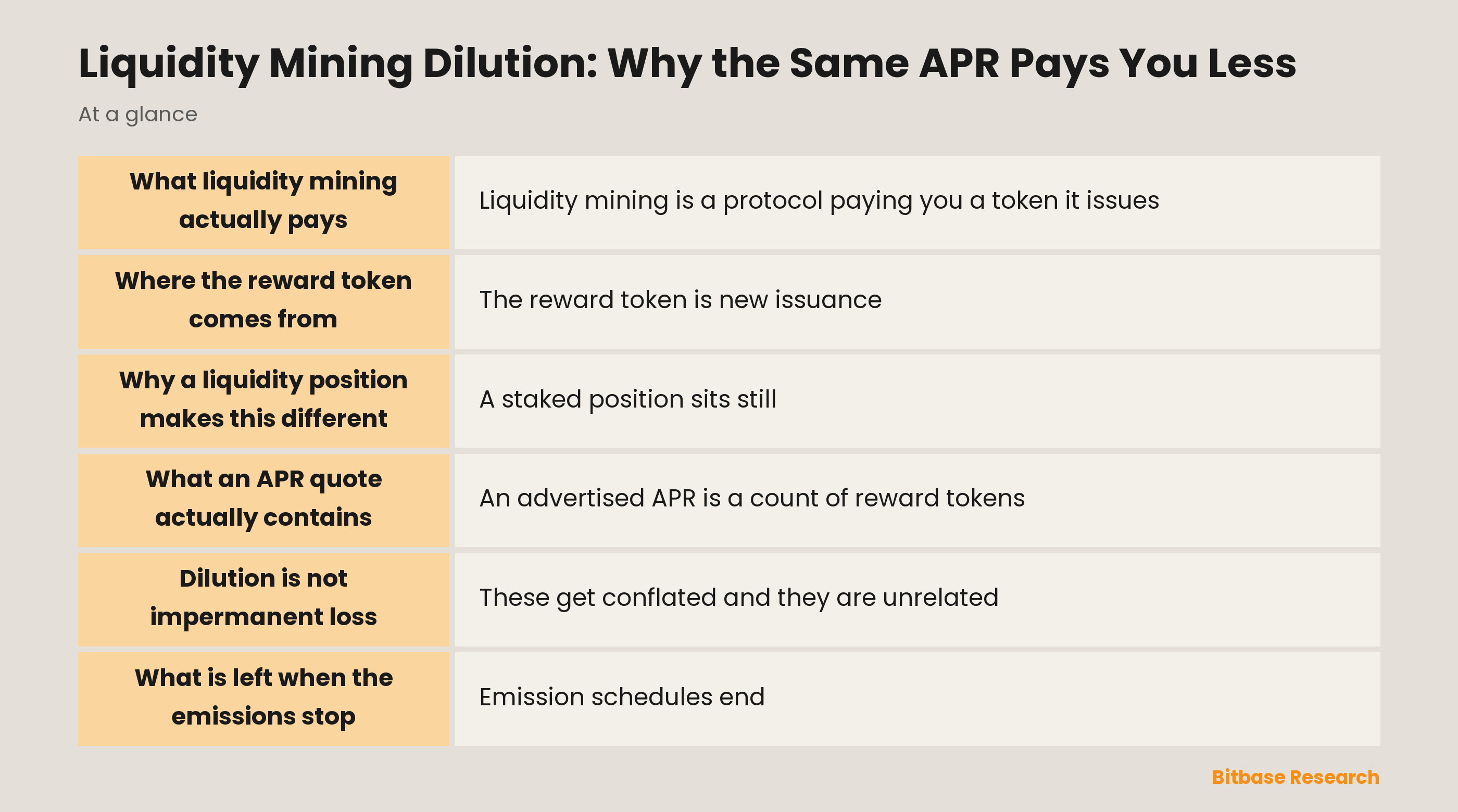
Liquidity mining is a protocol paying you a token it issues, in proportion to your share of a pool, on top of whatever trading fees that pool already generates. The fee income comes from activity inside the pool. The reward token does not; it is minted outside the pool and handed to depositors according to a schedule.
The word mining is doing no work here. In crypto it has been attached to block production, to storage proofs, and to several schemes for paying a community, and none of those is what happens in a liquidity pool. Nothing is being solved or secured. This article uses it only in the sense the term yield farming also covers: a reward token issued to people who supply liquidity.
Holding that separation clearly is what the rest of this depends on. Fees are internal to the pool and are shared out of money that changed hands. Rewards are external to it and are shared out of new supply.
Where the reward token comes from
The reward token is new issuance, released on a schedule that runs per block or per unit of time. That schedule is set by the protocol and it does not consult the pool. Whether ten people or ten thousand are depositing, the same quantity is released per block.
New issuance is exactly what emissions means, and it has the effect emissions always have: total supply of that token rises, so every existing holder owns a smaller fraction of it than before. That is the second denominator, and it operates whether or not you are in the pool.
Two denominators, not one
The first denominator is the pool itself. In the common design, your reward is the emission rate multiplied by your deposit and divided by the total deposited, and some protocols weight that share by other factors such as how long you have locked a governance token. Either way the rate is fixed, so the arrival of other depositors is enough, on its own, to cut what you receive. Deposit into a pool where you hold a tenth of the total and your share of each emission is 10%; if the pool doubles while your deposit stays where it is, your share is 5%, and the emission rate never moved.
The second denominator is the token's own supply, which the emissions are enlarging. Even a constant number of reward tokens per day is a shrinking claim on the network as the total grows.
| What it is | What makes it grow | Does it move the emission rate | |
|---|---|---|---|
| First denominator | Total deposits in the pool | Other people depositing | No |
| Second denominator | Total supply of the reward token | The emission schedule itself | No |
Neither denominator is peculiar to liquidity mining. A fixed-emission staking pool has both, which is why staking rewards fall as more of a supply gets staked, and why a nominal rate is worth less than it looks once the token's own inflation is subtracted. What follows is not a new mechanism; it is the same two denominators applied to a position that behaves differently.
Why a liquidity position makes this different
A staked position sits still. You stake a quantity of one token, and unless you add or remove, that quantity is what the denominators are dividing. The arithmetic is unpleasant but it is arithmetic on a fixed number.
A liquidity position does not sit still. It holds two assets, and it is continuously rebalanced by the trades passing through it, so the quantities you own drift as the price ratio moves. The denominators are therefore dividing a numerator that is itself changing for unrelated reasons. Your share of the pool can fall while the composition of your deposit is also shifting, and the reward token you are being paid in has its own price, which is a third moving part.
This is the part a staking comparison does not cover, and it is why a reward figure quoted for a liquidity position carries less information than the same figure quoted for a staked one.
What an APR quote actually contains
An advertised APR is a count of reward tokens, converted at the token's price at the moment of quoting. It is a projection built from present conditions, not a record of anything received.
Three things then move independently of each other and of the quote: how many reward tokens you actually accrue, what those tokens are worth when you sell them, and what your deposited position is worth when you withdraw it. A quote that was accurate the day you read it can be wrong on all three counts by the time you act on any of them, without anyone having misled you.
Compounding is also not automatic here. Where rewards accumulate as a claimable balance, they earn nothing until you claim them and put them back in. A rate that assumes compounding is describing something you have to go and do.
Dilution is not impermanent loss
These get conflated and they are unrelated. Impermanent loss is what a liquidity position gives up relative to simply holding the two assets, and it comes from the price ratio between them diverging. It is a comparison against a counterfactual.
Dilution involves no counterfactual and no price divergence. It is a denominator getting bigger. A pool whose two assets never move relative to each other has no impermanent loss at all and can still dilute you heavily, because other depositors arrived and the emission schedule kept running. The reverse holds too.
What is left when the emissions stop
Emission schedules end, or get cut by a vote. What remains at that point is the pool's share of trading fees, and nothing else.
That residue is worth examining before the schedule ends rather than after, because the two are connected: the size of the fee take depends on how much liquidity the pool holds, and part of that liquidity was attracted by the emissions that are about to stop. A yield paid out of fee revenue rests on activity that would exist anyway; a yield paid out of emissions rests on the schedule continuing.
Note that the phrase real yield is used in more than one sense across this subject, sometimes meaning the fee-funded portion and sometimes meaning a nominal rate with token inflation subtracted. They answer different questions, so it is worth checking which one a given figure means before comparing two of them.
The bottom line
One advertised number sits on top of two denominators that grow for different reasons, and a position whose composition is changing for a third reason. The emission rate can stay fixed the entire time and your return can still fall.
Before committing, ask three questions. Who else is arriving in this pool, since that alone dilutes you. What is the emission schedule doing to the reward token's supply, since that dilutes you again. And what would remain if the emissions stopped tomorrow, since that is the part of the yield that does not depend on a schedule. To keep learning the fundamentals, follow more from Bitbase Academy.
Related reading
Other Bitbase articles on this topic:
- CEX vs DEX: Centralized vs Decentralized Exchanges
- Institutional and Permissioned DeFi
- Realized PnL Report vs Transaction History: Which Record Your Taxes Need
- Bitcoin vs Ethereum: What's the Difference?
Disclaimer: This article is educational content from Bitbase Academy, provided for information only. It does not constitute investment, trading, tax, or financial advice. Crypto assets are volatile; assess your own risk. Written as of September 2026; refer to the latest official information.
References
[1] Synthetix, SIP-68: Staking Rewards contract sips.synthetix.io
[2] Uniswap, liquidity-staker StakingRewards.sol (commit 3edce550aeeb7b0c17a10701ff4484d6967e345f) github.com
[3] SushiSwap, MasterChef.sol (commit 271458b558afa6fdfd3e46b8eef5ee6618b60f9d) github.com
[4] Curve DAO contracts, liquidity gauge (commit dd5bdba7f8747ae9ec602787069c9389d08c1302) github.com
[5] Balancer, veBAL and gauges: APR calculation docs-v2.balancer.fi
[6] Uniswap Developer Documentation, fees developers.uniswap.org