The headline leverage on a contract is the number available at the smallest size. Open a large enough position and the maximum quietly drops, without any announcement and without the market having moved. The schedule that does this is published, and reading it is the difference between planning a large position and discovering its limits after the fact.
What a margin schedule is
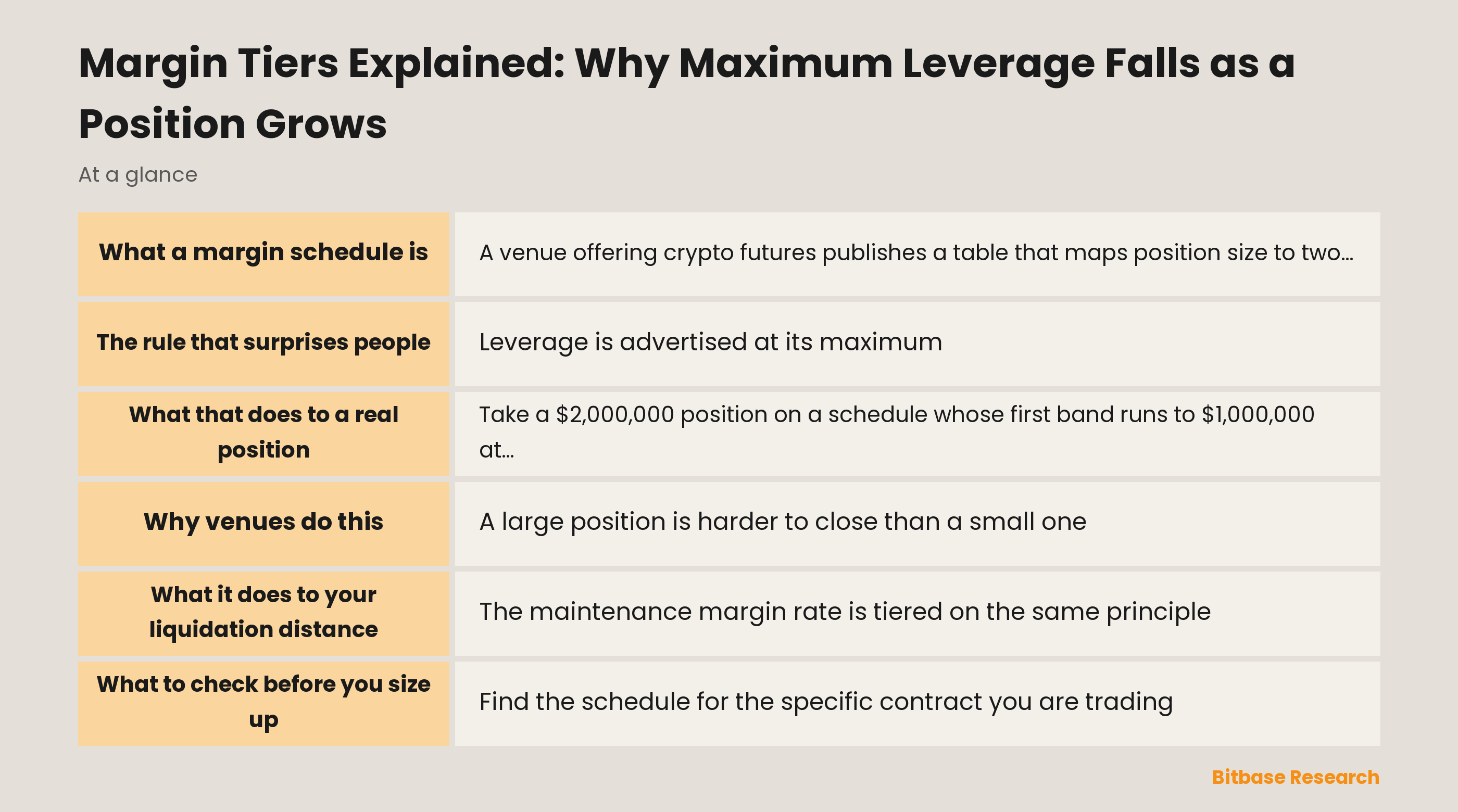
A venue offering crypto futures publishes a table that maps position size to two numbers: the initial margin rate, which is what you must post to open, and the maintenance margin rate, which is the level your equity must stay above. Maximum leverage is not an independent setting; it is the reciprocal of the initial margin rate. A 1% initial margin rate is 100x leverage, and a 2% rate is 50x, because that is the same statement written twice.
The table has rows for contracts and columns for size bands. Kraken, for example, publishes eight bands for its BTC perpetual, starting at 0 to $1,000,000 and stepping upward from there. The first band carries a 1% initial margin rate and the second carries 2%.
The rule that surprises people
Leverage is advertised at its maximum, and that maximum belongs to the first band only. Everything above it is smaller. This is not a penalty applied to particular accounts and it is not discretionary; the schedule is the same for everyone and it is published in advance.
The margin requirements for a given position therefore depend on the size of that position, not only on the contract and the leverage you selected. Two traders in the same contract at the same nominal leverage setting can face different effective requirements if their sizes fall in different bands.
How the bands actually apply
Here is the part that decides whether your arithmetic is right or wrong, and it is not obvious from the table alone.
When a position spans more than one band, the rate is applied to each portion separately rather than applying the top band's rate to the whole thing. Kraken's margin schedule page states this with a worked example: a position of 1,000,000 contracts is charged 2% on the first 500,000 and 4% on the second 500,000, which the page describes as an average initial margin of 3%.
That distinction is worth checking, because the alternative reading gives a different answer. Applying a single rate to the whole position would put all 1,000,000 contracts at 4%, and the page does not say that. The example exists precisely to rule that reading out.
| Size band | Maximum leverage | Initial margin rate |
|---|---|---|
| 0 to $1,000,000 | 100x | 1% |
| $1,000,000 to $3,000,000 | 50x | 2% |
| $3,000,000 to $5,000,000 | 25x | 4% |
| $5,000,000 to $10,000,000 | 20x | 5% |
What that does to a real position
Take a $2,000,000 position on a schedule whose first band runs to $1,000,000 at 100x and whose second band runs above it at 50x. The first million requires $10,000. The second million requires $20,000. The total is $30,000. Against $2,000,000 of notional that is an effective initial margin rate of 1.5%, which is neither the 1% the first band advertises nor the 2% the second band would imply if it applied to everything.
Read that carefully, because it is the point of the whole exercise. You did not select that rate anywhere. You may well have set the position to the maximum the interface offered. It fell out of the schedule, and it fell as the position grew.
Why venues do this
A large position is harder to close than a small one. Unwinding it moves the price against the person unwinding it, so the same percentage buffer covers less of the real risk at size. Raising the margin requirement as size grows is a way of making the buffer scale with the difficulty of exiting, rather than with the notional alone.
This is also why the schedule is per contract rather than global. A deep, liquid market can afford wider first bands than a thin one, and the published table reflects that judgement for each contract.
What it does to your liquidation distance
The maintenance margin rate is tiered on the same principle, and this is where it reaches you. Increasing a position can move it into a band with a higher maintenance rate, which brings the liquidation price closer without the market having moved at all. A liquidation level you calculated at one size is only valid at that size.
The practical consequence is that adding to a winning position is not the neutral act it appears to be. The addition can push the whole position into a band that recalculates the level protecting it.
What to check before you size up
Find the schedule for the specific contract you are trading, not a general leverage claim on a marketing page. Note where the band boundaries sit relative to the position you intend to open, and note whether your planned size straddles one.
Check whether the venue documents how it charges a position that spans bands, since the two readings give materially different requirements and not every venue states which it uses. Where a venue publishes a worked example, that example is more reliable than an inference from the table.
Then recompute your liquidation level at the size you actually intend to hold, rather than the size you started with.
The bottom line
Maximum leverage is a function of position size, and the headline figure belongs to the smallest band. Where a position spans several bands, at least one venue documents charging each portion at its own rate and reports the result as an average, so an effective rate sits between the bands rather than at the top one.
The number that matters is not the one on the contract page. It is the one your own size produces once the schedule is applied to it, and it is worth calculating before the position exists rather than after. To keep learning the fundamentals, follow more from Bitbase Academy.
Related reading
Other Bitbase articles on this topic:
- Automatic Margin Addition Explained: What It Does to Your Liquidation Price
- Coin-Margined vs USDT-Margined Futures: Which Contract to Trade
- How Funding Payments Affect Your Profit and Loss on a Perpetual
- RPC Rate Limit Exceeded and How to Stop Hitting It
- How Crypto Social Sentiment Analysis Works
Disclaimer: This article is educational content from Bitbase Academy, provided for information only. It does not constitute investment, trading, tax, or financial advice. Crypto assets are volatile; assess your own risk. Written as of September 2026; refer to the latest official information.
References
[1] Kraken Support, Derivatives Margin Schedule and Maximum Leverage support.kraken.com
[2] Kraken MTF Support, Margin Schedule (article 360005154753, Help Center API) support.mtf.kraken.com
[3] Kraken Blog, 100x leverage on BTC and ETH perps blog.kraken.com