A collection page shows one large number and calls it the floor. That number is the cheapest ask standing at this instant, which makes it a quote from one seller rather than a valuation of the collection. How few people it takes to move that quote is the whole subject.
What a floor price actually measures
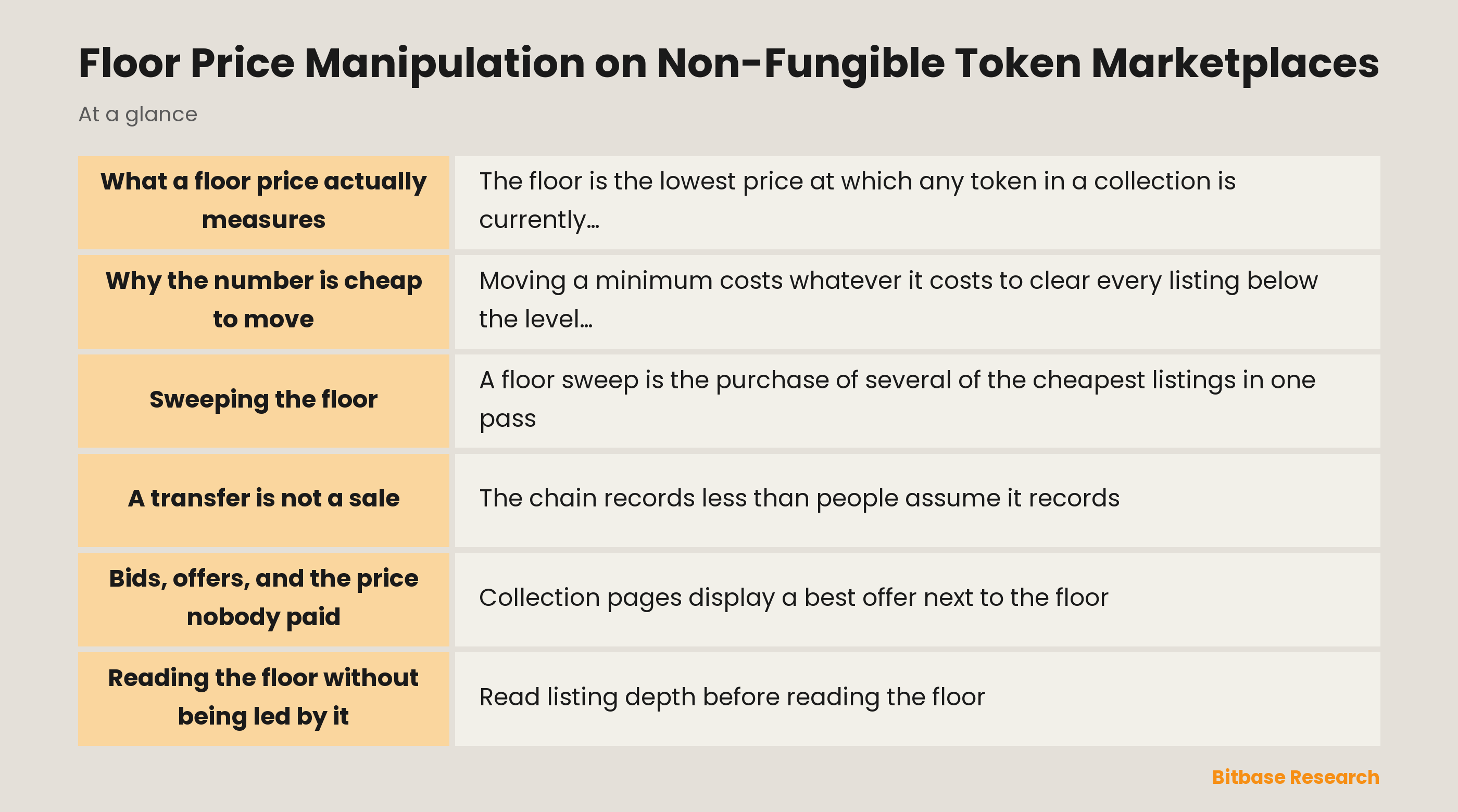
The floor is the lowest price at which any token in a collection is currently offered for sale. It is a minimum taken over the set of live listings, and that set is the part worth staring at. A token nobody has listed is not in it. A token whose owner listed it and then withdrew the listing is not in it either.
The denominator of a floor price is therefore the listed set, not the collection. Consider a collection of 10,000 NFTs in which 2% of the supply is listed. The floor is computed from that sliver, while the other 98% sit in wallets and contribute nothing to it.
That is a different denominator from the one rarity uses. A trait rarity share is computed over the whole collection precisely because the listed set keeps changing, while the floor is computed over the listed set precisely because it is a price someone could pay right now. Each is correct for its own question, and reading one as though it answered the other confuses a price with a property.
One more property follows from the word minimum. The floor moves when the single cheapest listing changes and at no other time. Ninety-nine listings can be repriced without touching it, and one listing can move it on its own.
Why the number is cheap to move
Moving a minimum costs whatever it costs to clear every listing below the level you want displayed. When the listed set is thin, that bill is small in absolute terms and it is spread across very few counterparties, which is a different situation from moving the price of an asset with a deep order book behind it.
Take that collection of 10,000 again. The cheapest ask sits at 3 ETH, a handful of asks form a short ladder just above it, and the next cluster of sellers begins at 4.5 ETH. Buy everything under that cluster and the page reports a floor of 4.5 ETH, a rise of 50%, without anyone holding the other 98% having made a single decision.
The purchase itself is real, and that is the constraint on the whole exercise. Whoever cleared the ladder now holds those tokens and paid fees to get them. A floor bought this way is backed by inventory the buyer has to do something with, which is why the useful question is never the purchase itself but what happens to the purchased tokens afterwards.
Sweeping the floor
A floor sweep is the purchase of several of the cheapest listings in one pass. The phrase describes an action rather than an intent. A collector who wants five pieces of a collection and does not mind which five will do exactly this, and so will someone whose only interest is the number on the page.
The order book world has an analogue in the liquidity sweep, where price is driven through a level to reach the orders resting at it. The version on a listings board is blunter: the cheapest listings are bought one after another, and there is no book to drive a price through.
What separates the two intents is the sequel. Tokens taken off the floor and held are inventory. Tokens taken off the floor and relisted above the new floor are supply pointed back at whoever the higher number attracted. The second pattern is legible after the fact and invisible while it is happening.
A transfer is not a sale
The chain records less than people assume it records. In ERC-721, the Transfer event emits when ownership of any NFT changes by any mechanism, and the same event covers creation and destruction. It reports that an owner changed. It does not report why, and it does not report that value moved in the other direction.
The royalty standard is explicit about that gap. ERC-2981 states that the royalty payment must be voluntary, as transfer mechanisms such as transferFrom() include NFT transfers between wallets, and executing them does not always imply a sale occurred. A standards document is saying in its own terms that a transfer between two wallets is not evidence of a trade.
The gap is what makes wash trading available here. One person controlling two wallets can sell a token to themselves at a price of their choosing, and the marketplace will record a sale at that price. Last sale, collection volume, and any chart built on either of them move. The floor need not move at all, because a sale at a chosen price says nothing about the cheapest ask still standing.
Bids, offers, and the price nobody paid
Collection pages display a best offer next to the floor. An offer is an option held by the bidder: it can be withdrawn, and until someone accepts it nothing has been paid. A high standing bid changes what a page displays without changing what anyone has spent.
Bidding on your own token closes that loop. The bid is accepted by a wallet the bidder also controls, the money returns to its source, and what remains is a public record of an acceptance at a price the bidder picked. The cost of the exercise is the marketplace fee plus whatever royalty the marketplace routes, since ERC-2981 asks that marketplaces supporting the standard should implement some method of transferring royalties to the royalty recipient rather than making the contract enforce it.
This is the collectibles version of a familiar shape. A pump and dump needs a story and a rising print. A collection needs a rising floor and a sale history that appears to support it. What differs is the cost of producing the print, which depends on how thin the listed set is.
Which number each tactic moves
Separating the displayed fields makes the tactics easier to tell apart, because each one touches a different field and leaves the others alone.
| Action | What it changes | What it leaves alone |
|---|---|---|
| Buying the cheapest listings | The displayed floor | Whether anyone lists lower tomorrow |
| Selling a token to a wallet you control | Last sale price and reported volume | The cheapest ask still standing |
| Placing a high offer you can withdraw | The best offer on the page | Every balance involved, until acceptance |
| Withdrawing your own cheap listing | The displayed floor | The supply, which can be relisted at any time |
Two of those rows involve no net spending. A standing offer can be withdrawn before anyone accepts it, and a listing can be withdrawn by its owner, so both the floor and the best offer can be walked upward by participants who never part with a token.
Reading the floor without being led by it
Read listing depth before reading the floor. The cheapest ask paired with the shape of the ladder above it carries more information than the cheapest ask alone: a floor with a dense ladder behind it and a floor with nothing behind it until a much higher price are two different markets displaying one number.
Read sale history for repetition rather than for verdicts. Recurring pairs of addresses, round trips that return a token to a previous owner, and prices that ratchet without ordinary variation are reasons to ask a further question. They are not findings on their own, because a public record shows transfers and prices while withholding account relationships and intent.
Read time as well. A floor established over weeks by unrelated sellers and a floor established in one afternoon are the same number with different evidence behind it, and the difference shows up only if you look at when the listings underneath it disappeared.
The bottom line
A floor price is the cheapest live ask, computed over the listed set rather than over the collection, and moved by whatever happens to a single listing. That is why it can be lifted by clearing a thin ladder, and why sale prices and reported volume can be produced by transfers that a standards document already declines to treat as sales.
The defence is not a better single number, because every displayed field has a cheap way to be moved. It is reading the fields together: the floor against listing depth, the sale history against the addresses involved, and both against the time they took to appear. To keep learning the fundamentals, follow more from Bitbase Academy.
Related reading
Other Bitbase articles on this topic:
- NFT Bid Scams and Fake Token Offers Explained
- Crypto Login Security: How to Protect Your Account
- Airdrop Scams and a Pre-Claim Safety Checklist
- How to Keep Your Cryptocurrency Safe
Disclaimer: This article is educational content from Bitbase Academy, provided for information only. It does not constitute investment, trading, tax, or financial advice. Crypto assets are volatile; assess your own risk. Written as of September 2026; refer to the latest official information.
References
[1] Ethereum Improvement Proposals, ERC-721: Non-Fungible Token Standard, Transfer event (Final) eips.ethereum.org
[2] Ethereum Improvement Proposals, ERC-2981: NFT Royalty Standard, sections Specification and Rationale (Final) eips.ethereum.org