One item too expensive to buy outright is locked into a contract, and 10,000 fungible shares are issued against it. Now you can hold a piece. What you hold is not a piece of the item, though. It is a claim on the contract that holds the item, and every risk particular to this arrangement follows from that one substitution.
Nothing about the token is divided
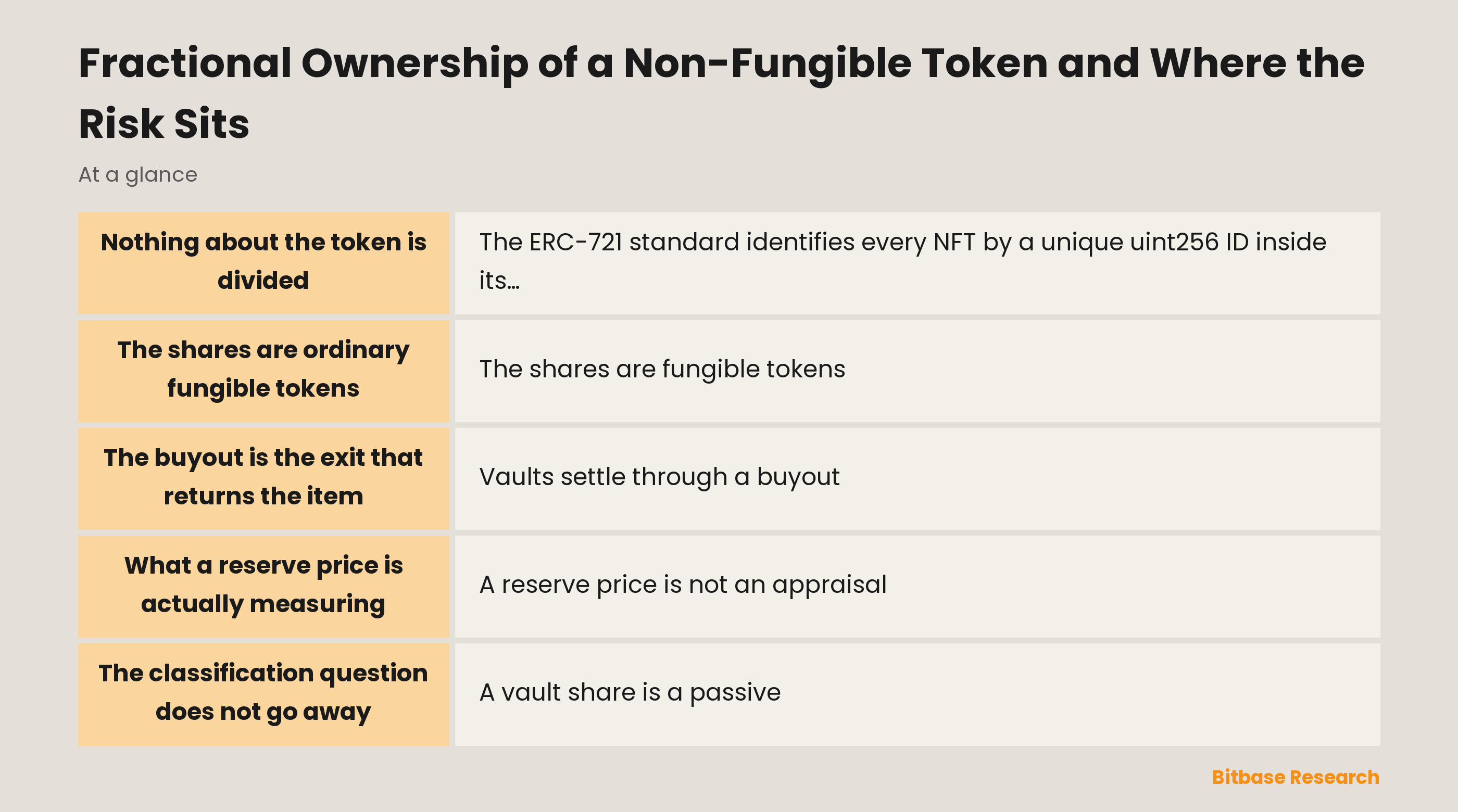
The ERC-721 standard identifies every NFT by a unique uint256 ID inside its contract, and that number, in the standard's own words, SHALL NOT change for the life of the contract [1]. The pair of contract address and token ID is the identifier. There is no function that halves it.
Fractionalization therefore works around the token rather than on it. The whole token is transferred into a second contract, the vault, and the vault issues fungible shares against what it now holds. The token sits in one address, intact, owned by the vault.
That substitution is the thing to keep in view. You went from holding an item to holding a claim against the address that holds the item. Everything below is a consequence of it.
The shares are ordinary fungible tokens
The shares are fungible tokens, and on Ethereum that role is filled by the ERC-20 token standard, which defines an API for transferring amounts and reading balances by address [2]. Fungible means interchangeable: one share is worth exactly what any other share is worth, and no share carries any trait of the underlying item.
That is what makes the position tradable, and it is also what removes the thing you may have wanted. Hold 500 of the 10,000 shares and you hold 5% of the vault, which entitles you to 5% of whatever the vault eventually distributes. It does not give you the token, any portion of the artwork, or any right to display it. Rights of that kind live in an agreement outside the contract, if such an agreement exists at all.
The share is also a second contract you did not audit. A holder of the whole item carries the risk of one contract. A share holder carries that risk plus the vault's, and the two fail independently.
Two markets, one item
A fractionalized item now has two prices, set by different people under different constraints.
| Item market | Share market | |
|---|---|---|
| What trades | one whole token | fungible vault shares |
| Smallest trade | the entire value at once | any fraction of the supply |
| Who can quote | a buyer for the whole item | anyone holding shares |
| What a price means | someone paid it for the item | someone paid it for a claim |
Multiply the share price by the supply and you get an implied value for the whole item. At $12 a share across 10,000 shares, that implied value is $120,000. Nothing obliges the item market to agree with it, because no bid for the item was involved in producing it.
The share market can also be thin, and thin markets are where implied values stop meaning much. Low liquidity means the last trade was small, the spread is wide, and your own exit moves the price against you. An implied valuation computed from a small trade describes what one buyer paid for a small claim, not what the item is worth.
The buyout is the exit that returns the item
Vaults settle through a buyout. A buyer deposits the reserve price, the vault releases the token to them, and every remaining share becomes a claim on the deposited amount instead of on the item.
Hold 5% of the supply when a buyout at $150,000 completes and your shares are redeemable for $7,500. That is the whole of your outcome. You did not pick the moment and you did not agree the price, because the reserve price decided both, and the reserve price is set by a vote among share holders rather than by you alone.
This is the structural difference from owning the item outright. An owner decides when to sell. A share holder holds an asset that can be bought out from under them at a number a majority wrote down earlier.
What a reserve price is actually measuring
A reserve price is not an appraisal. It is the figure a quorum of share holders was willing to commit to, and it is a statement about the future rather than a reading of the present. A reserve of $150,000 against an implied value of $120,000 is a 25% premium, and that premium is an opinion the vote happened to hold.
Both directions fail. Set the reserve too low and the item leaves for less than holders would have accepted. Set it too high and no buyout ever arrives, so the shares have no path back to the item and trade only against each other, at whatever the thin market says.
Pricing a one-of-a-kind item is hard for the ordinary reason: there is no second identical item to price it against. Measures such as trait rarity describe how unusual a token's features are within its own collection, which is an input to a price rather than a price.
Who can move the item while the vault holds it
The vault is a smart contract, and the token inside it is exactly as safe as that code and the permissions around it. Three questions are worth answering before buying a share: can any address withdraw the token without a buyout, can the vault's parameters be changed after issuance, and who holds the role that can do either.
Where reserve prices and vault settings are decided by a share-weighted vote, the arrangement inherits the concentration problem that any DAO has. Voting power tracks holdings, so a holder with enough of the supply can move the number that governs everyone else's exit, and buying more shares is the only way to raise your own weight against theirs.
| Risk | Where it comes from | What to check first |
|---|---|---|
| Vault contract | a second contract holds the token | withdrawal paths and upgrade permissions |
| Governance | reserve set by share-weighted vote | how concentrated the supply is |
| Forced exit | buyout can complete at any time | the current reserve price |
| Thin share market | few buyers for a niche claim | recent trade sizes and spread |
| Classification | share is a passive pooled stake | the rules where you are |
The classification question does not go away
A vault share is a passive, interchangeable stake in a pooled asset whose value depends on what other people do with that asset. That is a different shape from holding a collectible, and it is close to the shape that securities rules describe. Whether a given share counts as one is settled by the rules of your jurisdiction, not by the contract and not by the wording on the interface.
The practical form this takes is availability. A share that becomes restricted where you live is a share you cannot sell there, and a claim you cannot sell is worth what a buyout eventually pays rather than what the last trade implied. Check that question before you buy rather than at the moment you want out.
The bottom line
Fractional ownership never divides the token. It locks the token in a vault and sells fungible claims against the vault, so what you buy is exposure to an item plus a contract, a governance process, and a buyout rule you do not control.
Read the vault before the item. The reserve price is your exit price, the vote that sets it is the mechanism that can reprice your exit without you, and the share market is where you find out whether anyone else wants the claim you hold. To keep learning the fundamentals, follow more from Bitbase Academy.
Related reading
Other Bitbase articles on this topic:
- NFT Mint Succeeded but the NFT Is Not Showing in Your Wallet
- The NFT Reveal Process Explained: What Changes and When
- Optional NFT Royalties Explained
- Money Flow Index and the Chaikin Oscillator
Disclaimer: This article is educational content from Bitbase Academy, provided for information only. It does not constitute investment, trading, tax, or financial advice. Crypto assets are volatile; assess your own risk. Written as of September 2026; refer to the latest official information.
References
[1] Ethereum Improvement Proposals, ERC-721: Non-Fungible Token Standard (Final) eips.ethereum.org
[2] Ethereum Improvement Proposals, ERC-20: Token Standard (Final) eips.ethereum.org