Two rarity tools, one collection, two opposite answers about which token is rarer. Neither tool is broken. They are answering different questions, and the gap between those two questions is where the disagreement actually sits.
Where the trait table comes from
A generative collection gives every token one value in each of several trait categories: a background, a headwear slot, an eye style. Every rarity number you will ever see is computed from that table and from nothing else, so it is worth asking how firmly the table is pinned down.
Less firmly than it looks. The ERC-721 Metadata JSON Schema defines three fields, name and description and image, and a trait list is not one of them. ERC-1155 offers a properties object, described in the standard only as arbitrary properties whose values may be strings, numbers, object or arrays. Neither standard prescribes a category name, a value name, or how many slots a token carries.
The shape of the trait table is therefore settled outside the token standard, by whoever mints the collection and whoever reads it back. That is the first reason two rarity tools can disagree: they may not be counting the same slots.
Where the table lives matters as well. Writing a full trait table into contract storage costs gas fees at mint time, so a collection can instead publish the table as a document that the smart contract merely points at. That choice decides who is able to edit the table later, and an edited table means edited rarity.
Trait rarity: one slot at a time
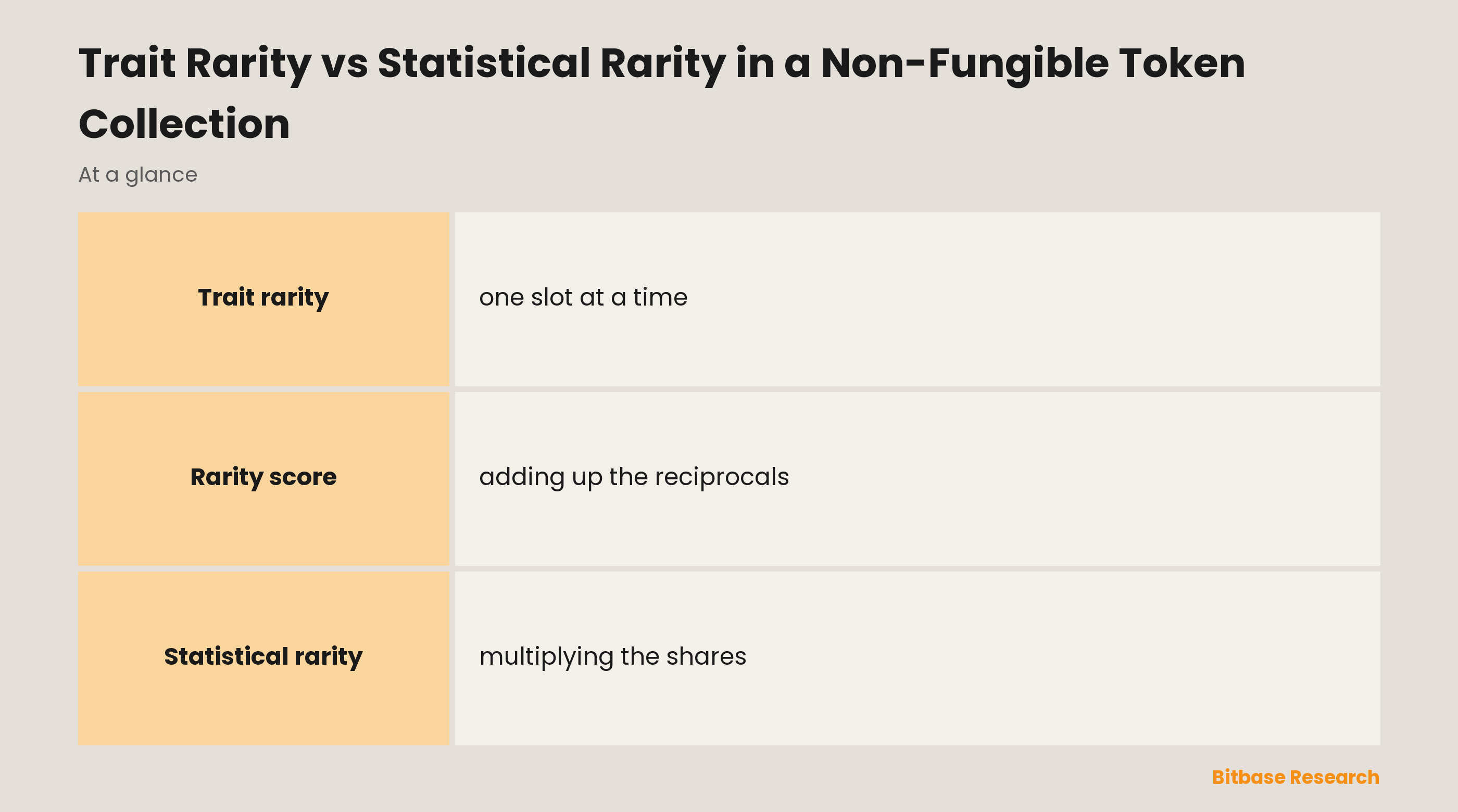
Trait rarity is the simple part. For a single value, it is the share of the collection that carries it. In a collection of 10,000 tokens where the Crown headwear sits on 1% of them, the trait rarity of Crown is 1%.
Two details decide whether that share is worth anything. The denominator has to be the whole collection rather than the tokens currently listed for sale, because that set changes as people list and delist. And an empty slot is itself a value: a token wearing no headwear has a headwear value of None, and if you drop those tokens from the count, the shares inside that category no longer cover the whole collection and every percentage in it is quietly wrong.
Trait rarity answers one question well and another badly. It tells you how unusual a single feature is. It says nothing about the token as a whole, because a token is a combination of features rather than a feature.
Rarity score: adding up the reciprocals
One route from features to tokens is to score each value and add the scores together. The score for a value is one divided by its share, so a rarer value scores higher: a value on 50% of the collection scores 2, a value on 1% scores 100. The rarity score of a token is the sum of the scores of the values it carries, and the collection is sorted by that sum to produce a rank.
The reciprocal is doing something specific, and it is worth naming. It turns rare into large on a scale with no ceiling: halve a share and the score doubles, halve it again and it doubles again. A single very unusual value can therefore outweigh everything else a token carries.
That property is a feature when you want the ranking to reward standout items, and a trap when you read the resulting number as a probability. It is not one.
Statistical rarity: multiplying the shares
The other route asks a different question: how likely is this exact combination? Treat the categories as drawn independently and the answer is the product of the shares rather than their sum.
For a token with a 20% background, a 1% headwear and 50% eyes, that is 20% × 1% × 50% = 0.1%. One token in a thousand carries that combination on average, which is ten of them in a collection of 10,000.
The product has the opposite temperament to the sum. Every additional category makes it smaller, and an ordinary value drags it down instead of leaving it alone, because multiplying by a large share is still multiplying by something below one. Nothing a token owns can rescue a slot it shares with half the collection.
Where the two answers split apart
Take two tokens from the same collection of 10,000.
| Token | Background | Headwear | Eyes |
|---|---|---|---|
| A | Blue, 20% | Crown, 1% | Plain, 50% |
| B | Gold, 5% | Cap, 4% | Laser, 5% |
By rarity score, token A totals 5 + 100 + 2 = 107 and token B totals 20 + 25 + 20 = 65. Token A ranks far ahead.
By statistical rarity, the combination on token A is 20% × 1% × 50% = 0.1% and the combination on token B is 5% × 4% × 5% = 0.01%. The combination on token B is 10 times rarer.
Both calculations are correct. Token A holds the single rarest feature in the pair, and the reciprocal makes that one feature worth more than the rest of its total put together. Token B holds no standout feature at all, yet it is unusual in every slot at once, and the product is the method that rewards exactly that.
So the two are not competing estimates of one quantity. One ranks tokens by their best feature; the other ranks them by their least likely combination. Asking which one is correct is the wrong question, and the useful question is which of the two you meant.
| Rarity score | Statistical rarity | |
|---|---|---|
| The question it answers | How unusual are the features of this token, added up | How likely is this exact combination |
| The arithmetic | Sum of one divided by each share | Product of the shares |
| What moves the ranking | A single very rare value | Every slot, the ordinary ones included |
| The assumption underneath | That features trade off against each other on one scale | That the categories were drawn independently |
Trait count and the empty slot
A token with fewer filled slots is a different kind of object from a token with more, and neither method handles that on its own. Record a missing value as None and it behaves like any other value: it earns a score under the first method and multiplies in under the second. Where None is itself rare in a category, a token gains from wearing nothing.
Trait count can also be treated as a category of its own, so that the number of filled slots receives a share and a score alongside background and eyes. That is a design choice rather than a correction. It adds a category, and adding a category changes every sum and every product in the collection. Before you compare two rarity numbers, check that both were computed over the same category list.
What a rarity number cannot tell you
A rank is relative to one collection and one method, and it does not travel. The same token is not rarer in any absolute sense, and moving it to a different category list rewrites its position.
The independence assumption behind statistical rarity is an assumption, not a fact about any particular collection. If the mint tied categories together, so that a Crown only ever appeared over a Gold background, the true share of that pair is not the product of the two shares, and the multiplied figure understates how many such tokens exist. Whether such a constraint was applied is a property of how the collection was generated, and the finished trait table does not show it.
Rarity is also not price. What separates NFTs from a currency is fungibility: each token is a distinct item rather than an interchangeable unit, so no single quantity ranks them. A feature can be scarce and wanted by nobody. Scarcity is an input to a price, not a price.
The bottom line
Trait rarity measures one value against the collection. A rarity score adds up the reciprocals of those measurements, which lets one exceptional feature carry a token to the top. Statistical rarity multiplies the shares instead, which asks how likely the whole combination is and lets an ordinary slot hold a token back.
The two methods rank the same tokens differently on purpose, so a rarity rank means something only next to the method and the category list that produced it. Check those two things before you compare anything, and read the number as a description of a trait table rather than a verdict on a token. To keep learning the fundamentals, follow more from Bitbase Academy.
Related reading
Other Bitbase articles on this topic:
- Fractional Ownership of a Non-Fungible Token and Where the Risk Sits
- NFT Mint Succeeded but the NFT Is Not Showing in Your Wallet
- The NFT Reveal Process Explained: What Changes and When
- ETF NAV, Premium/Discount and Tracking Error
- Trading Styles: Scalping to Position Trading
Disclaimer: This article is educational content from Bitbase Academy, provided for information only. It does not constitute investment, trading, tax, or financial advice. Crypto assets are volatile; assess your own risk. Written as of September 2026; refer to the latest official information.
References
[1] Ethereum Improvement Proposals, ERC-721: Non-Fungible Token Standard, the ERC-721 Metadata JSON Schema section eips.ethereum.org
[2] Ethereum Improvement Proposals, ERC-1155: Multi Token Standard, the Metadata JSON Schema section eips.ethereum.org