A collection page shows reported volume, a sale history, and a last price. All three are assembled from one kind of record, and that record has no field for who controlled the two addresses in it. Every warning sign for wash trading works around that missing field, which is why each one is a question rather than a verdict.
What a sale record actually contains
A marketplace sale writes down four things: a seller address, a buyer address, a price, and a time. Ownership moves one way and payment the other, and both movements are public. What the record never carries is whether one person holds the keys to both addresses.
The token standard is explicit about how little the chain commits to. In ERC-721, the Transfer event emits when ownership of any NFT changes by any mechanism, and the same event covers creation and destruction. It reports that an owner changed. It does not report why, and it does not report that value moved the other way.
The royalty standard says the same thing from the side of the money. ERC-2981 states that the royalty payment must be voluntary, as transfer mechanisms such as transferFrom() include NFT transfers between wallets, and executing them does not always imply a sale occurred. A standards document is declining, in its own terms, to treat a transfer as evidence of a trade.
That gap is the room wash trading operates in. The term describes a transaction in which the same party stands on both sides, so nobody's position and nobody's market risk have changed once it ends. On an order-book venue that arrangement needs two accounts meeting in a matching engine. On a marketplace it needs two wallets, one listing, and one purchase.
What the pattern buys, and what it costs
The exercise is not free, so the first question is what it is meant to purchase. A sale history makes a collection look traded, and reported trading volume is one of the first fields a prospective buyer reads. A recorded price also gives an item with no continuous market a public number that other systems can quote back. And where a venue distributes rewards in proportion to trading activity, the volume is the product rather than a side effect.
Against that sits the cost of each printed sale. Suppose a marketplace charges a 2% fee and the collection sets a 5% royalty that the marketplace routes. Every recorded sale then costs 7% of the price it prints, and that money leaves the pair of wallets while the token comes back to where it started. Because ERC-2981 asks only that marketplaces supporting the standard should implement some method of transferring royalties to the recipient, how much of that 7% is charged depends on the venue rather than on the contract.
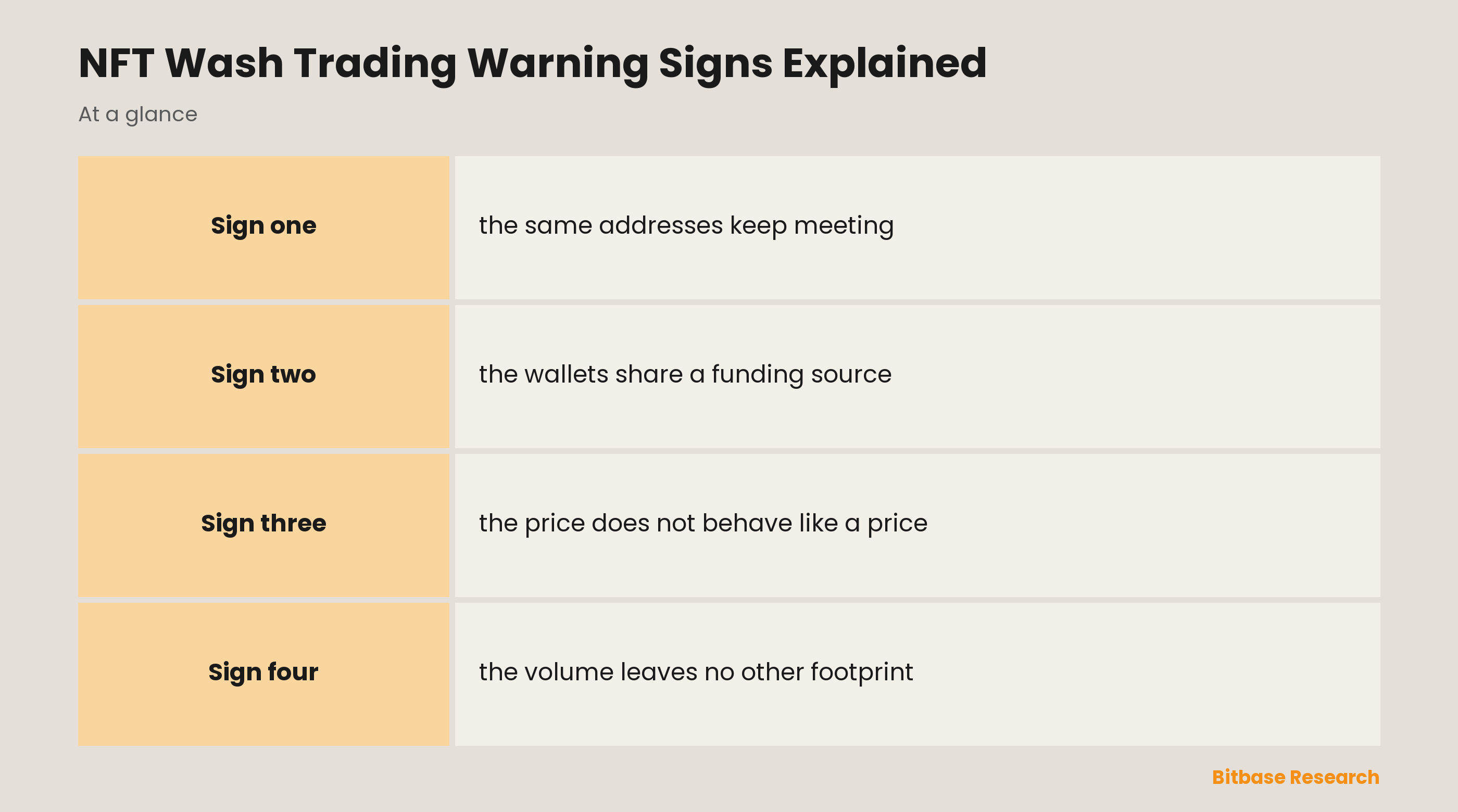
Sign one: the same addresses keep meeting
The plainest shape is the round trip. A token leaves an address, changes hands once or several times, and returns to an address that already held it. A cycle is the same idea spread wider: three or four addresses pass a token along so that no two consecutive rows share a pair, and it still ends where it began. The individual rows look ordinary, and the shape appears only when the history is read as a whole.
Cadence belongs in the same reading. Sales spaced at even intervals, or bunched into a short run that stops at a snapshot date, describe a process running to a schedule. Decisions made by separate people as they arrive do not arrange themselves that way, though an automated strategy will.
The counter-readings belong beside the observation. A collector can buy back a piece they regret selling, and an owner moving inventory between a hot wallet and cold storage produces transfers between addresses one person controls, which is the arrangement ERC-2981 has in mind when it declines to treat a transfer as a sale.
Sign two: the wallets share a funding source
Every address has a first inbound transfer, and a block explorer will show it. When several of the addresses in one sale history were funded from a single address, within a narrow window, in similar amounts, those addresses stop looking like independent participants and start looking like one balance sheet.
Gas widens the trail. Each address has to hold native currency before it can sign anything, so the funding question applies even to a wallet that never bought a token. An address whose only two events are an inbound top-up and a purchase from a related seller is a thin history to build a price on.
Funding overlap raises a question rather than settling one. A withdrawal address at a custodial venue funds many unrelated users from the same place, a team deployer funds wallets belonging to people with nothing to do with each other, and distribution contracts fund recipients in identical amounts by design. The observation is that a shared origin exists; the next step is to ask which of these explains it.
Sign three: the price does not behave like a price
A price produced by negotiation varies, because two parties have to converge on it. A price chosen by one party has no reason to vary at all. Identical prints repeated across a run of sales, steps that rise by an even increment each time, and round numbers with no relation to the asks standing on the board are all cheap to produce and hard to account for.
The relation to the rest of the page carries more information than the number alone. A sale well above the cheapest live listing means someone paid more than they had to while the cheaper token was still available. That does happen when a token carries traits the buyer wanted, so the trait table is where that reading is checked rather than assumed.
Sign four: the volume leaves no other footprint
Genuine demand changes several fields at once. Listings come off the board as they are bought, the count of distinct holders moves, standing offers reset to new levels, and the set of addresses that have ever bought grows. Activity manufactured to fill the volume field can move that one field and leave the others flat.
This is where on-chain analysis earns its place, because the comparisons are ratios rather than totals: distinct buyers against volume, holder count against recorded sales, and the share of a period's volume attributable to the busiest few addresses. Take a collection of 10,000 NFTs whose whole month of sales involves six addresses, and the volume total and the participation figure describe two different markets.
None of those ratios reaches intent. They describe the process that produced the data, which is a smaller claim than a reader may want and the only one the record supports.
What each sign reads, and what else would produce it
| Warning sign | Where you read it | What else would produce it |
|---|---|---|
| A token returns to a previous owner | The address columns of the sale history | A repurchase, or a move between one owner's wallets |
| Several wallets funded from one address | First inbound transfer on an explorer | A custodial withdrawal address, or a distribution contract |
| Repeated or evenly stepped prices | The price column across consecutive sales | One seller pricing a set by a fixed rule |
| Sales far from the cheapest live listing | Sale history read against the listings board | A trait the buyer specifically wanted |
| Volume rising while holder count is flat | Collection statistics over a period | Accumulation by an address that already held tokens |
Putting the signs together without overreaching
What changes as signs accumulate is not certainty but the cost of the alternative account. A round trip between two wallets funded from one address, priced away from the standing asks, and timed against a reward window is four observations, each of which needs its own benign explanation. Needing four at once is a different position from needing one.
Two limits hold even then. Public records show transfers, prices, and times while withholding account relationships and purpose, so an outside reading describes a data-generating process and not a person. And the same pattern can arise with no intent behind it at all, from an automated strategy, a market-making arrangement, or a treasury rotating inventory between its own addresses.
The bottom line
A sale record carries a seller, a buyer, a price, and a time, and carries nothing that distinguishes two independent parties from one party holding two sets of keys. Every warning sign for wash trading is a way of working around that missing field: repeated pairs, shared funding, prices detached from live listings, volume with no matching change in holders, and activity timed to a schedule.
Read any one of them as a question, and several of them together as a reason to shift weight onto the fields that cost more to manufacture: distinct buyers over a period, and how widely the tokens are actually held. To keep learning the fundamentals, follow more from Bitbase Academy.
Related reading
Other Bitbase articles on this topic:
- Network Congestion Indicators and What Each One Measures
- NVT Ratio Explained: Network Value to Transactions
- The SOPR Indicator Explained
- What Is a Blockchain Bridge?
Disclaimer: This article is educational content from Bitbase Academy, provided for information only. It does not constitute investment, trading, tax, or financial advice. Crypto assets are volatile; assess your own risk. Written as of September 2026; refer to the latest official information.
References
[1] Ethereum Improvement Proposals, ERC-721: Non-Fungible Token Standard (Final), Transfer event eips.ethereum.org
[2] Ethereum Improvement Proposals, ERC-2981: NFT Royalty Standard (Final), Rationale eips.ethereum.org