
A delisting notice leaves you two exits: sell the token while the market is still open, or withdraw it before withdrawals close. A balance worth a few cents can use neither. It is too small to place an order with and too small to send on-chain, so it sits there until the venue decides what to do with it. That decision is called conversion, and it is worth understanding before it happens to you rather than after.
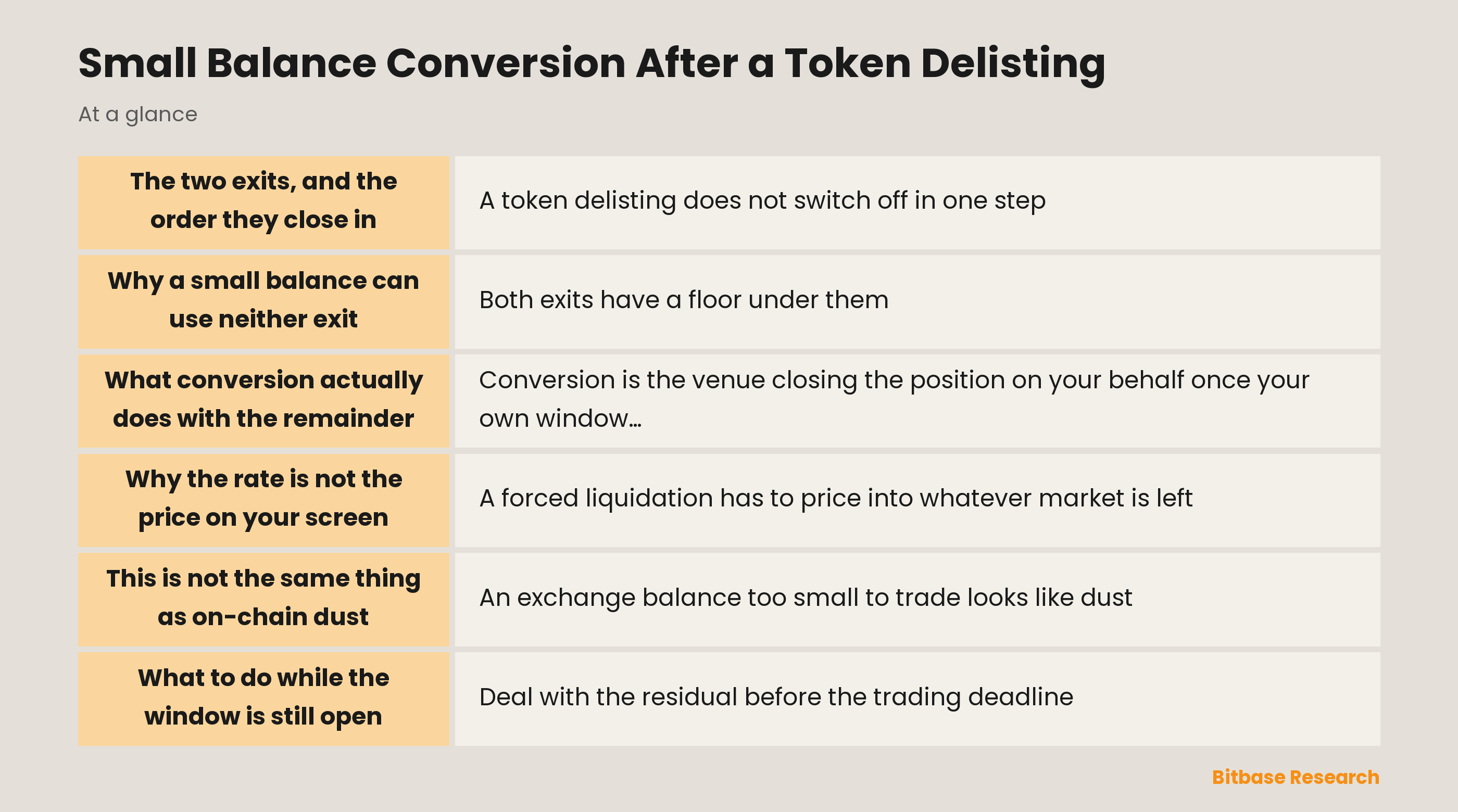
The two exits, and the order they close in
A token delisting does not switch off in one step. It runs as a sequence of separate deadlines, and each one closes a different door. Kraken's published notices set the pattern out plainly: depositing and trading of the affected assets are disabled on one date, withdrawals are disabled on a later one, and a liquidation period for any remaining balances follows after that.
The order of those dates matters more than the final one. The moment trading stops, selling is no longer an exit, and the only remaining door is withdrawal. When the second date passes, both doors are shut and whatever is left in your account is no longer something you act on.
An earlier stage can close quietly. In its notice for one delisted asset, Kraken moved the affected pairs to cancel-only mode and cancelled all open orders. A resting limit order left there months ago is not a plan; it is removed along with the market it was sitting in.
Why a small balance can use neither exit
Both exits have a floor under them. Selling requires an order that clears the venue's minimum order size, and that minimum is set per asset rather than as one number across the platform. Kraken's own figures go by base currency: an order in BTC must be 0.0001 BTC or larger, while an order in ETH must be 0.01 ETH or larger. A balance underneath that floor cannot be turned into an order at all.
Withdrawal has its own floor, and it is a harder one, because a withdrawal has to pay a network fee out of the amount being sent. When the fee is larger than the balance, there is nothing left to send. This is why the closing of the first exit costs a small holder more than a large one: a large position leaves in a single order, while a residual position was never eligible for either route.
The number on your screen does not change while any of this happens. What changes is that there is no longer a market to sell it into, which is a different situation from the available balance that an open order temporarily locks away. The funds are still recorded as yours; it is the route out that has closed.
What conversion actually does with the remainder
Conversion is the venue closing the position on your behalf once your own window has passed. Kraken's notice states that any remaining balances will be automatically liquidated, across a stated liquidation period, based on prevailing market conditions. The token leaves your account and proceeds arrive in its place.
Which asset those proceeds arrive in is set by the venue, not by a general rule, and it is not necessarily a stablecoin. In its notice for WAVES, Kraken records that any remaining WAVES were converted to BTC: a major asset rather than a dollar-denominated one, which leaves the proceeds carrying a price you did not choose.
Not every notice ends in a conversion at all. Some describe a balance that stays frozen pending a manual recovery request instead. The instruction that governs your case is the one in the notice for your asset on your venue, and that notice is the only place worth reading it from.
Why the rate is not the price on your screen
A forced liquidation has to price into whatever market is left, and by that point the market is thin by construction, since low volume is one of the reasons an asset gets delisted in the first place. Kraken states the consequence directly: liquidation prices may be significantly below recent reference prices and, in some cases, may result in minimal or no proceeds due to insufficient market liquidity.
That sentence is the practical argument for acting inside the window rather than after it. The last quoted price you saw is a reference price, and a reference price records a trade someone was willing to make earlier; it is not an offer standing in front of you. When the remaining depth is a handful of orders, a liquidation walks through them and ends where they run out.
The voluntary tool and the forced one are not the same thing
Some venues also offer a small-balance conversion you can run yourself, and the two are easy to confuse because they share a name and an outcome. They are not the same instrument. Kraken defines its small balances as those below the minimum instant buy or sell order size, lets you convert them into an asset of your choice, applies a 3% fee to the conversion, and limits the tool to once every 24 hours.
| Small-balance conversion you run | Liquidation after a delisting | |
|---|---|---|
| Who starts it | You | The venue |
| When it is available | While the asset is still supported | After withdrawals close |
| Destination asset | You choose it | The venue sets it |
| What it costs | A published conversion fee | Whatever the thin market takes |
Read the table one column at a time and the useful point falls out. The voluntary tool keeps the two choices that matter with you, the destination and the timing. Once a delisting has run its course, both of those have been made on your behalf.
This is not the same thing as on-chain dust
An exchange balance too small to trade looks like dust, and the resemblance is only on the surface. Dust is a property of an on-chain output: the network fee needed to spend it exceeds what it holds, and a dust limit in the node software keeps it from being relayed. It is the blockchain that makes dust stuck.
An exchange small balance is stuck for a different reason. It is a row in the venue's own ledger, and the floor under it is a business rule, the minimum order size or the withdrawal minimum, which the venue sets and can change. The distinction matters because the remedies differ: on-chain dust is a question of fee conditions and wallet behaviour, while an exchange residual is a question of what conversion the venue offers, if it offers one.
What to do while the window is still open
Deal with the residual before the trading deadline, not before the withdrawal deadline. Selling is the exit that closes first, and it is the one where the price and the destination asset are still yours to pick.
If you intend to withdraw instead, start early rather than on the last day. A withdrawal is not finished at the moment you click it: it enters a processing queue behind balance checks and security holds, and a newly added destination address can face a waiting period of its own. A request submitted against the deadline can miss it.
If the balance sits below every floor and the venue offers a self-service conversion, use it while the asset is still supported. That is the window in which the tool works at all, and it closes when trading does.
The bottom line
A delisting closes selling first and withdrawal second, and a small balance is the holding that can use neither exit before they shut. What follows is conversion: the venue liquidates what is left, on its own schedule, into an asset of its choosing, at whatever price a market thinned by the delisting will bear. A stablecoin is one possible destination, not a promised one.
Every deadline in a delisting notice removes an option you currently hold, so the value of acting is highest at the start of the window and gone by the end of it. Read the notice for the order of its dates, not only for the last one, and treat the trading deadline as the real one. To keep learning the fundamentals, follow more from Bitbase Academy.
Related reading
Other Bitbase articles on this topic:
- Corporate Crypto Account Verification: KYC Requirements for a Business
- Crypto Dust Conversion and the Records It Leaves
- Missed the Withdrawal Deadline on a Delisted Token
- Why Selfie Verification Keeps Failing on a Crypto Exchange
Disclaimer: This article is educational content from Bitbase Academy, provided for information only. It does not constitute investment, trading, tax, or financial advice. Crypto assets are volatile; assess your own risk. Written as of September 2026; refer to the latest official information.
References
[1] Kraken Support, Notice of scheduled asset delistings (June 2026) support.kraken.com
[2] Kraken Support, Notice of asset delisting for WAVES support.kraken.com
[3] Kraken Support, Converting Small Balances on Kraken support.kraken.com
[4] Kraken Support, Minimum order size (volume) for trading support.kraken.com