A stop-market and a stop-limit order both stay inactive until price reaches the trigger price you set. The difference is what happens next: a stop-market sends a market order and prioritises getting filled, while a stop-limit sends a limit order and prioritises the execution price, without guaranteeing a fill.
Trigger price vs order price
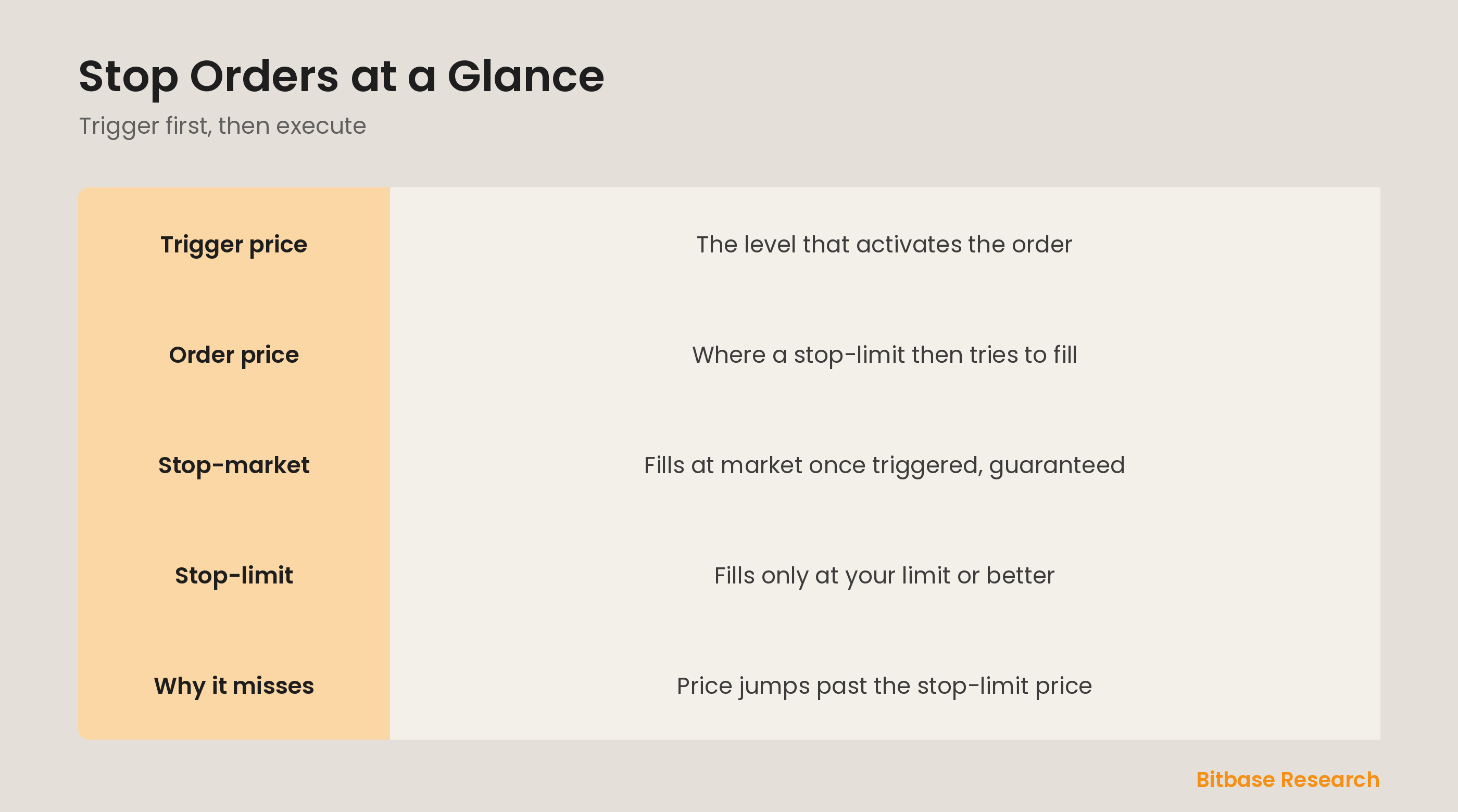
Every stop order has a trigger price: the level that activates it. Until the market reaches that price, the order is dormant and does nothing. Once triggered, what happens next depends on the type. A stop-market becomes a market order and fills right away. A stop-limit becomes a limit order at a second price you set, the order price, and will only fill at that price or better. Two prices, two jobs: one wakes the order, one controls its execution.
Trigger direction, above or below
The trigger can point up or down, and choosing the wrong direction is a classic mistake. A stop-loss on a long position sits below the current price and triggers when price falls to it. A stop used to enter or take profit may sit above the price and trigger when it rises. Exchanges let you set whether the trigger fires when price crosses from above or below, so match the direction to what you actually want the order to do.
Stop-market vs stop-limit
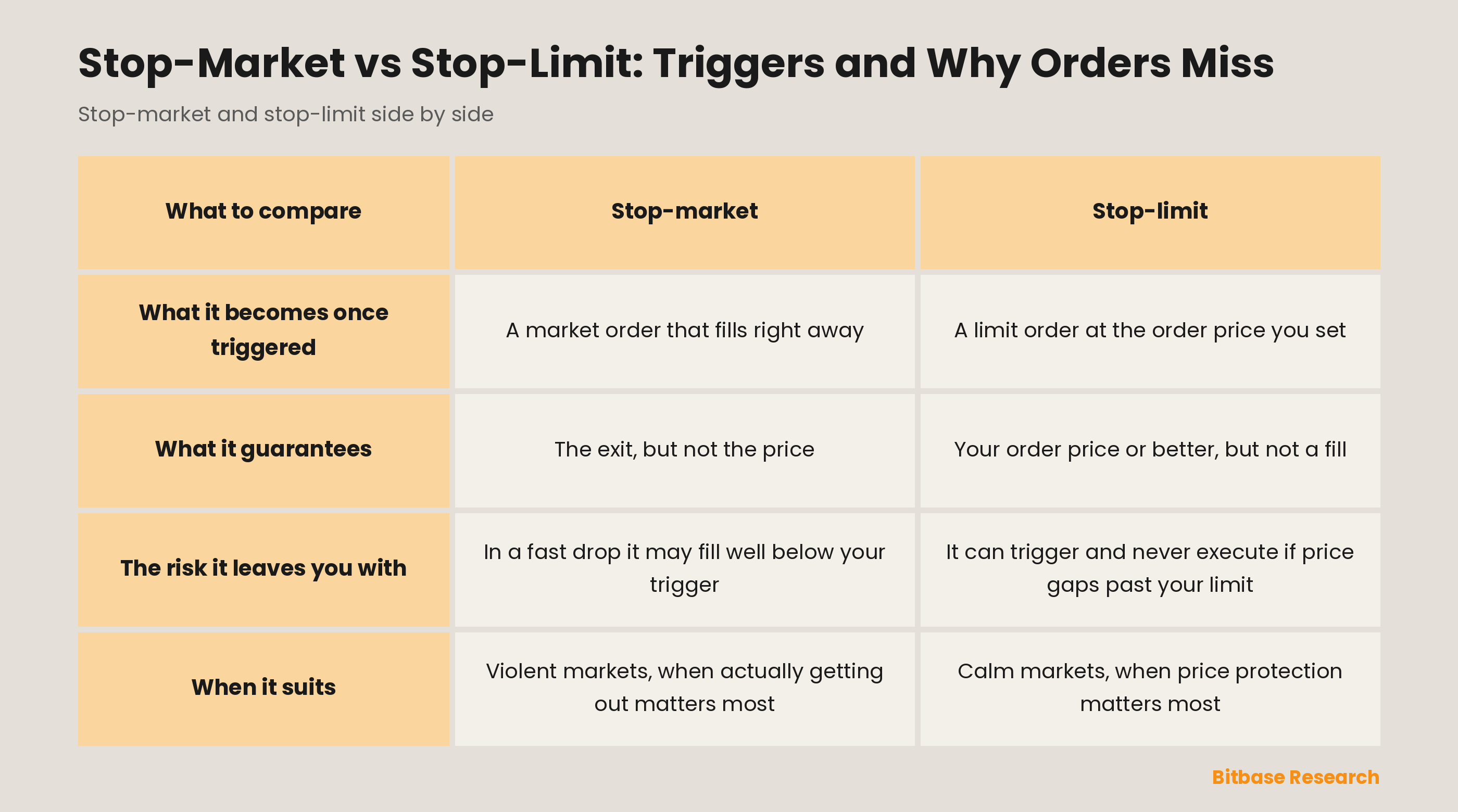
The difference is certainty of fill versus certainty of price. A stop-market guarantees you exit once triggered, but not at what price, so in a fast drop it may fill well below your trigger. A stop-limit guarantees you never fill worse than your order price, protecting you from bad slippage, but it risks not filling at all. In calm markets a stop-limit is precise; in violent ones a stop-market is safer for actually getting out.
Why a stop-limit does not fill
The most common surprise is a stop-limit that triggers but never executes. This happens when the price gaps or crashes straight past your limit: the order activates, but there is no trade available at your order price or better, so it just rests unfilled while the price runs away. If your goal is to definitely exit, a stop-market or a stop-limit with a wide gap between trigger and limit avoids being stranded.
A stop-loss example on a long position
Say the price is $100 and you want a stop-loss on a long position. With a stop-market, you set the trigger at $95. Once price falls to $95, the system sends a market sell order, and the fill may come at $95, at $94.8 or at whatever else is available at that moment.
With a stop-limit, you set the same $95 trigger and an order price of $94.5. Once price falls to $95, the system places a limit sell order at $94.5 or better. If the market drops straight through $94.5, the order may never fill.
Stop-market and stop-limit side by side
The bottom line
A stop order waits at a trigger price, then acts. A stop-market fills immediately at market once triggered, guaranteeing the exit but not the price. A stop-limit only fills at your order price or better, protecting the price but risking no fill if the market jumps past it. Set the trigger direction correctly, and choose stop-market when getting out matters most, stop-limit when price protection does. To keep learning the fundamentals, follow more from Bitbase Academy.
Frequently asked questions
Will a stop-market always fill once triggered?
Once triggered it becomes a market order, so it normally fills, but not at any guaranteed price. In a fast drop the fill can land well below your trigger, which is the price you give up in exchange for certainty of getting out.
Should the trigger price and the order price be the same on a stop-limit?
The two prices can be the same, but that pushes price protection to its tightest and the risk of no fill to its highest. Leaving a gap between the trigger and the order price makes a fill more likely, and if your goal is to definitely exit, a stop-market is the safer choice.
Which one should I use when the market gaps?
A gap is exactly where a stop-limit fails: price jumps straight past your order price, so the order activates but there is nothing available at that price or better. If you must exit, a stop-market is safer; if the price matters more, you have to accept that the order may not fill.
Why does a stop-limit trigger without filling?
Because the trigger price only wakes the order, while the order price decides what it may fill at. When price gaps or crashes straight past the order price, there is no trade available at that price or better, so the order just rests unfilled while the price runs away.
Related reading
Other Bitbase articles on this topic:
- What Is a Crypto Trading Pair?
- Managing Open Orders and Reading Order History
Disclaimer: This article is educational content from Bitbase Academy, provided for information only. It does not constitute investment, trading, tax, or financial advice. Crypto assets are volatile; assess your own risk. Written as of June 2026; refer to the latest official information.
References
[1] Investopedia, "Stop-Limit Order: What It Is and Why Investors Use It" investopedia.com
[2] Investopedia, "Stop-Loss Order: Definition, How It Works, and Examples" investopedia.com
[3] Investopedia, "Market Order: Definition, Example, Vs. Limit Order" investopedia.com