
A treasury reported at one headline figure and a treasury that can pay contributors for four more years are two different claims, and only the second is a measurement. A runway is that measurement: the number of months an organization can keep spending without selling the asset it issued. It comes out of a numerator and a denominator, and the arguments about a runway are arguments about what belongs in them.
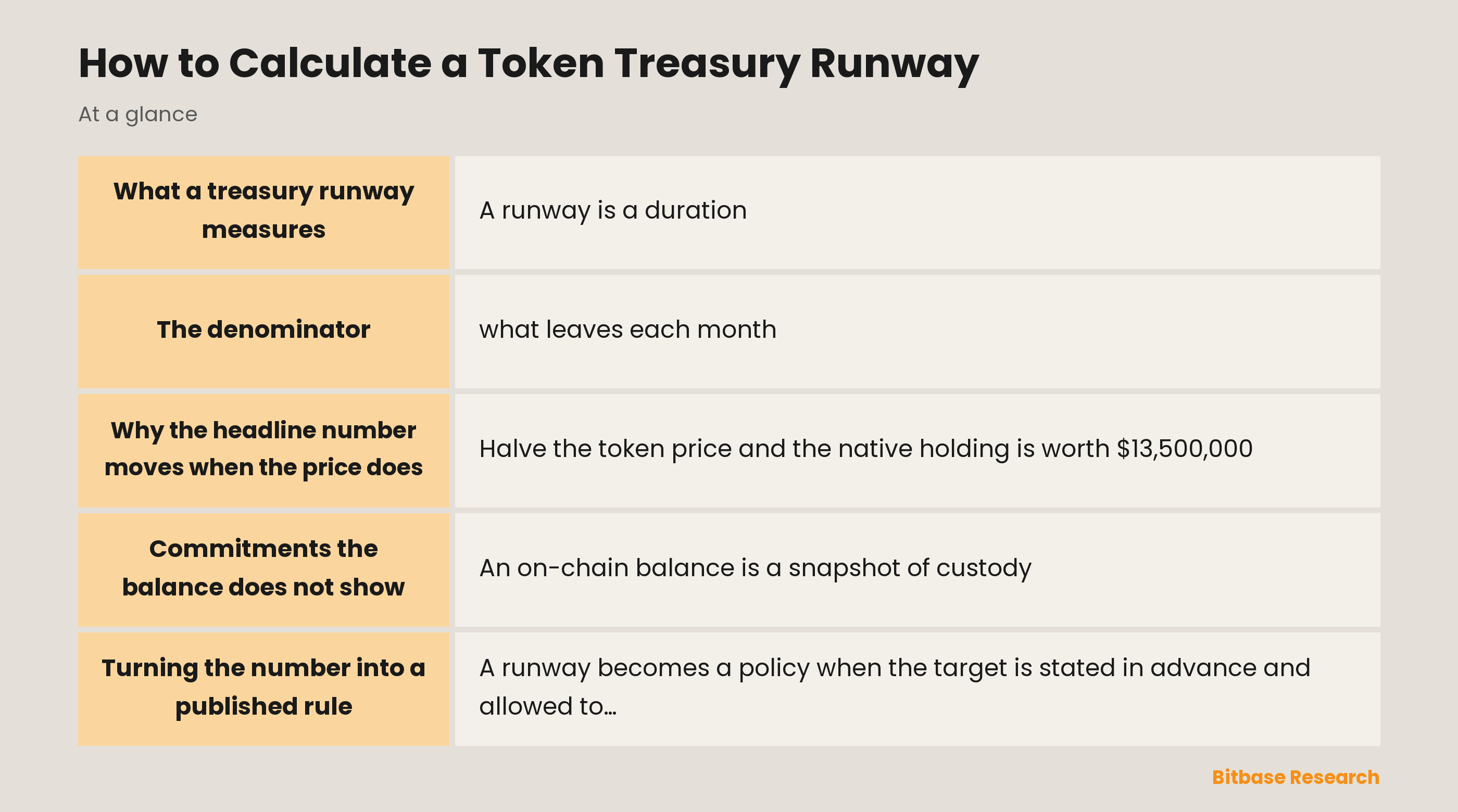
What a treasury runway measures
A runway is a duration, not a balance. Divide the part of the treasury that can settle an obligation by the amount that leaves each month, and the quotient is how long the spending can continue before that part is gone.
The division is worth doing because the two sides are denominated differently. Contributor pay, audits, servers and legal fees arrive in a currency the project does not issue, while the treasury, before anything has been converted, is denominated in the token the project does issue. A runway is where that mismatch stops being a description and becomes a number.
Two conventions circulate under the same word. The headline runway divides the whole treasury at its current mark. The working runway divides only the part that is not the project's own token, because that is the figure that holds without anyone selling. Both are arithmetic, both are true, and they can be far apart. A tokenomics checklist treats this as one pass among several; what follows is that pass on its own.
The numerator: what can actually settle an invoice
Start from the full balance and take out everything that cannot pay the obligations you are measuring against. What survives is the numerator.
The project's own token comes out first. It is not excluded because it might fall. It is excluded because converting it is the event the runway exists to warn about, and a runway measured on the asset whose sale is the emergency cannot see the emergency coming.
Locked balances come out next. Tokens still moving through a vesting schedule, staked positions inside an unbonding period, and anything sitting in a withdrawal queue are owned before they are available. A runway is a statement about availability, and ownership alone does not qualify.
Positions that cannot clear at their mark come out in part. A holding whose full size would move the price it is valued at is worth less than the mark says, and writing it down is the honest treatment.
What remains is cash equivalent: stablecoins, liquid assets the project did not issue, and off-chain balances held at a bank. That is the numerator, and in an organization that has never converted anything it is a fraction of the announced total.
| Item on the balance sheet | Counts toward the runway | Reason |
|---|---|---|
| Stablecoins and fiat balances | Yes | Denominated the way the invoices are |
| Liquid assets the project did not issue | Yes, at a conservative mark | Selling them signals nothing about the project |
| The project's own token | No | Selling it is the event the runway warns about |
| Vesting, staked or queued balances | No, until they are released | Owned but not yet available |
| Approved and unspent grant commitments | No | Already promised to someone else |
The denominator: what leaves each month
The denominator is what actually goes out each month in the same unit as the numerator, and that is not the same thing as the published budget.
Two adjustments matter here. Spending settled in the project's own token does not draw on the cash-equivalent pile, so charging it there understates the runway. Revenue that arrives in non-native assets and reaches the treasury does reduce the draw, so the figure to divide by is net burn rather than gross spend.
The second adjustment is where runways get overstated instead. Revenue denominated in the project's own token adds to the native pile and not to the buffer, and it cannot settle a payroll that leaves in stablecoins. Netting it anyway lengthens the runway on paper and adds no month of solvency.
Take the denominator from a trailing average rather than from last month. Treasury outflows are lumpy. Audits, conference seasons and grant rounds land in single months, and a denominator drawn from one of them is flattering or alarming for reasons that have nothing to do with the position.
The calculation on one treasury
Take an organization whose treasury marks at $36,000,000 in total. Of that, $27,000,000 is the project's own token and $9,000,000 sits in stablecoins and liquid assets it did not issue. The native share is 75% of the mark.
Gross monthly spending is $900,000. Protocol revenue reaching the treasury in non-native assets covers $300,000 of it, so the net draw on the buffer is $600,000 a month.
Now do both divisions. The headline runway takes the full mark over the net draw and returns 60 months. The working runway takes only the non-native part over the same draw and returns 15 months. The two figures describe the same treasury on the same day and stand 4 times apart, and only one of them survives a market in which the token cannot be sold at its mark.
| What goes in the numerator | Figure | Runway it returns |
|---|---|---|
| Full treasury at mark | $36,000,000 | 60 months |
| Non-native part only | $9,000,000 | 15 months |
| Non-native part after commitments | $7,200,000 | 12 months |
Why the headline number moves when the price does
Halve the token price and the native holding is worth $13,500,000. The treasury now marks at $22,500,000 and the headline runway falls to 37.5 months, without a single payment having changed.
The working runway does not move at all. Its numerator is the non-native part and its denominator is spending denominated the same way, so neither side is a function of the token price. That stability is the whole argument for measuring it this way: a number that falls only when spending rises or the buffer is drawn down is reporting on something the organization can act on.
The reflexive part comes afterwards. Refilling a buffer by selling the native token takes more tokens at the lower price, which delivers more supply to a market that is already weak. This is why treasury diversification is decided before it is needed rather than during the drawdown that makes it urgent.
Commitments the balance does not show
An on-chain balance is a snapshot of custody, not of obligation. Grants that passed a vote but have not been paid, multi-year service agreements, and audit engagements already signed are claims on the buffer that no block explorer displays.
Continue the example. Suppose $1,800,000 of the buffer is committed to grants already approved. The uncommitted buffer is $7,200,000. At the same net draw the runway is 12 months rather than 15, and nothing about the treasury changed except that the accounting caught up with what had already been promised.
Contingent liabilities belong in the same review even when they cannot be quantified. A bug bounty ceiling, an insurance deductible and a disputed tax position each have a scenario in which they consume months of buffer at once, and the useful output is a named list rather than one adjusted figure.
Turning the number into a published rule
A runway becomes a policy when the target is stated in advance and allowed to drive the selling. The Ethereum Foundation publishes its own in that form: annual operating expenses set at 15% of the treasury, an operating buffer of two and a half years of that spending held in fiat-denominated reserves, and a stated practice of measuring how far those reserves deviate from the buffer target to determine how much ether, if any, will be sold over the next three months.
Whether those parameters suit another organization is a separate question, and the shape is what transfers. A target expressed in months of spending stays constant in the unit the invoices are settled in, while a target set as a share of the treasury mark shrinks exactly when the mark falls, calling for a larger sale at a worse price.
For a DAO, publication is also what makes the figure checkable from outside. Published treasury addresses let anyone recompute the split between native and non-native assets, and a published spend figure lets them recompute the denominator. Without both, a runway is a claim rather than a measurement.
The bottom line
A treasury runway is one division done honestly: spendable non-native assets over net monthly burn, expressed in months. The work is in the inputs and not in the arithmetic. Take out the project's own token, take out what is locked, take out what is committed, and net only the revenue that arrives in the unit the invoices do.
Read a published runway by asking which numerator produced it. A figure taken from the full treasury mark will shorten on its own the next time the token falls, and it shortens fastest in exactly the conditions that make the buffer necessary. To keep learning the fundamentals, follow more from Bitbase Academy.
Related reading
Other Bitbase articles on this topic:
- What Is a Crypto Token? Tokens vs Coins Explained
- Crypto Payment Gateways and Merchant Settlement
- Crypto Trading Fees Explained: The Costs You Actually Pay
Disclaimer: This article is educational content from Bitbase Academy, provided for information only. It does not constitute investment, trading, tax, or financial advice. Crypto assets are volatile; assess your own risk. Written as of September 2026; refer to the latest official information.
References
[1] Ethereum Foundation, Ethereum Foundation Treasury Policy, June 4, 2025 blog.ethereum.org