
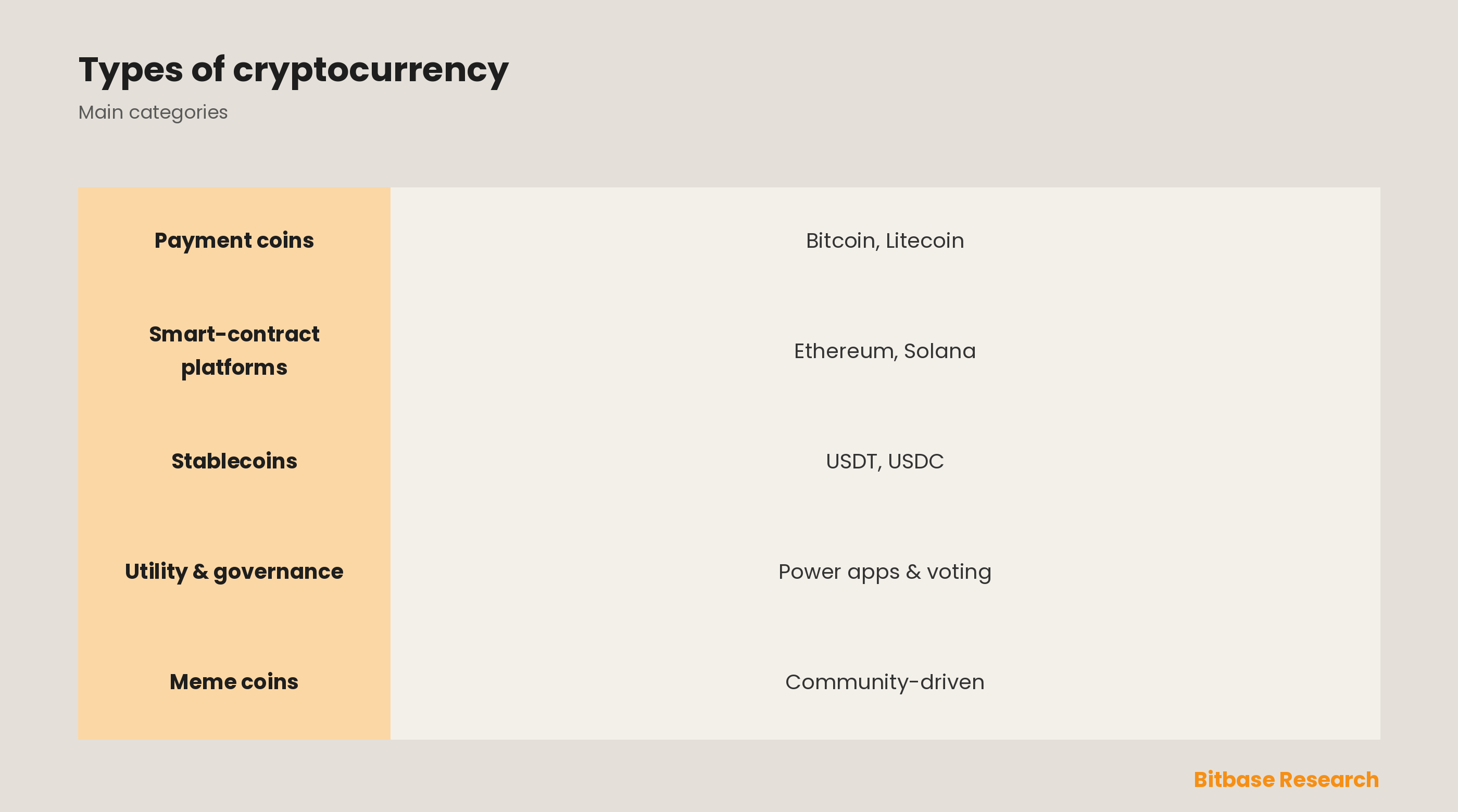
There are thousands of cryptocurrencies, but most fall into a few groups: payment coins, smart-contract platforms, stablecoins, utility and governance tokens, and meme coins. Knowing the categories makes the market far easier to navigate. This guide breaks them down.
Coins vs tokens
A useful first split is coins versus tokens. A coin has its own blockchain — like Bitcoin (BTC) or Ether (ETH) — and is usually used to pay fees or store value [1]. A token is built on top of an existing blockchain (for example, many run on Ethereum) and can represent almost anything, from a stablecoin to a governance right [2].
The main categories
The bottom line
Most cryptocurrencies fit a handful of categories: payment coins for transferring value, smart-contract platforms that run apps, stablecoins pegged to a currency, utility and governance tokens tied to a project, and community-driven meme coins. Categories can overlap, but they're a helpful map. To keep learning the fundamentals, follow more from Bitbase Academy.
Related reading
Other Bitbase articles on this topic:
- How to Buy Cryptocurrency: A Beginner's Guide
- Why Was Cryptocurrency Created?
Disclaimer: This article is educational content from Bitbase Academy, provided for information only. It does not constitute investment, trading, tax, or financial advice. Crypto assets are volatile; assess your own risk. Written as of June 2026; refer to the latest official information.
References
[1] Coinbase, "What is cryptocurrency?" coinbase.com
[2] Investopedia, "Types of Cryptocurrency." investopedia.com