
A wallet address, a public key and a private key are related, but each does a different job. Share the wallet address to receive crypto. The public key is what the network uses to verify signatures, and on many blockchains the address is derived from it. The private key authorizes spending and must never be shared.
What can you safely share?
| Item | Main purpose | Where it comes from | Safe to share? |
|---|---|---|---|
| Wallet address | Receive crypto | Encoded from the public key; the exact process depends on the chain | Yes, this is what you hand out |
| Public key | Lets the network verify signatures | Derived from the private key | Not secret, but not what you send for a payment |
| Private key | Authorizes spending by signing transactions | The starting secret | No, never |
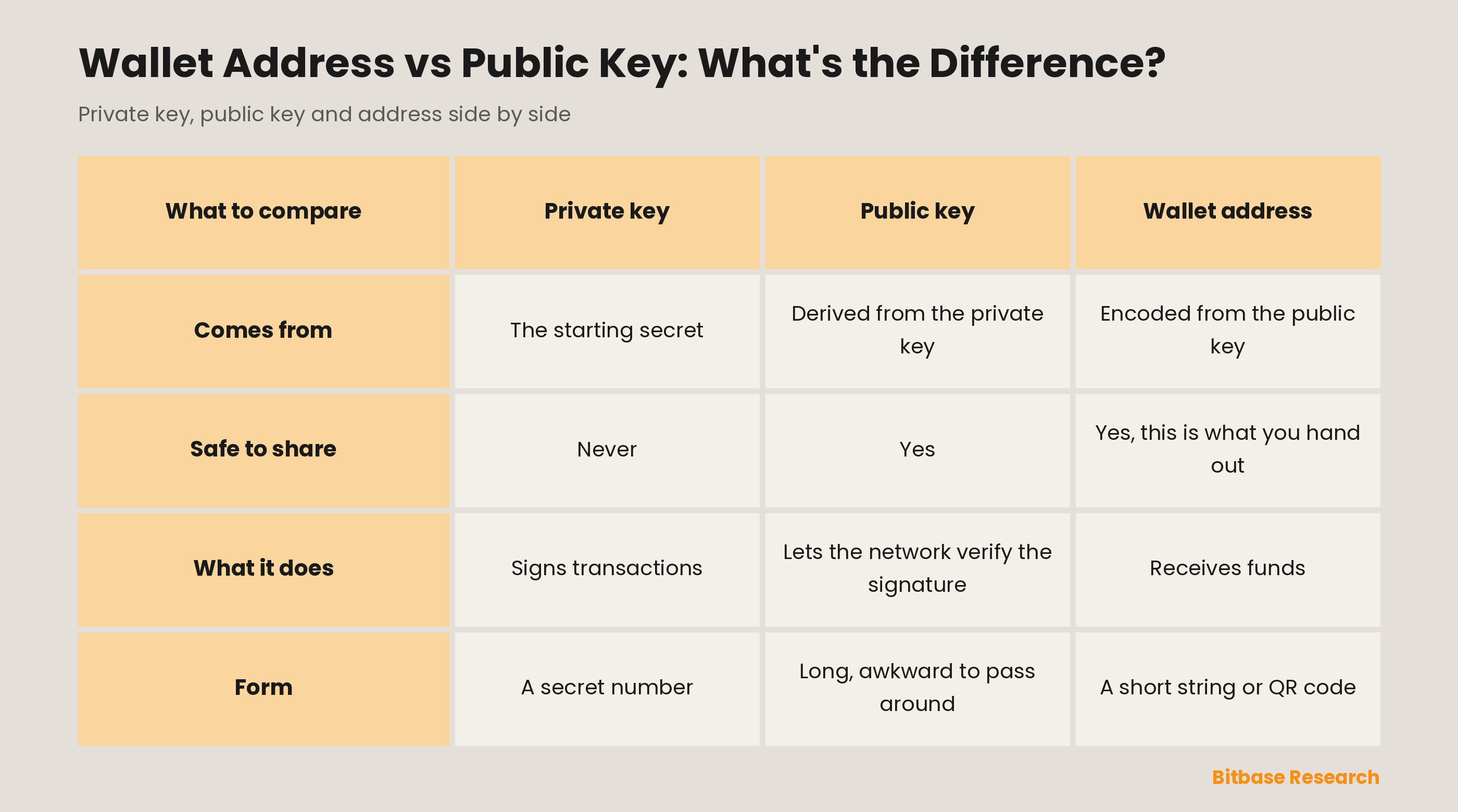
The wallet address is the one to hand out: it lets people send you funds, and neither it nor the public key can be used to spend your coins. The public key is not a secret either, since the network uses it to verify your transactions, but it is not what you send someone who wants to pay you. Only the private key can spend, which is why it must stay secret. Sharing your address is like giving someone your account number to receive a payment — useful and harmless, as long as the private key behind it stays yours alone.
Start with the private key
Everything begins with the private key: a secret number that must never be shared. Through one-way math, the private key produces a public key. The process only runs in that direction — you can compute the public key from the private key, but you cannot work backward from the public key to the private one. That one-way relationship is what makes the whole system safe to use in the open.
The public key
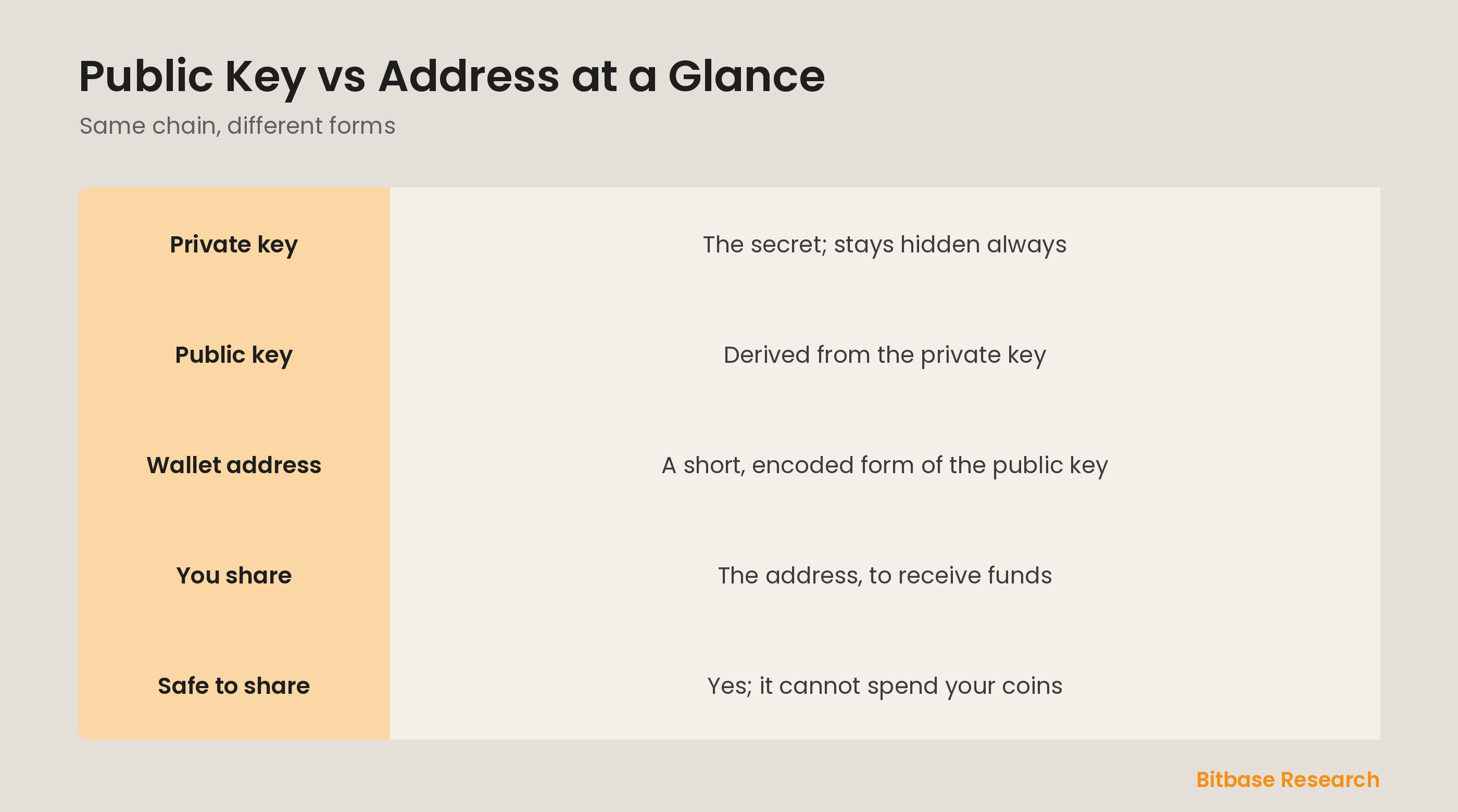
The public key is derived directly from the private key and is used by the network to verify that a transaction was really signed by the matching private key — without the private key ever being exposed. In some cases the public key becomes visible on the blockchain when you spend funds. It is longer and less convenient to pass around than the short address most people actually use.
The wallet address
The wallet address is a shortened, encoded version of the public key, produced by running it through additional hashing and formatting. This is the compact string you copy, share, or turn into a QR code so others can send you crypto. Because it is derived from the public key, which came from the private key, all three are mathematically linked — but only the address is meant for everyday sharing.
Is a Wallet Address Derived From a Public Key?
On many blockchains, an address is derived from a public key or from a script containing public-key information. The exact process differs by blockchain, so a wallet address should not be treated as a universal substitute for a public key.
Bitcoin vs Ethereum
Bitcoin can use several address formats depending on script type. Ethereum addresses are derived from the public key and normally begin with 0x. Similar-looking address formats do not mean two networks are interchangeable.
The bottom line
A private key generates a public key, and the public key is compressed and encoded into a wallet address. The address is the short, shareable form you give out to receive funds; the public key is the longer value the network uses to verify signatures. Both are safe to share because neither can spend your crypto — that power belongs only to the private key you keep hidden. To keep learning the fundamentals, follow more from Bitbase Academy.
Frequently asked questions
Is a wallet address the same as a public key?
No. They are linked cryptographically, but they are not interchangeable identifiers on every blockchain. On many chains the address is a shortened, encoded form of the public key, or of a script containing public-key information. The public key is the longer value the network uses to verify signatures, while the address is the compact string meant for everyday sharing.
Which one should I send someone who wants to pay me?
Your wallet address, for the asset and network the payment will use. Similar-looking address formats do not make two networks interchangeable, so confirm both with the sender before you share it. Never send your private key: no one needs it to pay you, and anyone who has it can spend your funds.
Can someone steal crypto with my wallet address?
No. The address, and by extension the public key, let people send you funds and verify your transactions, but neither can be used to spend your coins. Only the private key can do that, which is why it has to stay secret.
Can I derive a private key from a wallet address?
No. The maths runs one way only: a private key produces a public key, and the public key is compressed and encoded into an address, but you cannot work backward. That one-way relationship is what makes the whole system safe to use in the open.
Related reading
Other Bitbase articles on this topic:
- Hot Wallet vs Cold Wallet: Which Should You Choose?
- How to Recover a Crypto Wallet
- What Is a Recovery Phrase in Crypto? A Simple Guide
Disclaimer: This article is educational content from Bitbase Academy, provided for information only. It does not constitute investment, trading, tax, or financial advice. Crypto assets are volatile; assess your own risk. Written as of October 2026; refer to the latest official information.
References
[1] Investopedia, "Private Key: What It Is, How It Works, Best Ways to Store" investopedia.com
[2] Investopedia, "Cryptocurrency Explained With Pros and Cons for Investment" investopedia.com
[3] Bitcoin BIPs, "BIP-32: Hierarchical Deterministic Wallets" github.com