These three names are routinely listed together and they are not the same kind of thing. Pump.fun and Believe are applications on Solana that issue tokens; MemeCore is a standalone Layer 1 blockchain whose M is a native coin. They are also in very different states, from a launchpad still earning millions a week to one earning tens of dollars a month. This article takes each on its own terms and shows you how to check the state of any of them yourself.
What Is Pump.fun, What Is Believe, and What Is MemeCore?
Pump.fun is a memecoin launchpad on Solana. Its own site describes it as the fairest way to launch and trade memecoins on Solana, with coins instantly tradable on a transparent bonding curve, no liquidity to seed, no presales and no team allocations. Its token PUMP is a Solana SPL token at mint pumpCmXqMfrsAkQ5r49WcJnRayYRqmXz6ae8H7H9Dfn. The platform is unambiguously active: independent reporting put its fees at 10.03 million US dollars for the week of 3 to 9 August 2026.
Believe is also a Solana launch platform, originally branded Clout, and it is in a different condition entirely. Its current token is BELIEVE at mint BLVxek8YMXUQhcKmMvrFTrzh5FXg8ec88Crp6otEaCMf, which replaced the earlier LAUNCHCOIN token at Ey59PH7Z4BFU4HjyKnyMdWt5GGN76KazTAwQihoUXRnk in a one-for-one migration announced in October 2025. The adapter tracking the platform's fees recorded 26.89 US dollars over the trailing thirty days as of 13 August 2026, against more than 40 million US dollars all time. The contract still records transactions; as a business it has effectively stopped.
MemeCore is not a launchpad at all. It is a Layer 1 blockchain, operated by Anteater Labs Pte. Ltd. of Singapore, describing itself as the first Layer 1 built for what it calls Meme 2.0, running proof of stake with EVM compatibility and its own token standard. Its coin M is the native gas asset of that chain, which means it has no token contract on its own network in the way an SPL or ERC-20 token does; a bridged representation exists on BNB Smart Chain at 0x22b1458e780f8fa71e2f84502cee8b5a3cc731fa. Its own explorer showed blocks arriving roughly every seven seconds when this article was written, at around 0.2 transactions per second.
What Problem Do These Systems Try to Solve?
The launchpads address the same problem. Issuing a token used to require deploying a contract, funding a liquidity pool yourself and persuading buyers that the pool would not be withdrawn, which favoured whoever had capital and made presales the norm. The bonding-curve answer removes the presale and the seeded pool: the token trades immediately along a curve where price follows supply sold, and proceeds accumulate until they can seed a real pool. Everyone including the creator buys through the same curve.
Believe layered a second idea on top, aiming at issuance tied to social identity rather than anonymous launches, on the argument that a creator with an audience is a better anchor for a token than a pseudonymous deployer. That was the thesis; the fee record above is what happened to it.
MemeCore's problem statement is different in kind because it is a chain. Its argument is that meme culture is an application category deserving its own settlement layer, with the chain rather than an application capturing the activity, so that creators, communities and the applications serving them share one environment. Whether a category needs its own Layer 1 is a design argument the project makes about itself, and this article reports it as such.
How the Bonding Curve and the Chain Work
The launchpad mechanism is worth understanding because it is the same on both platforms in outline. A creator issues a token with no allocation to themselves. Buyers trade against a curve rather than against other buyers, so the price is a deterministic function of how much has been sold and there is no order book. When cumulative purchases pass a threshold, the accumulated proceeds seed a conventional liquidity pool and the token trades normally from then on. The platform earns a fee on curve trades and, where it operates its own exchange, on subsequent trading.
Pump.fun added a revenue-to-token link and then changed it, and the direction of that change is the part usually reported backwards. The platform originally directed all net revenue to buying back and burning PUMP. In late April 2026 it moved to a 50/50 split, under which half of net revenue from the bonding curve, its exchange and its terminal product flows into a contract that buys PUMP on the open market and burns it. That was a reduction from 100 percent, not the introduction of a buyback, and it was reported alongside the observation that the original model had not supported the token.
MemeCore works like any proof-of-stake EVM chain. Validators stake M, blocks are produced on a fixed cadence, and applications deploy ordinary EVM contracts. Its explorer is public and the chain was producing blocks when checked, though at very low utilisation: one to two transactions per block, with sampled recent transactions being zero-value transfers between a single pair of addresses.
What PUMP, BELIEVE and M Do in Their Own Systems
PUMP is the platform token of an operating business, and its documented role is the buyback described above: the site states that half of protocol fees buy back and burn the token, and it publishes a live buyback and burn tracker. In April 2026 the company said it had burned all the tokens it had repurchased over the preceding nine months, roughly 36 percent of circulating supply, in two transactions, a figure of around 370 million US dollars. Both numbers originate with the company and were reported as its claim rather than as an audited figure. A scheduled unlock of 6.875 billion PUMP took place on 12 August 2026, split between the team and existing investors, representing roughly 1.75 percent of circulating supply.
BELIEVE is the token of a platform whose fee revenue has collapsed, and the most important thing about it is the migration rather than any utility. Holders of the old LAUNCHCOIN were migrated one for one to BELIEVE, exchanges stopped supporting the old token, and unmigrated tokens were burned. The migration also changed the supply: a complaint filed against the founder alleges that total supply rose from 1,000,000,000 to 1,333,333,284, creating roughly 333 million new tokens and diluting existing holders by about a third. That figure comes from a legal filing and is an allegation, not a finding.
M is a native coin rather than a platform token, so its role is structural: it pays gas and secures the chain through staking. That difference matters for how you verify it, because a native coin has no contract to inspect on its own chain and its supply is a protocol parameter rather than a contract value.
The Ecosystem and Adoption Picture for Each
Pump.fun is the only one of the three with adoption that is straightforwardly real. Weekly fees in the eight figures, a live buyback tracker, continuing weekly burns and a token unlock that the market absorbed without collapse all describe an operating business. That is a statement about activity, not an endorsement of the token or of what is launched on the platform.
Believe's position is the opposite and the numbers are stark rather than ambiguous. Fees of 26.89 US dollars over thirty days, and 1.31 US dollars in the last day, against more than 40 million US dollars all time, describe a platform that ran and stopped. The adapter still records non-zero daily fees, so the contracts have not been switched off, but this should not be presented to a reader as a usable launch platform.
MemeCore is the case where a large headline valuation and very small real trading sit side by side, and both need stating. Total tracked trading volume across all venues was under six million US dollars a day when this article was written, concentrated with roughly 68 percent on a single exchange, Hotcoin, against a valuation implied by supply and price that runs into ten figures. It has no Binance spot listing; the project's own site lists Binance Alpha, along with Bitget and Kraken. Its official announcements page had no event newer than 23 April 2026 and no news post newer than 16 December 2025.
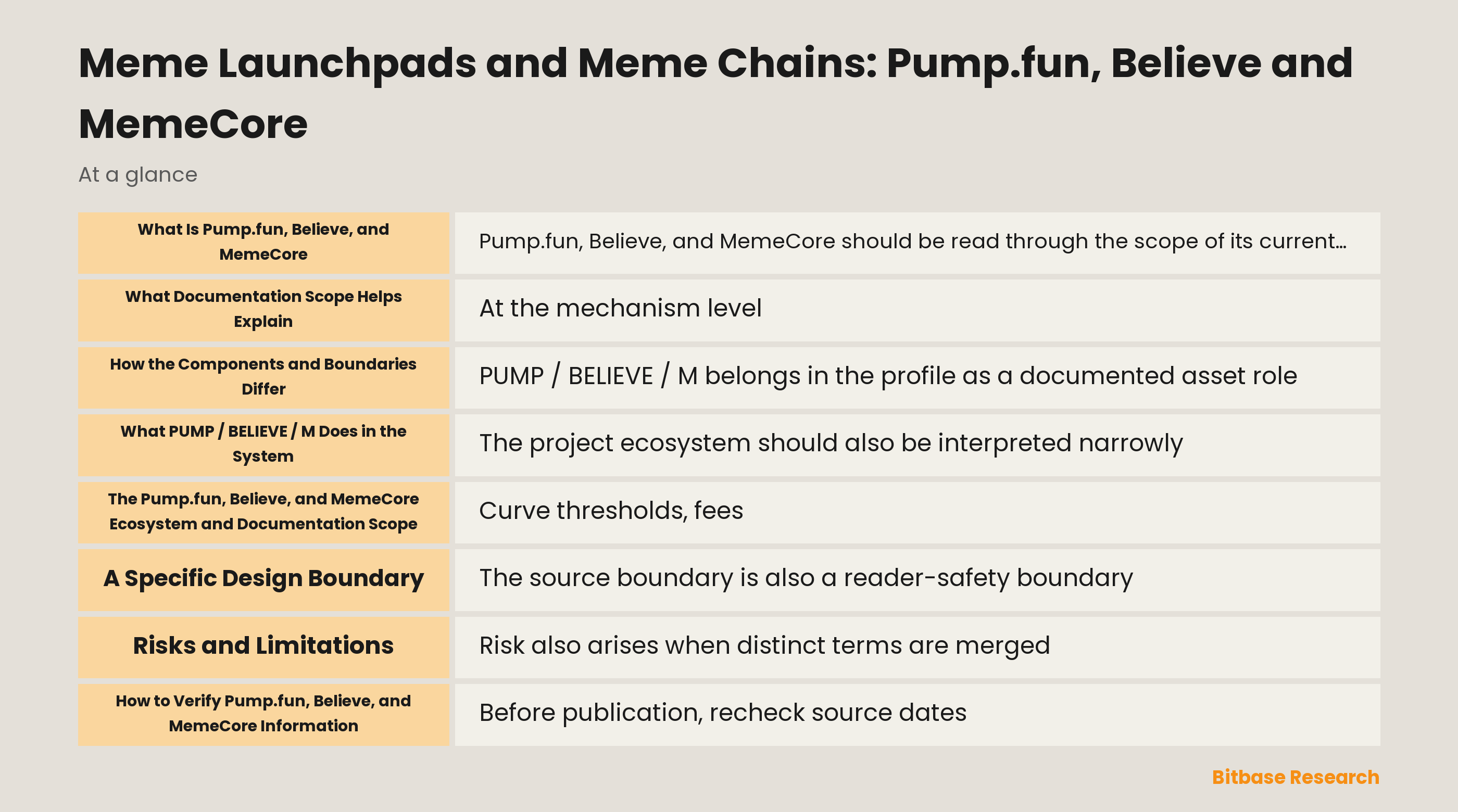
How an Application Token Differs from a Native Chain Coin
An application token lives as a contract on someone else's chain. Its supply, its holders and its transfers are all readable at a contract address, whatever the application does can be changed by the team that runs it, and the token's link to the business is whatever the team chooses to implement, such as a buyback that can be set at 100 percent one quarter and 50 percent the next.
A native coin is a protocol parameter of its own chain. There is no contract to read on that chain, supply and issuance are set by consensus rules rather than by a company, and changing them requires a network upgrade rather than a policy announcement. The practical consequence for a reader is that the verification steps are different: for PUMP and BELIEVE you inspect a mint address, while for M you inspect a chain, and any M contract address you are given belongs to a different network and is a bridged representation.
Risks and Limitations
The legal risks are open in both directions and none has been resolved. A consolidated class action against the company operating Pump.fun and its co-founders, into which an earlier case was merged in June 2025, has since added Solana Labs, the Solana Foundation and named Solana executives as defendants under an amended complaint filed in January 2026, with claims including racketeering and securities counts. Motions to dismiss were briefed through February 2026. Whether any ruling has issued could not be established from public sources when this article was written, so treat the matter as briefed with no publicly reported ruling rather than as decided either way. Separately, a civil case against the founder of Believe was filed in March 2026 with proof of service filed in July 2026 and no responsive pleadings yet, and the same individual faced an unrelated criminal matter with a court date set for 11 June 2026 whose outcome could not be verified. All of these are allegations at this stage.
The regulatory-access risk is narrower than it is often reported. The UK Financial Conduct Authority published a warning about Pump.fun on 3 December 2024, and the platform then updated its own terms to exclude UK users. That was a self-imposed restriction following a warning, not a regulatory ban, the warning page has not been updated since, and whether the platform still blocks UK users could not be verified when this article was written.
The platform-specific risks differ by name and should not be blended. For Pump.fun the risk is that the buyback policy is a company decision that has already been halved once and the reported burn figures are self-published. For Believe the risk is that the platform has effectively stopped, that its token was migrated to a new contract with an alleged one-third dilution, and that anyone holding the deprecated contract holds something exchanges no longer support. For MemeCore the risk is a very large valuation resting on very thin trading concentrated on one venue, a chain with almost no usage, and an official communications channel that has been silent for months.
Two further items belong here for accuracy. On 25 June 2026 M fell about 74 percent over 24 hours, from a high near 2.92 US dollars to as low as 0.51, on roughly 21 million US dollars of trading, with no exploit, hack or announcement identified and no confirmed catalyst since; the project did not publicly acknowledge the move. And separate allegations about coordinated withdrawals and price manipulation were made by an on-chain analyst in April 2026 and expressly flagged as not independently verified by the outlet reporting them. Both are recorded here as reported; neither is a finding. This article makes no claim about how any of these assets is classified anywhere.
How to Verify Pump.fun, Believe, and MemeCore
Start from domains you typed, one at a time. Enter pump.fun, believe.app and memecore.com in the address bar yourself and reach documentation, token pages and social accounts only by following links outward. Note that MemeCore also owns a memecore.org domain that redirects, so more than one legitimate spelling exists, which is exactly the condition impersonators rely on. Compare every domain character by character, and close any page reached from an advertisement or a message that asks you to connect a wallet to claim, migrate or verify.
Verify the two Solana tokens by mint address on a Solana explorer. Confirm PUMP at pumpCmXqMfrsAkQ5r49WcJnRayYRqmXz6ae8H7H9Dfn and BELIEVE at BLVxek8YMXUQhcKmMvrFTrzh5FXg8ec88Crp6otEaCMf, checking name, symbol, decimals, supply and holder distribution for each. For Believe in particular, confirm which mint you are looking at before anything else, because the deprecated LAUNCHCOIN mint still exists on chain and is no longer supported by the exchanges that handled the swap.
Verify MemeCore as a chain rather than as a token. Open its own explorer, check that blocks are arriving and at what interval, and look at the transactions inside recent blocks rather than at the headline transaction counter, because a chain can produce blocks that contain almost nothing. Only then look at the bridged BNB Smart Chain contract, and treat it as a representation on that network rather than as the coin itself.
Finally, grade each claim by its evidence class and check the calendar. Fee and revenue figures published by a fee-tracking service can be re-pulled and compared over time. Burn totals and buyback figures announced by a platform are that platform's own numbers. Volume concentration on any aggregator is a snapshot that recomputes continuously, so record the date you read it. Litigation status must come from a docket rather than from a law firm's summary page or a headline. And where an official announcements page has gone quiet, note the date of the last post, because silence through a major price event is itself information.
Conclusion
Pump.fun, Believe and MemeCore are three different things in three different states. Pump.fun is an operating Solana launchpad earning millions of dollars a week, whose PUMP token receives half of net revenue through a buyback that was cut from the original full allocation. Believe is a Solana launch platform whose fee revenue has collapsed to tens of dollars a month, whose token was migrated to a new contract with the old one deprecated, and whose founder faces an unresolved civil case. MemeCore is a separate Layer 1 whose M is a native coin, whose chain produces blocks with very little in them, whose trading is concentrated on a single exchange, and whose official channels have been quiet for months.
Nothing in that list is a recommendation and nothing supports treating the three as interchangeable. Check each token or chain by its own identifier on the right explorer, confirm which Believe mint you are looking at before doing anything else, read litigation status from a docket rather than a summary, and record the date on every figure you take from an aggregator.
Related market pages
Bitbase pages for the tokens named in this article:
- PUMP: Spot market · Perpetual market
- M: View price · Spot market · Perpetual market
Related reading
Other Bitbase articles on this topic:
- What Is TREAT? Shiba Inu Ecosystem Roles and Boundaries
- Cult Coins and Community Takeovers (CTO)
Disclaimer: This article is educational content from Bitbase Academy, provided for information only. It explains what a project does and what role its token plays in that system; it does not constitute investment, trading, tax, or financial advice, and it is neither a recommendation nor an endorsement of any project or token. Bitbase has not carried out due diligence on the project described here, and mentioning it does not mean Bitbase lists or supports the asset. Crypto assets carry significant risk, including price volatility, thin liquidity, smart-contract failure, regulatory uncertainty, and the possible loss of their entire value. Written as of August 2026; a project's status, tokenomics, team, and contracts can change at any time. Verify everything yourself through official channels, the contract address, and a block explorer, and beware of imitation sites and phishing links.
References
[1] Pump.fun official site (self-description, bonding curve, product surface) pump.fun
[2] Pump.fun PUMP token page (fee split, live buyback and burn tracker) pump.fun
[3] CoinDesk, Pump.fun burns 36 percent of PUMP supply and locks 50 percent of revenue into buybacks (29 April 2026) coindesk.com
[4] DefiLlama fee summary for the Believe launchpad (30-day and all-time fees) api.llama.fi
[5] Gate announcement of the LAUNCHCOIN to BELIEVE migration and the new mint address gate.com
[6] Burwick Law case page for the consolidated Pump.fun action (defendants, amended complaint, claims) burwick.law
[7] FCA warning notice concerning Pump.fun, first published 3 December 2024 fca.org.uk
[8] MemeCore official site (Layer 1 self-description, operator, listed venues) memecore.com
[9] MemeCore block explorer (block production and network activity) memecorescan.io
[10] CoinDesk, MemeCore M token crashes with no clear trigger (25 June 2026) coindesk.com