BEP-20 is a token standard used on BNB Smart Chain, modeled on Ethereum's ERC-20. It is not the same thing as BNB or the BNB Smart Chain itself. BNB is the network's native asset, while BEP-20 defines how compatible tokens can operate on the network.
What BEP-20 is
BEP-20 is a technical standard that defines how fungible tokens behave on BNB Smart Chain (BSC). Like ERC-20, it sets the functions a token must support — checking balances, transferring, approving spends — so wallets and apps can handle any BEP-20 token the same way. The BNB used to pay fees on the network is the chain's native coin; the tokens built on top of it, including many stablecoins, follow the BEP-20 standard.
How it relates to ERC-20
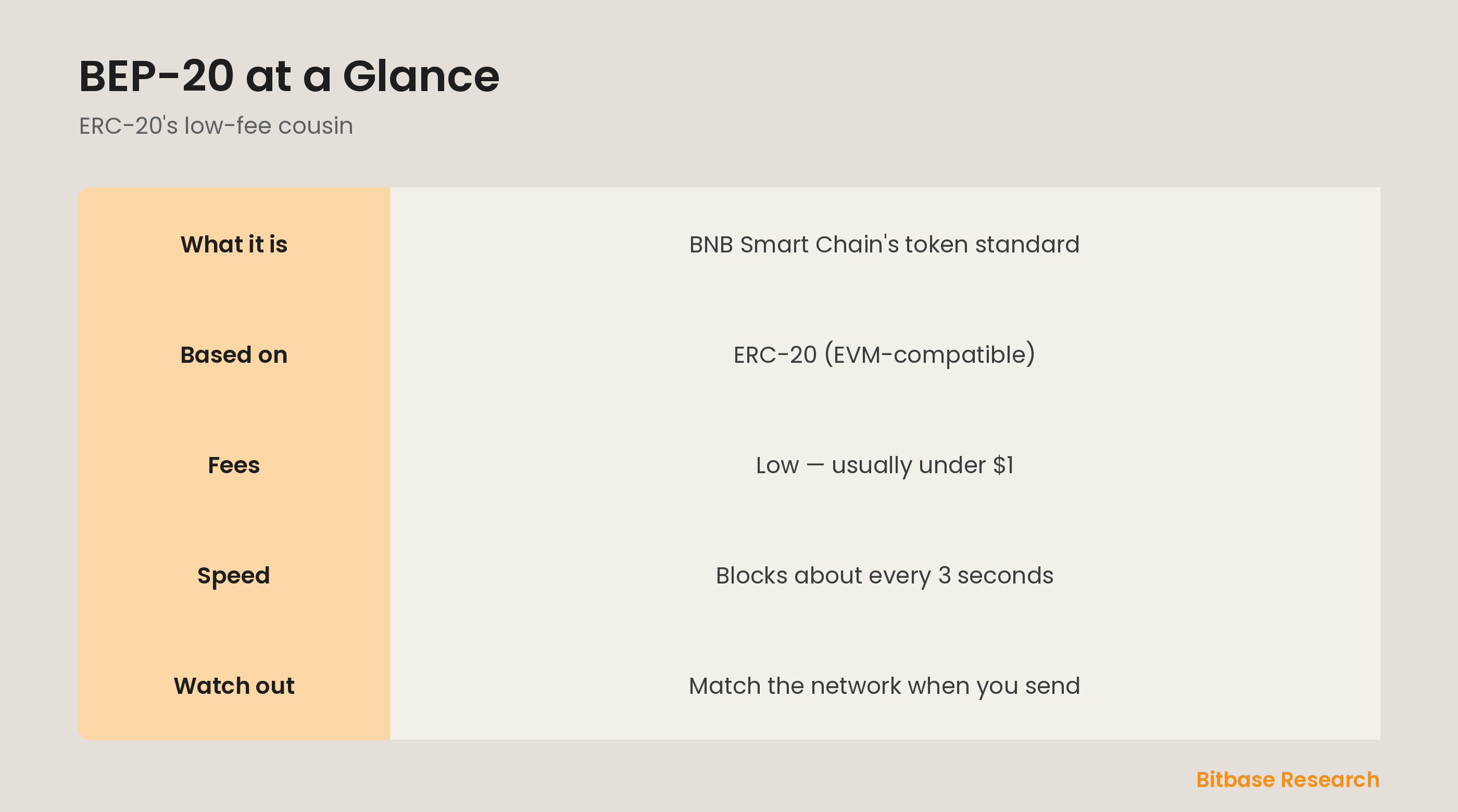
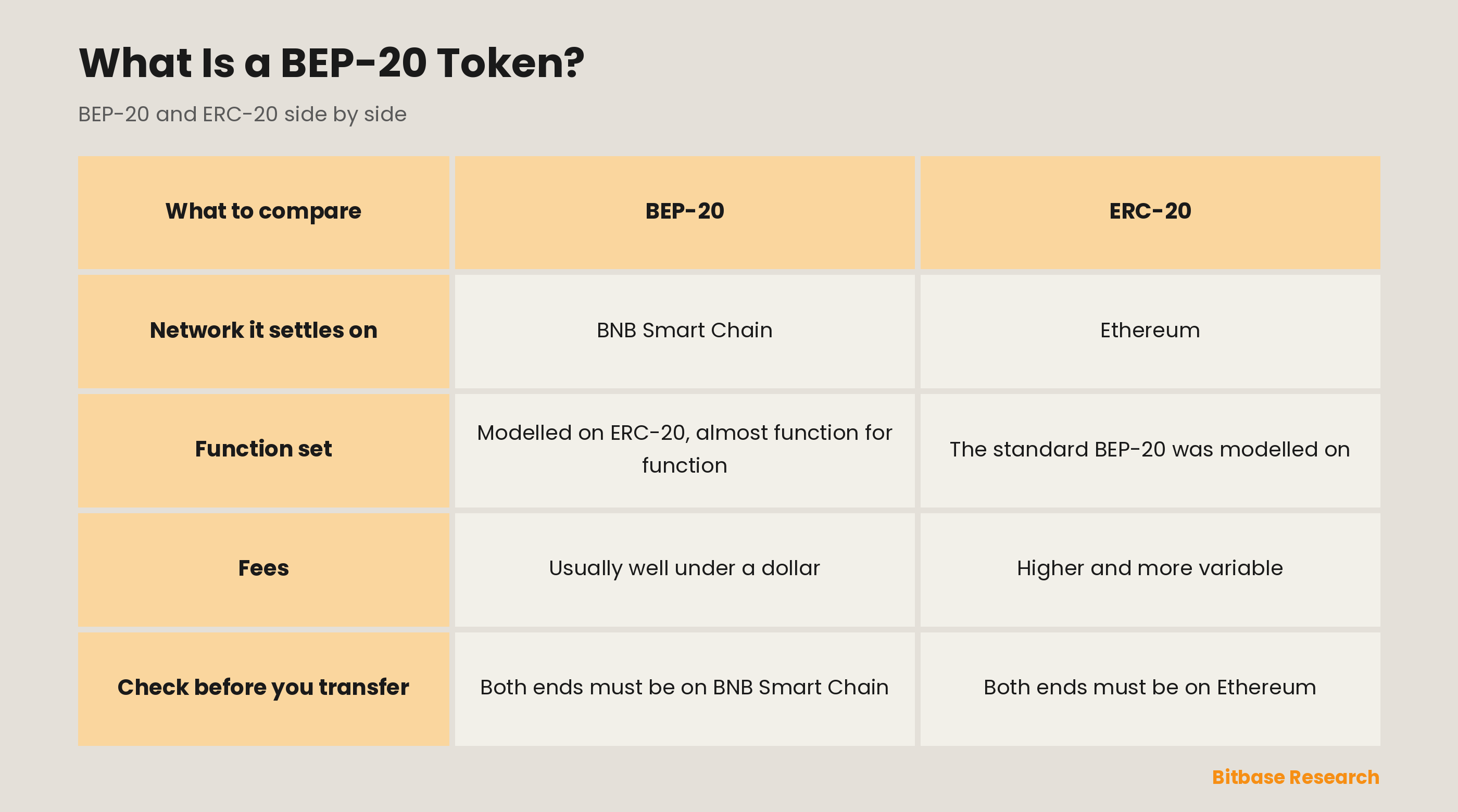
BNB Smart Chain is EVM-compatible, meaning it runs the same kind of smart contracts as Ethereum. As a result BEP-20 mirrors ERC-20 almost function for function, and developers can port a token from one chain to the other with little change. The practical difference is not the code but the network underneath: BEP-20 tokens settle on BSC, ERC-20 tokens on Ethereum. (An older standard, BEP-2, ran on the separate BNB Beacon Chain; most activity today uses BEP-20.)
Fees and speed
The reason BEP-20 exists is cost. BNB Smart Chain produces a block roughly every three seconds and charges fees that are usually well under a dollar, compared with Ethereum's higher and more variable gas. That makes BEP-20 a popular choice for everyday transfers and for users priced out of Ethereum during congestion. It sits between the two extremes — cheaper than ERC-20, though not always as cheap or fast as Tron's TRC-20.
The rule to remember
Because the same asset — say a dollar stablecoin — can exist as an ERC-20, a BEP-20, and a TRC-20 token, the network you choose matters when you send or withdraw. Sending a BEP-20 token to an address expecting ERC-20, or picking the wrong network on an exchange, can cause the funds to be lost. Always confirm that the sending and receiving networks match before you transfer.
BEP-20 and ERC-20 side by side
BEP-20 Transfer Checklist
Before you move a BEP-20 token, work through five checks. Select BNB Smart Chain as the network; confirm that the receiving platform accepts BEP-20 deposits; verify the token contract address if there is any doubt; keep enough BNB in the wallet to cover network fees when you send from self-custody; and send a small test transaction first when the amount is large.
The bottom line
BEP-20 is BNB Smart Chain's version of the ERC-20 standard: the same familiar token behaviour, on a faster and much cheaper network. It is a practical middle ground for moving stablecoins and tokens without high fees. Just remember that a BEP-20 token lives on BNB Smart Chain — and match the network on both ends before you hit send. To keep learning the fundamentals, follow more from Bitbase Academy.
Frequently asked questions
Is BEP-20 the same as BNB?
No. BNB is the native asset of BNB Smart Chain and is what pays the network fees. BEP-20 is the token standard that defines how other, compatible tokens behave on that network, including many of the stablecoins built on top of it.
Is BEP-20 the same as BNB Smart Chain?
No. BNB Smart Chain is the network itself, while BEP-20 is a technical standard that runs on it. The standard sets the functions a token must support — checking balances, transferring, approving spends — so wallets and apps can handle any BEP-20 token the same way.
Can I send BEP-20 tokens to an ERC-20 address?
Not directly. A BEP-20 token settles on BNB Smart Chain while an ERC-20 token settles on Ethereum, so sending one to an address that expects the other, or picking the wrong network on an exchange, can cause the funds to be lost. Confirm that the sending and receiving networks match, and that the receiving platform accepts BEP-20 deposits, before you transfer.
How do I find a BEP-20 token contract address?
Take it from the project's own official channel and cross-check it on a BNB Smart Chain block explorer before you use it. This is the verification step in the checklist above: a token name on its own does not identify a token, because anyone can deploy a contract under a name that already exists.
Related market pages
Bitbase pages for the tokens named in this article:
- BNB: View price · Spot market · Perpetual market
Related reading
Other Bitbase articles on this topic:
- Valuation Multiples for Tokens: P/F, P/S and FDV-to-Revenue
- Utility, Security, and Governance Tokens
- Treasury and Ecosystem Allocations
Disclaimer: This article is educational content from Bitbase Academy, provided for information only. It does not constitute investment, trading, tax, or financial advice. Crypto assets are volatile; assess your own risk. Written as of June 2026; refer to the latest official information.
References
[1] BNB Chain, "BNB Smart Chain Documentation" docs.bnbchain.org
[2] Investopedia, "What Is BNB? Definition, How It Works, Trading" investopedia.com
[3] Ethereum.org, "ERC-20 Token Standard" ethereum.org