
A meme coin is a cryptocurrency whose attention comes mainly from internet culture, community sharing, narratives, and market sentiment. Some meme coins do offer community apps or ecosystem functions, but their prices usually react far more sharply to social media hype, liquidity, and large holder movements than the prices of established assets.
Where meme coins come from
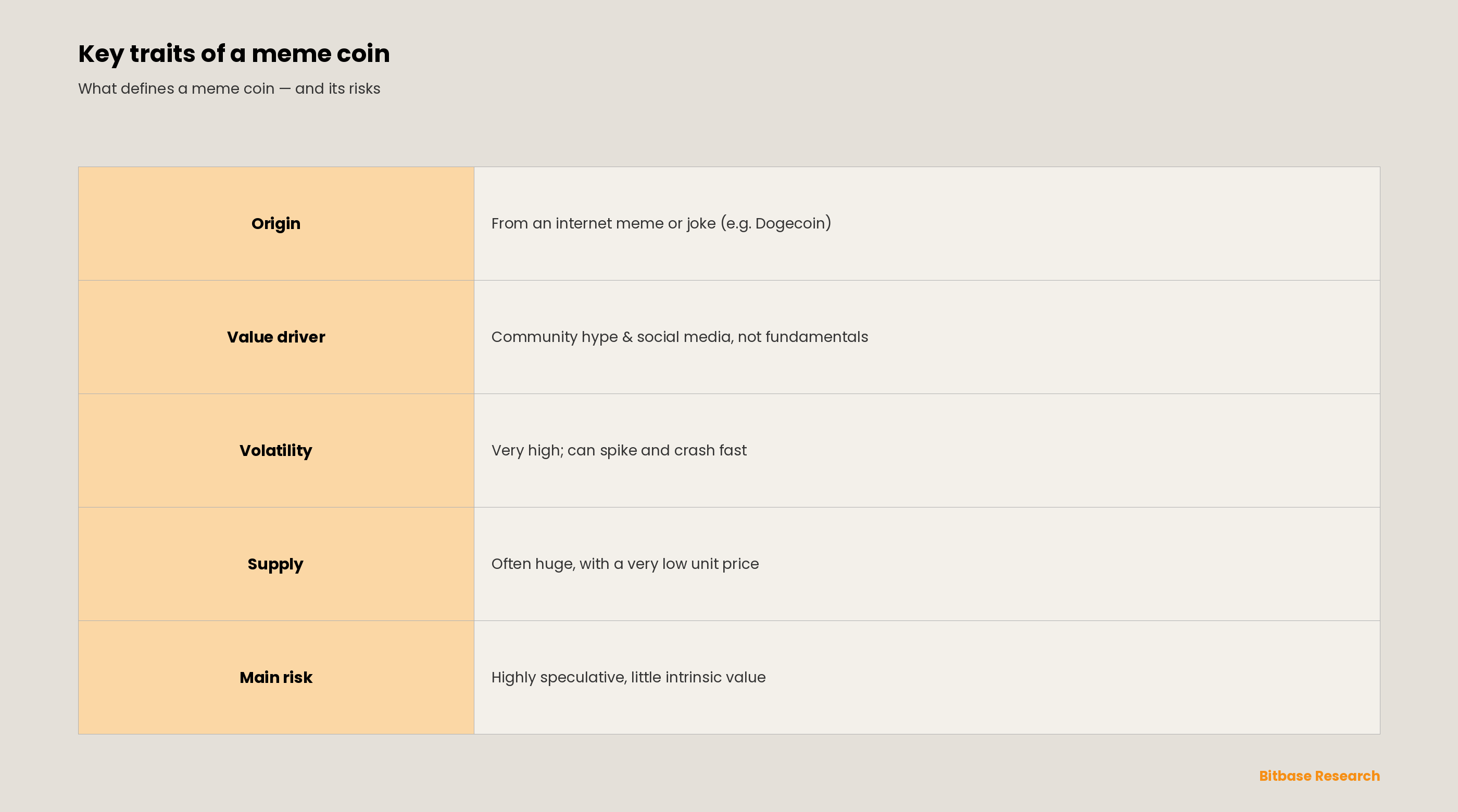
Meme coins start as jokes or references to internet culture. The best-known example is Dogecoin, created in late 2013 by two engineers as a parody of crypto speculation [1]. Despite the humorous origin, some meme coins have grown into multi-billion-dollar markets, especially after high-profile endorsements.
What drives their price
Unlike projects built around a specific use case, meme coins derive value mainly from community enthusiasm, social-media attention, and speculation [2]. That can send prices up sharply when hype builds — and down just as fast when interest fades, since there is little fundamental value underneath.
Key traits at a glance
The risks
Meme coins are among the most speculative assets in crypto. Many have enormous supplies and very low unit prices, and a large share lose most of their value once the initial hype fades. "Pump-and-dump" schemes are also common. Never put in more than you can afford to lose.
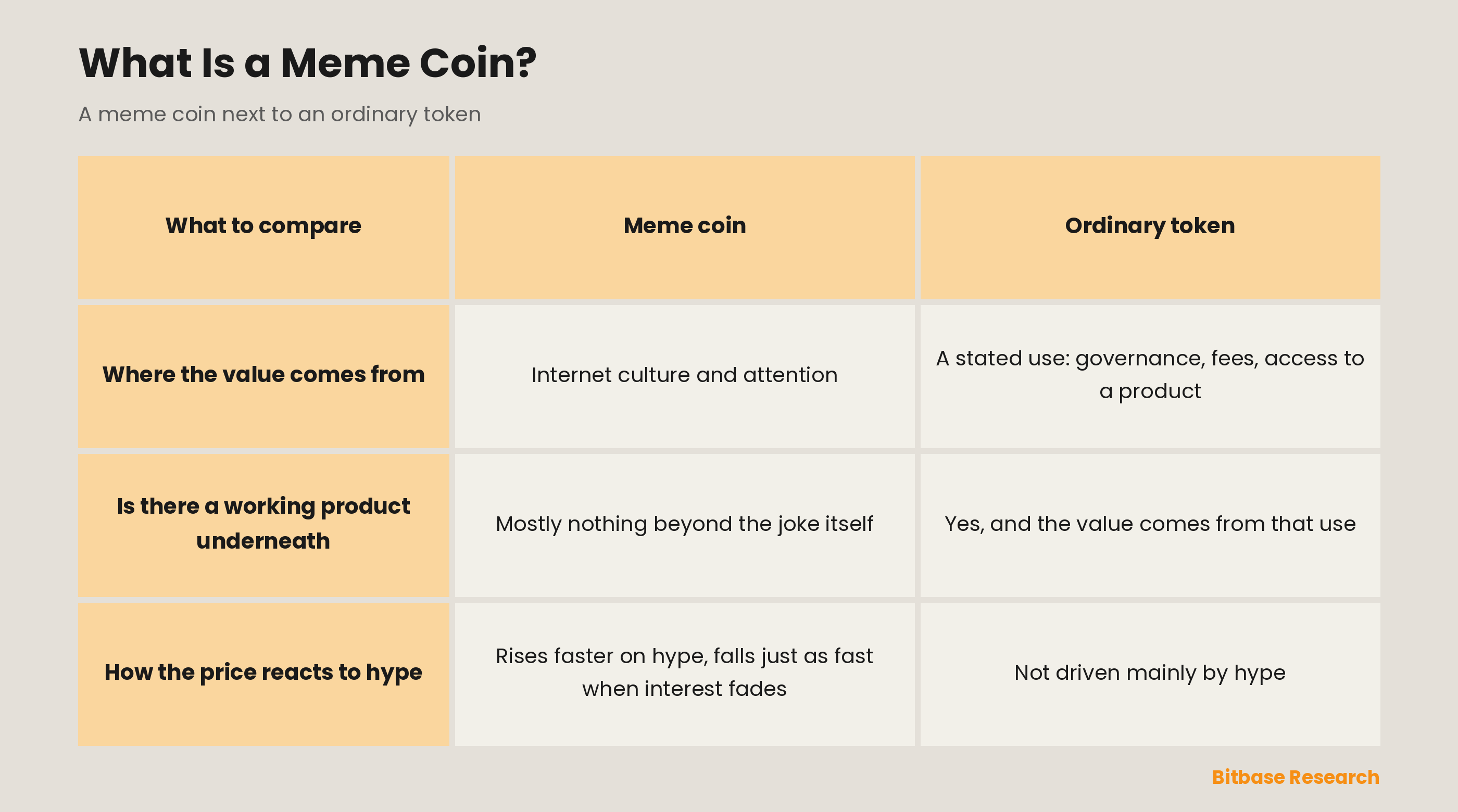
A meme coin next to an ordinary token
What to Check When Judging Meme Coin Risk
A few things are worth checking first when you weigh up a meme coin's risk: the share of supply held by the top ten addresses, how deep the liquidity is, what permissions the token contract still keeps, whether a large unlock is still ahead, whether attention on social media has spiked unusually, and whether copycat tokens or fake contract addresses are circulating.
The bottom line
A meme coin is a community- and hype-driven token with little intrinsic value. Prices can move fast in both directions, so understand the risks before getting involved. To keep learning the fundamentals, follow more from Bitbase Academy.
Frequently asked questions
Do meme coins have any real use?
Some meme coins add community features or a role in their ecosystem over time, but most have no use beyond the joke itself. A meme coin's price comes mainly from community enthusiasm, social-media attention and speculation, not from a working product.
Why do so many meme coins have such large supplies?
A large supply is a marketing choice: an enormous token count keeps the unit price at a fraction of a cent, which makes the coin feel cheap. It changes nothing about what the project is worth — the figure that matters is total market cap, not the price of a single token.
What is the difference between a meme coin and an ordinary token?
An ordinary token draws its value from a stated use — governance, fees, access to a product — while a meme coin draws it from internet culture and attention. That is why a meme coin's price rises faster on hype and falls just as fast once interest fades.
How can you tell whether a meme coin is too concentrated?
Look the token up on a blockchain explorer and check how much of the supply the largest addresses hold. When a handful of wallets hold a large share, a single sale can move the price sharply, and thin liquidity makes that move worse.
Related reading
Other Bitbase articles on this topic:
- What Is TREAT? Shiba Inu Ecosystem Roles and Boundaries
- Meme Coin Lifecycle and Hype
Disclaimer: This article is educational content from Bitbase Academy, provided for information only. It does not constitute investment, trading, tax, or financial advice. Crypto assets are volatile and meme coins especially so, which can lead to a total loss of capital. Written as of June 2026; refer to the latest official information.
References
[1] Charles Schwab, "What Is a Meme Coin? Risks, Regulation, and More." schwab.com
[2] Bitpanda Academy, "Meme Coins: Definition & Characteristics." bitpanda.com