
A validator is a participant in a proof-of-stake (PoS) blockchain responsible for validating new transactions and keeping the network secure. To become one, you lock up a set amount of the network's native token as "collateral" to vouch for your honesty. This guide explains it.
How it works
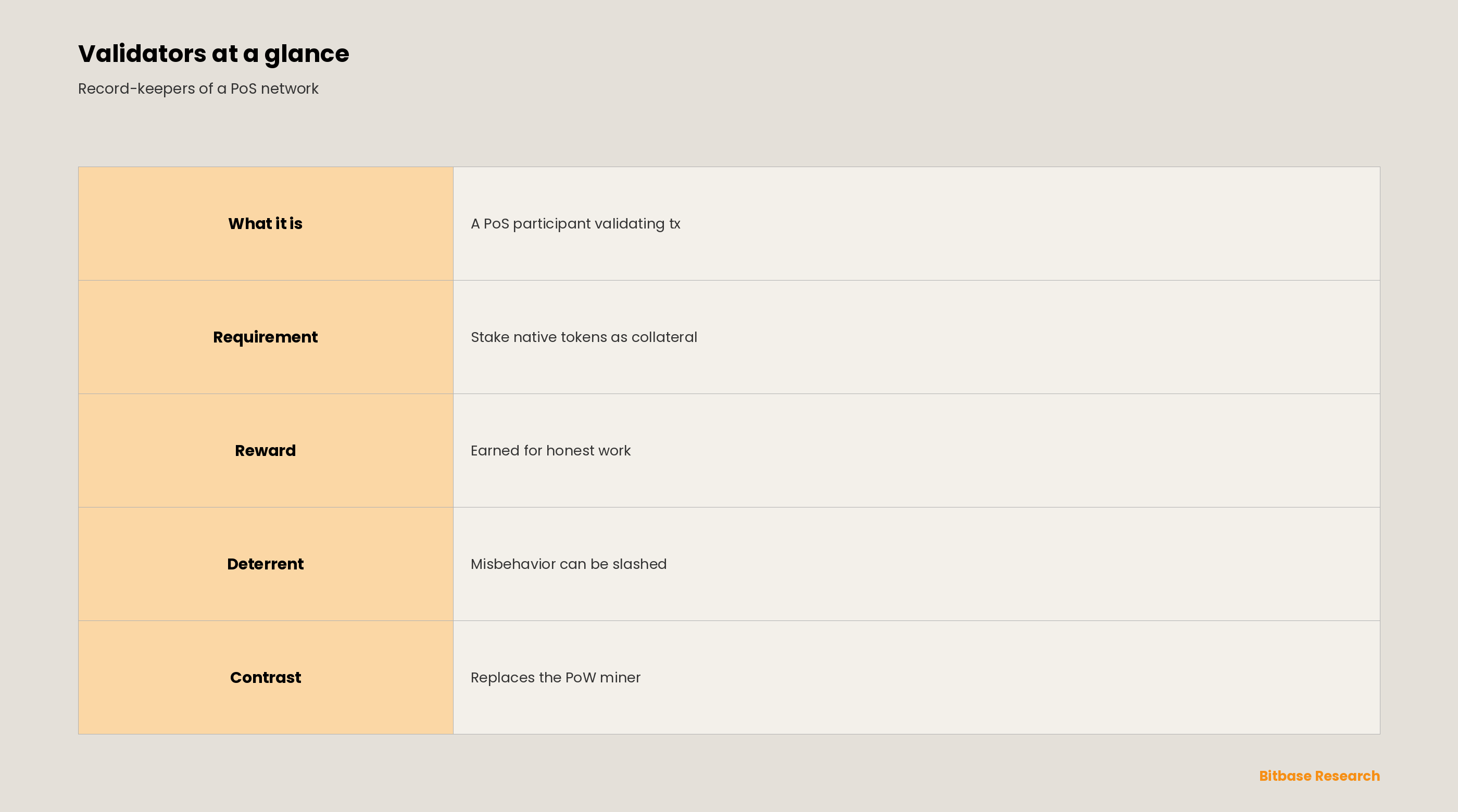
A validator supports the network by staking its own crypto [1]. That stake acts as collateral: if the validator works honestly, it earns rewards; if it misbehaves — for example, by trying to cheat — its stake can be "slashed," which keeps it honest [2].
Validators at a glance
How it differs from a miner
In proof of stake, a validator replaces the "miner" role from proof of work (PoW). Miners compete with computing power to add blocks, while validators are chosen through their stake and randomness — usually far more energy-efficient. Both maintain the ledger, but the mechanisms differ.
The bottom line
A validator is a participant in a PoS network that validates transactions and secures it through staking. Understanding validators helps you see how proof-of-stake networks run. To keep learning the fundamentals, follow more from Bitbase Academy.
Related reading
Other Bitbase articles on this topic:
- Validator Economics: Commission, Fee Revenue and Break-even
- Capricorn Tech, Formerly aPriori: APR, aprMON, and Order Flow on Monad
- Validator Operations Explained: The Job Behind Staking
Disclaimer: This article is educational content from Bitbase Academy, provided for information only. It does not constitute investment, trading, tax, or financial advice. Written as of June 2026; refer to the latest official information.
References
[1] Ledger, "What Is a Blockchain Validator?" ledger.com
[2] Crypto.com, "Validator." crypto.com