
A watch-only wallet lets you monitor wallet addresses, balances and transactions without storing the private keys required to spend the assets. It can be useful for tracking cold-storage funds or allowing view-only access, but it is not a complete wallet backup.
What a watch-only wallet is
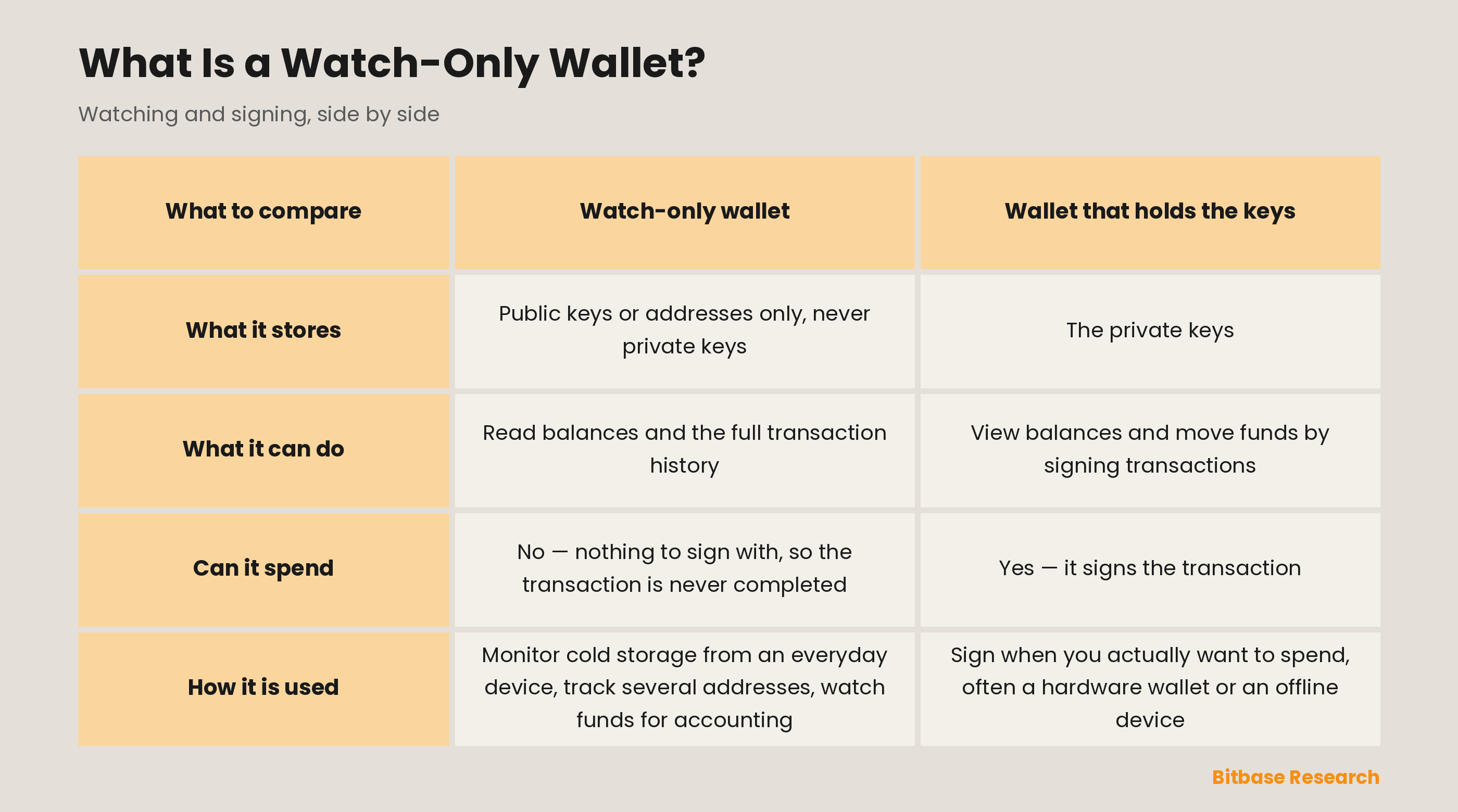
A watch-only wallet is loaded with your public keys or addresses only — never the private keys. Because spending crypto requires a private key to sign the transaction, a wallet that has none simply cannot spend. It can, however, read everything the blockchain shows publicly about those addresses: their balances and full transaction history. It is a window onto your funds, not a door to them.
How it works
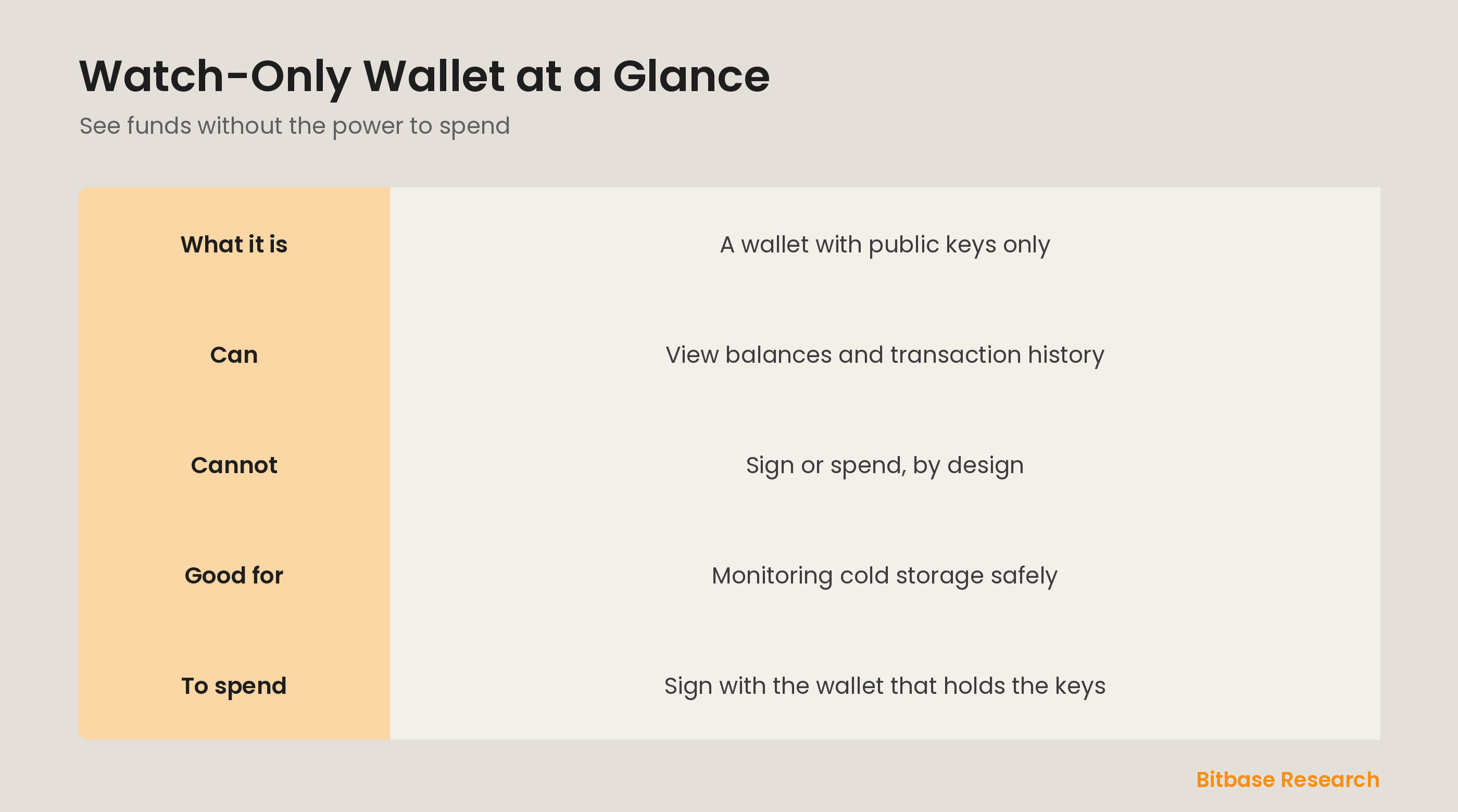
You set one up by importing a public address, or an extended public key that covers many addresses at once, into the wallet app. From then on it tracks incoming and outgoing transactions and updates the balance in real time, just like a normal wallet view. What it lacks is any private key, so when you try to send, there is nothing to sign the transaction with, and the wallet cannot complete it.
Why people use one
The main appeal is safety. You can keep your private keys in cold storage, completely offline, and still check on the funds anytime from a phone using a watch-only wallet — without ever exposing the keys to an internet-connected device. Traders and long-term holders use them to monitor cold wallets, track multiple addresses in one place, and keep an eye on funds for accounting, all with no spending risk.
Its limits and how to spend
By design, a watch-only wallet cannot move funds, so when you do want to spend, you sign the transaction with the wallet that actually holds the keys — often a hardware wallet or an offline device. Keep in mind a privacy point: an extended public key reveals all the addresses it generates, so treat it as sensitive even though it cannot spend. The safety comes from separating watching from signing.
Common Uses
People reach for one when they are monitoring cold wallet balances, doing accounting or portfolio tracking, giving team members view-only access, or tracking several public addresses in one interface.
Key Risks
Importing an xpub may reveal groups of related addresses. A watch-only wallet is not a recovery backup. Fake wallet apps may claim that additional secrets are required. Address privacy can be reduced when multiple addresses are grouped together.
Watching and signing, side by side
The bottom line
A watch-only wallet holds only public keys, letting you view balances and transaction history while making spending impossible. That makes it a safe way to monitor cold storage or track addresses from an everyday device without exposing your private keys. When you need to actually move funds, you sign with the wallet that holds the keys — keeping watching and spending cleanly apart. To keep learning the fundamentals, follow more from Bitbase Academy.
Frequently asked questions
Can a watch-only wallet send crypto?
A watch-only wallet cannot send crypto, because spending requires a private key to sign the transaction and this kind of wallet holds none. Trying to send simply leaves the wallet with nothing to sign, so the transaction is never completed.
Is a watch-only wallet safe?
Safety is exactly the point: with no private keys stored, there is nothing on the device that could be used to move the funds. One privacy caveat remains, since an extended public key reveals every address it generates, so treat that key as sensitive even though it cannot spend.
Is a watch-only wallet a backup?
A watch-only wallet is not a backup, because it holds only public keys or addresses and cannot restore the ability to spend. Your backup is still the recovery phrase, or the wallet that actually holds the private keys.
What is the difference between a watch-only wallet and a hardware wallet?
A hardware wallet holds the private keys and signs transactions, so it can both view balances and move funds. A watch-only wallet holds no keys at all and can only view; in practice the two are often used together, watching from an everyday device and signing on the one that holds the keys.
Related reading
Other Bitbase articles on this topic:
- Multisig Inheritance and Dead-Man Switches
Disclaimer: This article is educational content from Bitbase Academy, provided for information only. It does not constitute investment, trading, tax, or financial advice. Crypto assets are volatile; assess your own risk. Written as of June 2026; refer to the latest official information.
References
[1] Investopedia, "Private Key: What It Is, How It Works, Best Ways to Store" investopedia.com
[2] Investopedia, "Cold Wallet: What It Is, How It Works, Types, and Examples" investopedia.com
[3] Investopedia, "Hot Wallet: Definition, Types, Examples, and Safety Tips" investopedia.com