Aave is a decentralised, non-custodial liquidity protocol on Ethereum and other networks: suppliers deposit assets into shared pools, borrowers draw from them against over-collateralised positions. Its governance token is AAVE and its native stablecoin is GHO. This article separates V3, V4, Horizon and GHO, and marks which claims a reader must check independently.
What Is Aave?
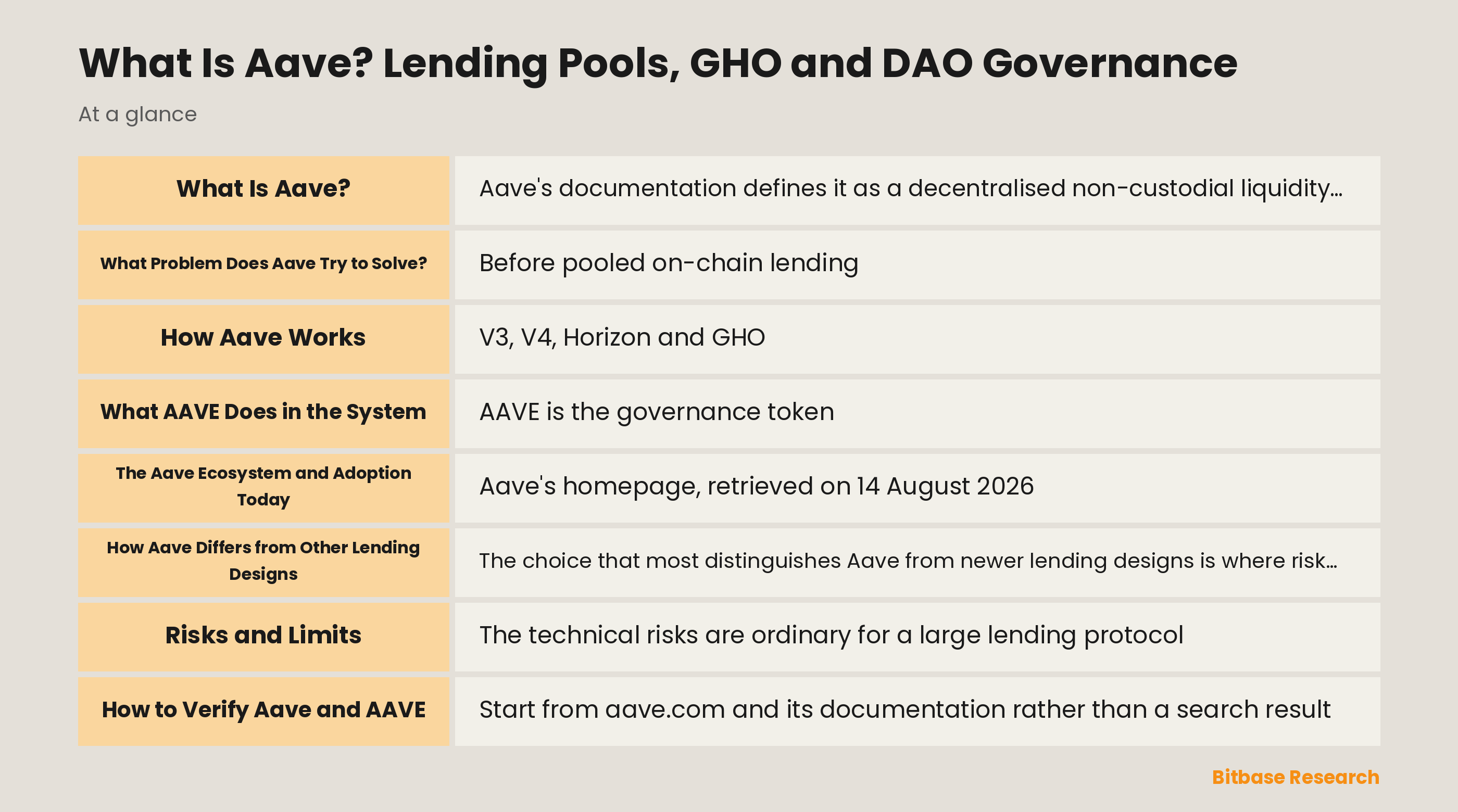
Aave's documentation defines it as a decentralised non-custodial liquidity protocol in which users act as suppliers or borrowers: suppliers provide liquidity and earn interest, borrowers access liquidity by posting collateral worth more than they borrow. The contracts are open source and deployed on Ethereum and other permissionless blockchains. AAVE is the governance token, an ERC-20 on Ethereum mainnet; GHO is a separate over-collateralised stablecoin.
Three entities must be kept apart. The Aave Protocol is the set of self-executing contracts. Aave Labs is a development company; the footer of aave.com states that it "does not control or operate any version of the Aave Protocol on any blockchain network". The Aave DAO is the token-holder body approving deployments, parameters and budgets. Sites like app.aave.com and pro.aave.com are front ends published by a company, not the protocol.
What Problem Does Aave Try to Solve?
Before pooled on-chain lending, borrowing against a crypto asset generally meant handing it to a counterparty: a lending desk, an exchange product, a bilateral agreement. Terms were private, the lender's book was not publicly auditable, and depositors carried that firm's custody practices and solvency as unpriced risk.
Aave's stated proposition is to replace that counterparty with public contracts: rates follow a utilisation curve rather than a negotiation, collateral requirements are governance-set parameters, and every position is inspectable on-chain. That is the project's claim about its design, not a verdict on outcomes. Counterparty risk is exchanged for contract, oracle, parameter and governance risk — different failure modes, not fewer of them.
How Aave Works: V3, V4, Horizon and GHO
Four things carry the Aave name and they are not interchangeable. V3 is the long-running market design: each deployment is a pool of reserves, a user supplies an asset, receives an interest-bearing aToken, then borrows against it. A position's health factor is eligible collateral value divided by debt value; below 1, anyone may liquidate it.
V4 is documented as a hub-and-spoke redesign. A Liquidity Hub consolidates protocol-wide liquidity and accounting and issues each Spoke a credit line for borrowing and a debit line for supplying; Spokes are modules handling a specific use case, asset type or risk profile with their own parameters. The documentation says this evolves V3's market-per-pool structure so governance can add markets without migrating liquidity, and describes a rebuilt liquidation engine with a Spoke-level target health factor. Aave Pro is the front end for V4.
Horizon is documented as an Aave Labs initiative and a licensed, separate instance of the protocol, initially forked from v3.3, for institutional and qualified participants. Its structure is deliberately asymmetric: tokenised real-world assets can be supplied as collateral only by users allowlisted by the issuer, the receipt tokens are non-transferable, stablecoin liquidity such as USDC, RLUSD and GHO is supplied permissionlessly, and only suppliers of permissioned RWA collateral may borrow. Any deposit figure published for Horizon belongs to Horizon alone; it is not the protocol's total value locked.
GHO is the system's native over-collateralised stablecoin, an ERC-20 originated on Ethereum mainnet and carried to other networks through Chainlink CCIP, approved by governance as the messaging bridge. It is minted on demand by facilitators — contracts approved by governance, each capped by a bucket capacity — with the Aave v3 Ethereum market as a primary facilitator, so a user mints GHO by borrowing it against collateral. It is liquidatable like any other borrow.
What AAVE Does in the System
AAVE is the governance token. Holders, and holders of staked AAVE (stkAAVE), can vote on proposals or delegate voting power, covering deployments, parameter adjustments and features. The documentation lists AAVE's Ethereum mainnet contract as 0x7Fc66500c84A76Ad7e9c93437bFc5Ac33E2DDaE9, with separate deployments on Arbitrum, Base, Optimism and Polygon — a different network means a different address.
AAVE can also be supplied as collateral and staked in the safety layer, which is being replaced. Umbrella, built by BGD Labs and approved by governance, lets users stake aTokens or GHO so those assets can be burned automatically to offset a deficit in that asset on that network. Staking is an exposure, not a guarantee: the documentation states that stakers accept slashing, and that although a deficit offset absorbs a first tranche, the design permits slashing up to the full staked amount.
On supply, the documentation describes a DAO buyback approved in August 2024 and executing since April 2025, with a $50 million annual budget and weekly purchases of $250,000 to $1.75 million, run by a four-member Aave Finance Committee multisig. Acquired tokens go to the DAO Ecosystem Reserve and are spent through governance-approved programmes rather than burned — a treasury mechanism, not a supply reduction.
The Aave Ecosystem and Adoption Today
Aave's homepage, retrieved on 14 August 2026, states six-plus years of uninterrupted operation, $3.46 trillion in lifetime deposits, $1 trillion in lifetime borrows, $88.44 billion of monthly volume across markets and an annual SOC 2 Type 2 security audit. Each is project-reported on a project-controlled page, several without a stated measurement window; re-fetch them on the day of publication.
The same site publishes integration case studies naming MetaMask, Kraken, Whop, Cap, Ethena and Kinexys by J.P. Morgan — again Aave's own descriptions of those relationships. What is independently checkable differs: proposals and discussion threads are public at governance.aave.com, and the documentation lists deployed addresses for AAVE, GHO, Umbrella and the Horizon pool.
How Aave Differs from Other Lending Designs
The choice that most distinguishes Aave from newer lending designs is where risk decisions live. V3 markets are broad shared pools whose collateral factors, caps and liquidation thresholds are set by DAO governance, so a parameter change is a public political process. Designs built around isolated markets or curated vaults push those decisions to whoever deploys a market, containing a bad parameter but spreading accountability. V4's Spokes move Aave partway toward modular isolation while keeping accounting in the Hub.
Two further differences are worth naming without ranking them. Aave issues its own stablecoin through the facilitator model rather than only intermediating stablecoins issued elsewhere, so GHO's supply mechanics and peg maintenance are governance responsibilities. And Horizon inverts the usual permissioning — the collateral side is allowlisted, the liquidity side open — introducing issuer-level administrative powers absent from the permissionless markets.
Risks and Limits
The technical risks are ordinary for a large lending protocol: contracts can contain defects, oracles can misprice, liquidations can fail to clear a position in thin markets. Horizon adds a different oracle risk, since RWA prices come from a net asset value reported by the issuer, mitigated by a Chainlink oracle network validating each update against pre-set bounds. The known historical case is November 2022, when a large CRV short position on Aave was liquidated and left the protocol with roughly $1.6 million of bad debt, later cleared by a governance-approved CRV purchase; that was a known limitation of the liquidation mechanism under extreme market conditions and thin liquidity, not a theft and not an exploit. Nothing here means deposits are protected: Umbrella coverage is capped by what is staked in that asset on that network, and it can be exhausted.
The 2026 governance dispute is unresolved and belongs here in full. A framework proposal from Aave Labs, "Aave Will Win", which would route 100% of product revenue to the DAO treasury in exchange for development funding of roughly $42.5 million in stablecoins plus 75,000 AAVE, passed on 1 March 2026 with 52.58% support, reported at 622,300 for, 497,100 against and 64,200 abstaining. The Aave Chan Initiative (ACI), led by Marc Zeller, publicly contested the result, stating that more than 233,000 AAVE held or delegated by addresses it identified as linked to Aave Labs and a co-founder had decided the vote. On 3 March 2026 ACI posted on the governance forum that it would not seek renewal and would wind down over four months. BGD Labs, the team that built and maintained the V3 codebase, had already announced it was ending its contribution, citing governance alignment and centralisation concerns.
All three items are the statements of the parties involved. No third party has adjudicated ACI's allegation about the identity or intent of those voting addresses, and no regulator or court has ruled on the dispute. As of August 2026 we could not verify the implementation progress of the "Aave Will Win" framework after March 2026, nor whether ACI's four-month wind-down has concluded, so this article makes no statement either way. The structural point survives: when voting power concentrates in parties that also receive DAO funding, a token holder inherits that risk.
On regulation, the U.S. Securities and Exchange Commission closed its four-year investigation into Aave in December 2025 without recommending enforcement action, a closure disclosed by co-founder Stani Kulechov and reported on 16–17 December 2025. That closure is not exoneration, does not bar the agency from reopening the matter, and says nothing about other jurisdictions — Aave should not be described as free of regulatory risk. Execution risk is live too: V4 and Horizon have far less operating history than V3, and the Umbrella and sGHO migrations are still under way.
How to Verify Aave and AAVE
Start from aave.com and its documentation rather than a search result, and let the official site point outward to social accounts, not the reverse. Read the four products as four things: aave.com/docs separates V3, V4, Horizon and GHO into their own sections, and any article blending their numbers has gone wrong. Where a figure is quoted, check which of the four it describes.
For the token, take the contract address from the documentation — aave.com/docs/ecosystem/aave lists Ethereum mainnet as 0x7Fc66500c84A76Ad7e9c93437bFc5Ac33E2DDaE9, with separate Arbitrum, Base, Optimism and Polygon deployments — and paste it into that network's block explorer. Confirm the chain matches the one claimed, the source code is verified, and the name and ticker agree; read supply from on-chain data and governance records, not aggregator sites.
For governance, governance.aave.com is the primary record: proposals, temp checks and resignation posts carry dates, and a forum thread outranks a summary of it. Audit reports should be findable on the auditor's own site, not only as a project-hosted PDF. Compare any domain character by character, be sceptical of paid search placements, and stop at any page asking you to connect a wallet to claim or rescue funds.
Conclusion
Aave is a non-custodial lending protocol built around over-collateralised borrowing from shared pools, spanning V3 markets, the V4 hub-and-spoke design, the separate Horizon instance and the GHO stablecoin. AAVE is its governance token: it votes, it can be staked into a safety layer carrying slashing risk, and it is the subject of a treasury buyback that is not a burn. The biggest open question in 2026 is political, not technical, and no third party has adjudicated the competing claims. Verify the contract address on a block explorer, read the four products separately, and treat headline totals as project-reported.
Related market pages
Bitbase pages for the tokens named in this article:
- AAVE: View price · Spot market · Perpetual market
Related reading
Other Bitbase articles on this topic:
- CEX vs DEX: Centralized vs Decentralized Exchanges
Disclaimer: This article is educational content from Bitbase Academy, provided for information only. It explains what a project does and what role its token plays in that system; it does not constitute investment, trading, tax, or financial advice, and it is neither a recommendation nor an endorsement of any project or token. Bitbase has not carried out due diligence on the project described here, and mentioning it does not mean Bitbase lists or supports the asset. Crypto assets carry significant risk, including price volatility, thin liquidity, smart-contract failure, regulatory uncertainty, and the possible loss of their entire value. Written as of August 2026; a project's status, tokenomics, team, and contracts can change at any time. Verify everything yourself through official channels, the contract address, and a block explorer, and beware of imitation sites and phishing links.
References
[1] Aave official homepage (self-reported operating metrics, retrieved 14 August 2026) aave.com
[2] Aave v4 Overview: Hub and Spoke liquidity model (Aave official documentation) aave.com
[3] Aave Horizon RWA Market (Aave official documentation) aave.com
[4] GHO stablecoin: facilitators, bucket capacity and cross-chain deployments (Aave official documentation) aave.com
[5] AAVE Token: governance, buyback programme and contract addresses by network (Aave official documentation) aave.com
[6] Umbrella: automated bad-debt coverage, slashing risk and Safety Module transition (Aave official documentation) aave.com
[7] Temp Check: Aave Will Win Framework (Aave governance forum thread) governance.aave.com
[8] ACI is leaving Aave, by Marc Zeller, 3 March 2026 (Aave governance forum) governance.aave.com
[9] BGD Labs to cease Aave contributions after four years as governance tensions grow (The Block) theblock.co
[10] SEC ends four-year probe into Aave with no enforcement action, December 2025 (Unchained) unchainedcrypto.com