
Capricorn Tech is the renamed aPriori, a liquid staking and order-flow project built on Monad, and its token is still called APR. This article separates the four names a reader will run into, explains what APR and aprMON actually do, sets out the disputed October 2025 airdrop, and gives you a way to confirm which brand and which contract you are looking at.
What Is Capricorn Tech?
Capricorn Tech is the current name of the project that launched as aPriori. Its site is capricorn.tech, apr.io redirects there, the documentation now sits at a capricorn-docs address that the old apriori-docs link forwards to, and the site describes the project in one line as an intelligent order flow coordination layer for high-performance blockchains. The token kept its old symbol: it is still APR, and the token page in the documentation is still headed Introducing APR.
Four names have to be kept apart or nothing else in this article will make sense. Monad is the blockchain, and it is not operated by Capricorn. MON is Monad's own asset. aprMON is Capricorn's liquid staking token, issued when MON is staked through Capricorn. APR is Capricorn's own token, and the documentation states that it launched on Ethereum and can be claimed on both Ethereum and BNB Chain, with the bulk of remaining supply intended to unlock on Monad.
The half-finished rename is itself a safety fact rather than a cosmetic detail. A reader searching for this project will land on pages carrying the old brand and pages carrying the new one, both legitimately: the careers page still sits under an apr path, the team's writing is published under a 0xapr address, and the docs link on the homepage still points at the old documentation domain. When two brands both look real, an impersonator only has to pick the one you have not seen before, which is why the section at the end of this article insists on starting from a domain you typed yourself.
What Problem Does Capricorn Tech Try to Solve?
The problem it names is fragmented execution. On a fast chain, transaction ordering is contested: the sequence in which trades land determines who captures value, and the surplus extracted by reordering leaks out of the system to whoever is fastest rather than flowing back to the people who supplied the capital. Meanwhile liquidity sits in pools spread thinly across a price range, so a trader pays more slippage than the underlying market would imply.
The project's stated answer joins two things that are usually separate. Its documentation describes an architecture resting on two pillars: an exchange that concentrates liquidity tightly around the real-time asset price and anchors it with low-latency oracle feeds, and a liquid staking token that accrues both staking rewards and revenue associated with transaction ordering. The claimed effect is a flywheel in which the staking base deepens the exchange's liquidity while trading activity strengthens the yield flowing back to aprMON holders.
That is the project's own framing of its own design, taken from its documentation. It describes an intention and a mechanism, not a measured outcome, and this article does not treat the flywheel as demonstrated.
How Capricorn Tech Works
Staking is the base. A holder of MON stakes through Capricorn and receives aprMON, a reward-bearing liquid staking token: the position keeps accruing while the token itself remains transferable and usable elsewhere in Monad decentralised finance. The documentation describes aprMON as accruing both staking and ordering-related revenue and as functioning as a core asset inside Capricorn's own markets. There is a smart-contract integration page for developers who want to compose with it.
The exchange is the second pillar. Capricorn Exchange is described as a composable decentralised exchange that concentrates liquidity around the live price rather than spreading it uniformly, with oracle feeds used to keep that concentration aligned as the price moves, and with its liquidity exposed to aggregators and other applications rather than kept private. The stated goal is execution quality comparable to a centralised venue while remaining composable.
The rest of the surface is smaller than the marketing implies. The homepage navigation offers exactly four actions: stake, bridge, exchange and lock. The bridge is not Capricorn's own; it routes through a third-party bridging service between Ethereum and BNB Chain. Two live counters sit on the homepage, reading roughly 27.18 million MON in total value locked and a little over 5,000 holders. Both are published by the project on its own site and neither is independently audited.
What APR Does in the Capricorn System
The documentation presents APR as the token at the centre of Capricorn Tech and describes it as representing shared participation in the network of order flow and data. That is a broad statement rather than a precise utility list, and it is worth noticing that the introductory documentation page for APR describes what the token represents more clearly than what it does. This article reports the roles the project documents and does not fill the gap with assumptions.
The supply and distribution are documented precisely, and this is the most concrete tokenomics information the project publishes. Total supply is one billion APR, allocated as early backers 16 percent, core contributors 16 percent, foundation 16 percent, genesis airdrop 12 percent, community incentives 22 percent, ecosystem growth 17 percent, and liquidity and market stability 1 percent. Early backers vest over three years with a one-year cliff, releasing 33 percent at twelve months and then quarterly over the following two years. Core contributors vest over four years with a one-year cliff, releasing 25 percent at twelve months and then quarterly over three years. The foundation, community incentives and ecosystem growth allocations each release 10 percent on day one and then vest quarterly over four years.
Three of those numbers deserve to be read together rather than separately. Insiders in the broad sense, meaning early backers plus core contributors, hold 32 percent. The three tranches with day-one unlocks account for 55 percent of supply, of which a tenth was liquid immediately. And the deployment is split across chains: launched on Ethereum, claimable on Ethereum and BNB Chain, with the majority of the airdrop allocation and the remaining supply intended to unlock on Monad. On Ethereum the token contract is 0x5A9610919f5e81183823A2be4Bd1BeB2B4da2a20; a token carrying the same ticker at any other address, on that chain or another, is a different token. A cross-chain token means a per-chain contract address, which is why the verification section below refuses to accept an address without a network label.
The Capricorn Ecosystem and Adoption Today
The ecosystem strip on the homepage names Monad itself alongside wallets and applications including Phantom, Backpack, Curvance, Hedgemony, Narwhal, PancakeSwap, Townesquare and LFJ. As with any logo wall, a mark on that page records a relationship the project chose to display; it is not evidence of an audited integration, a commercial agreement, or an endorsement of the token by the named party.
The two live figures the site publishes are total value locked, expressed in MON rather than in dollars, and a holder count. Expressing locked value in the underlying asset is more honest than a dollar figure that moves with price, and it is also the reason the number cannot be compared directly with dollar-denominated figures elsewhere. Both counters are self-reported, both move, and neither carries a timestamp on the page.
The important context is that Monad itself is young. A liquid staking token is only as established as the network it stakes, the validator set it delegates to and the applications that accept it as collateral. Capricorn's position is therefore doubly dependent: on Monad's own trajectory and on other builders choosing aprMON over alternatives. Neither of those is settled, and this article does not predict either.
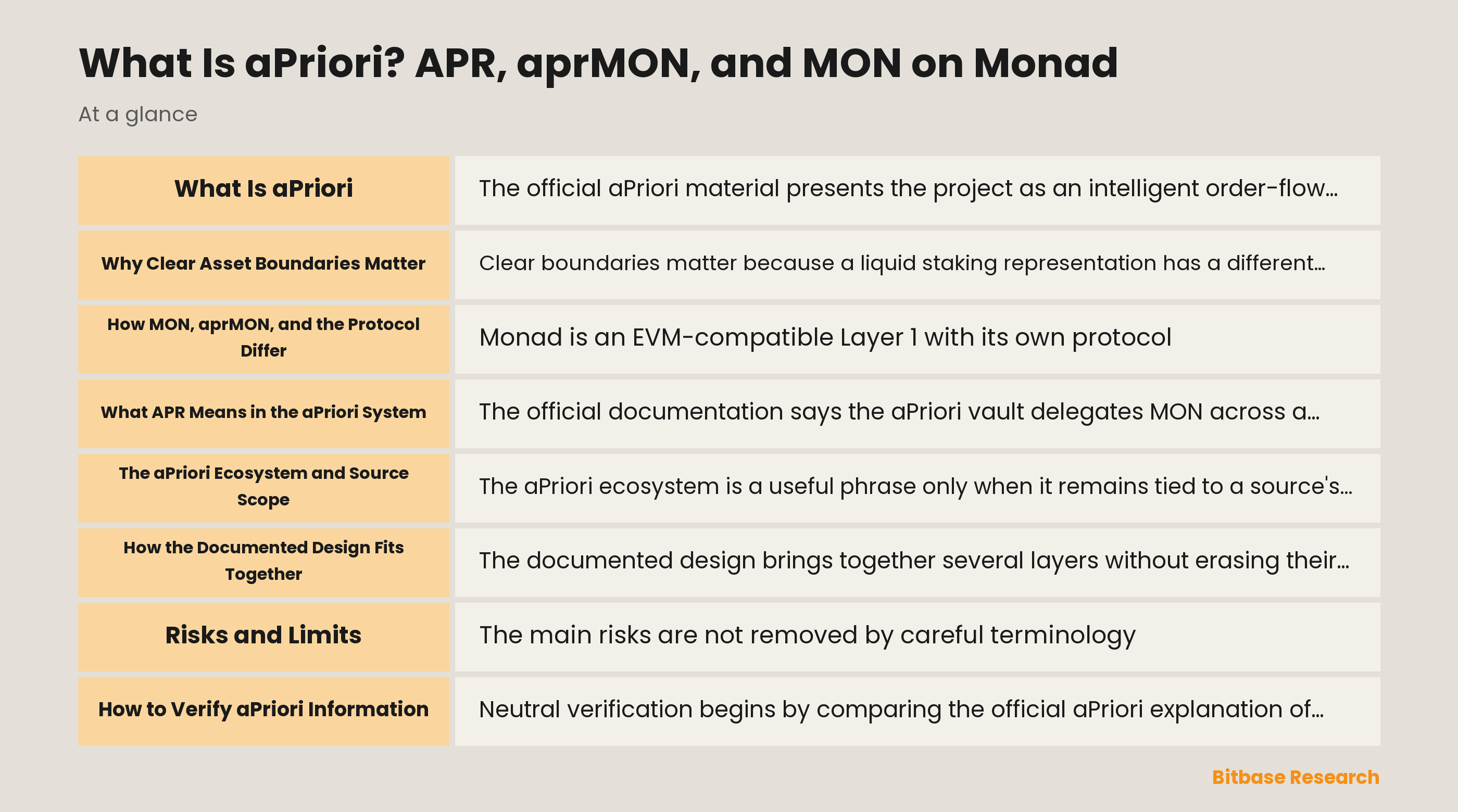
How Capricorn Differs from a Plain Liquid Staking Protocol
A conventional liquid staking protocol does one thing: it takes a network asset, delegates it to validators, and issues a receipt token that accrues the staking reward. Its revenue comes from a cut of that reward, and its competitive surface is validator selection, fee level and how widely the receipt token is accepted as collateral.
Capricorn's design adds a second revenue path and ties the two together, so that yield on the receipt token is meant to come from ordering-related revenue as well as base staking rewards, and the exchange is meant to be deepened by the staked base rather than by rented liquidity. The trade-off follows from the design rather than from any judgement about quality: a protocol earning from transaction ordering is exposed to how that ordering is arranged and to how the underlying chain evolves, which a pure delegation protocol is not. Different mechanism, different surface, not a ranking.
Risks and Limitations
The disputed airdrop belongs first because it is the largest open question about this project and because the project has not resolved it. Following the October 2025 genesis distribution, on-chain analysts reported that a single coordinated cluster of roughly fourteen thousand wallets claimed a majority of the airdrop, putting its share above 60 percent of the whole distribution. A separate count of a smaller cluster of roughly 5,800 wallets reported around 80 percent, but that figure covers only the portion claimed on BNB Chain, so the two numbers are different denominators rather than a range. The analysis described addresses freshly funded through an exchange with identical small gas amounts and created in tight time windows, and noted that the cluster was funded before the project publicly announced which chain the claim would run on. The project responded that it found no evidence that anyone on the contributing team or from the foundation claimed the airdrop. No independent adjudication exists, the analysts reported receiving no substantive response, and this article records the allegation, the denial and the absence of a finding without choosing between them.
The brand-transition risk is second. Two brands, two documentation domains and a redirect all resolve at once, which is exactly the condition under which impersonation succeeds. Anything that reaches you through an advertisement, a direct message or a search advertisement during a rename should be treated as untrusted until you have arrived at it from a domain you typed.
The token-structure risk is third and follows from the published schedule. Fifty-five percent of supply sits in three allocations that began unlocking on day one and continue vesting quarterly for four years, and a further 32 percent belongs to backers and contributors on cliffs. A supply schedule that keeps releasing for four years is a persistent structural feature, and this article states it as a fact about the design rather than as a forecast.
The remaining risks are ordinary but real. Liquid staking tokens carry smart-contract risk, validator and slashing risk, and the risk that the receipt token trades away from the value of the asset it represents when liquidity is thin. Monad is a young network and a young network can change its parameters. The exchange depends on oracle feeds, and an oracle that is stale or wrong prices trades wrongly. Both published counters are self-reported. And the documentation describes the token's role in general terms, which means the concrete utility set may change. This article makes no claim about how APR is classified anywhere.
How to Verify Capricorn Tech and APR
Start from a domain you typed. Enter capricorn.tech in the address bar yourself and reach the documentation, the staking application, the exchange and every social account only by following links outward from that page. Confirm for yourself that apr.io redirects to capricorn.tech rather than taking anyone's word for it, because that redirect is the cheapest single check that tells you the rename is genuine. Compare every domain you land on character by character, and if a page that reached you through an advertisement or a message asks you to connect a wallet to claim, migrate or verify, close it.
Then insist on a network label for every address. APR exists on more than one chain by design, and an address with no chain attached is not an answer to the question of what you are about to hold. Get the address from the project's own documentation, note which network it belongs to, and open a block explorer for that exact network. Confirm the token name, the symbol, that the source code is verified, the deployment age and the holder count. A same-ticker token on the wrong chain is the most common way funds go nowhere.
Check the four names against the artefacts rather than against prose. Monad has its own explorer and its own documentation; MON is its asset there. aprMON is a token contract on Monad and you can read its supply and holders on chain. APR is a separate contract on Ethereum, with a further deployment reachable on BNB Chain. If a claim you are reading mixes any two of these, stop and re-read it against the contracts.
Finally, grade the disputed and the self-reported separately from the documented. The distribution percentages and vesting schedules are published by the project and can be checked against unlock behaviour on chain over time. The total value locked and holder counters are self-reported and carry no timestamp. The airdrop cluster analysis is a third-party claim, the denial is the project's claim, and neither has been adjudicated. Where the documentation describes an intention, such as the remaining supply unlocking on Monad, record it as an intention until the contracts show otherwise, and re-check on the day you act.
Conclusion
Capricorn Tech is the renamed aPriori: same project, same APR ticker, new domain, and a documentation site that has moved with it while old links still redirect. Its two products are aprMON, a liquid staking token for MON on Monad, and Capricorn Exchange, a decentralised exchange that concentrates liquidity around the live price. APR is documented with a one billion supply and a published allocation and vesting schedule that keeps releasing for four years.
The largest open item is the October 2025 genesis airdrop, where analysts reported that a single coordinated cluster of about fourteen thousand wallets took most of the distribution, the project denied insider involvement, and no independent finding has been published. Keep Monad, MON, aprMON and APR separate in your notes, take every contract address from the project's own documentation with its network label attached, and confirm it on a block explorer for that exact chain.
Related market pages
Bitbase pages for the tokens named in this article:
- APR: View price · Perpetual market
Related reading
Other Bitbase articles on this topic:
- Validator Economics: Commission, Fee Revenue and Break-even
- What Is Casper Network? Design, CSPR, and Verification
- ETF Options and Staking Inside a Crypto ETF
Disclaimer: This article is educational content from Bitbase Academy, provided for information only. It explains what a project does and what role its token plays in that system; it does not constitute investment, trading, tax, or financial advice, and it is neither a recommendation nor an endorsement of any project or token. Bitbase has not carried out due diligence on the project described here, and mentioning it does not mean Bitbase lists or supports the asset. Crypto assets carry significant risk, including price volatility, thin liquidity, smart-contract failure, regulatory uncertainty, and the possible loss of their entire value. Written as of August 2026; a project's status, tokenomics, team, and contracts can change at any time. Verify everything yourself through official channels, the contract address, and a block explorer, and beware of imitation sites and phishing links.
References
[1] Capricorn Tech official homepage (rename, product navigation, self-reported TVL and holder counters) capricorn.tech
[2] Capricorn Tech documentation, Introduction (two-pillar architecture, Capricorn Exchange and aprMON) capricorn-docs.gitbook.io
[3] Capricorn Tech documentation, Introducing APR (supply, allocation, vesting, genesis airdrop eligibility, chains) capricorn-docs.gitbook.io
[4] Capricorn Tech documentation, What is liquid staking (aprMON mechanics) capricorn-docs.gitbook.io
[5] Capricorn Tech staking application app.capricorn.tech
[6] crypto.news, a single entity allegedly captures 60% of the aPriori airdrop via 14,000 wallets crypto.news
[7] BeInCrypto, what really happened in the aPriori airdrop (cluster analysis and the project response) beincrypto.com
[8] CryptoRank news feed, aPriori denies insider role in the APR airdrop cryptorank.io
[9] yzi labs apriori suspected sybil attack www.cryptopolitan.com
[10] apriori docs apriori-docs.gitbook.io
[11] apriori www.coingecko.com