Arbitrum is a family of Ethereum layer-2 networks built by Offchain Labs, governed by the Arbitrum DAO and administered by the Arbitrum Foundation; its governance token is ARB. This article separates the six entities sharing the Arbitrum name, explains Nitro along with BoLD, Timeboost and Stylus, sets out what ARB does, and lists checks you can run yourself.
What Is Arbitrum?
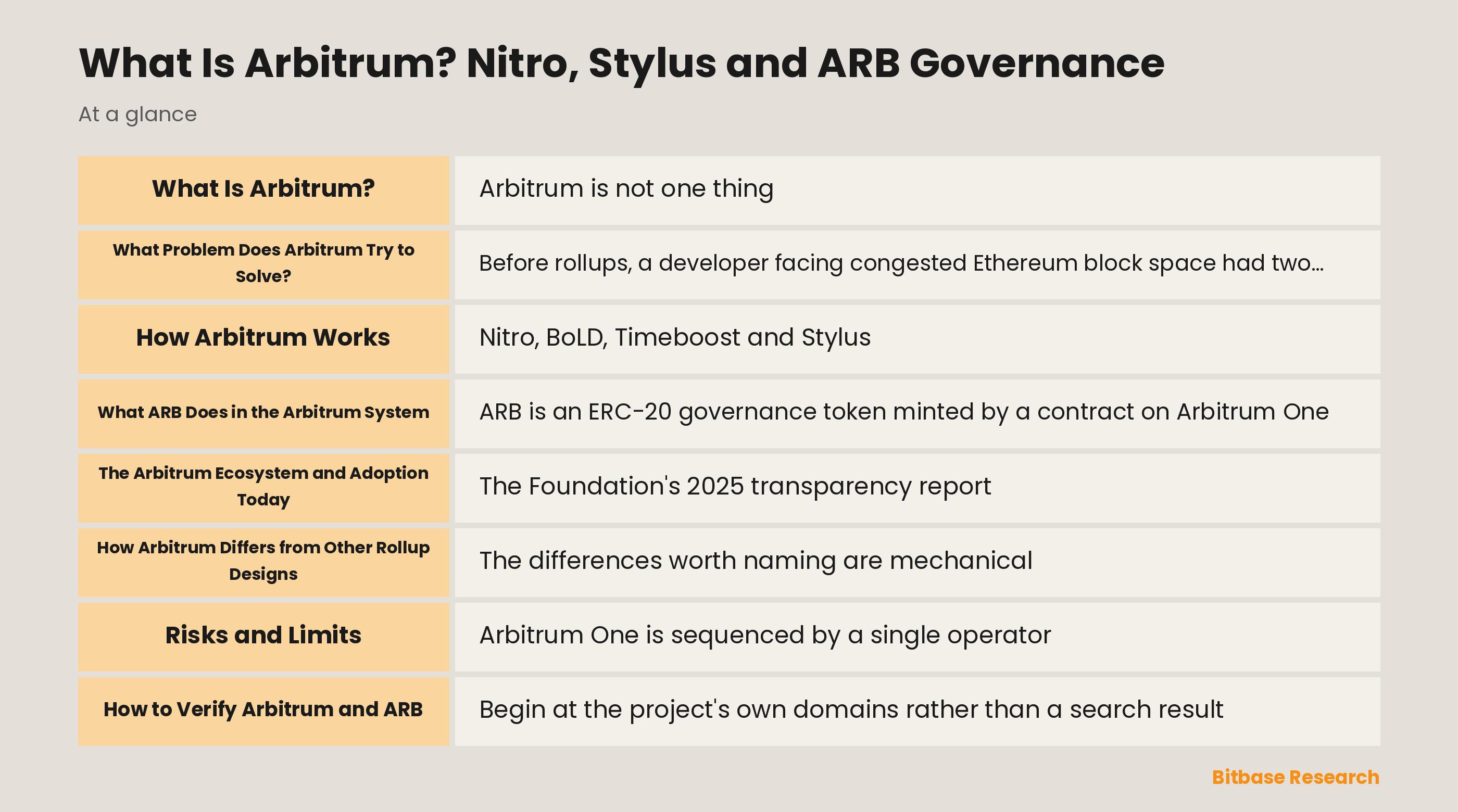
Arbitrum is not one thing, and six names must be kept apart. Arbitrum One is an optimistic rollup that settles to Ethereum and publishes its transaction data there. Arbitrum Nova is a separate chain using AnyTrust: rather than post all data to Ethereum, it relies on a Data Availability Committee, which lowers cost and adds a trust assumption. Arbitrum Orbit, which the documentation now describes as launching "an Arbitrum chain", lets a team run a dedicated chain on the same stack.
The other three names are organisational. Offchain Labs is the company that built Nitro and still develops it. The Arbitrum Foundation is a Cayman Islands foundation company acting as the DAO's legal wrapper: it signs agreements, handles compliance for approved proposals, and covers the running costs of Arbitrum One and Arbitrum Nova. The Arbitrum DAO is the ARB-token body voting on upgrades and treasury spending. Fees on Arbitrum One are paid in ETH; ARB is a governance token, not the gas token.
What Problem Does Arbitrum Try to Solve?
Before rollups, a developer facing congested Ethereum block space had two unattractive options: pay Ethereum's fees directly, which prices out small transactions whenever the network is busy, or move to a separate chain with its own validator set, which means a smaller security budget, a new bridge and new assumptions for users.
The project's claim, not an independent finding, is that a rollup can execute transactions away from Ethereum while still publishing the data on Ethereum and settling disputes there. Offchain Labs' documentation says the design gives security on par with Ethereum while cutting fees tenfold and accelerating speeds a hundredfold. Those figures are the vendor's own and describe a target, not an audited measurement.
How Arbitrum Works: Nitro, BoLD, Timeboost and Stylus
Nitro is the stack every Arbitrum chain runs: a Geth core wrapped by ArbOS, which handles cross-chain messaging, fee accounting and gas pricing. A single sequencer orders transactions and publishes them to a real-time feed, giving soft finality, a commitment from the sequencer rather than a cryptographic guarantee. It posts compressed batches to Ethereum, by default as EIP-4844 blobs with calldata as fallback; hard finality follows when Ethereum confirms the batch, typically in ten to twenty minutes. A user can instead submit to a delayed inbox contract, and after 24 hours anyone can force that transaction in.
BoLD, short for Bounded Liquidity Delay, is the dispute protocol deciding which claimed chain state Ethereum accepts. It replaced a design in which only allowlisted validators could open challenges, a restriction that existed because of delay attacks: an adversary could keep opening disputes and stretch the challenge period, and therefore withdrawals, for as long as it would forfeit bonds. BoLD lets anyone bond capital, propose a state and challenge another claim, resolving challenges in parallel inside a bounded window, 6.4 days by default on Arbitrum One. Nova keeps a DAO-controlled allowlist.
Timeboost is a transaction-ordering policy, live on Arbitrum One and Arbitrum Nova. First-come-first-served ordering pushed searchers into latency races, producing spam, and handed all extractable value to them. Timeboost auctions a 60-second express lane in a sealed-bid, second-price auction; transactions outside the lane take a 200-millisecond delay. The winner gets a temporary time advantage only, with no right to reorder and no view of others' transactions. Stylus, shipped with ArbOS 32, adds a second virtual machine executing WebAssembly beside the EVM, so contracts in Rust, C or C++ interoperate with Solidity. It cuts the cost of compute-heavy work, leaves storage costs roughly unchanged, and needs reactivating every 365 days.
What ARB Does in the Arbitrum System
ARB is an ERC-20 governance token minted by a contract on Arbitrum One. Holding it does not pay for gas, since Arbitrum One charges fees in ETH, and the official documentation describes no staking, burn or buyback function attached to it. What it does is vote. Votes are token-weighted, holders can delegate their voting power, and the scope covers upgrades to Arbitrum One and Arbitrum Nova plus DAO treasury decisions.
On supply, the governance documentation states that ARB launched with 10 billion tokens and that new ARB can be minted at a rate of at most 2% of supply per year, the first mint eligible from 15 March 2024 and each requiring a constitutional proposal. One design choice belongs beside this: BoLD bonds on Arbitrum One are denominated in ETH, not ARB, because, per Offchain Labs, an adversary able to move the bonding asset's value could make its attack cheaper.
ARB also exists at more than one address. The canonical token is on Arbitrum One at 0x912CE59144191C1204E64559FE8253a0e49E6548. A bridged representation is on Ethereum at 0xB50721BCf8d664c30412Cfbc6cf7a15145234ad1, and a third bridged address exists on Arbitrum Nova. These are different contracts on different networks. Both come from the Foundation's governance documentation, which is where they should be read from.
The Arbitrum Ecosystem and Adoption Today
The Foundation's 2025 transparency report, published on 17 March 2026 for calendar year 2025, is the project's own account of that year. It says the Foundation approved 189 ecosystem deals; that Robinhood began offering tokenized securities on Arbitrum One; that real-world assets on the network passed 800 million US dollars; that lifetime transactions crossed 2.1 billion; that over 1,000 projects were building on Arbitrum; and that more than 100 Arbitrum chains were live or in development. Each is a Foundation figure for 2025, to be re-taken from the source when read.
The same report describes DAO income as coming from four sources: transaction fees, Timeboost sequencing auctions, treasury management returns, and the Arbitrum Expansion Program, under which Arbitrum chains contribute 10% of net protocol revenue back to the ecosystem. It says each stream runs at gross margins above 90%, and that Timeboost alone returned more than 6 million US dollars to the DAO in its first year, citing a public Dune dashboard. Again: Foundation figures, 2025 period, re-verify before repeating.
Those figures became the centre of a public dispute. In a proposal posted to the governance forum on 22 May 2026, the Foundation requested 16 million US dollars in stablecoins and real-world assets, 1,740 ETH worth about 3.5 million dollars, and 230 million ARB worth roughly 26 million dollars, for another year of operations. Its own 2025 chain-level gross profit figure was 23.49 million dollars; an analyst posting as DefiIgnas argued the Foundation would be operating at about 2.3 times DAO revenue, and delegates asked for milestone-based releases. That is a public proposal and public criticism, unadjudicated either way. The on-chain vote closed on 25 June 2026 and passed; treasury advisers reported the transfer in July 2026.
How Arbitrum Differs from Other Rollup Designs
The differences worth naming are mechanical. Arbitrum resolves disputes interactively: two parties bisect their claimed histories down to a single WebAssembly instruction, and only that step is re-executed on Ethereum, unlike designs proving a whole batch cryptographically. Bonding is permissionless and poolable, since BoLD ships a contract letting strangers crowdfund a bond without trusting each other. AnyTrust is a distinct chain type, not a switch inside one chain, which is why Arbitrum One and Arbitrum Nova are separate networks.
Two further choices stand out. The MultiVM design adds a WebAssembly runtime next to the EVM instead of replacing it, so Solidity contracts behave exactly as they do on Ethereum. And ordering is a chain parameter, not a fixed rule: an owner can keep first-come-first-served, enable Timeboost, or configure something else. None of this makes Arbitrum better or worse than another network; the trade-offs are simply different, and different trade-offs fail differently.
Risks and Limits
Arbitrum One is sequenced by a single operator, so ordering and inclusion depend on that operator behaving; the delayed inbox and 24-hour force-inclusion path bound how long censorship lasts but do not prevent it. Withdrawals to Ethereum wait out the challenge window, 6.4 days by default. Bridge and governance contracts concentrate great value in little code, and ARB supply can grow by up to 2% a year. The mechanisms here are unsettled too: a June 2026 temperature check proposed replacing Timeboost on Arbitrum One with priority gas auctions and sunsetting it on Nova.
On 24 May 2026 the Security Council executed an emergency upgrade without a DAO vote. Per its own forum disclosure, the Foundation flagged the issue at 00:24 BST on 22 May and the transaction was signed at 18:50 BST on 24 May. The L1 Timelock contract inherited a public renounceRole function without the modifier verifying where a cross-chain message originated, so anyone could have instructed the Arbitrum Bridge from Arbitrum One to renounce its PROPOSER_ROLE, stopping constitutional proposals from executing. The fix rejects that one call payload at the bridge. The Council states no funds were ever at risk and that the seven-day queue gave it time to intervene; that is its own account of its own incident.
Governance design is contested too. In an April 2025 forum post titled "A Vision for the Future of Arbitrum", the Foundation proposed that it, Offchain Labs and three other "Arbitrum Aligned Entities" review every proposal before it reaches a vote and recommend rejection of ones they view unfavourably; outside coverage called this a soft veto. Delegates could still approve a proposal no aligned entity endorsed. Supporters called it a remedy for gridlock; a contributor writing as PaperImperium said governance tokens under such a regime trend towards zero control. As of August 2026 we were unable to verify a formal DAO vote result on that framework, and this article assumes nothing either way.
How to Verify Arbitrum and ARB
Begin at the project's own domains rather than a search result, and confirm the social accounts you follow are linked from the official site, not the other way round. The technical documentation, the governance documentation and the governance forum are separate sites answering different questions: what the software does, what the rules are, what the DAO decided.
For token facts, take the contract addresses from the Foundation's governance documentation, then paste each into the block explorer for its own network, Arbiscan for Arbitrum One and Etherscan for Ethereum. Confirm that name, symbol, decimals and creation history match and that the source code is verified. If a page gives one address without naming a network, stop there. For supply and minting, read the chain and the constitutional proposal record, not an aggregator.
For governance and security claims, a forum thread is a proposal, not a decision: find the on-chain or Snapshot record and read the result before repeating anything. Security Council actions are posted in a dedicated forum category with the transaction hash, which you can open on a block explorer. Audit and bug-bounty scope should be findable on the auditor's or bounty platform's own site. Finally, compare any domain character by character before connecting a wallet, and stop at any page offering to let you claim tokens.
Conclusion
Arbitrum is a set of Ethereum layer-2 networks running Nitro, with BoLD governing disputes, Timeboost governing ordering and Stylus adding a WebAssembly virtual machine beside the EVM. ARB is the governance token of the DAO controlling those chains; it is not the gas token, the documentation attaches no yield to it, and it exists at different addresses on different networks. Read the governance forum for what was decided, check both contract addresses against the official documentation and a block explorer, and re-take every number from its source.
Related market pages
Bitbase pages for the tokens named in this article:
- ARB: View price · Spot market · Perpetual market
Related reading
Other Bitbase articles on this topic:
- What Is Zora Network? L2 Architecture, Creator Infrastructure, and the Role of ZORA
- Modular vs Monolithic Blockchains
- What Is Linea? An Ethereum-Compatible zkEVM Layer 2
Disclaimer: This article is educational content from Bitbase Academy, provided for information only. It explains what a project does and what role its token plays in that system; it does not constitute investment, trading, tax, or financial advice, and it is neither a recommendation nor an endorsement of any project or token. Bitbase has not carried out due diligence on the project described here, and mentioning it does not mean Bitbase lists or supports the asset. Crypto assets carry significant risk, including price volatility, thin liquidity, smart-contract failure, regulatory uncertainty, and the possible loss of their entire value. Written as of August 2026; a project's status, tokenomics, team, and contracts can change at any time. Verify everything yourself through official channels, the contract address, and a block explorer, and beware of imitation sites and phishing links.
References
[1] Inside Arbitrum Nitro (Arbitrum official documentation) docs.arbitrum.io
[2] Overview of BoLD, the permissionless dispute protocol (Arbitrum official documentation) docs.arbitrum.io
[3] How Timeboost works (Arbitrum official documentation) docs.arbitrum.io
[4] A gentle introduction to Stylus (Arbitrum official documentation) docs.arbitrum.io
[5] Overview of Arbitrum chains, the Orbit framework (Arbitrum official documentation) docs.arbitrum.io
[6] The Arbitrum Foundation 2025 Transparency Report (official blog, 17 March 2026) blog.arbitrum.foundation
[7] DAO contract addresses, including the ARB token on Arbitrum One and Ethereum (Arbitrum DAO governance docs) docs.arbitrum.foundation
[8] The $ARB token: a conceptual overview (Arbitrum DAO governance docs) docs.arbitrum.foundation
[9] Security Council Emergency Action, 24/05/2026 (Arbitrum governance forum) forum.arbitrum.foundation
[10] Entropy Advisors Monthly Update July 2026, recording that the Continued Funding onchain vote passed in late June (Arbitrum governance forum) forum.arbitrum.foundation
[11] gentle introduction.md docs.arbitrum.io
[12] introduction.md docs.arbitrum.io