Chainlink is a decentralized oracle network: independent node operators deliver outside data to smart contracts and carry messages and tokens between blockchains, and LINK is the token used to pay for those services and to stake behind some of them. This article covers the four product lines the project currently ships, what LINK does in each, and a checklist you can run yourself.
What Is Chainlink?
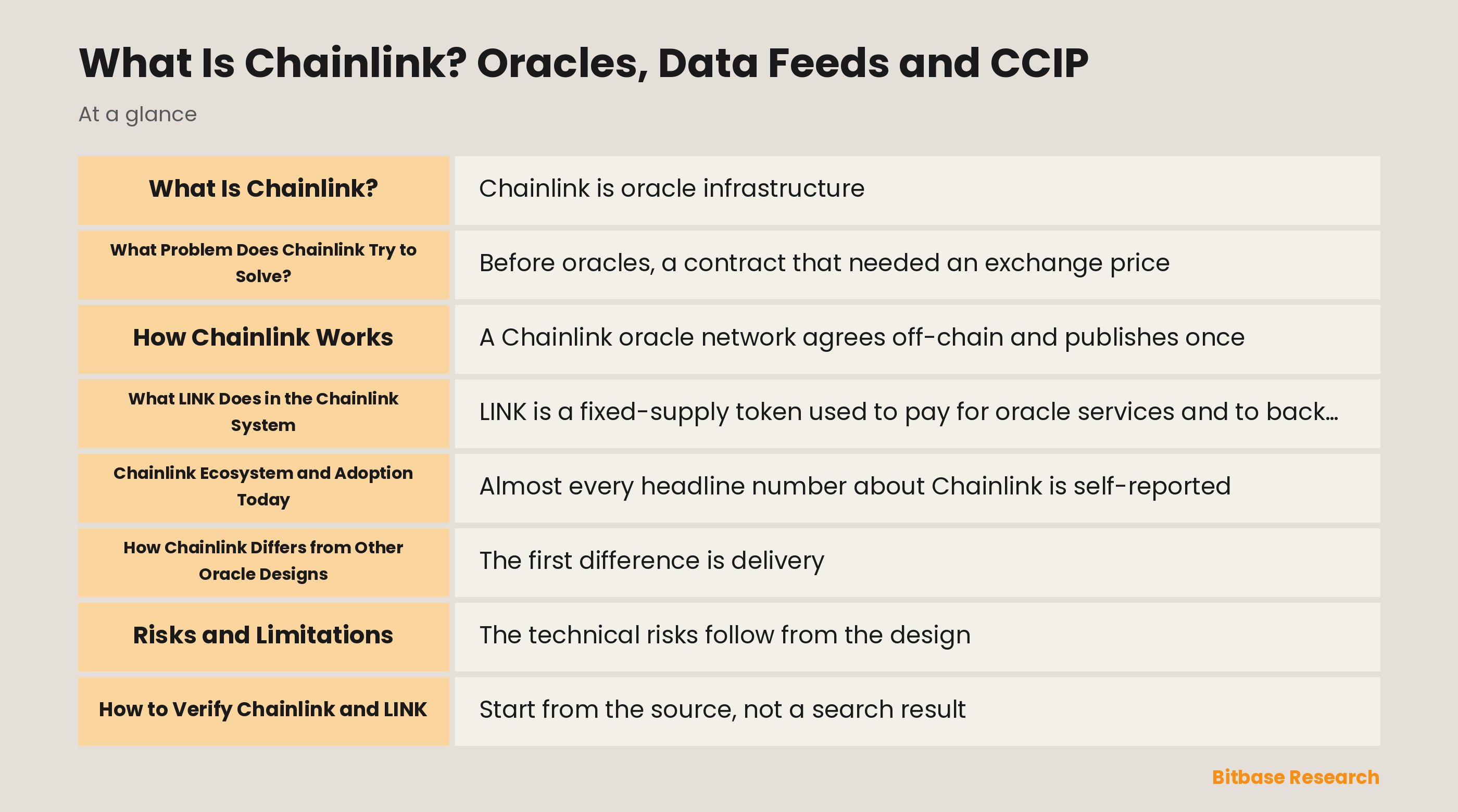
Chainlink is oracle infrastructure, not a blockchain. A contract can read only its own chain's state, so Chainlink runs networks of independent node operators that fetch, sign and aggregate information off-chain, then make the result available to contracts on a host chain. The native token is LINK, deployed on Ethereum and on many other networks. There is no Chainlink chain holding your assets.
Three names get used interchangeably and should not be. Chainlink is the protocol and the oracle networks. Chainlink Labs is a private software company that develops much of the code, hires staff and signs commercial agreements; the Q2 2026 review records both a Chainlink Labs hire and a Chainlink Labs decision to change how the Build program pays. The Chainlink Foundation appears as the rights holder in the chain.link footer.
The official site groups the platform into interoperability and orchestration (CCIP, the Chainlink Runtime Environment, Chainlink for Agents), data (Data Streams, Market and Data Feeds, DataLink, Proof of Reserve, SmartData) and compliance and privacy (the Automated Compliance Engine, the Privacy Standard, VRF). Four are covered here.
What Problem Does Chainlink Try to Solve?
Before oracles, a contract that needed an exchange price, a fund's net asset value or a reserve attestation could not see it, and one that needed to move value to another chain could not reach it. The workarounds concentrated trust in a single API server signing prices or one team-controlled key set bridging tokens, so failures were correlated: every application reading that feed acted on the same wrong number at once.
Chainlink's stated answer is to replace the single reporter with a committee. Several independent operators fetch or compute the same thing and sign it, the network aggregates before a contract consumes the output, and cross-chain messages follow the same pattern. That is the project's framing of its design goal: it relocates trust from one operator to a group and its configuration, and does not remove the need to trust anything.
How Chainlink Works
A Chainlink oracle network agrees off-chain and publishes once: nodes exchange observations, settle on a report, and one transaction posts the aggregated result with signatures. Data Feeds is the push version. An on-chain aggregator contract holds the latest answer, updated when the value moves past a deviation threshold or a heartbeat expires, and any contract reads it with an ordinary call.
Data Streams is the pull version. Reports are produced continuously off-chain, the application fetches the one it needs at the moment of use, and an on-chain verifier contract checks the signatures before the value is trusted. The commercial model differs too: the documentation states that Data Streams uses subscription billing and marks the older pay-per-verification model as deprecated. Figures for one product do not describe the other.
CCIP and CRE sit above that base. CCIP moves data and value along a lane between two chains, with a committing network, an executing network and a separate risk management network in the path, and with token pools that lock and unlock, burn and mint, lock and mint, or burn and unlock depending on the issuer's configuration. CRE is an orchestration layer: developers write a workflow in Go or TypeScript, compile it to WebAssembly, and a workflow network watches for the trigger while capability networks do the reads, writes and API calls under Byzantine fault tolerant consensus. Chainlink Functions and Automation are now CRE workflows.
What LINK Does in the Chainlink System
LINK is a fixed-supply token used to pay for oracle services and to back performance commitments with stake. It is not the gas token of any chain, the network burns no fees, and the documentation describes payment and staking roles rather than a token-holder governance vote.
Payment is the clearest role. The CCIP billing page defines a message fee as a blockchain fee plus a network fee, paid once on the source chain in a chosen fee token, and states that CCIP accepts LINK as well as native gas tokens and their wrapped versions. The published fee table prices LINK below the alternatives, for example 0.045% against 0.05% for lock-and-unlock transfers and 0.45 USD against 0.50 USD per message on Ethereum lanes. Those parameters can change, so read the billing page yourself.
Staking is the second role. Under Staking v0.2, launched November 2023 on Ethereum mainnet only, community stakers commit 1 to 15,000 LINK and node operator stakers 1,000 to 75,000 LINK, against a launch cap of 45,000,000 LINK. It secures the ETH/USD feed on Ethereum: a valid downtime alert slashes 700 LINK from each node operator staker and pays the alerter 7,000 LINK, while community stakers face no slashing here. Unstaking runs a 28-day cooldown then a seven-day claim window. Separately, the Chainlink Reserve accumulates LINK out of service revenue: the Q2 2026 review, published 24 July 2026, reports it added over 1.44 million LINK in the quarter for a total of 4.5 million, the project's own figure.
Chainlink Ecosystem and Adoption Today
Almost every headline number about Chainlink is self-reported, so treat each as a dated claim. The homepage counter showed transaction value enabled of about 33.3 trillion US dollars, updated 4 August 2026. The Q2 2026 review puts total value secured at 110 billion US dollars, says over 7 billion US dollars of cross-chain token value migrated to CCIP in the quarter, gives CCIP quarterly volume as 4.90 billion, and counts 84 tokens added to the Cross-Chain Token standard. None of it is independently audited; re-pull it the day you publish.
Chain coverage is the same kind of claim: the CCIP page advertises access to more than 70 blockchains in its hero section and more than 60 public and private blockchains further down, which is reason enough to read chain counts as marketing copy. Press releases from Swift and from SBI Digital Markets with UBS Asset Management describe completed pilots, and the review says DTCC is integrating CRE and the Chainlink data standard into its collateral chain, with an expected go-live in Q4 2026. Those are statements by the parties involved, and the DTCC date is an expectation, not a delivered system.
The same caution applies to the lists of protocols each quarterly review names as having migrated to CCIP or adopted Data Streams and CRE. Every entry is one counterparty's announcement, usually a post on its own channel. If an integration matters to you, confirm it in that counterparty's newsroom or governance forum.
How Chainlink Differs from Other Oracle Designs
The first difference is delivery. A push oracle writes to an aggregator contract on a schedule or when a deviation threshold trips, so the value sits on chain whether anyone reads it or not; a pull oracle hands a signed report to the application, which verifies it at the moment of use. Many networks ship only one of the two; Chainlink ships both, and they differ in latency, cost and failure characteristics.
The second is how cross-chain transfers are secured. CCIP separates the network that commits to a message from the network that executes it, adds an independent risk management layer, and for burn-and-mint tokens holds no liquidity pool at all. Other designs rely on a single validator set, a liquidity pool that quotes a price, or light-client proofs of the source chain. Those are different trust assumptions and failure surfaces, not a ranking.
Risks and Limitations
The technical risks follow from the design. A committee-based feed can still publish a wrong number if enough nodes collude or fail together, if the underlying market is thin, if a heartbeat lets a stale value stand, or if an application reads a feed never intended for it, and contracts act on that number immediately. CCIP adds contracts on both chains plus off-chain components, so contract bugs, misconfigured rate limits or pool ownership, and destination-chain reorganisations stay on the list.
Maturity is a separate risk: not everything with a product page is generally available. The CRE documentation says building and simulating workflows is open to anyone, but deploying workflows to a network is in an Early Access stage whose functionality "may be changed in later versions". The staking page still calls staking a beta, and the DTCC integration is dated as an expected Q4 2026 go-live. Roadmap items should be read as roadmap.
Economic, structural and regulatory risks round it out. Node operator sets are permissioned in practice, staking rewards are emissions that whoever runs the programme can change, and Chainlink Labs has said it is shifting Build program arrangements from payment in project tokens toward fees in LINK or other liquid assets. Rules for oracle services and tokenized assets differ by jurisdiction, and the staking page notes that Chainlink Rewards is being built for the European Union's MiCA regime and is unavailable in certain regions, including the United States. This article makes no claim about how LINK is classified.
How to Verify Chainlink and LINK
Start from the source, not a search result. Type chain.link and docs.chain.link into the address bar yourself, and use the official site as the origin for every other link, including social accounts; only the direction from the official domain outward is evidence. Compare any domain you land on character by character, and stop if a page reached from an advertisement or message asks you to connect a wallet to claim, migrate or verify anything.
Then pin the contract. The LINK Token Contracts page in the official docs is the reference, and it lists a different address per network, so an address quoted without its network is not an answer. On Ethereum mainnet LINK is 0x514910771AF9Ca656af840dff83E8264EcF986CA with 18 decimals; on Arbitrum One it is 0xf97f4df75117a78c1A5a0DBb814Af92458539FB4; on Base it is 0x88Fb150BDc53A65fe94Dea0c9BA0a6dAf8C6e196; on Avalanche it is 0x5947BB275c521040051D82396192181b413227A3. The Solana deployment uses a different address format and nine decimals.
Take that address to a block explorer for that exact chain. Confirm the token name and symbol, that the source code is verified, the deployment age and the holder count, and above all that the chain matches the one you were reading about: a same-ticker token on the wrong network is the most common way people send funds nowhere. For supply and any reserve balance, read the chain and the project's metrics pages, not a price aggregator.
Finally, grade the claims. Any figure in a quarterly review, press release or partner post is that party's own number, so record its date and definition before reusing it, and look for the counterparty's own announcement of a partnership. For audits, find the report on the auditing firm's site; a PDF hosted only by the project is weaker evidence. Where the documentation says Early Access, beta or deprecated, carry that label into your notes.
Conclusion
Chainlink is an oracle network that delivers outside data to smart contracts and moves messages and tokens across chains, developed largely by Chainlink Labs and organised around CCIP, Data Feeds, Data Streams and CRE. LINK is what applications pay those services with and what operators and community members stake to back performance, not a claim on revenue. The adoption numbers are the project's own, and CRE deployment is still in Early Access. Re-read the documentation, take the contract address for your network from the official contracts page, and confirm it on a block explorer for that chain.
Related market pages
Bitbase pages for the tokens named in this article:
- LINK: View price · Spot market · Perpetual market
Related reading
Other Bitbase articles on this topic:
- What Are Blockchain Confirmations?
- Block Height vs Block Time: What's the Difference?
Disclaimer: This article is educational content from Bitbase Academy, provided for information only. It explains what a project does and what role its token plays in that system; it does not constitute investment, trading, tax, or financial advice, and it is neither a recommendation nor an endorsement of any project or token. Bitbase has not carried out due diligence on the project described here, and mentioning it does not mean Bitbase lists or supports the asset. Crypto assets carry significant risk, including price volatility, thin liquidity, smart-contract failure, regulatory uncertainty, and the possible loss of their entire value. Written as of August 2026; a project's status, tokenomics, team, and contracts can change at any time. Verify everything yourself through official channels, the contract address, and a block explorer, and beware of imitation sites and phishing links.
References
[1] Chainlink, official homepage (platform overview and transaction value counter) chain.link
[2] Chainlink Quarterly Review: Q2, 2026 (official blog, published 24 July 2026) chain.link
[3] Cross-Chain Interoperability Protocol (CCIP), official product page chain.link
[4] Chainlink Staking, official economics page (v0.2 parameters, alerting and slashing) chain.link
[5] Chainlink press releases index (official newsroom archive) chain.link
[6] LINK Token Contracts, official documentation (per-network addresses) docs.chain.link
[7] VRF v2.5 Supported Networks, official documentation (LINK address per network) docs.chain.link
[8] CCIP Billing, official documentation (fee tokens and network fee table) docs.chain.link
[9] Data Streams Billing, official documentation (subscription model, deprecated pay-per-verification) docs.chain.link
[10] Chainlink Runtime Environment (CRE), official documentation (Early Access status) docs.chain.link
[11] chainlink collaborates with solv to introduce secure exchange rate feed powered by chainlink proof of reserve insights.solv.finance
[12] solv protocol migrates from layerzero to chainlink ccip insights.solv.finance