DAO Maker is a token launch platform, usually called a launchpad: projects raise money from retail participants in timed sales, and the platform token DAO is what you stake to reach the larger allocation tiers. This article covers the two sale types its documentation defines, what DAO actually does, the two 2021 exploits and the dispute that followed, and a checklist you can run yourself.
What Is DAO Maker
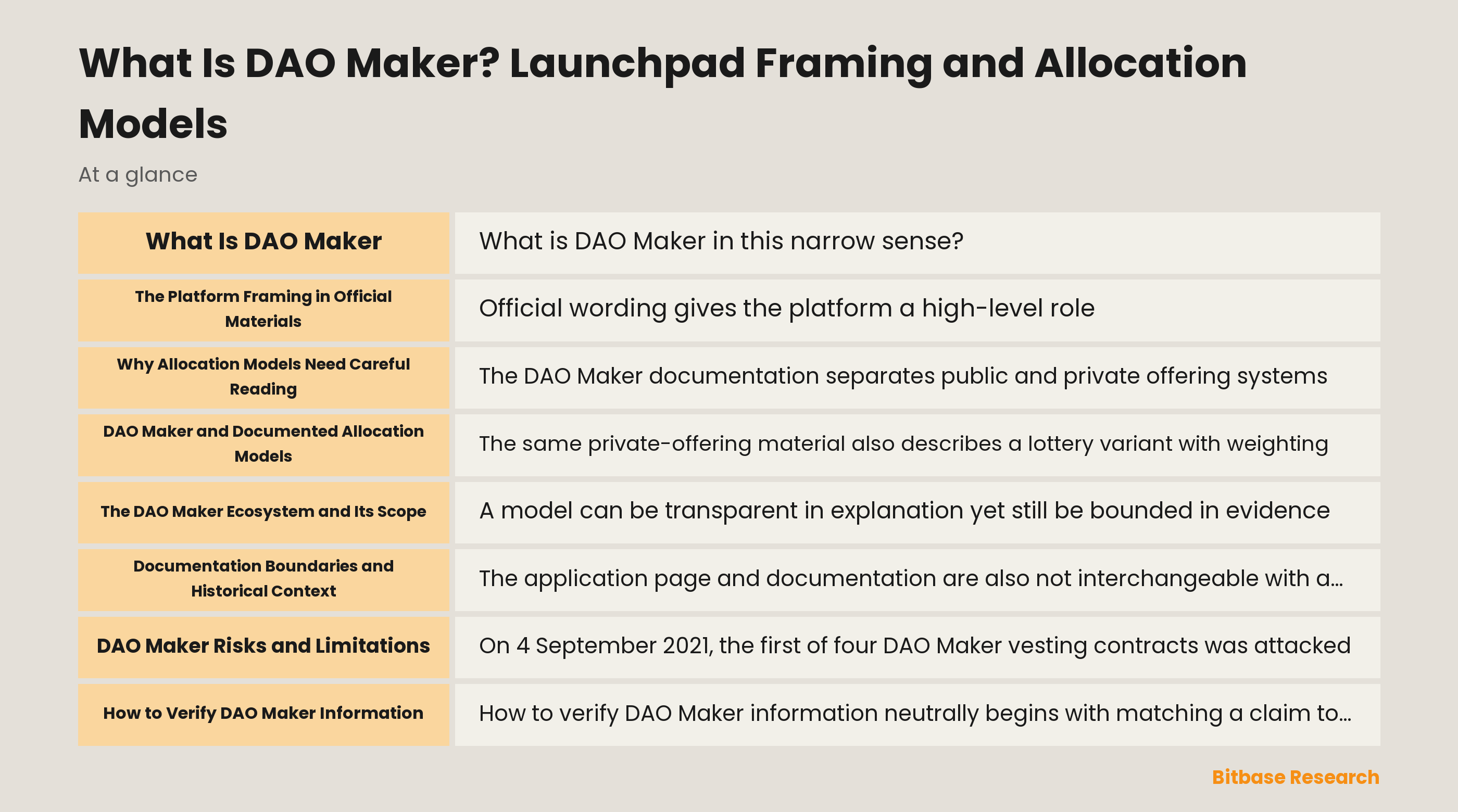
DAO Maker is an application and a set of contracts, not a blockchain. It runs token sales for other projects and takes a cut of what participants claim. Its token is DAO, and the official tokenomics page lists it on Ethereum at 0x0f51bb10119727a7e5ea3538074fb341f56b09ad, on BNB Smart Chain at 0x4d2d32d8652058bf98c772953e1df5c5c85d9f45 and on Solana at 85aM5XJhdDeUw4MbGKM56zmWnsRyh76zUVut97uPjiCg. The name collides with two unrelated things: this is not MakerDAO, which runs the Maker protocol and MKR, and not The DAO, the 2016 Ethereum fund.
Two official domains describe the same brand differently, so any quotation has to say which one it came from. Read on 14 August 2026, daomaker.com is an older brand site calling the project "an incubator" whose "flagship is Social Mining", a scheme for paying community members for work approved by other holders; it never mentions tiered sales. The live product at app.daomaker.com carries the line "The Launchpad For Real Founders", a navigation bar of Launchpad, Airdrops, Farms, Vaults, Staking and Tokenomics, and the footer "©2026 DAO Maker". Its documentation opens with a third label: "your go-to VC platform".
Nothing on the current site names the operating company, though the 2021 record does: Cointelegraph places DAO Maker in Prague, and the compensation plan of that year was published under the name of chief executive Christoph Zaknun. Treat the launchpad label as self-description: it says what the service sells, not how any given sale is configured.
What Problem Does DAO Maker Try to Solve?
Before platforms like this one, a retail buyer had two poor options for a new token: wait for the exchange listing and buy from whoever sold into it, or join an open first-come sale decided by the highest gas fee in the block, which in practice meant a bot. Neither route rewarded staying with a project, and both concentrated early supply in whoever could move fastest.
DAO Maker's stated answer is to make allocation a function of a recorded, held position rather than transaction speed. Participants register, the platform computes each address's share from a metric it maintains called DAO Power plus the amount deposited, and the sale settles afterwards instead of on a race. That is the project's own framing: it moves the advantage from bots to large stakers, and does not remove the risk that a sale is configured or delivered badly.
How DAO Maker Works
The documentation defines exactly two kinds of sale, both called a Strong Holder Offering, or SHO. A Public SHO is "Open to everyone"; a Private SHO is "Open to DAO Stakers". One fee covers both: "There is 5% platform fee for each round (Deducted from tokens) if you decide to claim your allocation." It is taken from the tokens, on claim, not from the deposit.
The private system splits allocation into a Guaranteed and an Excessive component. The guaranteed part is a user's DAO Power multiplied by the total allocation and a guaranteed ratio, divided by all DAO Power registered for that sale; the documentation puts that ratio "between 0.8 and 1, but it's generally close to 0.98". Deposits above that part compete pro rata for what is left. Participants may instead take a lottery option, buying tickets in multiples of a ticket size, usually 100 DAO; the draw is computed off chain and then replayed on chain. The hybrid offering contract source is published on BscScan.
The public system drops DAO Power entirely and uses shares. One USDT deposited buys one share; one DAO buys six, described as a boost of 500 percent, and that option swaps the deposit into DAO through PancakeSwap V3 under the hood, so it also creates exposure to the platform token. The target raise is split between a USDT part and a DAO Boost part by the ratio of the two deposit pools. Excess USDT returns automatically; excess DAO must be claimed. Airdrops reuse the same formula, return the whole deposit, and require identity verification to claim.
What the DAO Maker Token Does in the System
DAO has two documented jobs, and governance is not among them in the current documentation. The first is earning DAO Power. Staking on Ethereum, BNB Smart Chain or Solana yields one DAO Power per DAO staked, and a published multiplier table then tops that up, running from zero below 250 DAO Power to 1.3 times above 100,000. DAO Power sets the size of a private allocation and, per the public offering page, does nothing for a public one.
DAO Power also carries a duty after the sale. Under the Strong Holder Offering rules a participant must hold their DAO Power at the level used for that offering to stay eligible for the project's later vesting unlocks; if it drops there is a three-day grace period, and "failure to do so results in losing all future unlocks of that project's tokens". The second job is the staking programme itself. Ethereum stakes run 30 to 1,095 days behind a 15-day hard lock, and leaving early costs the rewards accrued over the first half of the term. On BNB Smart Chain a flat 15-day cooldown applies, jumping it costs 15 percent, and the documentation says outright that staking there is for DAO Power rather than yield.
Supply is finished rather than scheduled. The tokenomics page records 312,000,000 minted with vesting started 9 February 2021, 43,665,607 burned, and a current total of 268,334,393 marked fully circulating with "everything is unlocked". No unlock calendar remains to be read, and aggregator supply figures should be checked rather than assumed: on 14 August 2026 CoinGecko listed a lower circulating supply.
The DAO Maker Ecosystem and Adoption Today
Adoption evidence here is almost entirely the platform's own record. Read on 14 August 2026, the launchpad page listed roughly 140 project entries with raise sizes from 46,000 to 4,000,000 US dollars. Those are the platform's own figures for its own sales, published without an independent check, and the list mixes 2021 rounds with recent ones, so it describes a history rather than current activity.
Current activity has to be dated carefully. The most recent entry with a published sale page is Helios (HLS), whose terms give a raise of 500,000 US dollars and a listing date of 19 December 2025. The official X account has published nothing since 19 December 2025 and no next sale has been announced; the Featured Projects panel rendered empty on 14 August 2026. The application was online and every navigation entry responded that day, so the platform is running, but without announcements for roughly eight months.
Trading shows a live but thin asset. CoinGecko's DAO page on 14 August 2026 aggregated 16 exchanges and 18 markets for about 669,000 US dollars of 24-hour volume, of which one venue's DAO/USDT book took 50.03 percent while showing only 56.86 US dollars of depth within two percent of the quote; the two PancakeSwap V3 pools each showed roughly 3,500 US dollars in that band, and DefiLlama reported about 52,500 US dollars locked. The aggregator's quote also sat at the bottom of its recorded range.
How DAO Maker Differs from Other Launchpad Designs
The first mechanical difference is where allocation weight comes from. Many launchpads award a fixed tier for holding a threshold amount, or sell lottery tickets at a flat rate. Here the private formula is continuous rather than stepped: a share is a ratio of one address's DAO Power to all DAO Power registered. The public sale drops that metric and prices participation instead, six shares per DAO against one per USDT.
The second is where the obligation sits in time. The fee is deducted from tokens at the moment of claim rather than charged on the deposit, and the Strong Holder Offering condition keeps running after the sale closes: a participant who lets DAO Power fall below the level used, and does not restore it within three days, forfeits the remaining vesting. That turns a one-off purchase into a position that has to be maintained. These are trade-offs, not a ranking.
DAO Maker Risks and Limitations
Two exploits in one month in 2021 are the most consequential facts about this platform, and both should be read from outside sources, not only from the project. On 12 August 2021 an attacker drained about 7 million US dollars of USDC from a contract holding participant deposits. The team blamed "malicious use of one of our wallets with access to admin privileges"; the security firm SlowMist independently found that the admin address had pointed the victim contract's privileged role at an attacker contract, which then called withdrawFromUser in a loop. Counts differ: contemporaneous coverage put the number affected at 5,251, losing 1,250 US dollars on average, while the tracker Web3 Is Going Just Great logs 5,521.
The second incident came weeks later. On 4 September 2021 four DAO Maker vesting contracts were reinitialised because the init function had been left callable, and an emergencyExit function was used to pull the tokens out; rekt.news, publishing on 6 September, put the loss at about 4 million US dollars. The same report is why the audit position of that period should be recorded as unresolved: it quotes a researcher finding that of three audits the project claimed, two covered unrelated contracts and the third pointed to a dead link, and rekt closed with "We await clarification from Certik".
What happened next is disputed and must be labelled as such. The published plan was 500 USDC to each affected user plus an IOU token, USDR, redeemable a year later for 110 percent of face value in DAO. In October 2022 a proposal titled "Prevent Major $DAO DUMP from USDR distributions" put three options to holders, and the option that stopped redemption passed. Users and a researcher quoted by rekt.news and Cointelegraph allege that six wallets funded shortly before the vote carried 61.72 percent of it, that the plan and the proposal were then deleted, and that even the reduced payout was never distributed. Cointelegraph could not confirm who controlled those wallets and reported in April 2024 that victims remained uncompensated. No court has ruled on these claims.
The remaining risks are ordinary but real. The only audit reachable from an auditing firm's own site is Hacken's "[SCA] DAO Maker | Rewards | Mar2021" of 9 March 2021, whose scope covers exactly two files, Farm.sol and FarmManager.sol; it records three high, four medium and one informational finding, one high-severity issue still unfixed at final review, and says nothing about the offering contracts. The current documentation set is eight pages and contains no audit page, so the contracts should be treated as not publicly audited beyond that partial 2021 review. Add the silence since December 2025, order books thin enough that one venue carries half the volume, a fee and an eligibility rule the operator can change, and jurisdiction-by-jurisdiction regulation of public token sales.
How to Verify DAO Maker and DAO
Start from the domain, and write down which one you used. Type app.daomaker.com yourself rather than following a search result or an advertisement, and reach the documentation only through the Docs link in its footer. Because the older daomaker.com and the live application describe the business differently, a quotation without its source domain is not evidence. Compare any address bar you land on character by character, and stop if a page reached from a message or a promoted link asks you to connect a wallet to claim or verify.
Then pin the token. Take the contract addresses from the official tokenomics page, note that they differ per network, and paste the one for your network into that network's explorer: Etherscan for Ethereum, BscScan for BNB Smart Chain, a Solana explorer for the Solana mint. Confirm the symbol and decimals, that the source is verified, the deployment age and the holder count, and above all that the chain matches the one you were reading about, since a same-ticker token on the wrong network is the most common way people send funds nowhere. For supply, read the official page and the chain, not an aggregator; the two disagreed on 14 August 2026.
Finally, verify the specific sale rather than the general documentation. An offering page carries its own schedule, eligibility rules, refund window and identity requirements, and those override any general explainer; check that the 5 percent claim fee and the three-day DAO Power grace period still read as documented on the day you look. Look for audits on the auditing firm's website, then read the scope and the date, since a 2021 review of two farm contracts says nothing about a sale contract deployed later. Check the most recent post on official channels before assuming a sale is imminent.
Conclusion
DAO Maker is a launchpad running two documented sale types, a Public SHO open to anyone and a Private SHO open to stakers, and it charges 5 percent of the tokens you claim. DAO is staked for DAO Power, which sizes private allocations and must then be maintained to keep a project's later unlocks; supply is fully unlocked and the documentation describes no governance vote. The record also holds two 2021 exploits, a compensation plan that users and independent reporting say was reversed by a contested vote, one partial audit, and no announcements since December 2025. Take the contract address for your network from the tokenomics page, confirm it on that network's explorer, and read the terms of the specific offering on the day it opens.
Related reading
Other Bitbase articles on this topic:
- Token Velocity, Demand Sinks and Supply Sinks
- What Is a TRC-20 Token? Tron's Token Standard
Disclaimer: This article is educational content from Bitbase Academy, provided for information only. It explains what a project does and what role its token plays in that system; it does not constitute investment, trading, tax, or financial advice, and it is neither a recommendation nor an endorsement of any project or token. Bitbase has not carried out due diligence on the project described here, and mentioning it does not mean Bitbase lists or supports the asset. Crypto assets carry significant risk, including price volatility, thin liquidity, smart-contract failure, regulatory uncertainty, and the possible loss of their entire value. Its contracts have not been publicly audited, or the published audit covers only part of the code. Written as of August 2026; a project's status, tokenomics, team, and contracts can change at any time. Verify everything yourself through official channels, the contract address, and a block explorer, and beware of imitation sites and phishing links.
References
[1] DAO Maker application home page: 'The Launchpad For Real Founders', navigation and '(c)2026 DAO Maker' footer app.daomaker.com
[2] DAO Maker Tokenomics page: starting supply 312,000,000, burned 43,665,607, current total 268,334,393, vesting start 9 February 2021, and per-chain DAO contract addresses app.daomaker.com
[3] Older DAO Maker brand site describing the project as 'an incubator' whose 'flagship is Social Mining' daomaker.com
[4] Private Offering System, DAO Maker Docs: Guaranteed and Excessive allocation formulas, guaranteed ratio, lottery, hybrid offering contract on BscScan dao-maker-1.gitbook.io
[5] Public Offering System, DAO Maker Docs: shares, the 500% DAO Boost and the PancakeSwap V3 swap dao-maker-1.gitbook.io
[6] DAO Power, DAO Maker Docs: multiplier table, Strong Holder Offering maintenance rule and the three-day grace period dao-maker-1.gitbook.io
[7] Hacken audit report '[SCA] DAO Maker | Rewards | Mar2021', 9 March 2021, scope limited to Farm.sol and FarmManager.sol hacken.io
[8] Independent report on the 4 September 2021 incident: reinitialised vesting contracts, emergencyExit withdrawals, about $4M lost, and the unresolved audit claims rekt.news
[9] Independent community investigation into the USDR compensation plan and the October 2022 governance proposal rekt.news
[10] Cointelegraph, 23 April 2024: DAO Maker hack victims still await reimbursement three years later; Prague base; 61.72% vote claim unconfirmed cointelegraph.com
[11] dao maker www.coingecko.com
[12] launchpad app.daomaker.com