Falcon Finance is collateral infrastructure that issues USDf, an overcollateralised synthetic dollar minted against crypto assets and tokenised real-world assets, and FF is its separate governance and utility token. This article covers the four layers the project now runs, the July 2025 depeg and what changed afterwards, and a checklist you can run yourself.
What Is Falcon Finance?
Falcon Finance is a protocol and an operating business, not a blockchain. A user deposits an eligible asset and mints USDf against it; the deposit is then routed to third-party custodians and worked by the operator, not held in a self-custodial vault. The website footer names the legal entity as Falcon Digital Limited, and the October 2025 audit announcement was issued from Road Town, British Virgin Islands.
Four labels get used interchangeably and should not be. USDf is the overcollateralised synthetic dollar issued by the protocol. sUSDf is the yield-bearing token you receive by staking USDf into Falcon's ERC-4626 vaults. fUSD is a separate payment stablecoin announced on 27 May 2026 with Anchorage Digital Bank, N.A., and issued by that bank rather than by Falcon. FF is the native governance and utility token.
Chains and tickers matter here. FF is deployed on Ethereum and BNB Smart Chain, USDf on Ethereum, BNB Smart Chain and the XDC Network, and sUSDf on Ethereum. The project is Falcon Finance, the token is FF, and neither name refers to USDf. Treating FF as the stablecoin, or quoting a USDf reserve figure as an FF figure, is the most common error made about this project.
What Problem Does Falcon Finance Try to Solve?
Before designs of this kind, a holder who wanted dollars without selling had one ordinary route: borrowing on a lending market. Such venues usually accepted only a short list of blue-chip collateral, applied a liquidation price, and left the borrower exposed to the same market that created the need for cash. Tokenised treasuries, gold and equities largely could not be used at all, because collateral venues had no framework for instruments carrying an issuer and a legal claim.
Falcon's stated answer is what it calls universal collateralisation: accept a broad list of liquid assets, apply an overcollateralisation ratio calibrated per asset, hedge the directional exposure of non-stablecoin collateral, and issue one dollar unit against all of it. That is the project's own framing of its design goal, not a demonstration that the design holds under stress, and the sections below keep the two apart.
How Falcon Finance Works
Minting comes in two documented forms. Classic Mint issues USDf against a deposit, at par for supported stablecoins and against an overcollateralisation ratio for everything else; Innovative Mint locks collateral for a fixed tenure. The documentation defines that ratio as the initial mark price of the collateral times the amount deposited, divided by the USDf minted, and says it is calibrated per asset from that asset's volatility, liquidity, slippage and price history. Collateral held above the minted amount is the buffer, and how much of it a user reclaims depends on the market price at the time of claim.
Peg maintenance is described as three mechanisms working together. Collateral is managed with delta-neutral and market-neutral strategies so that directional moves in the underlying assets do not flow through to the backing. Overcollateralisation provides the buffer. Cross-market arbitrage supplies the corrective force: a user can mint at par and sell when USDf trades above a dollar, or buy below par on an external market and redeem for a dollar of collateral through Falcon. That redemption route is open only to users who have completed the protocol's KYC process.
Staking is separate from minting. Staking USDf produces sUSDf through ERC-4626 vaults, and restaking sUSDf for a fixed term produces a position recorded as an ERC-721 NFT. Staking FF produces sFF. Yield on the USDf side comes from strategies run on the collateral.
The boundary that matters most is where the assets sit. Falcon's documentation states that deposits are routed to third-party custodians, naming Ceffu (MirrorX) and Fireblocks (CVA); that off-exchange settlement mirrors those balances onto centralised exchanges where strategies run, naming Binance and Bybit; and that further portions go into on-chain liquidity pools and staking venues. A block explorer can show you a token contract and a balance. It cannot show you a custody arrangement, an exchange account or a hedge.
What the FF Token Does in Falcon Finance
FF is a fixed-supply token used for staking and reserved for governance. The documented maximum supply is 10 billion, with roughly 2.34 billion, or 23.4 per cent, circulating at the token generation event on 29 September 2025. The published allocation is 35 per cent ecosystem, 24 per cent foundation, 20 per cent core team and early contributors, 8.3 per cent community distributions, 8.2 per cent marketing and 4.5 per cent investors, with a one-year cliff and three-year vesting stated for the team and investor tranches.
Staking is the live utility. Staking FF converts it into sFF, which the launch announcement says earns distributions in USDf or FF, improves terms on USDf and sUSDf staking, and accrues Falcon Miles at published multipliers. FF is not the gas token of any chain, no burn or buyback mechanism appears in the documentation, and FF is not USDf: reserve and backing figures describe the synthetic dollar, not the token.
Governance is the part to read carefully. The documentation names FF as the governance token and points sFF holders to a forum, but the same page states that governance features are currently in development and lists voting on proposals as coming soon. The governance role is documented and prospective rather than exercised.
Falcon Finance Ecosystem and Adoption Today
The collateral list is the clearest published measure of scope. Falcon's supported-assets page names six stablecoins, including USDT, USDC, DAI and FDUSD; a longer list of non-stablecoin assets covering BTC, WBTC, ETH, SOL, XRP, TRX, TON, AVAX and NEAR; and a real-world-asset section listing Tether Gold, five xStocks equity tokens and a Superstate short-duration US government securities fund. The July 2026 card announcement adds Ondo tokenised stocks. Each entry is an eligibility listing, not evidence of how much of any asset is held.
Product reach widened through 2026. fUSD launched on 27 May 2026 with Anchorage Digital Bank as issuer and Ceffu as custody and collateral infrastructure, with a rewards programme paid by Falcon under separate bilateral agreements with qualifying institutional holders rather than by the issuer or the custodian. Falcon Card followed on 20 July 2026, described as open to eligible verified users in more than ninety jurisdictions, with no annual subscription fee and no additional Falcon fee beyond applicable foreign-exchange charges, and with card balances explicitly not earning yield.
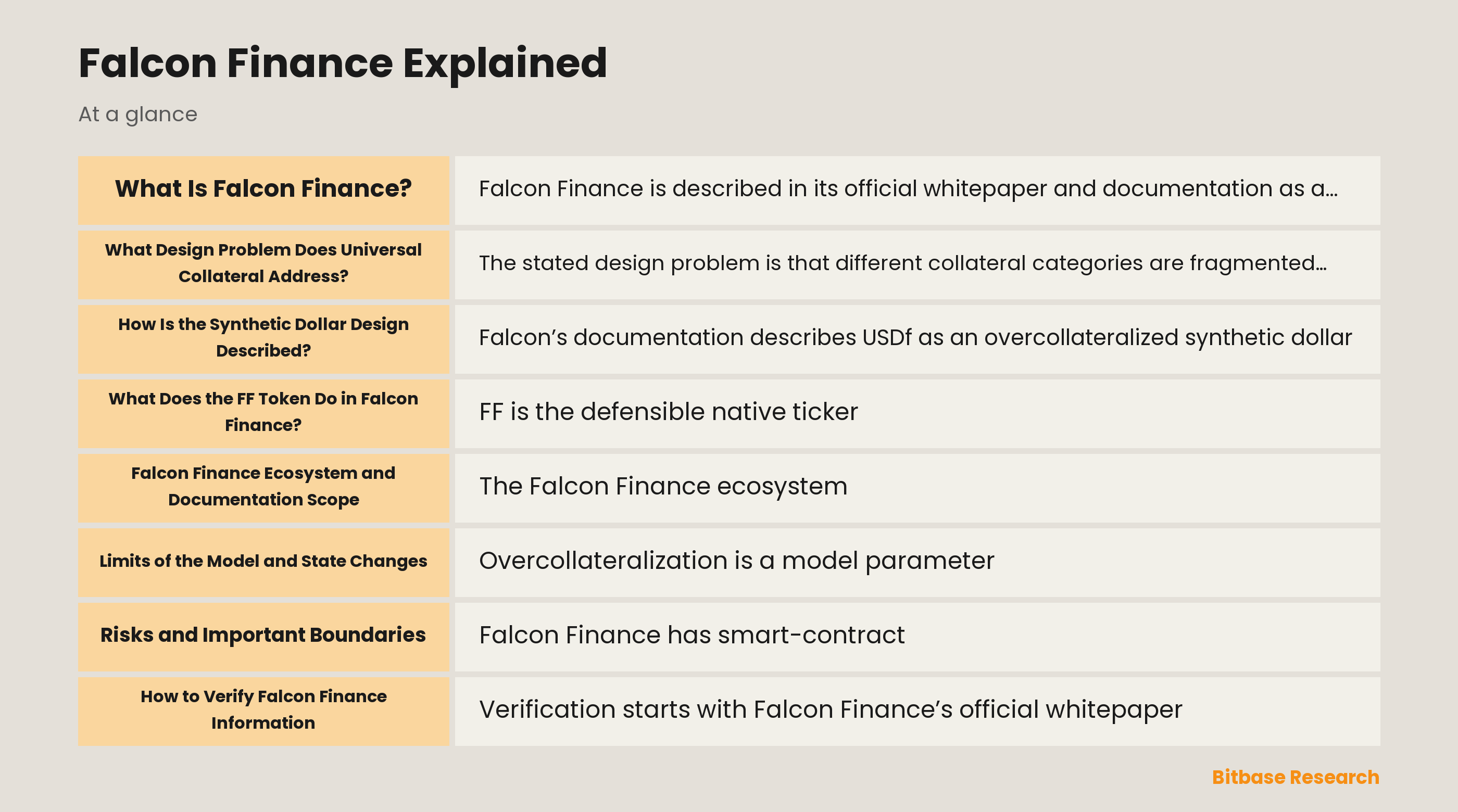
Headline size figures are self-reported and should carry a date. The fUSD announcement of 27 May 2026 gives USDf circulating supply as 1.63 billion dollars, and the FF launch post of 29 September 2025 gives roughly two billion dollars of total value locked; both are the project's own numbers on the day it published them. The official transparency page is a live dashboard rather than a document, so this article does not copy its instantaneous values: read it yourself and record the timestamp shown beside any figure you take from it.
How Falcon Finance Differs from Other Synthetic Dollars
The first difference is what backs the unit. A fiat-backed stablecoin holds cash and short-dated government paper at a regulated issuer, so its reserve report is an accounting question. USDf is backed by a broad mix of crypto assets and tokenised real-world assets under per-asset overcollateralisation ratios, so its reserve report is also a valuation question. Falcon runs both models under one brand: USDf issued by the protocol, fUSD issued by a federally chartered bank. Those are different legal and operational structures.
The second difference is where stability is produced. A purely on-chain collateralised-debt stablecoin liquidates on-chain collateral through contracts anyone can inspect. A delta-neutral synthetic dollar depends on hedges held in exchange and custodian accounts off-chain, so it rests on venues, counterparties and funding conditions no explorer displays. Both approaches have failure modes; they are simply different ones.
Risks and Limitations
The project has a documented depeg in its history. On 8 July 2025 USDf traded below its dollar peg; Protos and Cointelegraph, both citing CoinMarketCap data, put the low at roughly two per cent under par. The criticism was aimed at collateral quality and at how little of the backing could be verified on-chain: Protos reported that of about 635 million dollars shown on the dashboard that day, roughly 610 million sat off-chain in two buckets labelled only Stablecoins and Others, leaving about 25 million on-chain. A May 2025 LlamaRisk review filed to the Resupply governance forum had already flagged unilateral operational authority over reserve assets and a mint ceiling against one thinly traded collateral token that it considered disproportionate. Andrei Grachev, managing partner at Falcon Finance and at its backer DWF Labs, replied that stablecoins and bitcoin were 89 per cent of collateral and that USDf was 116 per cent collateralised; those are the operator's statements, not findings.
What changed afterwards is real, and its limits are equally real. From 1 October 2025 Falcon publishes an independent quarterly audit of USDf reserves by Harris and Trotter LLP, an ISAE 3000 assurance engagement covering wallet ownership, collateral valuation, user deposits and reserve sufficiency; the first report concluded that reserves exceeded liabilities, and Cryptopolitan, reading the dashboard on publication day, recorded a USDf backing ratio of 103.87 per cent. Weekly reserve letters and the transparency dashboard sit alongside it. An assurance report is a point-in-time statement about stated reserves within an agreed scope: it is not insurance, not a guarantee that USDf holds its peg, and not a promise that any amount is recoverable. The July 2025 reserve letter itself said the assessor had performed no procedures over control and ownership of the assets.
Collateral and counterparty risk follow from the design. Crypto collateral is volatile, and a buffer calibrated on past volatility can be consumed by a fast move, a gap, or a difference between a reference price and a realisable one. Tokenised real-world assets add the issuer behind the token, the custodian holding the underlying, transfer restrictions and the governing jurisdiction, none of which a token balance settles. Because deposits sit with named custodians and are mirrored to named exchanges, a failure or freeze at those venues is a direct channel to the backing. Funding rates can turn against market-neutral strategies, and peg arbitrage is open only to KYC-verified users.
Contract, governance and regulatory risk round it out. The audits page lists reports from Zellic and Pashov for USDf and sUSDf and from Zellic for FF, all hosted on the project's own documentation; the published contract list also includes sFF, sFF-Prime, the FF staking vault, per-asset staking vaults and a position NFT, for which the audit index names no report, so the published audits cover part of the deployed contract set rather than all of it. Governance is documented as still in development, so decisions today are made by the operator and its foundation. fUSD is built around a United States federal framework that USDf is not, Falcon Card is offered only in listed jurisdictions, and rules for synthetic dollars and tokenised assets differ by country.
How to Verify Falcon Finance and FF
Start from the source rather than a search result. Type falcon.finance and docs.falcon.finance into the address bar yourself, and use the official site as the origin for every other link, including social accounts and the app domain; only the direction from the official domain outward is evidence. Compare any domain you land on character by character, and stop if a page reached from an advertisement asks you to connect a wallet to claim, migrate or verify anything.
Then pin the contracts. The official Smart Contracts page in the documentation is the reference, and it lists a different address per network, so an address quoted without its network is not an answer. On Ethereum mainnet, USDf is 0xFa2B947eEc368f42195f24F36d2aF29f7c24CeC2, sUSDf is 0xc8CF6D7991f15525488b2A83Df53468D682Ba4B0 and FF is 0xFA1C09fC8B491B6A4d3Ff53A10CAd29381b3F949. On BNB Smart Chain, USDf is 0xb3b02e4a9fb2bd28cc2ff97b0ab3f6b3ec1ee9d2 and FF is 0xAC23B90A79504865D52B49B327328411a23d4dB2. On the XDC Network, USDf is 0x8210c0634AB8f273806e4b7866E9Db353773c44B.
Take each address to a block explorer for that exact chain. Confirm the token name and symbol, that the source code is verified, the deployment age and the holder count, and above all that the chain matches the one you read about, because a same-ticker token on the wrong network is the most common way people send funds nowhere. For supply and vesting, read the chain and the official tokenomics page rather than an aggregator. For reserves, open the transparency page yourself, note the timestamp it displays, and read the scope paragraph of the weekly letter or quarterly report before reusing any number.
Finally, grade the evidence. An audit report is stronger when you can find it on the auditing firm's own site; either way, check which contracts each report covers and compare that against the deployed contract list. Treat every figure in an announcement, a dashboard or a partner post as that party's own number with a date attached, and where documentation says a feature is coming soon, carry that label into your notes.
Conclusion
Falcon Finance turns eligible crypto assets and tokenised real-world assets into USDf, an overcollateralised synthetic dollar, with sUSDf as the staked yield-bearing form, fUSD as a separate bank-issued payment stablecoin launched with Anchorage Digital Bank in May 2026, and FF as the governance and utility token. FF is what you stake for sFF and what the documentation reserves for a governance system still described as in development; it is not the stablecoin. The project depegged in July 2025 amid questions about collateral quality and on-chain verifiability, and has since published quarterly assurance reports, weekly reserve letters and a live transparency dashboard, none of which is a guarantee of value. Read the official contracts page for the address on your network, confirm it on that chain's block explorer, and read the transparency page yourself on the day you need the number.
Related market pages
Bitbase pages for the tokens named in this article:
- FF: View price · Spot market · Perpetual market
Related reading
Other Bitbase articles on this topic:
- Proof of Reserves and Liabilities
- What Is an Algorithmic Stablecoin? Peg Held by Code
Disclaimer: This article is educational content from Bitbase Academy, provided for information only. It explains what a project does and what role its token plays in that system; it does not constitute investment, trading, tax, or financial advice, and it is neither a recommendation nor an endorsement of any project or token. Bitbase has not carried out due diligence on the project described here, and mentioning it does not mean Bitbase lists or supports the asset. Crypto assets carry significant risk, including price volatility, thin liquidity, smart-contract failure, regulatory uncertainty, and the possible loss of their entire value. Its contracts have not been publicly audited, or the published audit covers only part of the code. Written as of August 2026; a project's status, tokenomics, team, and contracts can change at any time. Verify everything yourself through official channels, the contract address, and a block explorer, and beware of imitation sites and phishing links.
References
[1] Falcon Finance, Transparency Dashboard (live reserve dashboard; footer names Falcon Digital Limited) app.falcon.finance
[2] Falcon Finance, Smart Contracts, official documentation (per-network addresses for USDf, sUSDf and FF) docs.falcon.finance
[3] Falcon Finance, Audits, official documentation (Zellic and Pashov reports and their scope) docs.falcon.finance
[4] Falcon Finance, User Deposit Process, official documentation (custodians and exchange venues) docs.falcon.finance
[5] Falcon Finance, FF Tokenomics, official documentation (supply, allocation, cliff and vesting) docs.falcon.finance
[6] Falcon Finance and Anchorage Digital Bank launch fUSD, official announcement, 27 May 2026 falcon.finance
[7] Introducing Falcon Card, official announcement, 20 July 2026 falcon.finance
[8] Protos, DWF Labs-backed USDf depegs as red flags raised over quality of backing, 8 July 2025 protos.com
[9] Cointelegraph, Falcon USD stablecoin loses dollar peg amid liquidity, collateral concerns, 8 July 2025 cointelegraph.com
[10] PR Newswire, Falcon Finance publishes first independent quarterly audit report on USDf reserves, 1 October 2025 prnewswire.com
[11] falcon finance releases an audit report www.cryptopolitan.com
[12] falcon finance enters its next chapter with the launch of ff token falcon.finance