Jito is documented as Solana infrastructure for MEV-aware block construction and liquid staking, while JTO is the governance token and JitoSOL is a separate liquid staking receipt token.
Readers researching jito tokenomics and use cases, asking what is jito crypto, or searching what is jito solana should separate a documented mechanism from a statement about a token, service, or outcome. This profile explains first-party descriptions of Jito's MEV infrastructure, governance, and JitoSOL without giving instructions for obtaining assets, operating a product, or authorizing an onchain request.
What Is Jito?
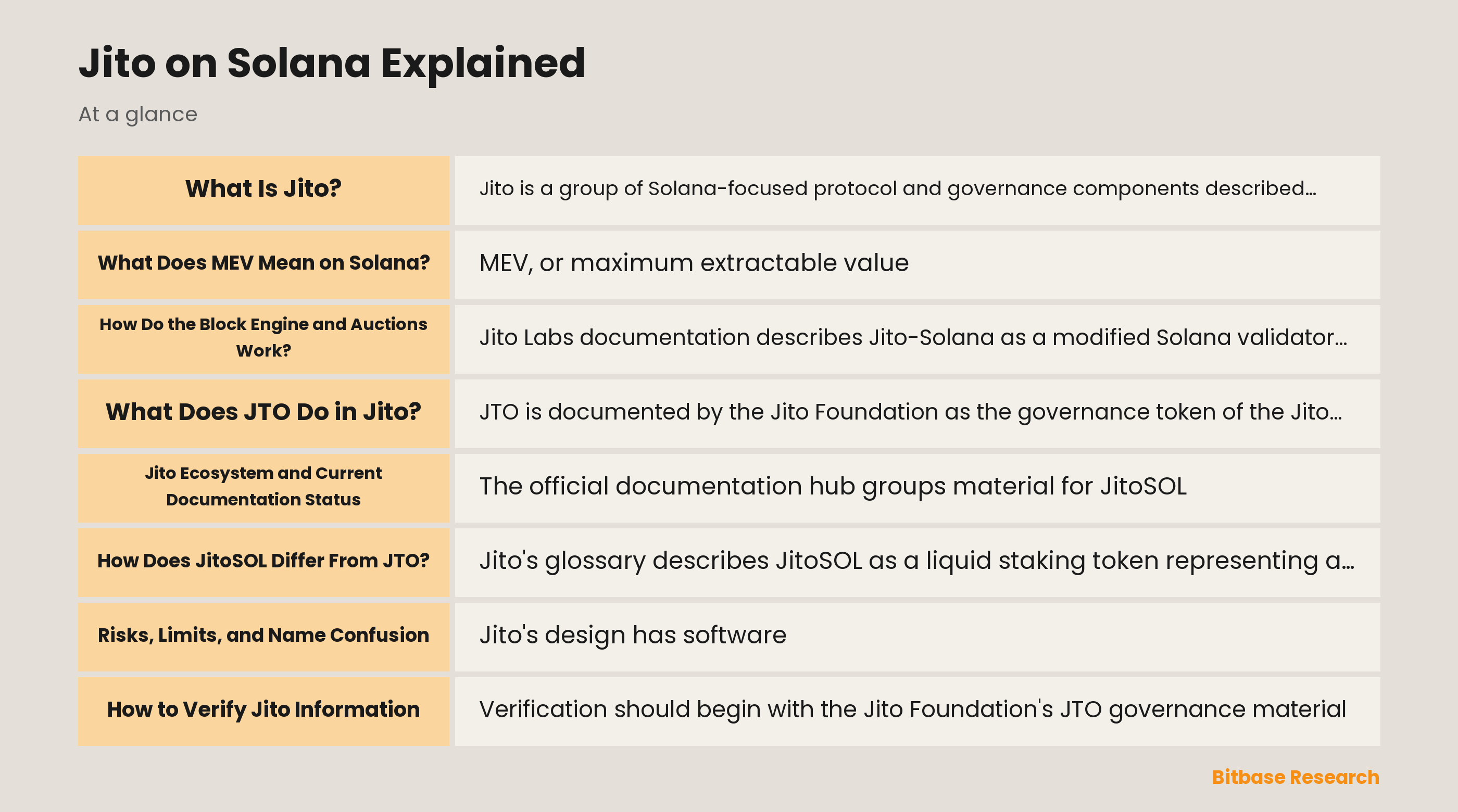
Jito is a group of Solana-focused protocol and governance components described across Jito Foundation and Jito Labs material. The documented picture includes the Jito-Solana validator client, a Block Engine that coordinates bundle auctions, the JitoSOL stake pool, governance around JTO, and ecosystem components such as StakeNet and TipRouter. These names identify related work, not one interchangeable token or one simple application.
At a high level, the materials discuss scarce block space, explicit MEV-related bids, and a liquid receipt associated with a Solana stake pool. Some components are onchain programs and others are offchain services. That distinction matters because a system description should not be reduced to a website, a single program, or a ticker.
Jito is documented in relation to Solana rather than as a separate blockchain. A first-party description can explain intended roles and relationships, but it does not establish that every component has the same current status, scope, or conditions on a given date.
What Does MEV Mean on Solana?
MEV, or maximum extractable value, describes economic value associated with the ordering, inclusion, or exclusion of onchain instructions in a block. It identifies a class of incentives created by limited block space and competing requests. The term itself does not determine whether a particular outcome is fair, compliant, successful, or available.
Jito's technical documentation describes an approach in which some ordering opportunities compete through explicit tips. In the documented architecture, specialized participants may form bundles of instructions, while the Jito-Solana client and Block Engine coordinate an auction-oriented selection process. This is a description of a mechanism for scarce block space, not a promise about any participant or result.
MEV is also a limited explanatory label. It does not show that a program is correct, that a block will be produced as expected, or that a changing Solana environment will behave in a particular way. Congestion, software releases, validator behavior, external dependencies, and governance decisions can change the practical context.
How Do the Block Engine and Auctions Work?
Jito Labs documentation describes Jito-Solana as a modified Solana validator client that can communicate with a Block Engine. The Block Engine is documented as receiving bundles, evaluating compatible combinations, and forwarding a selected set to a block-producing validator. This is a system-level description of software coordination, not a procedure for interacting with the service.
A bundle can be read as a grouped set of onchain instructions evaluated together under stated execution constraints. The documentation explains that account-lock patterns help distinguish conflicting groups from non-conflicting groups, allowing parallel auctions where the documented rules permit it. Groups that compete for overlapping state are assessed in the same auction context.
The architecture does not guarantee ordering, inclusion, execution, protection, performance, or network access. Auction cadence, bundle constraints, compute limits, software versions, fee routing, regional infrastructure, and connected services are time-sensitive operational facts. They need publication-day confirmation in current official material.
What Does JTO Do in Jito?
JTO is documented by the Jito Foundation as the governance token of the Jito Network. The governance material describes a role through which the Jito DAO can address protocol direction, including upgrades, parameters, and treasury management. This is a governance role, not ownership of a Jito entity, a right to payment, or an assertion about token value.
The official governance material also connects JTO decision-making with areas such as protocol configuration and fee-related questions. Rules, proposals, outcomes, and scope can evolve through the relevant governance framework. The presence of JTO does not establish that a proposal will pass, that a decision will occur, or that a parameter will stay unchanged.
JTO is not JitoSOL. JTO is the governance ticker, while JitoSOL is a separate liquid staking receipt token associated with the Jito stake pool. Treating those roles as distinct avoids confusing governance participation with a pool position, which depend on different records, rules, and publication-day checks.
Jito Ecosystem and Current Documentation Status
The official documentation hub groups material for JitoSOL, governance, StakeNet, TipRouter, and related technical topics. This helps map the ecosystem: JitoSOL concerns the pool receipt, JTO concerns governance, the Block Engine concerns MEV-aware block construction, StakeNet concerns validator-selection infrastructure, and TipRouter concerns a documented mechanism for certain MEV-tip distributions.
Jito Foundation pages and Jito Labs technical pages serve different purposes and may be revised on different schedules. A governance page can explain JTO, a glossary can define JitoSOL, and an engineering page can explain auction behavior. No one of those sources independently proves the current state of every other component.
At publication, product status, supported surfaces, network identifiers, deployed-program identifiers, token parameters, fee arrangements, and component availability all require a fresh official-source review. This article intentionally avoids time-sensitive quantities and identifiers. Documentation of a component is evidence of a documented concept, not a guarantee of security, compliance, liquidity, availability, or a distribution outcome.
Two figures give a sense of scale, and they measure different things. Jito's own April 2026 monthly report states that its Block Assembly Marketplace grew 155% over the first quarter of 2026 and ended the quarter at 28% of Solana's total stake, with 118 million SOL delegated across 344 validators as of 2026-04-30. That is not the same as client adoption: the IMC 2025 measurement study cites Jito's own StakeNet data for September 2025 showing that 97% of Solana's top 500 validators ran a Jito-compatible client. Separately, DefiLlama recorded about 753 million US dollars of total value locked in Jito Liquid Staking on 2026-08-15, while reported JTO trading was widely dispersed, with Biconomy at about 12.7% of 24-hour volume, Binance at about 9.4% and LBank at about 7.5%.
How Does JitoSOL Differ From JTO?
Jito's glossary describes JitoSOL as a liquid staking token representing a position in the Jito stake pool on Solana. The important category is that it is a pool receipt token, not the governance token of the Jito Network. Its relationship to pool accounting and documented MEV-related distributions does not make JTO and JitoSOL the same thing.
A statement about JTO voting or treasury governance belongs to the governance layer. A statement about the JitoSOL pool belongs to a separate pool and accounting context. Neither description establishes a personal outcome or proves that a program, parameter, integration, or legal treatment has stayed unchanged.
Jito documentation discusses stake-pool and MEV-related value mechanics in connection with JitoSOL, but those mechanics depend on program logic, validator conditions, protocol rules, fees, and other changing factors. They should be read as a documented mechanism with dependencies and risks, not as a guarantee of safety, liquidity, a distribution, or any financial result.
Where the yield comes from is part of what JitoSOL is. Jito's documentation describes JitoSOL as accruing value from a combination of staking rewards and MEV rewards, and the MEV component is the part a reader is entitled to have spelled out: some maximal extractable value on Solana is produced by ordering ordinary users' transactions unfavourably, so a share of the return on a liquid-staking token can originate in costs borne by other traders. Describing the result as higher yield alone would omit the mechanism, and the mechanism is the reason the subject is contested.
Risks, Limits, and Name Confusion
Jito's design has software, smart-contract, validator, consensus, governance, operational, and third-party dependency risks. A documented auction, pool, or distribution process can still be affected by faults, changing rules, incentive conflicts, delayed data, congestion, or unexpected behavior. Official documentation does not remove those risks or independently validate every implementation.
MEV-oriented mechanisms raise difficult questions about ordering, access, competition, and external effects. Parallel auctions and block-construction design are technical approaches to a stated problem, not a universal measure of fairness or proof that unwanted ordering outcomes cannot occur. Exact fee splits, routing rules, and consensus details are especially time-sensitive.
There is also identity risk. Project names, tickers, logos, web pages, and alleged program identifiers can be copied or presented beside unrelated material. A search result or unaffiliated post is not enough to establish an official identity. This profile supplies no authorization, acquisition, or product-use procedure.
The operator has intervened more than once over sandwich attacks. On 2024-03-08 Jito Labs suspended the public mempool of its block engine, citing negative externalities affecting Solana users; bundle functionality remained, and the change was itself contested, with observers arguing that extraction had moved into private order flow rather than stopped. Later, on 2025-10-22, the JitoSOL blacklist committee removed a further fifteen validators from the staking pool after an onchain report identified them as participating in sandwich attacks; this followed an earlier round of removals whose exact size and date this article could not confirm from a first-party source.
The scale of the problem is documented by two different kinds of evidence, and they should not be merged. A peer-reviewed measurement study presented at the ACM Internet Measurement Conference 2025, Quantifying the Threat of Sandwiching MEV on Jito by Gerzon, Weintraub, In, Mislove and Nita-Rotaru, analysed the period from 2025-02-09 to 2025-06-09 and reported 521,903 sandwich instances, victim losses above 7.71 million US dollars and attacker profits of about 9.68 million, while noting that sandwiches made up only 0.038% of all Jito bundles and that users spent about 2.42 million US dollars on defensive single-transaction bundles.
The more dramatic figures that circulate, namely that more than 6% of leader slots contained a sandwich against a retail user, that one validator reached 12.3%, that 30,000 to 60,000 SOL was extracted monthly with a peak near 87,000 in January 2025, and that roughly 222,272 people were affected, come from the onchain analytics account 0xGhostLogs and its sandwiched.me report of October 2025, not from the academic study. The same source reports that wide, multi-slot sandwiches now account for 93% of the total. Attributing analyst estimates to a peer-reviewed paper would overstate their standing, and this article keeps the two apart.
How to Verify Jito Information
Verification should begin with the Jito Foundation's JTO governance material, the JitoSOL glossary, the documentation hub, and Jito Labs technical documentation. These first-party sources should consistently distinguish JTO governance from JitoSOL's pool-receipt role and place Block Engine material in its technical context. A copied overview or similarly named token is not equivalent identity evidence.
Check the date, scope, and author of each official page before treating a detail as current. Governance rules, documentation menus, product status, program identifiers, network information, token parameters, fee arrangements, and TipRouter configuration are publication-day facts. Where official records name a contract address or program identifier, read it only in the matching official context and alongside any corresponding block explorer record for the same network.
A block explorer can show recorded public data, but it cannot by itself establish project identity, current service scope, safety, compliance, or future behavior. A missing, stale, or conflicting official record is a reason not to state the associated detail as current. These are source-reading principles, not directions for using a protocol.
Conclusion
Jito is best understood as a documented Solana-oriented set of mechanisms and governance components. Its materials describe MEV-aware block construction through Jito-Solana and the Block Engine, a TipRouter-related distribution design, JTO governance, and the separate JitoSOL liquid stake-pool receipt.
The key boundary is between a first-party description and a verified current condition. JTO's governance role and JitoSOL's receipt role do not guarantee security, compliance, liquidity, availability, a distribution, or any result. Before publication, re-check identity, documentation, product state, network and program information, and token parameters without turning the article into operational guidance.
Related market pages
Bitbase pages for the tokens named in this article:
- JTO: View price · Spot market · Perpetual market
Related reading
Other Bitbase articles on this topic:
- Solana MEV and On-Chain Attacks
- Solana Meme Launches and Token Risks
Disclaimer: This article is educational content from Bitbase Academy, provided for information only. It explains what a project does and what role its token plays in that system; it does not constitute investment, trading, tax, or financial advice, and it is neither a recommendation nor an endorsement of any project or token. Bitbase has not carried out due diligence on the project described here, and mentioning it does not mean Bitbase lists or supports the asset. Crypto assets carry significant risk, including price volatility, thin liquidity, smart-contract failure, regulatory uncertainty, and the possible loss of their entire value. Written as of August 2026; a project's status, tokenomics, team, and contracts can change at any time. Verify everything yourself through official channels, the contract address, and a block explorer, and beware of imitation sites and phishing links.
References
[1] The Jito Governance Token (JTO), Jito Foundation www.jito.network
[2] Constitution of the Jito Foundation www.jito.network
[3] JitoSOL Glossary, Jito Foundation www.jito.network
[4] Documentation Hub, Jito Foundation www.jito.network
[5] Low Latency Transaction Send, Jito Labs Documentation docs.jito.wtf
[6] TipRouter Learn More, Jito Foundation www.jito.network