
JPM Coin is a US dollar deposit token issued by J.P. Morgan through its blockchain unit Kinexys, and JPMD is the ticker the bank uses for it. The issuer states plainly that it is not a cryptocurrency and not a stablecoin, and that only vetted institutional counterparties can hold it. This article explains what a deposit token is, where JPM Coin runs, who can use it, and how to check every one of those claims yourself.
What Is JPM Coin?
JPM Coin is a deposit token: a digital representation of a US dollar deposit held at J.P. Morgan, recorded on a blockchain. It is issued by Kinexys by J.P. Morgan, the firm's blockchain business unit, which the bank says has been operating since 2015. The product name carries a service mark and is written JPM Coin. JPMD is its ticker, and the bank uses that ticker consistently: the 12 November 2025 announcement is headed JPM Coin (JPMD) USD Deposit Token Available for Institutional Clients, and its text states that JPMD remains the ticker for the JPM Coin USD deposit token.
The distinction between product name and ticker is worth holding onto, because much of the third-party coverage treats JPMD as if it were the name of a separate product. It is not. The bank's own Kinexys product page uses the JPM Coin service-marked name throughout and does not use the ticker in its body copy at all, while the newsroom release uses both and defines the relationship between them.
The issuer's characterisation of what this is could not be more explicit, and it is quoted here rather than summarised. Asked in its own FAQ whether JPM Coin is a cryptocurrency, J.P. Morgan answers: No. JPM Coin is a bank-issued deposit token, not a cryptocurrency or a stablecoin. It uses blockchain technology, but the token itself is backed by the safety and security of J.P. Morgan, and funds never leave the firm's regulated banking infrastructure. Describing this asset as a stablecoin is a factual error, not a stylistic choice.
What Problem Does a Deposit Token Try to Solve?
The problem is the gap between execution and settlement. In conventional institutional plumbing a payment, its settlement and its reconciliation are three separate steps that run in sequence, often across time zones and cut-off windows, and the capital involved is immobilised while they complete. Firms pre-fund accounts in multiple jurisdictions so that money is where it needs to be before it is needed, and that pre-funding is idle balance sheet.
The bank's stated answer is to collapse those steps. Its product page describes JPM Coin as unifying payment, settlement and reconciliation into a single on-chain action, with movement between cash and token handled through the Blockchain Deposit Account framework, and it argues that near-instant settlement frees cash that would otherwise be locked in sequential processing. Because a deposit token is a claim on a bank deposit rather than a claim on a reserve pool, the bank says it carries the credit risk profile of commercial bank money and sits inside existing regulatory deposit frameworks.
That is the issuer's argument for its own product, and the bank attaches its own caveat: a footnote on the same page states that the potential benefits listed are illustrative only, outcomes are not guaranteed, and any client offering is subject to development, internal review, due diligence and regulatory approvals. Note also an operational limit the bank itself discloses: transfers on the network run continuously, but moving funds between legacy demand deposit accounts and blockchain deposit accounts has a three-hour weekend downtime.
How JPM Coin Works
The lifecycle has three stages and the bank names them fund, move and redeem. A client deposits US dollars into a Blockchain Deposit Account and converts that cash into JPM Coin. The client then uses the token to send payments, post collateral, settle transactions and access on-chain markets, with payment and settlement unified on a shared ledger so reconciliation happens automatically. The client redeems the token back into US dollars on the same account whenever it chooses, with the bank stating there are no lock-up periods.
The venue is a public chain, which is the genuinely new part. The bank states that JPM Coin is issued on Base, the Ethereum Layer 2 network built within Coinbase, and it publishes the smart contract address itself: 0x7e0aedc93d9f898be835a44bfca3842e52416b82, reachable on the Base explorer. The November 2025 release describes near real-time peer-to-peer transfers between EVM-compatible wallets and says the token is designed for integration with smart contracts on public networks.
Public does not mean open here, and the bank draws that line explicitly: JPM Coin operates on a public blockchain where only vetted counterparties transact. Every transaction is recorded on a shared ledger with full traceability, and because the token is bank-issued it operates inside J.P. Morgan's existing compliance and risk frameworks rather than outside them. There is also a documented expansion path. On 7 January 2026 Digital Asset and Kinexys announced an intention to bring JPM Coin natively to the Canton Network, described as a phased approach through 2026 that begins with establishing technical and business frameworks. An announced intention is not a shipped product, and this article does not treat it as one.
What the JPMD Ticker Covers and What the Token Does
JPMD identifies one thing: the US dollar deposit token issued as JPM Coin. It is a ticker, not a second product, and it does not designate a tradable retail asset. The bank's own materials show the boundary clearly. JPM Coin is currently available in US dollars only, while the separate Blockchain Deposit Account framework that funds and redeems it supports multiple currencies. Those are different offerings and should not be merged into a single sentence.
What the token does is settle institutional flows. The bank lists cross-border payments, intraday liquidity transfers, on-chain collateral posting for securities transactions and programmable payment execution, and it describes programmability as supporting conditional release, scheduled transfers and rule-based payments. Corporates are told they can stop pre-funding accounts across time zones; financial institutions are told they can post collateral and settle securities on a shared ledger; payment service providers are told they can offer near-real-time settlement with fewer intermediaries.
There is no token economics section to write here, and the absence is the point. A deposit token has no supply schedule, no emissions, no staking, no burn, no governance vote and no fee-sharing claim. Its value is a bank deposit; it does not float, it is not distributed to a community, and there is nothing to farm. Anyone offering you yield on it, a presale of it, or a way to buy it as an individual is describing something J.P. Morgan does not offer.
The Kinexys Ecosystem and Adoption Today
The named participants come from the bank's own announcement, and they were participants in a proof of concept rather than an open user base. B2C2, Coinbase and Mastercard completed near-instant issuance and redemption of JPMD on Base as part of that exercise, which Kinexys launched in June 2025 and concluded with general availability to institutional clients on 12 November 2025. Executives from all three companies are quoted in the release, and quotes from partners in an issuer's press release are marketing statements by the parties involved.
The scale figures are the bank's own proprietary data, and they describe Kinexys as a whole rather than JPM Coin specifically. The unit publishes cumulative transaction value and daily average volume for its blockchain payments business; those are internal figures, not third-party audited numbers, and the split between the older private permissioned deposit-account business and the newer public-chain token is not broken out. Do not attribute the whole unit's history to a product that became generally available in late 2025.
The most useful adoption fact is structural rather than numerical: this is the first time a bank has issued a US dollar deposit token on a public blockchain, which is how the bank itself headlines the announcement. The population of holders is therefore, by design, the set of institutions J.P. Morgan has onboarded, and that set is not published.
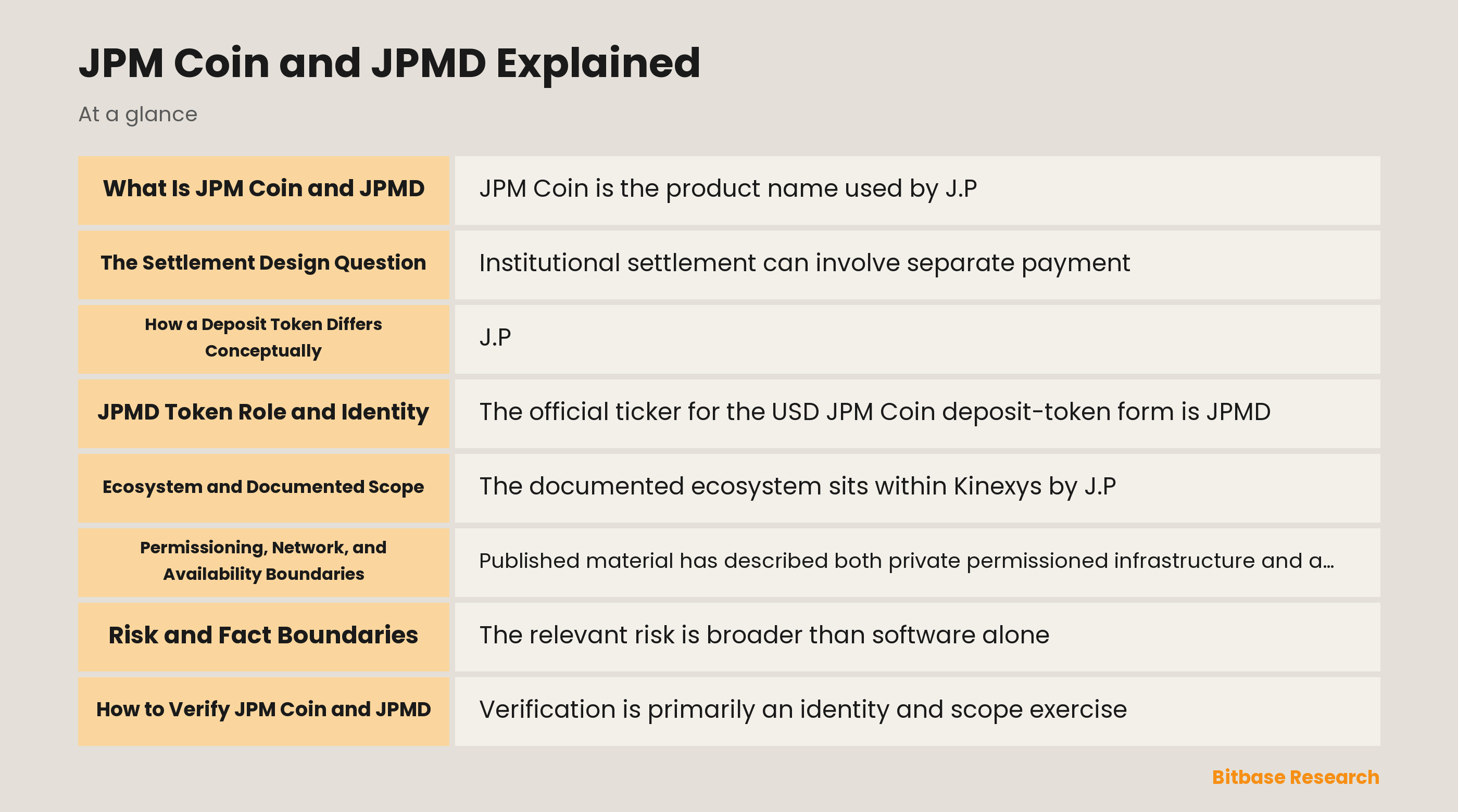
How a Deposit Token Differs from a Stablecoin
The claim is on a different thing. A holder of a fiat-backed stablecoin holds a claim on the issuer, whose backing sits in a reserve of cash and short-term instruments held at third-party banks and custodians, typically evidenced by attestations. A holder of JPM Coin holds a commercial bank deposit at J.P. Morgan, which is why the bank describes it as carrying the credit risk profile and balance-sheet certainty of commercial bank money and as benefiting from existing regulatory deposit frameworks. Those are different legal instruments with different failure modes.
Access is the other structural difference, and it is the one most likely to trip up a retail reader. A public stablecoin can be held by anyone with a wallet. JPM Coin is transferable only between counterparties the bank has vetted and approved, even though the ledger it moves on is public. A token can therefore be fully visible on a public explorer and still be entirely unavailable to you. That is not a ranking of one design over the other; it is a statement about who each instrument is built for.
Risks and Limitations
The first limitation is access, and it is absolute rather than a matter of degree. JPM Coin is available to J.P. Morgan's institutional clients and can only move between vetted, approved counterparties. Individuals cannot open a position in it. If you encounter an offer to buy JPMD, a presale, an airdrop, a yield product or a listing that lets a retail account hold it, that offer does not originate from J.P. Morgan.
The second is impersonation, and the bank publishes its own warning about it: any tokens with the same or similar name, but at different contract addresses, are not affiliated with J.P. Morgan. That sentence exists because deploying a token called JPM Coin or JPMD on any chain costs almost nothing, and the name alone proves nothing. The published Base address is the only identifier that separates the real instrument from a copy.
The third is that the counterparty is a bank and the exposure is bank exposure. A deposit token inherits the credit standing of its issuer, and the bank's own footer notes that deposits held in non-US branches are not FDIC insured and that non-deposit products are not FDIC insured. Deposit insurance coverage depends on the client, the entity and the jurisdiction, and this article does not tell you what applies to any particular account.
The remaining risks are operational and forward-looking. The token settles on Base, so it inherits that network's operational and upgrade characteristics alongside the bank's own controls. The bank discloses a three-hour weekly window when movement between legacy and blockchain deposit accounts pauses. The Canton expansion is an announced intention with a phased 2026 timeline rather than a live deployment. And the bank's own disclaimer states that services may not be available in all geographic areas and that its ability to offer them remains subject to approvals. This article makes no claim about how JPM Coin is treated under any specific regulation.
How to Verify JPM Coin and JPMD
Start at jpmorgan.com and navigate inward. The product page for JPM Coin sits under the Kinexys section, and the announcement sits in the J.P. Morgan Payments newsroom; reach both by typing the bank's domain yourself and following its own navigation. A bank's brand is among the most heavily impersonated in phishing, so compare the domain you are on character by character, and treat any page that reached you through an advertisement, a message or an email with suspicion. No legitimate J.P. Morgan page will ask you to connect a personal wallet to claim, migrate or verify a deposit token.
Pin the contract address, and read it as a per-network fact. The bank publishes the Base address 0x7e0aedc93d9f898be835a44bfca3842e52416b82 and links it directly to the Base block explorer from its own FAQ. Open that explorer, confirm the chain is Base, confirm the token name and symbol, and confirm the contract matches character for character. Any JPM Coin or JPMD at a different address, or on a different chain, is not this instrument, and the bank says so in its own words.
Read the two issuer sentences in the original rather than in a summary. The first is the answer to the cryptocurrency question in the Kinexys FAQ. The second is the same-or-similar-name warning attached to the contract-address answer. Both are short, both are unambiguous, and both are routinely mangled by secondary coverage that calls this a stablecoin or treats JPMD as a separate coin. If a source you are reading contradicts either sentence, the source is wrong.
Finally, separate what the bank asserts from what a third party verified, and check dates. Cumulative volume figures are the bank's proprietary data. Partner quotes are statements by those partners. Coverage in the financial press describes the announcement rather than independently auditing the reserves or the client list. The Canton issuance is dated 7 January 2026 as an intention. Note the publication date on every page you rely on, because a product that reached general availability in November 2025 and announced a second network in January 2026 is still changing.
Conclusion
JPM Coin is a US dollar deposit token issued by J.P. Morgan through Kinexys, and JPMD is the ticker the bank assigns to it rather than a separate product. It became available to the bank's institutional clients on 12 November 2025, it is issued on Base at a contract address the bank publishes itself, and it moves only between counterparties the bank has vetted.
The issuer states that it is not a cryptocurrency and not a stablecoin, that it represents a deposit inside the bank's regulated infrastructure, and that any token with the same or a similar name at a different contract address is unaffiliated with J.P. Morgan. There is nothing here for an individual to buy, stake or farm, so any offer that suggests otherwise should be treated as a fraud signal. Read the Kinexys product page and the 12 November 2025 newsroom release directly, and confirm the contract on the Base explorer before accepting any address.
Related market pages
Bitbase pages for the tokens named in this article:
- JPMD: View price
Related reading
Other Bitbase articles on this topic:
- What Is Propy (PRO)? Real Estate Transactions On-Chain
- What Is Rizenet? T-RIZE, RIZE, and Tokenization Boundaries
- What Is a Fiat On-Ramp? Turning Cash Into Crypto
Disclaimer: This article is educational content from Bitbase Academy, provided for information only. It explains what a project does and what role its token plays in that system; it does not constitute investment, trading, tax, or financial advice, and it is neither a recommendation nor an endorsement of any project or token. Bitbase has not carried out due diligence on the project described here, and mentioning it does not mean Bitbase lists or supports the asset. Crypto assets carry significant risk, including price volatility, thin liquidity, smart-contract failure, regulatory uncertainty, and the possible loss of their entire value. Written as of August 2026; a project's status, tokenomics, team, and contracts can change at any time. Verify everything yourself through official channels, the contract address, and a block explorer, and beware of imitation sites and phishing links.
References
[1] Kinexys by J.P. Morgan, JPM Coin product page (issued on Base, contract address, not a cryptocurrency or a stablecoin, vetted counterparties, FAQs) jpmorgan.com
[2] J.P. Morgan Payments newsroom, JPM Coin (JPMD) USD Deposit Token Available for Institutional Clients, 12 November 2025 jpmorgan.com
[3] Kinexys Blockchain Deposit Accounts, official product page (multi-currency BDA framework) jpmorgan.com
[4] Kinexys digital payments, official page (cumulative volume, proprietary data) jpmorgan.com
[5] Base block explorer entry for the JPM Coin contract published by J.P. Morgan basescan.org
[6] Kinexys USD digital deposit tokens proof-of-concept announcement (June 2025) jpmorgan.com
[7] Digital Asset and Kinexys announce intention to bring JPM Coin natively to the Canton Network, 7 January 2026 digitalasset.com
[8] CoinDesk, JPMorgan rolls out JPM Coin leveraging Coinbase Base (12 November 2025) coindesk.com
[9] kinexys milestones 2026 www.jpmorgan.com
[10] jpm coin jpmd usd deposit token available institutional clients www.jpmorgan.com