Lido is a liquid staking protocol on Ethereum: a user deposits ether, the protocol allocates it to node operators, and the depositor receives stETH, a transferable token representing the staked position. Its governance token is LDO. This profile covers how the system works, how stETH, wstETH and LDO differ, and what to verify independently.
What Is Lido?
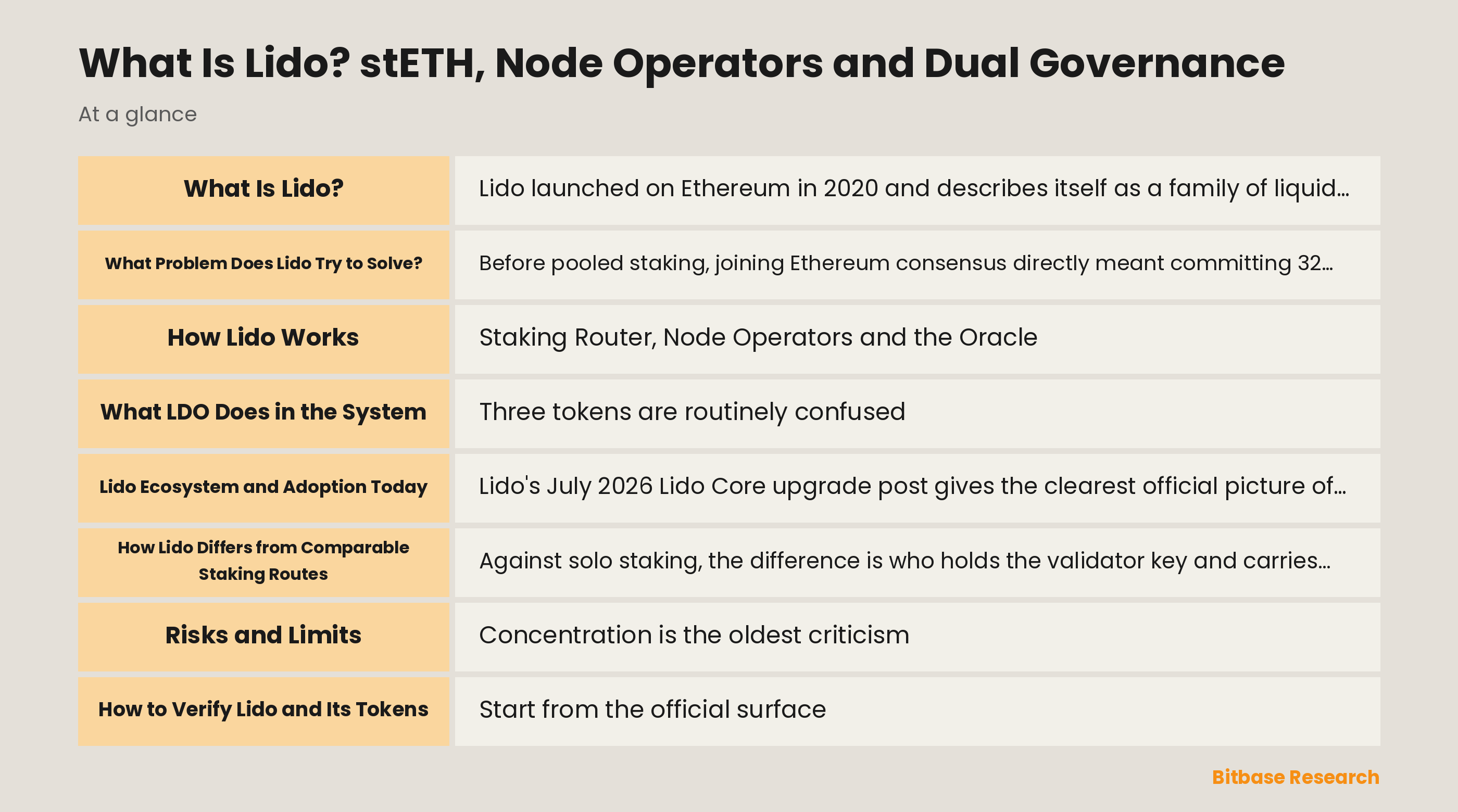
Lido launched on Ethereum in 2020 and describes itself as a family of liquid staking protocols headquartered on Ethereum. It is not a separate blockchain: Lido on Ethereum is a set of smart contracts that accept ether deposits, allocate that ether to validators run by third-party node operators, and issue a liquid receipt token. The documentation calls the pooled part Lido Core, to distinguish it from stVaults, the modular primitive introduced with Lido V3.
Four actors must be kept apart. The protocol is the on-chain contract system. The Lido DAO is the organisation of LDO holders that sets parameters, approves upgrades and controls the treasury through Aragon on-chain votes, Snapshot signalling and Easy Track motions. The grant-funded Lido Labs, Lido Ecosystem and Lido Alliance foundations employ contributors and build the software; Lido's May 2026 tokenholder update states they hold no meaningful LDO and do not vote. Node operators are separate firms and individuals running the validators and holding the validator keys.
What Problem Does Lido Try to Solve?
Before pooled staking, joining Ethereum consensus directly meant committing 32 ether per validator, running client software continuously, and accepting that the stake could not be moved. Leaving is not instant either: withdrawals pass through Ethereum's exit queue, which lengthens when many validators leave at once. The practical alternative for most holders was custodial staking at an exchange, where the ether sits off-chain and the position generally cannot be used on-chain.
Lido's stated proposition is that a depositor of any size can hand the operational job to professional operators while still holding a transferable token that tracks the position, so the stake stays usable as collateral or liquidity as it accrues consensus-layer and execution-layer rewards. That framing is the project's own. It changes the dependency rather than removing it: instead of a machine, the depositor now depends on contracts, operators, an oracle and a DAO.
How Lido Works: Staking Router, Node Operators and the Oracle
Ether submitted to the Lido core contract mints stETH one-to-one, and the ether is allocated by a component called the Staking Router into staking modules, each with its own operator set, fee structure and deposit rules. Redemption runs the other way through a withdrawal queue: the request locks stETH and mints an unstETH ERC-721 token representing a queue position, and the ether becomes claimable once an oracle report finalises it.
The oracle is the part most readers overlook. Lido's documentation describes nine independent oracle daemons hosted by established node operators selected by the DAO, with a report accepted once five of the nine submit the same data. That report triggers the daily stETH rebase, which can in principle be negative if validators are penalised, and the contract applies sanity checks that bound what a single report may claim.
The module set is not static. After the Lido Core upgrade published in July 2026, Curated Module v2 is live and stake is due to migrate from the legacy Curated Module, while the permissionless Community Staking Module runs as CSM v3, where an operator posts a bond instead of being approved by the DAO. The same upgrade added an Identified DVT Cluster operator type, and the 72 regular clusters of the older Simple DVT Module were wound down.
What LDO Does in the System
Three tokens are routinely confused. stETH is the rebasing receipt: an ERC-20 whose balance is recalculated when the oracle reports, so the number in the wallet moves without a transfer. wstETH is the wrapped version and does not rebase; its balance stays fixed while its value in stETH changes, which is why it is the form used by applications that cannot handle rebasing and the form bridged to other networks. LDO is neither: it is the DAO's governance token.
LDO does not represent a claim on staking rewards. Holding it does not entitle the holder to staked ether, to a share of any staker's rebase, or to redeem anything from the staking contracts; that role belongs to stETH and wstETH. LDO carries voting weight proportional to the balance over protocol parameters, the operator set, oracle membership and treasury allocations, and follows the MiniMe design, so balances can be read at a past block while a vote is open.
Rewards come from Ethereum, not from Lido: consensus-layer issuance plus execution-layer priority fees and MEV, minus validator penalties. Of that flow, Lido's May 2026 tokenholder update describes roughly 90 percent going to stakers, approximately 4 percent to node operators depending on the module, and the remainder to the DAO treasury. The DAO share is a changeable parameter: after a tokenholder vote adjusting Curated Module economics, Lido reports the effective take rate moving from 4.96 percent in December 2025 to about 6.10 percent in May 2026.
Dual Governance is the counterweight to that voting power. It inserts a programmed timelock between a proposal passed by LDO holders and its execution, letting stETH holders delay or block execution by locking stETH, wstETH or withdrawal NFTs in a signalling escrow. Opposition above about one percent of stETH supply extends the delay from roughly five days up to forty-five; above about ten percent the system enters rage quit and nothing executes until the opposing stakers have exited. The purpose is to make a hostile takeover impractical and to guarantee stakers a window to leave. The DAO vote closed on 30 June 2025, reporting put on-chain activation on 4 July 2025, and Lido's governance page now lists a minimum three-day Dual Governance delay.
Lido Ecosystem and Adoption Today
Lido's July 2026 Lido Core upgrade post gives the clearest official picture of scale. It states that the Community Staking Module then secured over 770,000 staked ether across an estimated 335 active operators, roughly 8.5 percent of Lido's total value locked and about 1.9 percent of the whole Ethereum validator stake, while the Curated Module accounted for around 90 percent of the ether staked in Lido Core. Those are the project's own figures and cut-off.
Lido's documentation lists wstETH as collateral in Aave v3 markets on Ethereum, Arbitrum, Base and Optimism, and lists wstETH deployments on further networks including Linea, BNB Chain and Unichain. The Lido Earn vaults EarnETH and EarnUSD went live in March 2026, and the WisdomTree stETH exchange-traded product has been live since December 2025, with holdings Lido reported growing from roughly 17,000 to roughly 21,000 ether over early 2026. stVaults held approximately 5,500 ether at the May 2026 call.
How Lido Differs from Comparable Staking Routes
Against solo staking, the difference is who holds the validator key and carries the operational duty: a solo staker deposits in units of 32 ether and cannot move the position until the exit queue releases it, while a Lido depositor holds a token rather than a validator and does not choose the operator. Against other pooled designs, Lido runs several operator models in parallel through one Staking Router, and its receipt token rebases by default with a non-rebasing wrapper alongside, whereas several other liquid staking tokens are value-accruing only.
Risks and Limits
Concentration is the oldest criticism. Lido has been the largest single staking entity on Ethereum for years, and critics have argued for just as long that one protocol holding a large slice of validators is a decentralisation problem for Ethereum itself. Lido's own May 2026 update describes its share of the wider staking market falling as institutional delegated staking grew, while it still held roughly 90 percent of what it calls the simple liquid staking segment. A current figure for its share of all staked ether at this article's publication date could not be verified, so any percentage found elsewhere needs re-checking against a live dashboard.
On 10 May 2025 a hot wallet used for Lido Oracle voting, managed by node operator Chorus One, was accessed without authorisation and drained of 1.46 ether, a balance deliberately kept low as a gas float. Because the oracle requires five of nine participants to agree, the compromise of one oracle did not affect protocol operation; Lido stated that stakers were not affected and no user funds were lost, and the DAO rotated the key through an emergency proposal. Chorus One attributed it to a hot wallet created in 2021 that lacked the safeguards of its newer keys, making this an operational key-management failure rather than a defect in the contracts or the oracle software. It should not be described as Lido being hacked.
stETH is not pegged to ether. The protocol mints and redeems at parity by design, but redemption is asynchronous and, in a serious loss scenario, the documentation allows a request to be finalised at a discounted rate. In the secondary market the two have traded apart repeatedly: Lido's own June 2026 review of the April 2026 KelpDAO stress event reports the Curve main-pool daily volume-weighted price of stETH reaching about 0.9941 ether, roughly 59 basis points below parity, before recovering to near parity by 20 May 2026.
Several roadmap items are unfinished. A dedicated 0x02 Community Staking Module for compounding validators has DAO approval but is targeted for the fourth quarter of 2026 and is not live; Curated Module v2 has completed only its first phase; stVaults adoption is behind Lido's own plan; and the NEST automated buyback mechanism was approved by Snapshot with on-chain deployment expected from July 2026, which a reader should confirm rather than assume. Smart contract failure, slashing, oracle unavailability, adverse governance outcomes and shifting regulation all remain live, and the April 2026 KelpDAO incident showed composability transmitting risk: Lido's EarnETH vault was frozen for 27 days over exposure it did not create.
How to Verify Lido and Its Tokens
Start from the official surface, not from a search result. Open lido.fi and docs.lido.fi directly, and confirm any social account you follow is linked from the site rather than the other way round. Governance claims belong on research.lido.fi and the on-chain voting interface at dao.lido.fi: if a text says the DAO approved something, the proposal thread and the vote should both exist and match.
For the tokens, take the addresses from Lido's own documentation and check them on a block explorer. On Ethereum mainnet the documentation gives stETH as 0xae7ab96520DE3A18E5e111B5EaAb095312D7fE84, wstETH as 0x7f39C581F595B53c5cb19bD0b3f8dA6c935E2Ca0 and LDO as 0x5A98FcBEA516Cf06857215779Fd812CA3beF1B32. Confirm the explorer shows Ethereum mainnet, the source code is verified, and the creation date and holder count fit a contract years old. wstETH also exists on other networks under different addresses, and a same-ticker token on another chain is the most common misidentification.
For anything numeric, prefer the chain and official dashboards over aggregator pages, and read the date attached to every figure: a take rate, a share of staked ether or a vault balance is a snapshot, not a constant. Audit reports should be findable on the auditor's own site, as the Dual Governance reviews are. Finally, compare any domain character by character, treat paid search placements with suspicion, and stop at any page asking you to connect a wallet in order to claim something.
Conclusion
Lido is a liquid staking protocol on Ethereum that pools ether, routes it to node operators through modules, and issues stETH against it, with wstETH as the non-rebasing wrapper and LDO as the governance token that carries votes but no claim on staking rewards. Its distinctive feature is Dual Governance, which lets stETH holders delay or block proposals passed by LDO holders and exit first. The points most argued over are its size relative to Ethereum staking and the fact that stETH can trade below ether under stress. Check the documentation, the contract addresses on a block explorer, and the date on every figure yourself.
Related market pages
Bitbase pages for the tokens named in this article:
- LDO: View price · Spot market · Perpetual market
Related reading
Other Bitbase articles on this topic:
- What Is Casper Network? Design, CSPR, and Verification
Disclaimer: This article is educational content from Bitbase Academy, provided for information only. It explains what a project does and what role its token plays in that system; it does not constitute investment, trading, tax, or financial advice, and it is neither a recommendation nor an endorsement of any project or token. Bitbase has not carried out due diligence on the project described here, and mentioning it does not mean Bitbase lists or supports the asset. Crypto assets carry significant risk, including price volatility, thin liquidity, smart-contract failure, regulatory uncertainty, and the possible loss of their entire value. Written as of August 2026; a project's status, tokenomics, team, and contracts can change at any time. Verify everything yourself through official channels, the contract address, and a block explorer, and beware of imitation sites and phishing links.
References
[1] Lido tokens integration guide: stETH, wstETH, LDO and unstETH (Lido official documentation) docs.lido.fi
[2] Community Staking Module intro, CSM v3 and the planned 0x02 CSM (Lido official documentation) docs.lido.fi
[3] Lido DAO Governance: governance process, Dual Governance veto signalling and rage quit (Lido official site) lido.fi
[4] Dual Governance 101: Explainer (Lido official blog) blog.lido.fi
[5] Emergency rotation of compromised Chorus One oracle, including Chorus One's own statement (Lido governance forum) research.lido.fi
[6] Lido secure after oracle compromise sparks emergency DAO vote, reporting the 1.46 ETH drained (The Block) theblock.co
[7] Lido DAO votes to enable dual governance, giving stakers veto power (The Block) theblock.co
[8] Lido Poolside Recap: Tokenholder Update, May 2026, with fee split, DAO take rate and segment shares (Lido official blog) blog.lido.fi
[9] A New Lido Core Upgrade for Protocol Sustainability and a Leaner Ethereum, July 2026 (Lido official blog) blog.lido.fi
[10] stETH Liquidity Held Its Ground During the KelpDAO Stress Event, with stETH/ETH secondary-market pricing (Lido official blog) blog.lido.fi