
Litecoin is an independent proof-of-work blockchain launched in 2011, and LTC is the native coin that pays its fees and rewards its miners. This article covers Scrypt mining and the 2.5-minute block target, the optional MWEB layer, what LTC does in the system, and the risks — including the 2026 MWEB security incidents — that a reader should check.
What Is Litecoin?
Litecoin is its own layer-1 blockchain, launched in October 2011 by Charlie Lee from a modified copy of the Bitcoin codebase. Its coin carries the ticker LTC and is native to that chain, not a token issued on Ethereum or anywhere else. Three things should be kept apart: the open-source protocol and its reference client Litecoin Core, maintained in public on the litecoin-project GitHub repository; the Litecoin Foundation; and the miners and node operators who run the network.
The Litecoin Foundation is a non-profit that runs litecoin.com, the learning centre, events and community work, and publishes incident reports; it does not own the protocol and cannot change consensus rules alone. The headline parameters come from that learning centre rather than a market site: a maximum supply of 84 million coins, blocks roughly every 2.5 minutes, and a reward that began at 50 LTC and halves every 840,000 blocks — about every four years — until issuance reaches zero around 2142.
What Problem Does Litecoin Set Out to Solve?
When Litecoin appeared in 2011, the practical complaint about Bitcoin-style payments was confirmation latency, alongside a mining market drifting toward specialised hardware. Litecoin's stated answer was a shorter block target, 2.5 minutes instead of ten, plus a different proof-of-work function, Scrypt, chosen on the argument that memory-hard hashing resists concentration into custom chips.
Two caveats belong with that. The hardware argument did not hold: Scrypt mining machines have existed for years and Litecoin mining is now industrial. And a faster block target changes how quickly a first confirmation arrives, not how much work sits behind it — a point the April 2026 reorganisation made concrete. Litecoin also had no confidential-transaction option until MWEB activated in 2022.
How Litecoin Works: Scrypt, Blocks and MWEB
Litecoin uses Scrypt proof of work. The official technical page gives the parameters exactly: N=1024, r=1 and p=1, with the 80-byte block header as both input and salt and a 256-bit output. Miners search for a nonce that puts the header's Scrypt hash below the current target, and nodes follow the chain with the most accumulated work.
MWEB — the MimbleWimble Extension Block — activated as a soft fork in 2022. It is an extension block attached to each ordinary Litecoin block and secured by the same miners, described officially as an optional privacy and scalability layer. Coins move in by pegging in to an address beginning ltcmweb1 and leave by pegging out to a transparent address; inside MWEB, amounts and addresses are confidential.
The important word is optional. The base chain stays fully transparent and MWEB is used only by those who choose it, so Litecoin is not a privacy coin. The Foundation's page is explicit about the limits: peg-in and peg-out amounts stay visible on the transparent chain, and the confidentiality is narrower than on a chain where it is on by default.
What LTC Does Inside the Litecoin System
LTC pays transaction fees on the Litecoin chain, and it is what miners receive — the block subsidy plus those fees — for producing blocks. It is also the unit that moves in and out of MWEB: a peg-in or peg-out is LTC changing which layer it sits on, not a swap into a different asset.
What LTC does not do matters as much. There is no staking, no yield mechanism, no governance vote attached to holding it, and no burn or buyback; the official material describes rule changes as requiring consensus among participants, a miner and node-operator process rather than a token vote. There is no team allocation or unlock schedule either, because issuance follows the halving schedule written into the code, so supply is arithmetic and chain data rather than announcements. Anyone quoting a different cap, a different schedule, or a contract that supposedly governs LTC supply is describing something other than Litecoin.
Litecoin Ecosystem and Adoption Today
Litecoin has run continuously since 2011, its most concrete adoption fact. The Foundation's site groups the ecosystem into buying, spending, storing and business use, links a block explorer at litecoinspace.org, and points node operators to litecoin.org. MWEB wallet support spans the Litecoin Core desktop client, Electrum-LTC and several mobile wallets; the Foundation's 2026 news feed covered a Nexus Wallet release adding Tor and MWEB.
Anything more precise is a moving number that needs a source and a date. Node counts, MWEB balances and merchant integrations all change, and several figures circulating about Litecoin in 2026 come from third-party trackers rather than the project — the version-distribution numbers in the risk section are one example, an outside count of reachable nodes at one moment rather than an official statistic.
Availability is jurisdictional, not universal. Because MWEB adds an optional confidential layer, some venues and regulators treat Litecoin differently from a fully transparent chain — the Foundation's own MWEB explainer lists delisting pressure among the four standard objections to adding privacy. Whether a platform supports LTC has to be checked there.
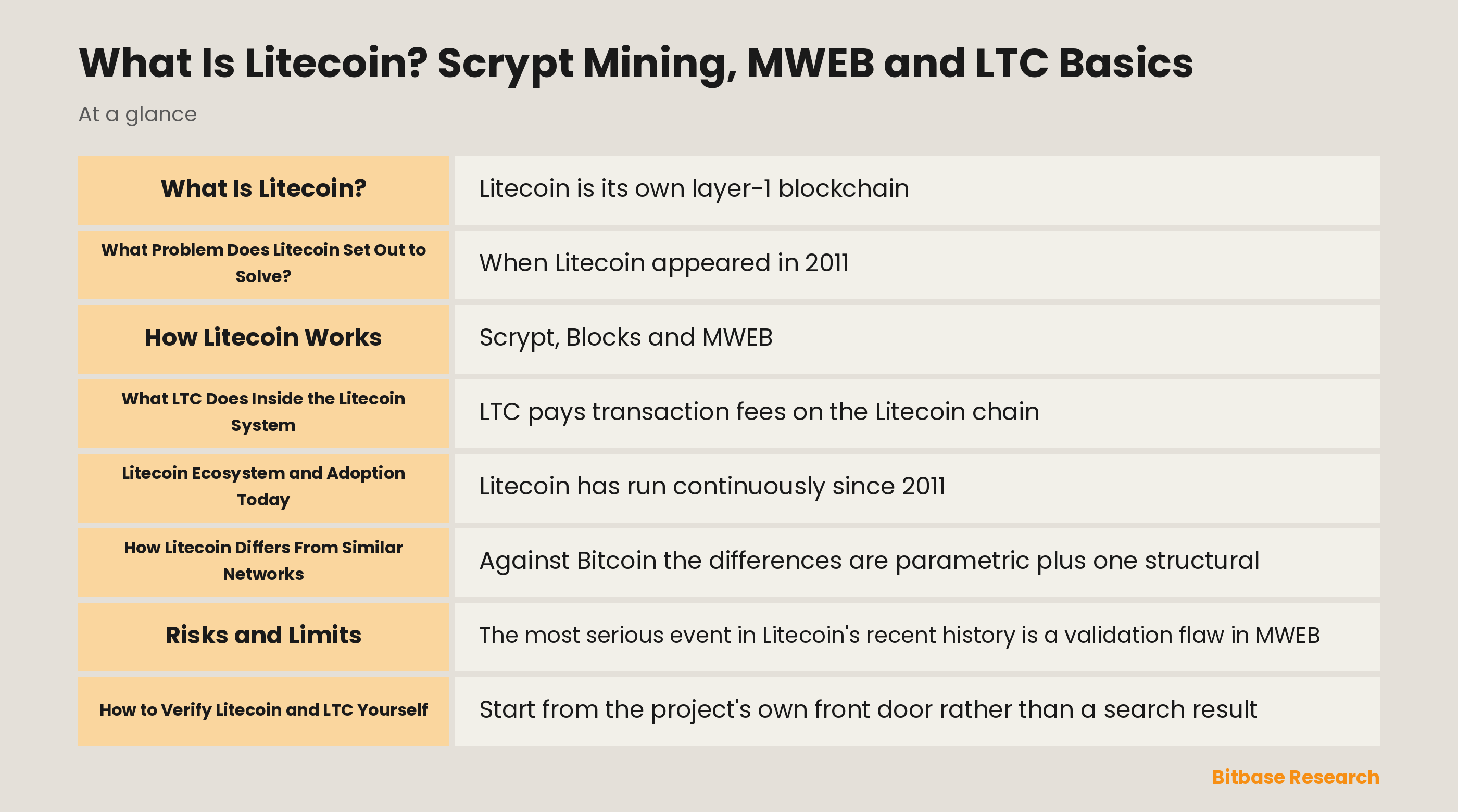
How Litecoin Differs From Similar Networks
Against Bitcoin the differences are parametric plus one structural. Litecoin hashes with Scrypt rather than SHA-256, targets 2.5-minute rather than ten-minute blocks, and caps supply at 84 million rather than 21 million. The structural difference is MWEB: Bitcoin has no equivalent extension block.
Against chains built around confidentiality, the difference is where privacy lives. Monero applies it to every transaction by default; Zcash offers shielded transactions on the same layer. Litecoin puts confidentiality in a separate, optional extension block, so its base ledger stays auditable while MWEB users accept a narrower guarantee. The 2026 incidents fell entirely inside the MWEB layer.
Risks and Limits
The most serious event in Litecoin's recent history is a validation flaw in MWEB. Metadata carried by an MWEB input was not fully revalidated during block connection, so a mined block could let a small MWEB input appear to back a far larger peg-out. Developers found the flaw during an internal review on 19 March 2026, and a chain scan showed it had already been used: at block 3,073,882 an attacker pegged out 85,034 LTC that had never existed. The outputs were frozen, and the actor was contacted and returned the funds, keeping an agreed 850 LTC bounty.
In April 2026 a second actor attempted the same path. Upgraded nodes rejected the malformed block, but the handling of mutated MWEB block data left upgraded mining nodes stuck, while miners that had not upgraded kept extending the invalid chain. The valid chain later overtook it and reorganised out 13 bad blocks, roughly 32 minutes of block time at the 2.5-minute target. Third parties that had settled against the invalid chain lost money: the postmortem records NEAR Intents losing 11,000 LTC, swapped for 7.78814476 BTC. Those 11,000 LTC are a separate figure from the 85,034 LTC of March — the March amount was created out of nothing and later returned, while the April amount was a third party's real loss.
Litecoin Core v0.21.5.4, published on 26 April 2026, is the release that addresses both sides. Its notes list an MWEB consensus fix for the input-validation issue that could leave the MWEB kernel sum unbalanced — a required upgrade for all node operators, miners and wallet users — alongside a change that erases stored data for mutated blocks so the mining denial-of-service condition could not recur. Patching continued: v0.21.5.5 followed in May and v0.21.5.6 on 2 August 2026, adding a narrow soft-forking rule that activates at block height 3,154,440.
The characterisation of the April event is disputed, and this article does not settle it. The Litecoin Foundation's official account said the incident began with a bug that was not known in advance and caused a denial-of-service attack disrupting major mining pools. CoinDesk reported on 26 April 2026 that the public commit history shows the consensus vulnerability behind the invalid peg-out had been patched privately between 19 and 26 March, roughly four weeks before the attack, and that this timeline does not match the official description. Both versions are recorded here as each party's own statement; no third party has adjudicated between them.
The unresolved part is deployment. Protos reported on 19 June 2026, citing Blockchair's node tracker, that fewer than 30% of reachable Litecoin nodes ran up-to-date software and roughly 39% still ran v0.21.4 — the third-party basis for the widely repeated statement that around 70% of nodes had not upgraded. That is an outside count from mid-June 2026, not an official statistic and not a current reading, so anyone using it should re-measure. On a proof-of-work network nobody can force an upgrade, so a fixed bug and a deployed fix are different things. Ordinary exposures apply too: hashrate concentration, deep reorganisations, and shifting regulatory treatment of optional privacy.
How to Verify Litecoin and LTC Yourself
Start from the project's own front door rather than a search result. Open litecoin.com and litecoin.org directly, and confirm the official social accounts are linked out from those sites rather than trusting an account that links back in. Compare the domain character by character with the one you meant to visit, and treat any page asking you to connect a wallet to claim something as a reason to stop.
Then use a block explorer — the one linked from the official site is litecoinspace.org — and read the record yourself. The incident blocks are public: look up height 3,073,882 for the March peg-out, the range 3,095,931 to 3,095,943 for the 13 blocks reorganised out in April, and height 3,078,098 for the peg-in that rebalanced MWEB. MWEB peg-outs and peg-ins appear as transparent amounts even though activity inside MWEB does not.
Note what you will not find on an explorer: a contract address. Litecoin is an independent layer-1 chain and LTC is its native coin, so it has no smart-contract address at all. Any token presented as the LTC contract address is a wrapped or imitation asset on some other chain, and that is exactly why the block explorer check matters — paste the identifier into the explorer for the chain it claims to belong to and see what it is.
For software, read the release page on the litecoin-project GitHub repository and check which version you run; the postmortem advises confirming a node keeps advancing and comparing its height against a trusted explorer. For supply, take the coins issued from chain data and the schedule from official documentation, not an aggregator. Litecoin has no smart contracts, so there is no contract audit to look for; the equivalent evidence is the commit history, the release notes and the postmortem.
Conclusion
Litecoin is a 2011 proof-of-work chain with Scrypt mining, a 2.5-minute block target and an 84 million coin cap, and LTC is the native coin that pays its fees and rewards its miners, with no staking, governance or burn. MWEB is an optional confidential layer, not a default one, which is why Litecoin is not a privacy coin.
The 2026 MWEB incidents belong in the same picture: an inflation flaw that produced 85,034 LTC before the funds were returned, a follow-up attempt that cost a third party 11,000 LTC in a 13-block reorganisation, a disputed account of the timeline, and a patch many node operators have been slow to install. Check the blocks, the releases and the node version yourself, through official sources and a block explorer.
Related market pages
Bitbase pages for the tokens named in this article:
- LTC: View price · Spot market · Perpetual market
Related reading
Other Bitbase articles on this topic:
- Bitcoin Staking and Yield: How BTCfi Works
- Stablecoin vs Bitcoin: What's the Difference?
- UTXO vs Account Model: Two Ways to Track Coins
Disclaimer: This article is educational content from Bitbase Academy, provided for information only. It explains what a project does and what role its token plays in that system; it does not constitute investment, trading, tax, or financial advice, and it is neither a recommendation nor an endorsement of any project or token. Bitbase has not carried out due diligence on the project described here, and mentioning it does not mean Bitbase lists or supports the asset. Crypto assets carry significant risk, including price volatility, thin liquidity, smart-contract failure, regulatory uncertainty, and the possible loss of their entire value. Written as of August 2026; a project's status, tokenomics, team, and contracts can change at any time. Verify everything yourself through official channels, the contract address, and a block explorer, and beware of imitation sites and phishing links.
References
[1] Litecoin MWEB Security Incident Postmortem, Litecoin Foundation (David Burkett, 28 April 2026) litecoin.com
[2] Litecoin and MWEB: What it is and how to use it, Litecoin Learning Center litecoin.com
[3] Proof of Work: Scrypt parameters, Litecoin Learning Center litecoin.com
[4] What makes Litecoin different? Supply cap, block interval and halving schedule, Litecoin Learning Center litecoin.com
[5] How does Litecoin mining work? Litecoin Learning Center litecoin.com
[6] Litecoin Core v0.21.5.4 release notes, litecoin-project on GitHub (26 April 2026) github.com
[7] Litecoin Core v0.21.5.6 release notes, litecoin-project on GitHub (2 August 2026) github.com
[8] CoinDesk, 26 April 2026: reporting on the 13-block reorganisation and the public commit timeline coindesk.com
[9] Protos, 19 June 2026: node version distribution measured against Blockchair's node tracker protos.com
[10] The Crypto Times, 4 August 2026: Litecoin Core v0.21.5.6 MWEB soft fork and activation height cryptotimes.io
[11] litecoin.org litecoin.org