Meteora is a liquidity infrastructure protocol on Solana: on-chain programs that liquidity providers use to quote markets and that other teams use to launch tokens, with MET as its token. This article covers the products it currently ships, what MET does, who uses it, and the United States class action in which Meteora and its former chief executive are defendants.
What Is Meteora?
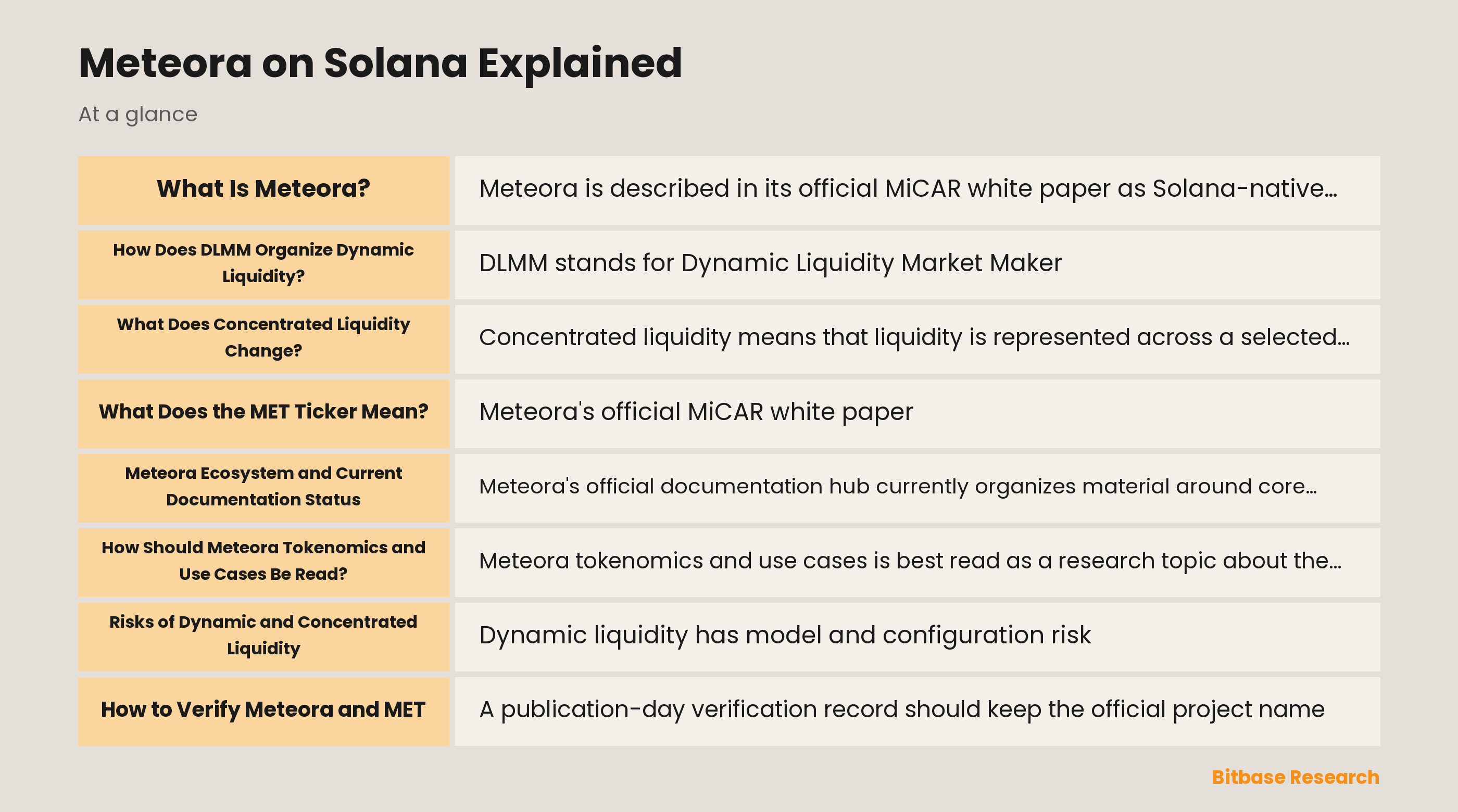
Meteora is a group of programs deployed on Solana, not a blockchain of its own. Its documentation describes the project as a composable liquidity layer for liquidity providers, launchpads and token launches. The token is MET, an SPL token on Solana whose mint address the official tokenomics page gives as METvsvVRapdj9cFLzq4Tr43xK4tAjQfwX76z3n6mWQL.
Three things carry the Meteora name and should be kept apart. The protocol is the on-chain programs. Meteora Comet Limited is a British Virgin Islands company that prepared and filed the MET MiCAR white paper, version 1.1, dated October 2025, and is the counterparty named in the MET airdrop terms. That white paper lists Meteora Foundation as the parent company and one individual, Sean John Inggs, as sole director.
The product map on the documentation home page has three tiers as of 14 August 2026. The core products are DLMM, DAMM v2 and Dynamic Bonding Curve. The helper products are Presale Vault, Alpha Vault, Dynamic Fee Sharing and Zap. The legacy tier holds DAMM v1, Dynamic Vault and Stake2Earn, whose debut token M3M3 is one of the two launches at issue in the litigation below.
What Problem Does Meteora Try to Solve?
A plain constant-product pool spreads deposits across every price from zero to infinity, so most of the capital sits where the pair will never trade. A team launching a token seeds such a pool and accepts whatever the first blocks do to it: automated buyers can take the cheapest supply before anyone else sees the pool, and fees are fixed while volatility is not.
Meteora's stated answer is to make the pool itself programmable: concentrated liquidity in discrete price ranges, fee schedules that change over time or with volatility, deposit vaults that run before public trading opens, and bonding curves that graduate into a standard pool automatically. That is the project's own framing, and it describes configuration options rather than a guarantee about how any launch behaves.
How Meteora Works
DLMM, the Dynamic Liquidity Market Maker, stores liquidity in discrete price bins. Each bin holds reserves at a single price, so a swap inside one bin has no slippage, and the bin step sets the spacing between bins. One bin is active at a time, and the active position walks up or down the ladder as reserves are consumed. On top of a base fee the program adds a volatility-aware component driven by an accumulator that responds to bin movement and decays when the market is quiet.
DAMM v2 is the constant-product pool. Positions are NFTs rather than fungible LP tokens, ranges can optionally be concentrated, and a share of fees can be compounded back into reserves. Its fee layer carries most of the configuration: a base fee that can stay fixed or decay over a set period, a variant that lowers the fee as the pool price rises, a rate limiter that raises the fee with buy size during a bounded launch window, and an optional dynamic component.
Dynamic Bonding Curve is the launch program. A team configures a curve in up to sixteen segments, and once the quote threshold is reached the pool graduates automatically into a DAMM v1 or DAMM v2 pool. The helper programs sit around this: Presale Vault runs fixed-price, first-come-first-served or pro rata presales; Alpha Vault takes deposits before a launch and buys from the connected pool during a protected pre-activation window; Dynamic Fee Sharing splits fees across a fixed set of recipients on chain; and Zap combines program actions and Jupiter swaps into one transaction.
What MET Does in the Meteora System
MET is an SPL token on Solana with a total supply of 1,000,000,000. The official tokenomics page gives the token generation event as 23 October 2025 and circulating supply at that event as 480,000,000, or 48 per cent of the total. It is not a gas token: Solana transactions are paid in SOL, and the official FAQ notes that claiming MET required SOL for fees.
What the token is said to do comes mainly from the MiCAR white paper, and it is deliberately narrow. That document describes MET as an access and coordination asset that holders may use to gain access or priority in token launches and protocol campaigns, and states that MET "does not grant ownership, governance, or profit-sharing rights and cannot be redeemed by the issuer". A staking function that would mint non-transferable engagement points is "subject to later activation", so it is a plan rather than a live mechanism. There is no protocol burn; the one team burn recorded on the tokenomics page is 2,261,990 MET on 25 October 2025.
Distribution ran through two airdrop seasons, each with a hard deadline. Clause 2.1 of the first airdrop terms sets the claim period from 23 October 2025 to an expiry date of 23 April 2026, six months after the start, and states that unclaimed tokens are no longer available afterwards. The documentation is not internally consistent here: the TGE FAQ page still says the window closed on 23 January 2026, so the date should be treated as unresolved. The second season terms, last updated 20 July 2026, run a claim period from 21 July 2026 to 21 October 2026. The tokenomics table gives the team 18 per cent and the Meteora Reserve 34 per cent, both with a one-month cliff and 72 months of vesting to 23 October 2031.
Meteora Ecosystem and Adoption Today
Almost every adoption claim here is the project's own. The documentation home page calls Meteora "the dynamic liquidity infrastructure powering Solana's most successful token launches and biggest LP community", marketing copy with no audited figure behind it. What can be checked is the surface the project publishes: TypeScript and Rust SDKs, free public REST APIs, a command-line tool, agent skill files and a documentation MCP server.
The tightest integration is with Jupiter. Meteora pool pages carry JupShield and the Jupiter Organic Score as token risk signals, swaps can route through Jupiter Terminal, and 3 per cent of MET supply went to JUP stakers, who were also opted in automatically for the Liquidity Distributor NFT position. The two projects share a co-founder, publicly known only by the pseudonym Meow. The official FAQ states that initial MET liquidity sat in a Meteora DAMM v2 pool, so the token launched on the protocol's own venue.
For anything numeric, the project publishes wallet addresses rather than dashboards. The tokenomics page names an operations wallet, an ecosystem wallet used for the TGE airdrop, and two locked vault wallets, each linked to a Solana explorer. That is also the reason to read the chain yourself: the same page sends readers to a price aggregator for current circulating supply, a second-hand number.
How Meteora Differs from Other AMM Designs
The first difference is how concentrated liquidity is represented. DLMM discretises the price axis into bins, and everything inside a bin trades at one price, so a swap contained in a bin has zero slippage. Tick-based designs price continuously along a curve within a range. The two differ in rounding behaviour and in how a position's composition changes as price moves through it.
The second is how much of the launch pipeline lives inside the protocol. Many automated market makers stop at the pool. Meteora ships the bonding curve, the automatic graduation, the pre-launch deposit vaults and the fee-splitting program in the same stack, so a launching team controls curve shape, fee schedule, rate limiter, collect-fee mode, lock and vesting settings, and whitelists. That is a different trust surface, not a better one, and those parameters are set by whoever runs the launch, not by the person buying into it.
Risks and Limitations
The largest item on this list is litigation, and it is unresolved. Meteora and its former chief executive Benjamin Chow are among the defendants in Hurlock v. Kelsier Labs, LLC, case number 1:25-cv-03891-JLR in the United States District Court for the Southern District of New York, a putative class action brought on behalf of buyers of the M3M3 and LIBRA tokens. The complaint was filed on 19 April 2025 and an amended complaint on 29 July 2025. The other defendants are Kelsier Labs LLC, doing business as Kelsier Ventures, and Hayden Mark Davis, Gideon Davis and Charles Thomas Davis.
The allegations are the plaintiffs' and have not been established by any court. Plaintiffs allege in the complaint that before M3M3 opened to the public in December 2024 the token was frozen while roughly 150 insider wallets funded by Kelsier acquired over 95 per cent of supply at low prices; that the approach was repeated with LIBRA in February 2025 using one-sided DLMM pools with manipulated price curves, extracting more than 57 million US dollars from buyers within hours; and that defendants held hidden upgrade authority over Meteora's programs through a multisig wallet. The claims pleaded include common law fraud, conspiracy to defraud, violations of the Racketeer Influenced and Corrupt Organizations Act under 18 U.S.C. sections 1962(c) and (d), New York General Business Law sections 349 and 350, and unjust enrichment. Plaintiffs' counsel still listed the matter as an active case on 30 March 2026, and there is no final judgment.
One interim ruling is widely misread. At a hearing on 19 August 2025 Judge Jennifer L. Rochon dissolved the earlier ex parte temporary restraining order and denied the motion for a preliminary injunction, releasing about 57.6 million US dollars in USDC held in wallets tied to Davis and Chow; she wrote that money damages would be available to compensate the class and said she was skeptical of the plaintiffs' prospects. She did not dismiss the case. Defendants filed motions to dismiss on 29 September and 31 October 2025, and as of 14 August 2026 we found no public record of a ruling on them. Assets being unfrozen is not the same thing as a case being over.
Chow resigned in February 2025, in an announcement made by the pseudonymous co-founder Meow, and he denies wrongdoing. In his own statement he said that "Neither I nor the Meteora team compromised the $LIBRA launch by leaking information, nor did we purchase, receive, or manage any tokens", while acknowledging that he had referred Kelsier to other projects as a token deployer. Team identity is a separate limitation: apart from Chow, the people running Meteora are not publicly named, the co-founder who speaks for the project uses a pseudonym, and the only individual named in the white paper is the sole director of the issuing company.
The remaining risks are ordinary but not small. Pools are permissionless, so anyone can list anything, and the project's own safety page tells users to check tokens on Rugcheck, JupShield and the Organic Score and to watch for freeze authority. Concentrated positions stop earning when price leaves the range, and their composition changes as bins are traversed. Audits exist for all ten programs, by Zenith, Offside Labs, OtterSec, Sherlock and Sec3, but each report covers a named program version rather than whatever is deployed today, and the white paper's audit section reports a successful audit without naming an auditor, a date or a report. The two official documents also disagree on tokenomics: the white paper says 470,000,000 MET circulating at the token generation event and a twelve-month cliff with 60 months of vesting, while the documentation says 480,000,000 and a one-month cliff with 72 months.
How to Verify Meteora and MET
Start from the official domain typed into the address bar, not from a search result or a link in a message. Use meteora.ag and docs.meteora.ag as the origin for every other link, including social accounts, because only the direction from the official domain outward is evidence. Compare any domain character by character, and stop if a page reached from an advertisement or a message asks you to connect a wallet to claim, migrate or verify anything. The official FAQ says the mint address is published only through official channels.
Then pin the token. The official tokenomics page gives the MET contract address on Solana as METvsvVRapdj9cFLzq4Tr43xK4tAjQfwX76z3n6mWQL. Paste it into a Solana block explorer and confirm the mint, the decimals, the holder count and the creation date, and confirm the network too: MET is a Solana SPL token, so anything with the same ticker on another chain is a different asset. Read supply and unlocks on chain rather than from an aggregator, including where the official page points you at one.
Grade the documents next. Each audit report should be identified by program, version and date, and read from the auditing firm's own material where it exists; a PDF linked only from the project's repository is weaker evidence. Then read the MiCAR white paper against the documentation instead of choosing between them. Where the two disagree, as they do on supply at the token generation event, on cliff and vesting length, and on the first claim deadline, record both and leave the point unresolved.
Finally, check the litigation yourself rather than a headline about it. The docket is 1:25-cv-03891-JLR in the Southern District of New York, and the filings are the primary source. Keep three distinctions in view: an allegation in a complaint is not a finding; an interim ruling on a restraining order is not a judgment on the merits; and a case still listed as active has not ended.
Conclusion
Meteora is Solana liquidity infrastructure built around DLMM, DAMM v2 and Dynamic Bonding Curve, plus four helper programs and three now marked legacy. MET is an SPL token that the project's own white paper calls an access and coordination asset with no ownership, governance or profit-sharing rights. The protocol and its former chief executive are defendants in a US class action that includes RICO claims and has produced no final judgment, and the August 2025 unfreezing of about 57.6 million US dollars was an interim ruling, not the end of the case. Take the contract address from the official tokenomics page, confirm it on a Solana block explorer, and note where two official documents disagree.
Related market pages
Bitbase pages for the tokens named in this article:
- MET: View price · Perpetual market
Related reading
Other Bitbase articles on this topic:
- Solana Staking and Validator Economics
- Solana Meme Launches and Token Risks
Disclaimer: This article is educational content from Bitbase Academy, provided for information only. It explains what a project does and what role its token plays in that system; it does not constitute investment, trading, tax, or financial advice, and it is neither a recommendation nor an endorsement of any project or token. Bitbase has not carried out due diligence on the project described here, and mentioning it does not mean Bitbase lists or supports the asset. Crypto assets carry significant risk, including price volatility, thin liquidity, smart-contract failure, regulatory uncertainty, and the possible loss of their entire value. The team behind this project has not publicly disclosed its identity. Written as of August 2026; a project's status, tokenomics, team, and contracts can change at any time. Verify everything yourself through official channels, the contract address, and a block explorer, and beware of imitation sites and phishing links.
References
[1] Meteora, official documentation home (core, helper and legacy product tiers) docs.meteora.ag
[2] MET Tokenomics, official documentation (mint address, TGE date, supply, burns, vesting, transparency wallets) docs.meteora.ag
[3] MET Airdrop Terms and Conditions, season 1 (clause 2.1 claim period 23 October 2025 to 23 April 2026) docs.meteora.ag
[4] MET Airdrop Terms and Conditions, season 2 (last updated 20 July 2026, claim period 21 July to 21 October 2026) docs.meteora.ag
[5] Meteora TGE FAQ, official documentation (claim mechanics, initial DAMM v2 liquidity, conflicting claim deadline) docs.meteora.ag
[6] Meteora audit report index, official documentation (ten program families, Zenith, Offside Labs, OtterSec, Sherlock, Sec3) docs.meteora.ag
[7] MET Token MiCAR White Paper, version 1.1, October 2025, prepared and filed by Meteora Comet Limited static.meteora.ag
[8] Burwick Law, Hurlock v. Kelsier case page dated 30 March 2026 (case number, amended complaint, RICO claims, active case) burwick.law
[9] crypto.news, 21 August 2025, court unfreezes 57.6 million USDC and declines to dismiss the case crypto.news
[10] The Block, 18 February 2025, Ben Chow resigns and denies wrongdoing theblock.co
[11] Documentation Index > Fetch the complete documentation index at: https://docs.meteora.ag/llms.txt > Use th docs.meteora.ag
[12] Documentation Index > Fetch the complete documenta docs.meteora.ag