Pendle is a permissionless yield-trading protocol: it wraps a yield-bearing token and splits it into a principal part and a yield part so the two trade separately. Its token is PENDLE. This article covers SY, PT, YT and LP, what maturity does to each, what PENDLE and sPENDLE do, and what to verify yourself.
What Is Pendle?
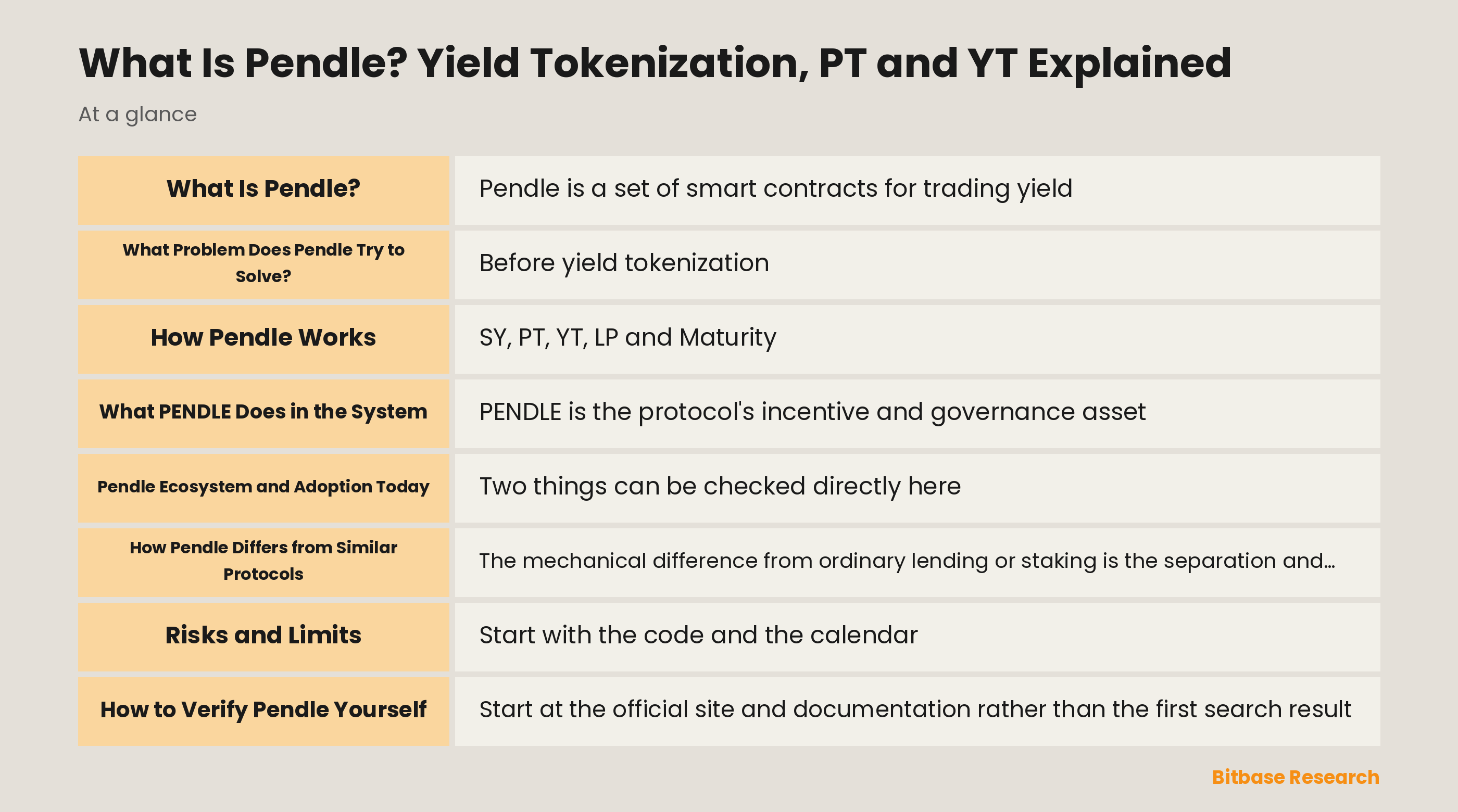
Pendle is a set of smart contracts for trading yield, deployed on Ethereum and other EVM networks. Its documentation calls the protocol a second-order derivative layer built on existing yield-generating primitives: liquid staking and restaking tokens, stablecoins and tokenized real-world assets. The project name and the ticker are the same string, PENDLE. Keep three things separate: the on-chain protocol, the Pendle team that writes the contracts and currently deploys the pools in the official app, and governance, which runs through Pendle Protocol Proposals voted by holders of the staked token sPENDLE.
Pendle is also two products, not one. Pendle V2 is the spot yield-tokenization market this article mostly describes; Boros is a separate margin-based venue for interest and funding rates. The official Deployments page listed core contracts on twelve chains as of 14 August 2026: Ethereum, Optimism, BNB Chain, Sonic, HyperEVM, Mantle, Base, Arbitrum, Berachain, Monad, Katana and Ink.
What Problem Does Pendle Try to Solve?
Before yield tokenization, a lending-pool depositor or a liquid staking token holder owned one position with a floating return. The rate moved with demand, and there was no way to lock it in, to sell the future income separately, or to take a view on the rate without holding the deposit. Traditional finance has traded interest-rate derivatives for decades; on-chain, a token and its yield stayed welded together.
Pendle's own stated proposition is that separating the two turns yield into something that can be priced and traded: a user can fix an outcome by buying the principal leg at a discount, sell future yield forward, or take exposure to yield alone. That is a mechanism, not a guarantee; any outcome depends on the underlying asset, the price of each leg and the end date.
How Pendle Works: SY, PT, YT, LP and Maturity
Standardization comes first. SY, or Standardized Yield, is a token standard written by the Pendle team that wraps any yield-bearing token behind one interface, so the protocol need not know how each asset earns its return. The documentation is explicit that SY is purely technical and users do not interact with it directly. Depositing stETH produces SY-stETH before anything is split.
SY is then split into two tokens. PT, the Principal Token, entitles the holder to redeem one unit of the accounting asset at maturity. YT, the Yield Token, entitles the holder to all yield generated by one unit of that asset until maturity, claimable in real time. One unit of the underlying mints one PT plus one YT, and the pair redeems one unit back, so the price of PT plus the price of YT equals the accounting asset's price. The documentation compares PT to a zero-coupon bond and YT to a detached coupon.
Every split carries a maturity date, the most important thing to understand here. At maturity, PT becomes redeemable one-for-one for the underlying without its YT counterpart, and YT stops accruing yield; the documentation states plainly that matured YT have zero value, since they no longer generate yield. A YT held to maturity expires worthless, so what was paid for it must be recovered from yield claimed beforehand; both trade on Pendle's AMM until then. Afterwards the calendar still bites: the fee documentation says an unredeemed matured PT or LP keeps accruing inside the SY contract, but all of it goes to the Pendle treasury fee wallet.
The LP position is the fourth piece. The LP token represents a share of a Pendle pool made of PT and SY, and the documentation lists four simultaneous sources of return for liquidity providers: swap fees, PENDLE incentives, the underlying yield from the SY portion, and an implicit fixed yield from the PT portion. A separate LP Wrapper contract wraps it one-for-one as an ERC-20 so it can serve as collateral in external money markets while the depositor keeps the rewards.
Boros works differently and should not be described in V2's vocabulary. It is a margined venue where a position is expressed in Yield Units; each YU represents the yield of one unit of the collateral asset in that market, and any rate with an oracle feed can be listed, including funding rates from centralized perpetual venues. Positions need collateral and can be liquidated below maintenance margin. Boros also lists funding-rate markets for WTI and Brent crude oil, which are not crypto underlyings: Pendle's Boros newsletter of 16 June 2026 describes live July oil maturities, and third-party summaries date a further WTI and Brent listing to 22 July 2026.
What PENDLE Does in the System
PENDLE is the protocol's incentive and governance asset, not a claim on yield. Its main programmatic use is the incentive emitted to liquidity providers. The tokenomics documentation states that all team and investor tokens had fully vested by September 2024, so later supply growth comes from incentives and ecosystem building, not unlocks. Weekly emissions stood at 216,076 PENDLE as of September 2024, decreasing 1.1 percent each week until April 2026, after which the documentation describes a terminal inflation rate of two percent a year.
Staking is where governance now sits. PENDLE can be staked one-for-one for sPENDLE, which the documentation calls the protocol's native governance token and which does not appreciate over time. sPENDLE unstakes back to PENDLE one-for-one after a fourteen-day withdrawal period, or immediately for a five percent fee. It carries voting power, snapshotted whenever a Pendle Protocol Proposal is created, plus a pro-rata share of rewards for holders meeting the documented active-participation criteria.
Fees connect the two. Pendle V2 has two revenue sources: a five percent fee on all yield accrued by YT, including points, and a swap fee scaled to time left to maturity. Twenty percent of swap fees go to the pool's liquidity providers; the rest, plus all YT fees, splits eighty percent to a PENDLE buyback fund, ten percent to the treasury and ten percent to operations, with buybacks executed by a named contract on a one-hourly TWAP. vePENDLE, the older vote-escrow lock, is described as winding down with users told to migrate to sPENDLE, and the Ethereum deployment file lists it under deprecated.
Pendle Ecosystem and Adoption Today
Two things can be checked directly here. The official Deployments page lists core contracts on the twelve chains named above, retrieved on 14 August 2026. The official Pencosystem page listed twenty-eight apps and integrations on the same date, grouped as money markets, centralized exchanges and Web3 wallets, yield strategies and insurance. Those money-market entries are the practical evidence that PT and wrapped LP are accepted as collateral outside Pendle.
Reported figures need a label. Third-party write-ups of Pendle's mid-2026 community call put V2's average daily value locked at around thirteen billion dollars for the first half of 2026, say nine of eleven key markets were collateralized by real-world assets, and say Pendle went live on Monad and reached that network's top five by value locked within a month, at roughly one and a half billion dollars. Those are community-call numbers relayed by third parties for a stated period, not audited data, and should be retaken on the publication date. Real-world-asset collateral is also not risk-free yield: it brings issuer and custodian risk.
How Pendle Differs from Similar Protocols
The mechanical difference from ordinary lending or staking is the separation and the end date. A floating-rate deposit is one position with one balance; on Pendle the same exposure becomes two transferable tokens with a defined expiry, and a fixed outcome comes from buying the principal leg below the value it redeems at, not from a rate set administratively.
That has consequences. Because every market expires, liquidity sits in separate pools per maturity, the same asset can carry several maturities with different implied rates, and a position someone wants to keep must be rolled. Market creation is permissionless at the contract level, but the documentation notes that visibility in the official interface is curated and that pools are currently deployed by the Pendle team.
Risks and Limits
Start with the code and the calendar. The official security page says Pendle's contracts have been audited by Ackee, Dedaub, Dingbats and wardens from Code4rena, with reports in a public repository; an audit narrows known bugs and does not remove smart-contract risk. The calendar risk is specific to this design: a YT is worth nothing after maturity, a PT redeems at par and not before, and a matured position left unredeemed keeps producing yield for the treasury fee wallet.
The second layer is what Pendle is built on. The negative-yield page explains that if the exchange rate between an interest-bearing token and its accounting asset falls below the highest level recorded, called the watermark rate, PT redeems for less than expected at maturity and YT stops earning until it recovers; the watermark can also be inflated by oracle mispricing. Pendle inherits whatever it wraps, so a failure in a liquid staking token, a stablecoin or a tokenized real-world asset lands on the PT and YT above.
The third layer is the token, governance and what this article could not verify. Supply keeps growing through emissions on a schedule governance can change, and voting power is proportional to sPENDLE, so influence follows concentration; the vePENDLE migration is unfinished. Boros adds margin, liquidation and rate-oracle dependence, including on off-chain funding rates. The current open-interest and volume conventions for Boros could not be confirmed against an official source, so no figure appears here. Curator infrastructure and institutional real-world-asset work reported for the second half of 2026 are plans, not shipped features.
How to Verify Pendle Yourself
Start at the official site and documentation rather than the first search result, and confirm the social accounts you follow are reachable from the site, not the reverse. For contract addresses, use the official Deployments page, which points to one deployment file per chain in the Pendle contract repository. The Ethereum file gives PENDLE as 0x808507121b80c02388fad14726482e061b8da827; the Arbitrum file gives a different address for the same ticker, 0x0c880f6761F1af8d9Aa9C466984b80DAb9a8c9e8. One ticker, two networks, two addresses: check which chain you are on, then paste the address into that chain's explorer and confirm the creation date, holder count and verified source.
Then check what changes. Take supply from the chain and the docs, not an aggregator: they define circulating supply as total supply minus balances at five named addresses, including the sPENDLE and vePENDLE contracts. For any market, read the maturity date and that market's own SY, PT and YT addresses first, because a PT of a different maturity is a different token. Audit reports should be findable on the auditor's own site too. Compare the domain character by character, and treat any page asking you to connect a wallet to claim something as a reason to stop.
Conclusion
Pendle wraps a yield-bearing asset as SY and splits it into a principal token and a yield token with a fixed maturity. PENDLE is the incentive and governance asset, staked as sPENDLE for voting power and a share of fee-funded buybacks; it is not a claim on any return. Boros is a separate margined product for interest and funding rates, so its figures are not V2's. Carry away the calendar: YT goes to zero at maturity while PT redeems at par. Check every maturity date, verify the network and address on a block explorer, and take supply and fees from official documentation.
Related market pages
Bitbase pages for the tokens named in this article:
- PENDLE: Spot market · Perpetual market
Related reading
Other Bitbase articles on this topic:
- Maple Finance and SYRUP Explained
- Yield-Bearing and Synthetic Dollars Explained
Disclaimer: This article is educational content from Bitbase Academy, provided for information only. It explains what a project does and what role its token plays in that system; it does not constitute investment, trading, tax, or financial advice, and it is neither a recommendation nor an endorsement of any project or token. Bitbase has not carried out due diligence on the project described here, and mentioning it does not mean Bitbase lists or supports the asset. Crypto assets carry significant risk, including price volatility, thin liquidity, smart-contract failure, regulatory uncertainty, and the possible loss of their entire value. Written as of August 2026; a project's status, tokenomics, team, and contracts can change at any time. Verify everything yourself through official channels, the contract address, and a block explorer, and beware of imitation sites and phishing links.
References
[1] Glossary: SY, PT, YT, LP, Maturity and Watermark Rate (Pendle official documentation) docs.pendle.finance
[2] Pendle 101, Chapter 2: Yield Tokenization Basics (Pendle Academy, official) docs.pendle.finance
[3] Fees: YT fee, swap fee, fee split and post-maturity yield redirection (Pendle official documentation) docs.pendle.finance
[4] sPENDLE: staking, unstaking, voting power and buybacks (Pendle official documentation) docs.pendle.finance
[5] Tokenomics: weekly emission, circulating supply definition and the vePENDLE contract (Pendle official documentation) docs.pendle.finance
[6] Deployments: supported chains and per-chain deployment files (Pendle official developer documentation) docs.pendle.finance
[7] Ethereum core deployment file, PENDLE token address on Ethereum mainnet (Pendle official contract repository) raw.githubusercontent.com
[8] Arbitrum core deployment file, PENDLE token address on Arbitrum One (Pendle official contract repository) raw.githubusercontent.com
[9] Boros Overview: Yield Units, margin and funding-rate markets (Pendle official documentation) docs.pendle.finance
[10] Boros Broadcast #5, 16 June 2026: live July WTIOIL and BRENTOIL funding-rate maturities (Pendle official newsletter) pendlefi.substack.com
[11] Overview docs.pendle.finance
[12] pencosystem www.pendle.finance